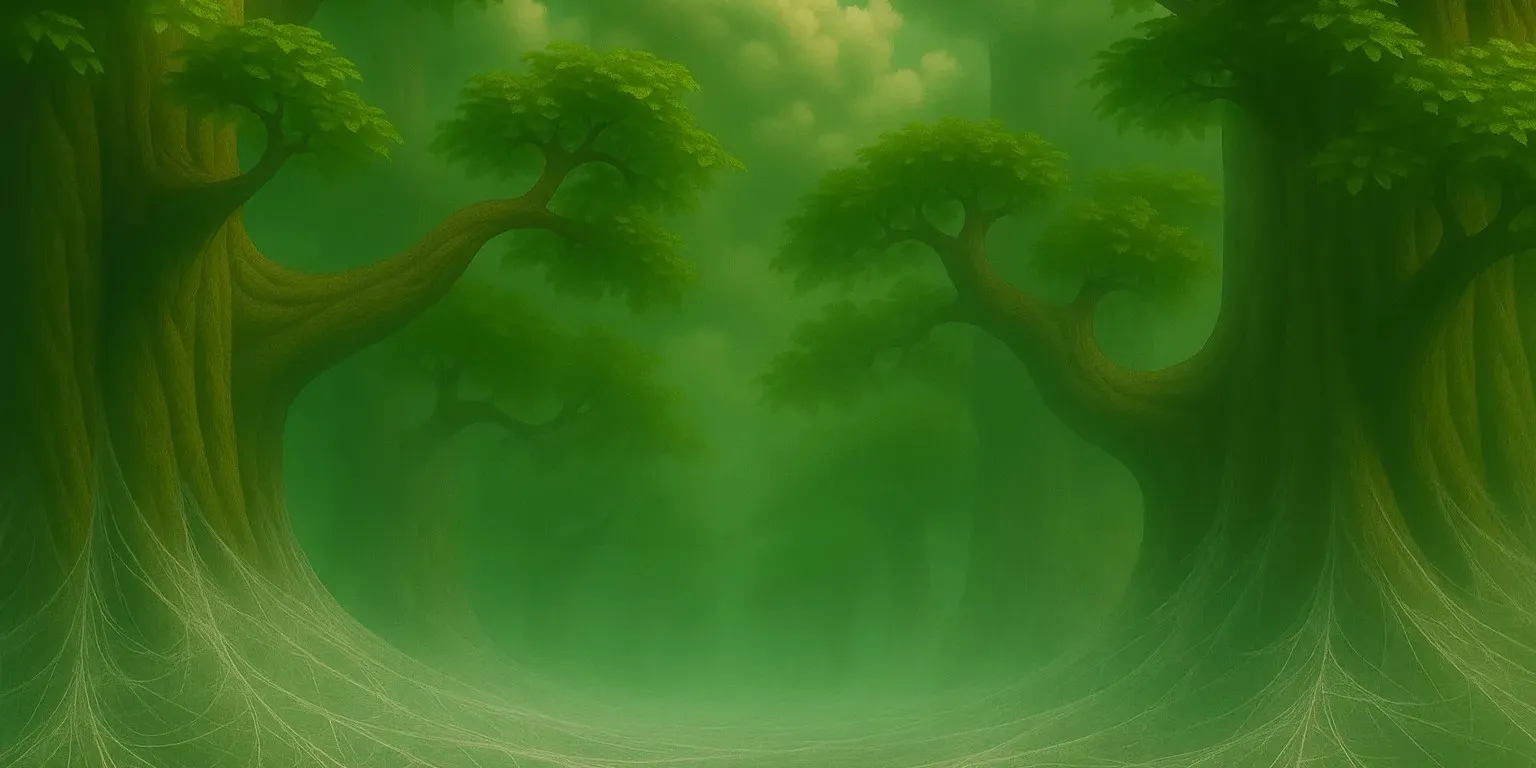
The Trees of Arborea
Introduction
When I first arrived in Arborea, I was immediately struck by the sheer magnitude of its trees. They rise from the Webs below and vanish into the Clouds above, extending through the world in a manner both wondrous and disorienting. It is for them that I have named this world Arborea, for they are its defining feature - shaping all else by their immensity.
As my studies continued, I found within myself a deep and abiding awe for these arboreal behemoths. They are not merely vast; they are near to godlike in their scale and majesty. The People themselves revere the trees as divine, and it is hardly surprising that they do so. Nowhere else have I encountered beings of such colossal presence, nor any that inspired such fascination. In the pages that follow, I shall endeavor to describe the trees of Arborea - both the several species I was able to catalogue, and the countless ways in which they have fashioned the world in which the People dwell and thrive.
Mountains of Wood
In speaking of the Trees of Arborea, it is most useful to borrow the language of geology as well as that of botany. They exist upon a scale which utterly dwarfs all other forms of life, and they provide, in truth, the very foundation of the ecosystem itself. As I noted in the Introduction, the trees of Arborea extend for a thousand spans from their emergence in the Webs below to their vanishing into the Clouds above. Their trunks may reach nine hundred spans in breadth, while their branches - some attaining nearly five hundred spans in diameter - project outward for hundreds of spans into the void. Upon these titanic limbs can be found all the elements located upon the ground of other worlds: forests root themselves in the bark, and water collects in hollows to form lakes. The People build great towns upon the trees, carving dwellings into the trunks and constructing buildings, roads, and bridges among the boughs. In every respect, the trees constitute the living and sustaining substrate of life in Arborea.
Branchfall
From time to time, a tree will shed a branch, sending it plummeting through the air into the Webs below. Such occurrences are regarded as catastrophic by the People: beyond the great damage a falling branch may inflict upon their settlements, a branch of sufficient size will tear a hole through the Webs, exposing a gap into the darkness beneath. According to the accounts I collected, monsters will then surge forth from this opening, devouring and destroying all within reach. Until the Telatextrices repair the breach, the People are compelled to contend with these abominations, and many communities have perished in the struggle. I count myself fortunate never to have witnessed one of these catastrophes, for the tales of the horrors below sent chills to my very marrow.But it is of paramount importance to recall that these are not merely geological formations, but living creatures in their own right. They are born, they grow, and they eventually die. While it is not possible to determine the full lifespan of these titanic beings, the accounts of the People indicate that the Trees endure for eons, slowly extending both in height and breadth. I had the opportunity to examine a tree whose uppermost branches reached only half the distance from the Webs to the Clouds, and learned that its emergence from the darkness below had been recorded more than twenty-six hundred years prior. From the measurements I conducted upon this comparatively young specimen, I estimated that some of the elder trees must surpass ten thousand years in age. It must be noted, however, that differing species - of which there are dozens in Arborea - may exhibit varying rates of growth from that of the tree I observed.
The Stuff of Life
The Trees of Arborea are not merely the soil from which all other plants take root; they are the very fount of sustenance and material wealth for the People. It would be a grave error to suppose that wood is their sole product, for nothing could be further from the truth. From these titans of vegetation the People derive scores of substances, both edible and inedible, and they live upon their bounty as surely as any farmer rests his livelihood upon the tilth of his fields.
Amber

Cloth is fashioned from the fibrous bark and broad leaves (for though the People commonly go unclothed, fabric has many uses apart from raiment), and a form of paper is made from their pulped tissues. The varied saps of different species serve manifold purposes: one is employed to seal balloon-ships against the ever-present moisture, another to fashion the balloons themselves, for from a particular tree is yielded a rubber of extraordinary quality. Various resins are also collected and put to a multitude of uses; one notable application is the creation of translucent sheets, formed by joining the resin to crushed shells. These sheets are dyed in many colors and arranged into elaborate mosaics that rival the stained glass of the great cathedrals of my homeland.
The branches likewise bestow nuts, syrups, and fruits in great abundance, which serve as staples of the diet. As for the heartwood, it is a substance of surpassing strength—harder, I believe, than steel itself. Yet it lies so deep within the trunk, more than fifty spans beneath the bark, that it cannot be reached by any tool the People possess. Indeed, they must resort to magical means if they would obtain even the smallest fragment of this precious material.
All this, however, represents but the smallest portion of the Trees' bounty; for in addition to the materials they themselves provide, their branches are host to a prodigious multitude of lesser plants, which take root in the bark and wood, and thereby multiply the variety of useful materials available to the People a thousandfold. The forests that spring from these boughs rival, in richness and diversity, any landscape that might be found upon the soil of other worlds. If they lack trees of great height among their branch-bound groves, this deficiency is more than compensated by the vastness and majesty of the colossal trunks upon which they grow.
The Fundament of Civilization
The works of the People rest wholly upon the foundation of the Trees. Whether carved into the living trunks or anchored upon the vast branches, all that they build is, in one way or another, dependent upon these colossal forms. Their communities are most often arranged vertically about the trunk, where the outer layers provide innumerable hollows - some natural, others laboriously hewn - and from these extend outbuildings upon the boughs. Platforms suspended by massive pulleys allow for the ascent and descent of persons and goods between the branches and the inner chambers of the trunk, while balloons of every description lend buoyancy wherever it is needed. I have seen silk-woven bridges stretched for hundreds of spans, buoyed at intervals by small balloons, linking distant quarters of a settlement across the branches. Yet always - always - the Trees themselves remain the anchor and the foundation of all.
Tree-Thought
One consideration in selecting a tree to inhabit is peculiarly Arborean, and stems from the omnipresence of telepathy. Each tree, as I have noted before, possesses a distinct signature of thought - an identity unmistakable from any other. This quality is invaluable for navigation, for one may know each tree as an individual, a landmark with a mind of its own, recognizable even from its outermost branches.Yet it also means that each tree exerts an atmosphere of temperament upon those who dwell within it. The thoughts of the great Trees cannot be truly comprehended - being too alien, too slow, too immense - but their influence is undeniable. The prevailing mood of a region arises from the disposition of its Tree, and not all People find every Tree equally congenial.
The Tree that hosts Highmarket, where I spent much of my time in Arborea, is known for its particularly welcoming and beneficent nature, said to calm tempers and ease daily life. Others, however, are thought to engender darker moods - drawing to themselves the suspicious, the reclusive, or the quarrelsome. Some among the People - especially the Roark - claim they can discern the kind of settlement a Tree will foster merely by sensing its mental atmosphere. Having spent time in their company, I confess I have no reason to doubt their assertion.
When selecting a Tree upon which to dwell, the People must exercise the utmost discernment. The world of Arborea abounds in perils and predatory creatures, and the choice of a site is therefore critical to the safety of any settlement. Some species of Tree graciously permit the excavation of hollows within their outer trunks - a hallmark of Arborean architecture, and an absolute necessity for shelter during the violent tempests that accompany the onset of the wet season. Others, however, fiercely repel such intrusion, exuding noxious vapours into any cavity formed within them, as though to punish those who would presume to burrow into their living flesh. A sound knowledge of the temperaments and peculiarities of each species is indispensable, for a single misjudgment may spell calamity for an entire community.
The particulars of the chosen Tree itself are no less vital. Its size, its health, the creatures that already make their homes upon it - all must be carefully weighed. Even the arrangement of its branches must be considered, for these immense limbs cannot be severed at a whim. The junction of each bough with the trunk is examined for signs of weakness, that the peril of Branchfall might be averted; for to build upon an unsound limb would be courting utter ruin. Nor can the neighboring Trees be ignored, for each harbors its own complement of resources - and of predators. No prudent community of the People neglects such precautions, lest their homes be despoiled and their young stolen by the hunters that prowl the night.
Finally, one must never forget that the Trees - majestic, immense, and seemingly eternal - are not immortal. Their lives span unimaginable centuries, yet even they must one day decline and die. The People, possessed of their peculiar sensitivity to the Trees' telepathic emanations, can perceive the first intimations of mortality long before any outward sign appears. When they sense that a Tree's vitality is waning - and such forewarning may come a full century in advance - they abandon it without hesitation. For if Branchfall is a calamity, then Treefall is a cataclysm fit for legend, and only distance grants safety from its ruinous descent. In the wake of such a fall, there remains a vast and aching void until a new Tree thrusts upward to pierce the Webs, and only then, slowly and with caution, do the People return to the scar of the disaster.
Living Sanctity
The People of Arborea hold the Trees in profound reverence, for they are the supreme life form of that world - its axis and its essence. Every aspect of existence is shaped by their vast presence. The Webs are strung between them; they rise crowned with Clouds; and all that the People possess or comprehend is either fashioned from, or sustained by, these arboreal colossi. They are mountains, homelands, living temples - creatures so immense and enduring as to border upon divinity.
I have come to believe that dwelling among their branches has rendered the People uniquely attuned to the living world and their place within it. They regard their Trees with a sanctity that might well serve as an example to many other civilizations I have known. Though they do not worship the Trees, they love them, tend them, and never presume upon their bounty. Since my time among them, I have visited worlds where the ground itself lies poisoned and the air befouled - worlds where life clings in spite of its keepers rather than because of them. To those poor, desolate peoples, I wish only this: that they might once stand upon a living land, gaze across a sea of green, and feel the fierce and joyful devotion the People of Arborea bear toward their magnificent home.
An Ocean Above
And now, dear reader, I would have you lift your thoughts upward, toward the vault of the sky. In the pages to come, we shall ascend into the Clouds that crown Arborea - vast and drifting realms where creatures both great and small make their homes. There dwell the six-winged giants who never descend, and the strange predators that prowl among them. The Clouds above are as wondrous and singular as any domain below, a boundless ocean of mist and light that rolls perpetually over the green world of the People.

I am really enjoying the voice of this world. I also really like the look of it; very nice.
Thank you! I spent a lot of time working on both, so I’m happy they are enjoyable!