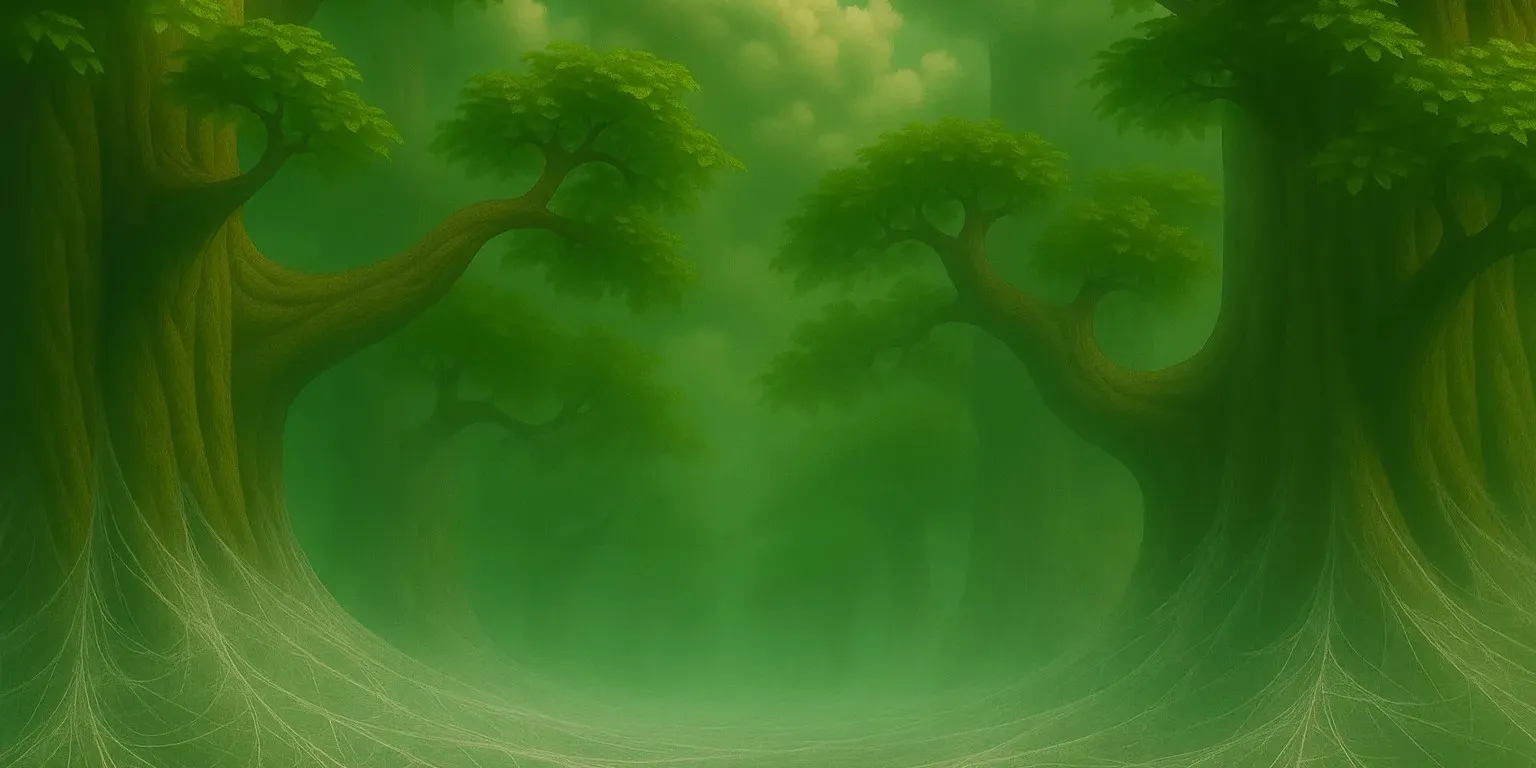
The Structure of Arborea
Introduction
When one undertakes the description of a new world, it is prudent first to establish the conditions which shape both its peoples and its creatures. In this section, therefore, we shall examine those fundamental forces: the cycles of day and night, the turning of the seasons, and the weather and climate which prevail over all. Having laid these foundations, we shall then turn our attention to the great structural elements of the realm itself - the Trees, the Webs, and the Clouds. Finally, we will investigate the paranatural elements of Arborea - the twin forces of psychical and magical powers which suffuse this realm.
The Shape of the World
A Dearth of Geology
I can report nothing of what lies at the roots of Arborea, for the knowledge of the People extends no farther than the Webs, which form the lower boundary of their world. They hold that the Trees are anchored in some vaster organism - a hidden mirror of the living realm they know above - but they possess no conception of earth, soil, or stone. In all my travels I encountered no sample of mineral substance, nor any object mined or quarried. Indeed, the few metallic tools I carried were regarded with wonder, as if they were fashioned from some unearthly matter. There may well be a ground beneath the Webs, but I cannot, in honesty, attest to its existence.Under the prevailing conditions of Arborea, I cannot with certainty establish whether it is a sphere, a plane, or some other configuration altogether. The instruments of the astronomer are denied me, for both sky and horizon are perpetually concealed by the interposition of Clouds and Trees. My experiments with plumb-line and pendulum yield no decisive results, at least not within the limits of my calculation. Likewise, the great circulations of the winds suggest a world whose larger motions are not wholly unlike those of my own home-realm, yet so much of their operation remains obscure that I dare not make a definitive pronouncement.
Nor can I make any definitive statement concerning the true extent of Arborea, or whether its characteristic ecosystem yields at any point to other climes. In the course of my travels I journeyed more than a million spans in various excursions outward from Highmarket, yet nowhere did I encounter aught but the seemingly boundless forest. Distances of this magnitude are considerable to a living creature, yet in the measure of a world they are trifling. It may be that Arborea has its limits, or it may be that the great wood extends without end. The People themselves speak of it as infinite, and perhaps they are correct; but to establish the truth, an expedition must be undertaken of a scope far greater than my own.
One truth may be stated with confidence: gravity is constant. "Up" and "down" are ever in their place, and no measure of distance traversed revealed the least alteration in their direction. From this I incline to believe that Arborea is indeed spherical, akin to my own world, though proof must await a future expedition furnished with instruments designed for such an undertaking. Yet I confess a hope that such an expedition may prove unnecessary. In my conversations with the Karapax, I learned that they had never even framed the question of the world's form; and I venture to trust that, once set to pondering it, their rigor of mind and taste for geometry may accomplish what my crude contrivances could not.
The Night and the Day
Though the light of Arborea is ever dim and tinged with green to my eyes, it is not uniform across the passage of time. Like most worlds, it possesses a cycle of illumination and obscurity, though the Clouds permit no direct observation of any celestial source. Morning is announced by the gradual brightening of the vapors to the east - a direction defined solely by this phenomenon, for my compass proved useless within Arborea. The effect is subtle beneath the canopy, yet perceptible to the persistent observer. Light then diffuses through the clouds until the entire firmament is suffused, and the shadows of cloud-dwelling creatures can be glimpsed moving within the mist above. As day declines, the process reverses: the east darkens first, and this umbral tide spreads across the heavens until the last traces of radiance vanish far to the west.
Measuring Time
As ever, it is the Karapax who are most intent upon measuring and quantifying the world about them, and time is no exception. They have constructed vast water-clocks by which they measure the passage of the days, and employ a unit I shall render as a stretch - this being the nearest approximation to their own conception. A stretch constitutes one one-thousandth part of a day, amounting by my watch to approximately forty-four seconds. The lengths of day and night vary but little over the course of the year, the difference between the longest and shortest days amounting to no more than thirteen stretches. These alternations of light and darkness seemed wholly natural to my constitution, and correspond so nearly to those of my own home realm (at certain seasons of the year) that I found no difficulty in accommodating myself to them.Daylight in Arborea is a curious phenomenon, for it never attains the brightness or clarity required to cast a sharp shadow. Instead, the light is diffused and gentle, filtered through the clouds and scattered among the countless leaves. The effect is a perpetual half-light, a dreamlike atmosphere wherein shapes seem to emerge and dissolve again into the green-gloaming of the understory. Many an afternoon did I pass in such conditions, seated quietly upon a broad branch, ordering my notes and preparing them for record. Few places have I found more congenial to reflection than that dim and tranquil twilight which Arborea calls its day.
Night in Arborea is profound, though not absolute. No moon nor stars break through to lend their glow; instead, nature has contrived a different and most enchanting illumination. With the onset of darkness, innumerable small creatures reveal themselves by their own light, kindling constellations not only above, but in every direction about the observer. These living sparks drift among the Clouds, climb upon the branches, and even gleam faintly within the Webs below. The effect is that of floating in a sea of shifting, multicolored stars, an ever-changing firmament wrought of life rather than distant fire.
Yet this nocturnal wonder conceals grave peril. Predators stir beneath the cover of darkness, and even where they are absent, the risk of misstep is constant, for the living lights do not truly illuminate the paths of the branches. Indeed, they more often contrive illusions of solidity than offer guidance to the eye. Among the People, some - most notably the Roark and the Bohra - move with assurance in the night, guided by senses keener than my own. But for the majority, prudence dictates remaining within their shelters until the world is bathed again in its muted green light.
Seasons and the Weather
In my own realm, the course of the seasons exerts the chief influence upon the weather, and I found the same to be true in Arborea. While the seasons here do not correspond precisely with those of my homeland, they are no less decisive in shaping the lives of those who dwell among the branches. The Arborean year itself is somewhat longer than that of my own world, comprising 376 days. The Karapax reckon the year as beginning upon the longest day, whereas most of the People mark its commencement with the first great storm that ushers in the wet season. Thus, even in the ordering of time, one sees the primacy of the rains.
The Storm-Season
Though tempests may arise at any time, there is one particular interval of the year which is infamous for its violence. It comes with the transition from the dry times into the wet, when the very heavens convulse with fury. Storms of prodigious force descend upon the People's settlements: winds strong enough to tear structures from their fastenings roar along the branches; lightning, sudden and merciless, strikes without discernment; and the rain, flung earthward as though it were cast stones, smites so fiercely that I myself have carried bruises from its impact.At such times, the People retreat within the trees themselves, taking refuge in hollows, both natural and crafted, and they stir not abroad - for to be caught in the open is to risk being snatched away into the air, and lost beyond all hope of recovery. If necessity compels that some errand be undertaken amidst the tumult, the task is assigned to the Kouatl, whose extraordinary power of adhesion to the bark exceeds that of any other race. I have watched them on such occasions: all six limbs splayed wide, their bodies flattened against the trunk as though to glide, yet pressed so firmly that no gust might pass beneath to dislodge them. Even so, such excursions are rare, perilous, and never undertaken save in the most extreme need.
For the Arboreans, the most conspicuous marker of seasonal change lies indeed in the rhythm of those rains. The temperature, while it does shift, seldom varies to any extreme: it never grows cold enough for frost or ice. Rather, the year is divided between a season of rains and a season of comparative dryness.
During the wet season, precipitation is nearly constant. The air is heavy with humidity, the clouds descend low upon the branches, and thick fog shrouds the upper world. The warmth is greater at this time than in the dry season, and the rain itself is warm to the touch, affording no relief to one already oppressed by the heat. Indeed, the conditions I endured in Arborea's wet season taxed my fortitude, and I expended no small effort in devising means of cooling myself - none of which proved effective.
The dry season, by contrast, is temperate and agreeable. The air is neither cold nor oppressively hot, and rainfall is more intermittent: a shower every third day is the norm. On one occasion, we endured an eight-day drought, which greatly alarmed some of the younger among the People, who feared that the rains might never return. Yet their anxiety proved unfounded, for the cycle is dependable, and there is no true scarcity of water.
Rain, indeed, is the universal source of water in Arborea. The People gather it in wooden cisterns; it pools naturally in hollows upon the branches; and many of the plants have evolved their own contrivances for storing it. One such plant - of carnivorous habit - is notorious for luring the unwary to their doom by means of its treacherously sweet pools, and at times will seize upon a thirsty beast with a whip-like tendril, ensnaring its victim and dragging it into the plant's inner cavity.
One phenomenon which greatly engaged my attention was the formation of what might be termed rivers during periods of heavy rain. These were not, however, horizontal streams, but almost wholly vertical systems, composed of cascades and waterfalls that plunged from branch to branch, often following channels worn into the bark by long centuries of overflow. As each hollow filled, it would spill its excess downward in a steady fall, striking the branch below, where it pooled once more until the process repeated itself. The locations of these cascades are so regular that the People employ them to drive waterwheels, and I recall with pleasure an afternoon spent observing a mighty mill reducing nuts to flour by such means. These same torrents are notorious for sweeping away unwary creatures, and it is a common practice to suspend a net within the flow in hopes of securing a meal.
The year is not evenly divided between the two seasons. The wet accounts for the lesser portion, perhaps a third of the whole, while the remainder is given to the longer and more fruitful dry season, during which the People undertake their journeys and prosecute the greater part of their affairs. This rhythm is reinforced by the seasonal currents of the air. In the dry season, steady winds prevail, upon which the balloon-ships may depend: the pilot has but to choose his altitude and course, and he is borne swiftly and with constancy. Yet as the wet season draws near, these currents grow erratic, shifting without pattern, until they vanish altogether - or in some quarters, perversely reverse. Travel of any distance is therefore strongly discouraged in the rainy months, and most ships are laid up in safety: their balloons deflated, their hulls tarred against the ceaseless rains.
Trees Like Mountains
Having established the conditions that pervade Arborea as a whole, we may now turn our attention to its most singular feature - the very structure for which I have named this world. Turn the page, dear reader, and together we shall examine the nature of those gargantuan trees whose colossal trunks rise from the woven depths and ascend higher than any tower, vanishing at last into the clouds above. These arboreal marvels are at once familiar and alien to my eye, and their study proved one of the great scientific adventures of my life.

This article paints such a vivid and enchanting portrait of Arborea’s natural rhythms and mysteries—I felt transported into its half-lit world. The descriptions of day and night cycles are especially beautiful, balancing wonder with a sense of danger. I also love how the storms and rains shape not just the environment but the very lives of Arborea’s peoples, giving the world a sense of living authenticity. The blend of scientific observation and awe makes the piece a joy to read!
Thank you so much!