The Clouds
A Sea in the Sky
When I first arrived in Arborea, I did not at once comprehend the true significance of the Clouds that hung above the canopy. For several days, I regarded them merely as one might the mists of any humid world - until I began to wonder at their unbroken persistence. When I communicated my curiosity to Odysseus, they did not at first understand the nature of my question, and then, with mild amusement, explained that the Clouds were always there - much as I might answer a bewildered child who inquired when the sky would be taken away.
Indeed, throughout the entirety of my sojourn in Arborea, I never once saw the Clouds part - not even for a moment - despite many long days of observation. The historians among the People could recount only a few fragmentary and half-legendary tales of such an event, so distant in both time and place that even they dismissed them as fanciful. The Clouds were always there, and would always be there. Such was simply the nature of the world.
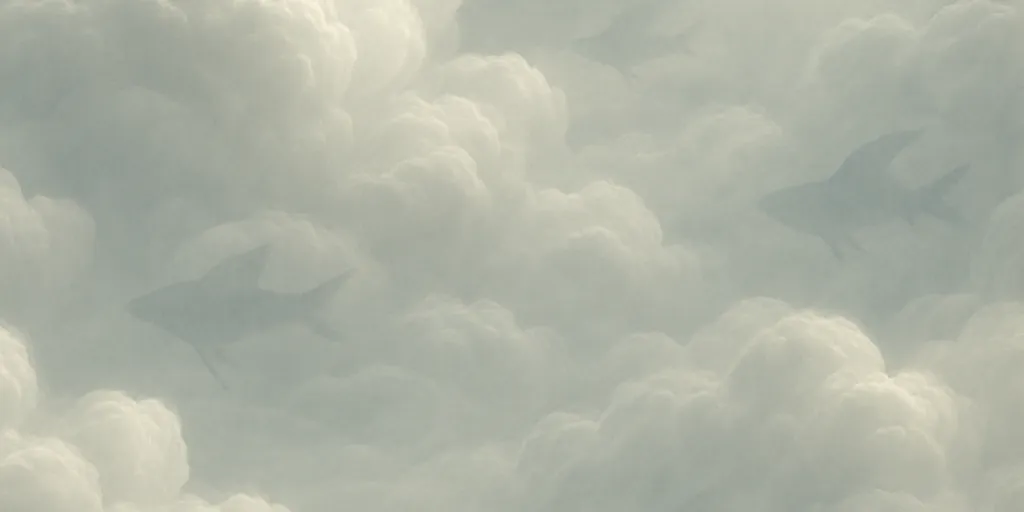
Although my constant study of those high vapors revealed no glimpse of the firmament beyond, my efforts were far from fruitless. For the Clouds are themselves a realm abundant with life - a vast aerial sea inhabited by a multitude of creatures. By casting my gaze upward, I could often discern the shadows of several dozen beings gliding through the mist, some dipping low enough for me to glimpse their form. They appeared in a bewildering variety of shapes and sizes: from the minute, drifting Meteormorphidae - which, to my astonishment, proved to be of fungal nature like the People's own Mycora - to the distant and majestic Ouranoketoi, whose telepathic songs could be sensed across thousands of spans. The denizens of that lofty realm seemed, to my eyes, more suited to the depths of an ocean than to the heights of the air. Yet as I would come to understand, the Clouds of Arborea are indeed less like vapor - and far more like a sea suspended in the sky.
A Viscous Fog
I shall never forget my first true contact with the Clouds, for it was among those moments when Arborea most forcefully impressed upon me its strangeness and difference from the world of my birth. In that familiar homeland, we know well the nature of fog: many a morning have I stepped forth into a landscape shrouded in grey, where even my outstretched hand vanished into obscurity. I have walked for miles through mists of every temperament and density, and had come to regard them as among the most ordinary of phenomena. Yet the Clouds of Arborea confounded every expectation I held of such vapors.
A Harvest Overhead
The Clouds are a principal source of food and other resources for the People, and many make their living by daring the upper air with its predators and tempests. Ascending in their balloon-ships, they employ a variety of baited nets and traps to capture the creatures of the Clouds, dragging them down to the pots and tables of the communities below. It is perilous work - navigation within the Clouds is difficult, and the predators of the sky grant no special conduct to those who come from beneath. Moreover, the weather aloft is volatile: sudden gales and unseen currents can carry a balloon-ship far from home before descent is possible, or dash it against the upper branches of the Trees, wrecking and stranding its crew.Still, the People persevere, and draw a rich harvest from overhead. The Clouds supply a great portion of their sustenance, and also yield the lifting gas that fills their balloons. One technique I observed deserves particular mention for its ingenious simplicity. The People consume several species of Konkheiai - shelled animals that secure themselves to the high branches and subsist upon the vapors (or, more precisely, upon the minute organisms adrift within them). It was discovered that these creatures can anchor themselves to a thick rope as readily as to a bough, and thus the People devised a form of cultivation I have termed nubiculture.
In this practice, a rope is suspended from a balloon, upon which seed-shells are affixed at intervals before being lifted into the Clouds. At regular times, the ropes are drawn down to harvest the mature Konkheiai and to set new seed-shells, gathered from the previous yield. This method is remarkably productive, and far safer than venturing into the lofty natural homes of the Konkheiai themselves.
It was in my first few days that I learned the highest levels of Highmarket lay within the very embrace of the Clouds, which had descended unusually low. Seizing upon this rare opportunity, I resolved to examine them directly, and hastened upward by means of lifts and ladders, ascending until the air itself grew pale and luminous. When at last I stepped into one of the Cloud's trailing tendrils, I was astonished - for it was thick, heavy, and warm, as though I were pushing through a curtain of damp and living velvet. I found that I could breathe within it, though not without some effort, and soon discovered that covering my mouth and nose with a handkerchief made it easier to draw air. Within moments my garments were drenched, and the moisture that soaked me carried a distinct odor - not unpleasant, but unmistakably alive, reminiscent of the scent of some fresh and thriving pool.
I would later discover, through examination with the magnifying lenses I had brought for such purposes, that this moisture teemed with innumerable minute organisms - so abundant and diverse as to defy complete cataloguing. These, I am convinced, suffuse the entirety of the Clouds and are the principal cause of their extraordinary properties. When I introduced a small quantity of the vaporous water into an ordinary vessel, I observed that it swiftly transformed, rising in a slender tendril of mist that drifted upward and away without dispersing. Yet when I later examined rainwater collected from the same region, I found only a scant fraction of those same life-forms. Why they do not descend with the rain, or how they contrive to remain aloft when their fellows fall, remains a mystery that continues to vex my understanding.
Life in the Clouds
The creatures which inhabit the Clouds are as manifold and wondrous as those dwelling amidst the branches below. I have endeavoured to arrange them into several broad taxonomic classes, though I am certain that countless others await discovery by future naturalists more fortunate - or foolhardy - than myself. The most prominent among these I have designated the Nubicolae - the "Dwellers of the Clouds." These are vertebrate beings possessed of a smooth, elastic skin and six wings, by means of which they navigate the shifting currents of the upper air. Each specimen I have examined was found to contain within its body a remarkable organ - a float-bladder - filled with a light gas that imparts natural buoyancy. This adaptation, more than any other, distinguishes them from the fliers of terrestrial worlds; for their wings need not sustain their weight, but rather serve as delicate rudders and vanes, guiding their motion through the ether. In most, the wings are short, supple, and capable of exquisite articulation, allowing the Nubicolae to perform astonishing feats of aerial agility - an essential gift in that ceaseless ballet of pursuit and escape which constitutes life amid the Clouds.
There are hundreds of species of Nubicolae, ranging from creatures so minute that one might rest upon my thumbnail, to giants exceeding twelve or even fifteen spans in length. One of the most notable is the voracious Nubicarcharias - a large, toothy predator that prowls the breadth of the Clouds, and is known on occasion to seize prey from high-flying balloon-ships or the loftier branches of the Trees. These formidable beasts are both feared and despised by the People for their depredations, and figure prominently in their folklore and song. Another remarkable member of the Nubicolae is the Nubisalmo - one of the most abundant species inhabiting the lower strata of the Clouds, and a staple of the People's diet. The Nubisalmo attains nearly a span in length, and possesses a delicate pink flesh of singular sweetness, which I myself found most agreeable.
Numerous as the Nubicolae are, they are far from the only taxonomic order I have discerned within the Clouds. Floating amidst the vapors are the many species of Meteormorphidae - spherical, fungoid beings that drift upon the breeze, trailing long, filamentous tentacles through the mists. Clinging to the loftiest branches are the shelled Konkheiai - creatures which do not float freely among the Clouds, but rather anchor themselves within them, drawing sustenance from the vapors they absorb. Higher still, beyond the reach of any vessel, I have glimpsed the immense Ouranoketoi - vast, sinuous shadows that move swifter than any balloon might pursue, and which fill the upper airs with a low, resonant song perceived not by the ear, but by the mind itself. These, and countless others yet unnamed, populate the firmament with life, all suspended in that airy ocean above the world.
The Roof of the World
During my stay in Arborea, I greatly desired to pierce the Clouds and discover what lay beyond. At length, I prevailed upon my friend Odysseus to embark with me upon this adventure - to ascend as far as a balloon-ship could bear us, and behold the open sky I was convinced must lie above.
As we rose, the Clouds - at first as warm as bathwater - grew steadily chill, and the creatures about us began to change. I quickly perceived that the aerial realm was layered, each stratum home to its own distinct life. My earlier forays, I realized, had scarcely touched the lowest region of this vast and tiered domain. Great drifts of floating sky-grass passed by as we ascended, and I confess I longed to examine every new specimen that came within sight. The light, too, altered in quality - it grew ever brighter, until it seemed almost the full brilliance of a summer's day in my homeland. Though my own eyes - accustomed as they were to such illumination - soon adapted, it pained poor Odysseus greatly, and they could scarcely open their eyes for long without suffering. Yet that noble Ceph never once proposed that we turn back, and so we continued our ascent, driven by the fire heating our central balloon.
Alas, my dream of observing Arborea from above the Clouds was not to be. The cold increased cruelly as we climbed, and we were soon forced to huddle by the fire, wrapped in the blankets I had brought for just such necessity. Yet it was not the chill that defeated us, but the thinness of the air. Before we could breach the uppermost reaches, breathing became impossible, and we were compelled to descend or perish. Even had we found means to breathe, our balloon could rise no higher - for the gas within swelled so alarmingly that we feared it would burst, dashing us to our certain destruction.
Reluctantly, I abandoned my quest to see what stars shine above Arborea's Clouds. Yet I remain convinced that it may one day be done. Should I ever return to that world, I shall bring with me my esteemed colleague, Doctor Aciago, and charge him with constructing a craft fit for so lofty a voyage.
What Lies Below
And now, my dear reader, it is time to descend from the Clouds and seek the nether regions of Arborea - the dark and perilous Webs, and the many strange beings that make their homes therein. This is the realm of the dreadful Telatextrices and their vast, shadowed palaces of silk. All things in Arborea, in time, fall to the Webs; and so we too must follow, to see how this hidden world upholds all that rises above.

I really like how the fog is so much like the ocean with fishing and farming. I love the way that you use the experiences of the narrator to highlight the ways that the fog is different then we would expect and how this is so normal to the people that live here. Well done. Brilliant story telling. In general, I am really enjoying the articles of your world. Each one is rather self contained and feels like a little mini story all unto itself. I can read each without knowing anything about the world and it gives me everything that I need to fully appreciate what is presented. But they also work very well together to build a larger story of exploration. Fabulous.
Thank you so much!