Introduction to Arborea
A Naturalist in Arborea
Regarding Names
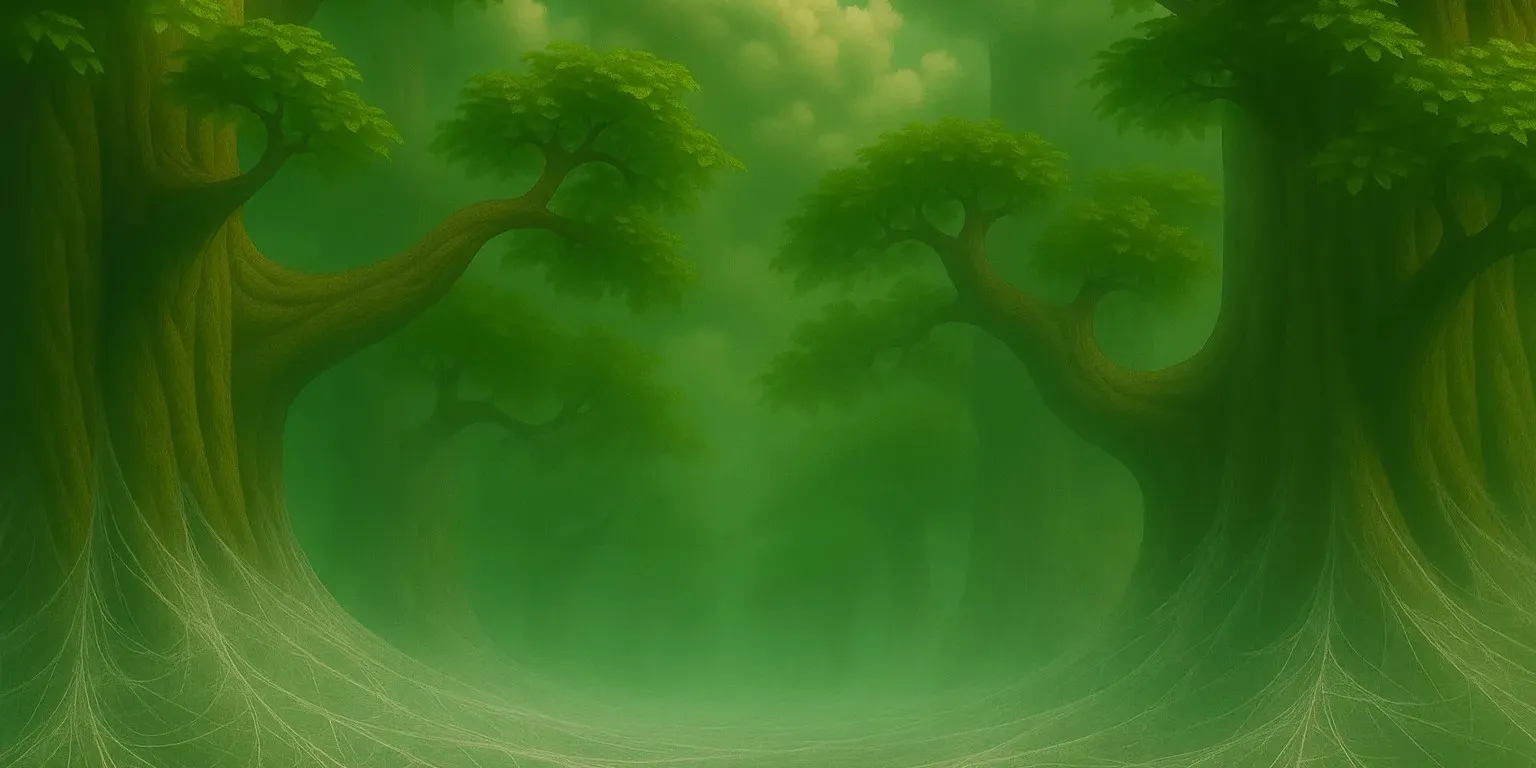
In the course of my travels, it has ever been my custom to assign names to the creatures I encounter, and to devise taxonomic groupings in accordance with my observations. I must make it plain, however, that the appellations employed herein are entirely of my own contrivance, and bear no relation to the designations by which the creatures refer to themselves. This is especially true in Arborea, where the omnipresence of telepathic communication renders most such names conceptual rather than linguistic, and thus incapable of faithful transcription into text. The labels I employ are intended solely for the convenience of the reader; let it not be imagined that these are names of the People's own choosing.The path by which I entered Arborea was but a narrow fissure, and I was obliged to turn sideways to squeeze through. Emerging at length, I found myself stepping forth from a crevice in what proved to be a cliff-face of bark, and standing upon a branch broader than the grandest city avenue. At first, I could scarce comprehend the spectacle before me; for all was wrapped in the peculiar green-tinted gloaming of the forest's depths, and the scale of every object so exceeded the bounds of ordinary experience as to confound interpretation. The rift from which I had issued was but one fracture in a mountainside composed wholly of living tree. Above me spread leaves vast as the sails of mighty ships, and beneath my feet the colossal branch extended into the dimness until it was lost from sight. As my eyes grew accustomed to this prodigious scene, I was seized by the curious sensation of being some minute insect upon the greatest of trees - a comparison which I was soon to discover both apt and wholly inadequate to the immensity of Arborea.
Being no stranger to uncharted realms, I set myself to a careful survey of my immediate surroundings. There were no apparent signs of habitation - though such absence proved little more than that any civilization was neither obvious nor immediately at hand. Raising my gaze, I perceived naught but the immense boughs of the tree and, through occasional openings, glimpses of a cloud-filled sky beyond. I ventured cautiously to the edge of the branch and peered downward, yet could discern nothing within the dim and shadowed recesses below. It would be many months before I descended sufficiently to behold the continental Webs which mark the boundary between Arborea and the darkness that lies beneath.
Units of Measure
The Karapax, being consummate geometers and engineers, have devised an extensive and precise system of measurement of their own invention. In the present record, I shall employ these units where appropriate, offering explanations as required. At present, I shall introduce but a single measure - the span. This unit of length is derived from the average distance between the Webs and the Clouds, a distance which the Karapax divide into one thousand equal parts. I offer it forthwith to provide, dear reader, some notion of scale. I - considered slightly above average in stature within my own realm - am just under two spans in height. The distance separating the Webs from the Clouds is, as I have mentioned, one thousand spans. With this in mind, I entreat you to imagine the magnitude of the trees: their trunks ranging between five and nine hundred spans across, and their branches ranging from twenty to nearly five hundred spans in breadth, and extending hundreds of spans in length. Picture this, and you may begin to comprehend the colossal nature of these arboreal giants.Having satisfied myself that I was indeed perched high upon a massive living tree, I applied my attention to the scene with greater minuteness. A trunk of such proportions must surely harbor innumerable forms of life, and within the few first minutes of observation I encountered no small dozens of creatures, each bearing a singularity of structure. What at first I had taken for mere outgrowths of the tree itself proved to be, upon closer scrutiny, a most various assembly of plants - some parasitic, some apparently symbiotic, though at that distance I could not determine which. Small animals threaded among these branch-rooted herbiage with a furtive industry. I had bent forward to examine them more closely when a curious and unmistakable sensation of being observed fell upon me - such a sensation as I had hitherto known only when subjected to psychical scrutiny.
I cast my gaze about, seeking the source of the sensation, and it proved easy to find. Above and before me there hung a craft, bobbing gently in the air. It consisted of a broad basket suspended from three balloons - two smaller ones at either end of an elongated, flat-bottomed hull, which appeared entirely sealed, and a third, larger globe amidships, kept aloft by a ring of fire burning just beneath it. This balloon-ship was marvel enough to behold, but it was the pilot who truly astounded me.
Peering down from the vessel was a being unlike any I had ever encountered beyond the sea. It possessed ten tentacular arms, arranged radially about a great bulbous head. Two of these were longer and more robust, tipped with heavy, club-like pads; with one of these it secured itself amongst the rigging of its vessel. Its two eyes, each with an elongated pupil, regarded me with evident curiosity - and, as I later learned, with no less astonishment than that which seized me at the sight of it. Its hide was thick and rubbery, alive with shifting hues, which I would soon discover to be the very index of its emotions, and in this instance a vivid expression of surprise. Presently it raised itself upon four of its smaller arms and emitted a trilling song, composed of whistles and clicks, from a beak concealed beneath its mass. In that instant I named the species Ceph. Though in time I would consign it to the taxonomic order Polypodes, the name Ceph has remained constant in my writings. Thus did I encounter the first of the seven known species of the People of Arborea.
The Folly of Analogy
In many volumes that seek to describe creatures novel and strange, the author leans excessively upon analogy - asserting, for example, that a beast was like an octopus, and like a squid, and yet also like a flying squirrel or a bird. In my experience, such a practice ill serves both writer and reader. It is a misuse of our common tongue, and leads only to confusion as to the true nature of the subject. When analogy is employed in place of precise observation and description, it predisposes the reader to imagine features not present, and to carry away misconceptions most grievous. In this record, therefore, I shall endeavor to forgo the easy crutch of analogy, and instead to present, as faithfully as I may, what I have myself observed in its exact detail.The World Revealed
Though my esteemed friend Doctor Aciago was not with me in person, he had furnished me most generously with a variety of ingenious contrivances to aid my explorations. Chief among these was a psychic enhancer - a curious device which, when placed upon the head, served to augment the receptivity and aptitude of the wearer in matters of the psychic faculty. I had previously employed it to surmount barriers of language and comprehension, and, given that the being before me was clearly possessed of innate powers of the mind requiring no mechanical assistance, I entertained the hope that the instrument might enable true discourse between us.
Of the potency of its effect I was, however, entirely unprepared. Scarcely had I set the device upon my brow and activated its mechanism when I was overwhelmed by a flood of impressions - so vivid, so multitudinous, that for a moment I scarce retained command of my own thoughts. Yes, the Ceph aboard the vessel now spoke with crystalline clarity within my mind, their principal curiosity being the question of what manner of creature I might be, for I was wholly alien to their experience. Yet this was but the merest beginning. For, with my perception thus opened, I discovered that all things in Arborea were psychically alive. From the tiniest insect to the mighty trees themselves, each emanated a presence in the great mental tapestry. It was as though I, having all my life gone blindfolded, had at last been permitted to open my eyes upon a world radiant with light.
In the ensuing months, as I grew accustomed to this expanded faculty, I learned that many beings were not so easily discerned, cloaking their psychic emanations with instinctive subtlety. My first impression - staggering though it was - proved but a fragment of the greater whole. Telepathy is, in truth, the warp and woof of Arborean existence: it is the common tongue whereby the disparate races of the People converse; it is a weapon and a safeguard alike in the endless play of predator and prey; and, most wondrous of all, it is the very compass of navigation. Each colossal tree bears a signature entirely its own, distinct and unmistakable, and by these emanations the traveler may chart their way across the endless forest.
I must have staggered and fallen - mercifully, the branch was of such breadth that I was in little danger of tumbling from it - for the next I knew, the Ceph stood above me, gazing intently into my eyes. I perceived at once the tenor of their thoughts: chiefly curiosity, tempered with a measure of concern. Rallying myself, I contrived a reply of my own, whereupon the creature courteously withdrew, affording me space to sit upright and accustom myself to this newly awakened faculty. Their demeanour was polite and restrained, yet I could not mistake the fervent eagerness that burned within them, a longing to ply me with inquiries - an eagerness, I confess, that was very much reciprocated. When at length the Ceph extended an invitation to ascend into its balloon-borne vessel, there to accompany them for a time and exchange our manifold questions, I accepted with the greatest alacrity.
Regarding Telepathy
Although I did learn to interpret a few of the songs employed by the Ceph, as well as certain words in the spoken tongues of the other Peoples, the great bulk of my intercourse with the inhabitants of Arborea was conducted by telepathic means. If you, dear reader, have never experienced such a faculty, it is worth pausing for a brief digression upon its nature. In telepathic communion, one does not employ words nor any language properly so called; rather, whole concepts are conveyed directly, in a manner which transcends all linguistic contrivance. This is, of course, an invaluable instrument when conversing with those who share no common speech, but it poses considerable difficulty for the chronicler. I shall not, therefore, attempt to present dialogues in these pages as I might in an account where verbal discourse prevailed. Instead, when I report the exchange of ideas between myself and one of the People, I shall strive to impart the essence of the communication, without clothing it in the artificial garb of words never spoken. I believe this to be the more honest representation of my experience in Arborea, and I trust my readers will concur.A City in the Branches
As we journeyed together, my new companion plied me with questions as often as they answered my own, and it was in that discourse that the foundation of this present work was laid. The knowledge thus obtained I have since laboured to expand, through two subsequent years of close inquiry and observation. My companion - whom I have styled Odysseus in these notes, both for the manifold adventures they so vividly recounted and because their true name is a conceptual structure beyond my power to record - spoke to me of the seven races of the People, and of the diverse manners in which they order their lives.
It was from Odysseus that I first learned of the prodigious webs that undergird Arborea, woven by the dire Telatextrices - creatures fearsome in aspect, yet far preferable to the monstrous forms they restrain in the darkness below. They also acquainted me with the innumerable beings who make their abode amidst the clouds above Arborea - clouds which almost never part as to reveal any firmament beyond. In truth, the very architecture of this volume owes much to that first conversation, and I can but hope that my own efforts have been equal to the breadth and clarity of their generous discourse.
We travelled together for a day and a night before at last arriving at the destination Odysseus had selected. This was a city of the People of Arborea, and though my companion had spoken of it at length, I confess it was only upon beholding the place with my own eyes that I began to apprehend the true strangeness of life among them.
The city - which I have chosen to style Highmarket - was built about the colossal trunk of one of the world-trees, its structures dispersed across a hundred branching limbs. Hundreds of balloon-ships of every description hovered nearby: some drifting freely, as had ours, while others were drawn upon taut lines that guided them along prescribed paths. From crown to base, the city encompassed no less than three hundred spans, with great lifts suspended by pulleys to bear passengers and cargo alike upward or downward. They also possessed what they termed "bridges" - though in truth many were no more than a single silken line stretched across the yawning void, upon which the People trod with the same assurance that I might show upon a span of stone ten paces wide. Every element was fashioned of wood, shell, or silk; for in all of Arborea there is neither stone nor metal to quarry, and so the People have bent their wit and labour to the most ingenious uses of the materials at hand.
The Seven Races
Later in these pages, I will delve into each of the seven races of the People in detail, I would like to give you a brief introduction to them at this juncture. They will appear throughout my chronicle, and one cannot imagine Arborea without imagining its People.- Avara: Six-limbed, feathered folk of tireless curiosity, whose wandering villages, ceaseless discourse, and astonishing aerial agility mark them as the most restless travelers of Arborea.
- Bohra: Great clawed hunters of the night, formidable in strength and endurance, whose taciturn bearing and martial prowess make them the most feared warriors of Arborea.
- Ceph: Ten-limbed, gliding sorcerers of the branches, their fleeting lives sustained by a lineage of psychic inheritance that grants them both continuity of memory and a brilliance of mind unmatched among the People.
- Karapax: Immense, six-limbed beings encased in domed shells that open to reveal broad wings, their societies ordered with a relentless devotion to symmetry, logic, and geometric design.
- Kouatl: Solitary, six-limbed serpentine climbers, their shifting hues and unerring grip lending them mastery of both canopy and concealment, a gift well-suited to their trade in goods and in secrets.
- Mycora: Drifting colonial beings of fungal tissue, sustained aloft by their own secret gases, who speak only through the mind, split into new selves when they grow vast, and dazzle the branches with sudden light or smother them in clouds of spores.
- Roark: Small-bodied, long-limbed beings whose leathery hides and membranous wings cloak a people defined by song and thought, for they are among the most sensitive of telepaths, and in their great choirs of voice and mind they may merge into a single, resonant community of will.
Yet more wondrous than the city itself were its inhabitants. All seven races of Arborea were gathered there, in their unearthly profusion. I beheld the Karapax crawling with patient diligence along the branches, or launching into brief but ponderous flight. I heard a company of Roarks suspended beneath a vast limb, their voices raised in a chorus that resonated at once in the ear and in the mind. And it was there that I first saw a Ceph in flight - its supple body flattened into a living disc as it glided gracefully through the air, seized a dangling rope, and descended with practiced ease to its destination.
In those first moments I stood in awe of the marvels to which I had been brought, and daunted in equal measure by the task I had undertaken - to render intelligible to those who have never glimpsed Arborea the nature of this place, at once so strange and so magnificent. For two years thereafter Highmarket was my home in the branches: the haven to which I returned after every foray into the farther reaches, as far as silk and wood might bear me.
Between Webs and Clouds
And now, dear reader, we arrive at the close of this introduction, and the threshold of the greater volume. In the pages that follow, I shall set forth the substance of my observations during two years amidst the branches of Arborea - no more than a fragment of its vast reality, yet, I trust, sufficient to impart some true sense of this singular world. I shall begin with The Structure of Arborea itself: the nature of its Trees, its alternations of light and darkness, its weather and climate, and, at the very boundaries of knowledge, the webs that stretch below into shadow, and the cloud-ocean that ever conceals the heights above.
Once we have established the framework of the world itself, we shall turn our attention to The People of Arborea - the seven races who dwell among the branches. Each species shall be examined in turn, both in terms of its biological particularities and its cultural distinctiveness. We shall also consider their interactions, for the People do not segregate themselves into enclaves of a single race, but rather form vast, diverse communities, each relying upon the individual strengths of its members. I shall demonstrate how, employing only the materials afforded by their arboreal realm, they have constructed a civilization as intricate and advanced as any found in the more grounded worlds, and shall recount as much of their history as my investigations permitted.
In our final section, we shall embark upon a thorough exploration of Arborean Flora & Fauna. Life in this realm diversifies into an astonishing multitude of forms, and the species of Arborea are remarkable in both their complexity and their variety. We shall examine not only the plants and animals of the trees themselves, but also the strange denizens of the clouds, such as the immense Ouranoketoi, whose haunting songs permeate the ether, and the dreaded toothy Nubicarcharias, which occasionally plunge from the clouds to hunt among the uppermost branches. We shall also descend to the lower reaches of the world, to encounter the many creatures of the Webs - from the Telatextrices, who have woven them, to the myriad species that have adapted to dwell within this knotted and perilous realm.
If these words have intrigued you, dear reader, I invite you to turn the page and accompany me into Arborea, the realm suspended between Webs and Clouds, where we shall continue our investigations and uncover the marvels that this singular world holds. Here you shall witness the extraordinary denizens of the branches, the astonishing architecture of life itself, and myriad phenomena that challenge all preconceptions. Advance cautiously and with curiosity, for Arborea rewards those who observe with patience and an eye for the unimaginable.






This is a fantastic introduction and I love the way you framed how your going to write this, cause its a great device and a way to still provide that 'human' connection for us simple humans as readers because we'll be having things explained to us by one of our own. Fantastic way to approach it honestly, and narratively such a fun idea, this could be a recurring narrator for projects even beyond this one, given the way you introduced the premise. I can't wait to learn more about this strange and intriguing world however, I am very excited :D
Thank you! I really appreciate your encouragement and support, as this is a new kind of project for me and I’m really hopeful that it will be an enjoyable read.