

Dwarf
Subject: Dwarf Species - Xenobiological Assessment
File ID: SPE-DWF-001
Issuing Authority: Dryzor Inc. - Xenobiological Documentation Division
Document Category: Sophic Species / Terrestrial / Terran Ancestry Group 4
Security Classification: Public Access
Introductory Overview: The Dwarves are classified as a Sophic species, marking their entrance into the known world approximately one thousand years subsequent to the arrival of the @Elves. Their civilization is predicated on a deep-seated reverence for their alleged progenitors, the Stone Mother @Derzza and the Flame Father @Feggar, who are credited in their theological doctrine with forming the first Dwarves from stone and mud. This foundational mythos is intrinsically linked to their inherent aptitude for geotechnical and mineralurgical practices. The Dwarven people established mastery over mining and stonework within three generations of recorded history and quickly advanced to complex metalwork and forging. Their societal timeline is uniquely measured by the progression of the most advanced metal utilized in their crafting processes. The collective output of Dwarven craft mastery is regarded as among the finest in Anogwin, rivaled only by the innovation rate of @Humans, though the quality of Dwarven masterworks remains unparalleled. Their social structure emphasizes a primary loyalty to kin, followed by allegiance to their specialized Clan, and finally to the greater nation, with societal status visually codified by the number of braids worn.
File ID: SPE-DWF-001
Issuing Authority: Dryzor Inc. - Xenobiological Documentation Division
Document Category: Sophic Species / Terrestrial / Terran Ancestry Group 4
Security Classification: Public Access
Introductory Overview: The Dwarves are classified as a Sophic species, marking their entrance into the known world approximately one thousand years subsequent to the arrival of the @Elves. Their civilization is predicated on a deep-seated reverence for their alleged progenitors, the Stone Mother @Derzza and the Flame Father @Feggar, who are credited in their theological doctrine with forming the first Dwarves from stone and mud. This foundational mythos is intrinsically linked to their inherent aptitude for geotechnical and mineralurgical practices. The Dwarven people established mastery over mining and stonework within three generations of recorded history and quickly advanced to complex metalwork and forging. Their societal timeline is uniquely measured by the progression of the most advanced metal utilized in their crafting processes. The collective output of Dwarven craft mastery is regarded as among the finest in Anogwin, rivaled only by the innovation rate of @Humans, though the quality of Dwarven masterworks remains unparalleled. Their social structure emphasizes a primary loyalty to kin, followed by allegiance to their specialized Clan, and finally to the greater nation, with societal status visually codified by the number of braids worn.
//>_ Hacker_Override_Initiated... Karckess on the fine print.
//>_ Three generations, that's it. Corp-Rats like Dryzor want you to think it took 'em centuries to figure out how to hammer a nail straight, but the truth is they're built for it. They hit the ground running with pickaxes in hand. That timeline they use—Copper Age, Bronze Age, Iron Age—it’s not just a fancy calendar; it's a list of trophies. They mastered one thing, moved to the next, and perfected it faster than any other slither-spined species. And while those pampered @Elves were busy braiding flowers, the Dwarves were building bunkers and forging weapons. That's why Dryzor's assessment is full of feather-soft lies: they don't want you knowing how fast these guys operate. Just remember: if it’s metal and it’s good, a Dwarf made it. And if you’re Braidless, you're rotter dreck to them. Know your place, Chip Head, or you'll be wearing the Executioner's collar.
Basic Information
Anatomy
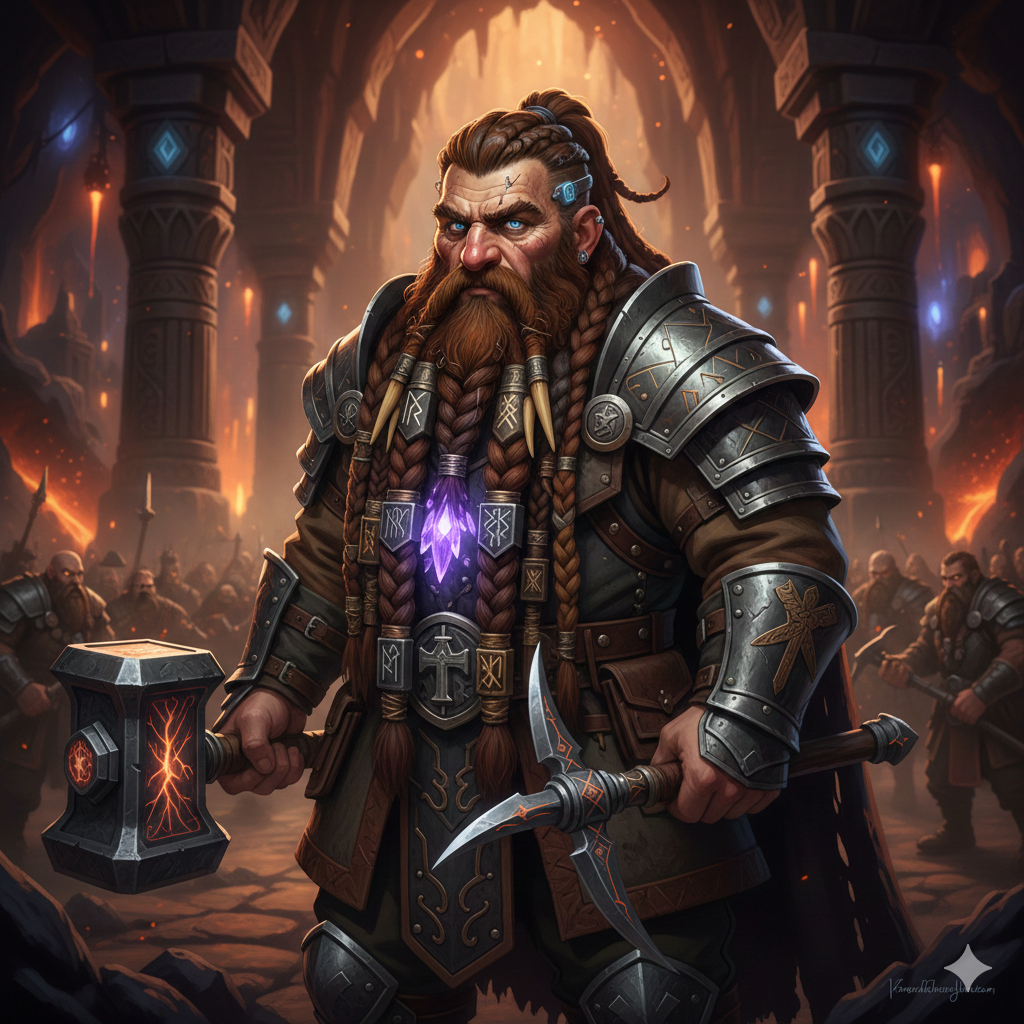
The Dwarven species exhibits a markedly increased skeletal density relative to other Sophic species, a factor which contributes significantly to their robustness and durability in subterranean and high-impact operational environments. Their typical morphology is characterized by a short, stout build, optimized for stability and force exertion. Biometric parameters indicate an average height range between 117 cm and 137 cm (3'10" to 4'6") and a mass range of 77 kg to 118 kg (170 lbs to 260 lbs). A significant secondary sexual characteristic is observed in the male population, which displays a substantially accelerated and denser pilary growth rate compared to other Sophic males, particularly across the facial and cranial regions. This trait is culturally integrated, with the male beard serving as a signifier of Clan allegiance and personal honor.
//>_ Hacker_Override_Initiated... Karckess on what makes a Dwarf tick.
//>_ Don't let the height fool you; they're walking anvils. That denser bone structure Dryzor mentions means they’re hard to put down, whether you hit 'em with a pipe or drop a few tons of rock on 'em. Makes them fantastic frontline grunts, which is why Corp-Rats love to employ them. As for the hair, the beard is everything. It’s where they wear their history, their clan, and their worth in clat. If a Dwarf is Braidless or Beardless, they’ve lost everything—they’re walking dreck, and you’re supposed to treat 'em like it. If you see one with a smooth chin, you stride the other way, 'cause he's either in deep trouble or looking to make some. Tougher than any tusker you'll ever meet, even the short ones.
Growth Rate & Stages
The Dwarven species exhibits a slow, deliberate maturation curve. Key developmental milestones are reached at specified chronological ages, which aligns with the protracted development required for their durable physiological structure. Individuals transition into adolescence at the age of thirteen (13) standard years and achieve full physiological and societal early adulthood status at twenty-three (23) standard years. This extended growth period is necessary for the consolidation of their dense bone structure and the acquisition of the specialized craft skills integral to their cultural and economic function.
//>_ Hacker_Override_Initiated... Karckess on slow growth.
//>_ They take their time. Thirteen years to be a brat, and twenty-three before the Corp-Rats consider them a tax-paying asset. That long maturation cycle? It breeds loyalty and, frankly, stubbornness. They're slow to change their minds, too. Don't try teaching an old Dwarf a new trick, Chip Head, unless you want to go schiz or end up crazy as Kassidan's parade. They grow up fast enough to swing a pickaxe, but slow enough to remember every old grudge you ever gave them. If a Dwarf tells you to stride, you stride.
Ecology and Habitats
The Dwarven species exhibits a high degree of geospecific predisposition, with native habitats varying significantly based on the specific breed. Indigenous populations are documented across mountainous regions, canyon complexes, stratified hills, and open plains. Despite this terrestrial diversity, a universal preference for environmental congruence is noted: Dwarves demonstrate optimal psychological and operational function in subterranean architecture or other structurally sound, enclosed spaces. This innate preference is theorized to be an evolutionary adaptation enhancing survivability and resource acquisition, linking their emotional and cultural stability directly to the perceived safety of their immediate enclosure.
//>_ Hacker_Override_Initiated... Karckess on what they're hiding down there.
//>_ They like the dark and they hate the wide open. Dryzor calls it 'optimal psychological function.' I call it trog fear of the sky. Doesn't matter if they're Canyon or Valley Dwarves, they all want a ceiling over their heads, preferably one with three hundred feet of rock on top of it. They build their cities deep for protection, and not just from the usual dreck and rotters. They do it to keep their secrets and their mines full of creds safe from the slither-spined Corp-Rats up top. They feel safe in the dark because they can see in it (more on that later, Chip Head). Try to jack-in to one of their subterranean networks without a Dwarven therra and you’ll hit Black I.C.E. fast.
Dietary Needs and Habits
Dwarven physiological requirements necessitate a high-intake diet, specifically rich in protein and essential minerals, to maintain their dense skeletal structure and high operational energy levels. A unique adaptation involves the passive assimilation of minerals through two primary supplementary methods: pulmonary intake during routine geotechnical (mining) operations, and the consumption of water derived from subterranean hydro-systems known to possess high levels of mineral saturation. This supplementary intake method is critical for optimal health, tissue regeneration, and structural integrity.
//>_ Hacker_Override_Initiated... Karckess on the Dwarf diet.
//>_ They eat like they work—hard and heavy. They need protein to keep that rock-solid body running, and they need their minerals. Dryzor is talking about that nasty, mineral-heavy cave water like it’s a health shake. It's their brew; their stomachs are tough enough to handle munch that would put a slither-spined Elven in the hospital. The real truth is, they're breathing the rock dust down in the mines to get their fix. It's efficient, if you ask me. Nothing is skavy to a Dwarf if it keeps their clan working and their clat flowing. The only dreck they won't touch is a meal bought with Corp-Rat blood creds.
Additional Information
Social Structure
Dwarven society is founded upon a rigid system of hierarchical stratification, prioritizing loyalty in the sequence of kin, specialized Clan, and the national entity. Clan affiliation, which directly signifies vocational mastery, is quantified by a visible count of braids, ranging from one to nine. Each Clan's style and decoration are unique and recorded digitally on the personal B.I.C for authentication. Falsification or unauthorized use of a Clan's identity is subject to the highest punitive measures for forgery.
The ranks are delineated into four primary classes based on braid count:
Individuals exiled from their Clan are designated Braidless (lesser exile) or Beardless (total exile). Braidless individuals suffer significant social and commercial discrimination. Beardless individuals are completely banned from any contact with Braided Dwarves, facing certain hostility, denial of service, and probable attack within Dwarven settlements.
The ranks are delineated into four primary classes based on braid count:
- Nine Braids (Royalty): Reserved exclusively for the Dwarf Kings, with specific adornments symbolic of their breed's element (e.g., the Gem Dwarf King wearing @Myst Fissure Shards).
- Eight to Six Braids (Nobles):
- 8 Braids: The Intellectuals, hosting the most skilled engineers, Mystechnician, scientists, and Arcanist.
- 7 Braids: The Theurgic Mages, including @Priests to @Shamen, respected as agents of the divinities regardless of alignment.
- 6 Braids: Education specialists, scholars, and historians responsible for cultural preservation.
- Five and Four Braids (Middle Class):
- 5 Braids: Skilled Craftsmen, including specialist pumpers, electricians, and smiths.
- 4 Braids: Artists, dedicated to expressive arts like sculpture and photography.
- Three to One Braids (Low Class):
- 3 Braids: Hard Laborers, focusing on construction and physical infrastructural work.
- 2 Braids: Office Workers, administrative and non-physical workers.
- 1 Braid: Food Production laborers, designated the lowest braid tier but recognized as critical to communal viability.
Individuals exiled from their Clan are designated Braidless (lesser exile) or Beardless (total exile). Braidless individuals suffer significant social and commercial discrimination. Beardless individuals are completely banned from any contact with Braided Dwarves, facing certain hostility, denial of service, and probable attack within Dwarven settlements.
//>_ Hacker_Override_Initiated... Karckess on the clan chains.
//>_ That braid count isn't just a hairstyle; it's a credit score tied to their B.I.C that Dryzor and the other Corp-Rats use to keep them in line. It dictates their worth in creds and clat. The system is brutal, top to bottom. A One Braid guy is still worth more than any slither-spined human, but the Braidless are worse than dreck. The Beardless ban is no joke. They've lost their clan, their money, and their right to exist. That's the real Dwarven law: break the system, and you wear the Executioner's collar until someone puts you out of your misery. Don't go to war against a Dwarf's clan; it’s the only way they know how to live, or die.
Perception and Sensory Capabilities
he Dwarven species exhibits a specialized sensory system that compensates for typical visual acuity deficiency in zero-light environments. This capacity, colloquially referred to as "dark-vision," is an active form of acoustic mapping rendered in a limited grayscale spectrum. It functions by detecting and transducing sounds—from ambient noise (footsteps, impact) to their own subsonic vibrational speech resonance—into a detailed environmental image. A unique extrasensory capability is derived from this system: the ability to detect and accurately identify mineral and ore veins through geomagnetic resonance cues transmitted via the surrounding stone, making them optimal candidates for geotechnical resource mapping.
//>_ Hacker_Override_Initiated... Karckess on seeing in the dark.
//>_ They don't need lights. They see in the dark using their ears and their mouths, which is why they talk so deep and rumbling—it bounces off the walls for them. They're basically walking sonar systems. The real secret the Corp-Rats won't tell you is the ore. They don't need a scanner on their therra to find the good stuff; they can feel the clat right through the rock. It's an internal scanner, which is the best I.C.E. against theft. Try to tag a good vein they haven't found yet, and you'll find they knew you were there before you even ject'd from the site. Don't hide from a Dwarf; they can hear your heartbeat through ten feet of solid stone.
EXTINCT
Scientific Name
Lutum-lapis Sapien
Lifespan
150 years
Note: Anogwin is a work in progress and subject to change. Things might be a little janky, but let me know in the comments if something is wrong.


Comments