
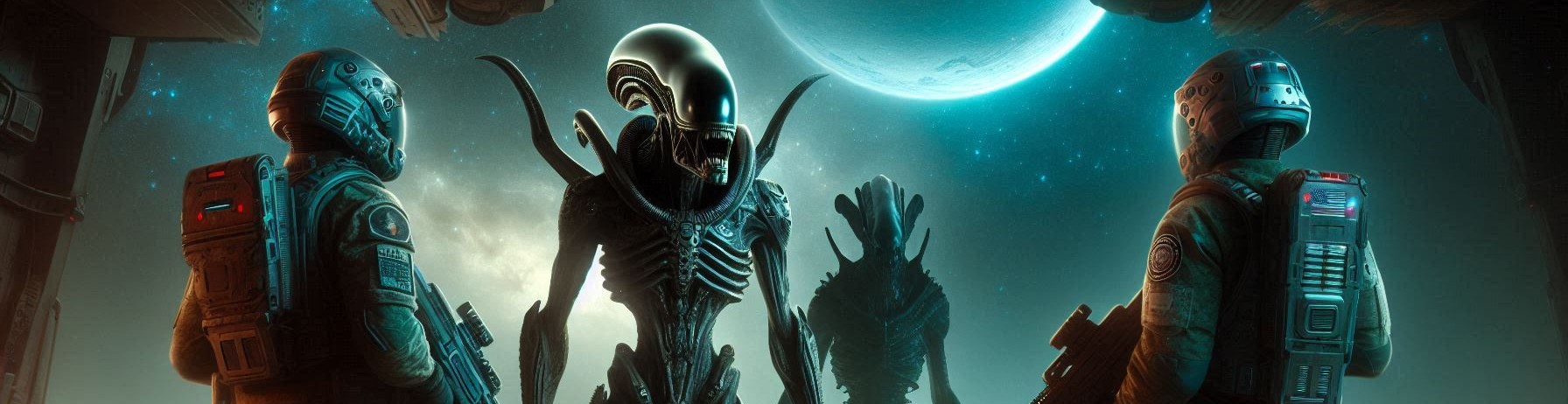
4.0 Mutant Menagerie
in Aether 2d12INTRODUCTION
In Life Science, a mutant is an organism with genetic variation from its original species. The alteration of a single a gene or chromosome within a DNA sequence causes an organism to mutate resulting in a new type of creature. Over the course of many generations genetic mutations is a natural occurrence and is integral to the process of evolution. Although many of the mutations found in the Mutant Menagerie could potentially be the result of natural evolution, it is more likely these often-extreme mutations are the product of unnatural causes or are intentionally induced using the latest bioware and gene therapies.
Different environmental factors are responsible for the evolution of a species and its rate of mutation. Variation within a population of organisms exist and organisms with the traits most suited for a specific environment pass on their genes to future generations while those with less suitable traits die out. Eventually, the population evolves into a new species or entirely new organism.
For example, rats reproduce rapidly (even in space) and can produce thousands of generations over just a few years. The rats on space station might gain adaptations allowing them to survive in near vacuum conditions by storing air in mutated cheek compartments. This mutation would allow the rats to survive behind stations walls and in low atmosphere areas while their cheek poaches serve as rebreathers. Rats on a newly terraformed moon might evolve and mutate into several new species filling every available niche. When their mutations diverge one branch of the rat family might become extremely large and only eat a specific low nutrient lichen like an herbivore. On the same moon, a second branch of the rat family might gain a set of predatory mutations which makes them better suited to hunt their larger cousins.
Since this is a science fiction/fantasy game accelerating the rate of mutation within a species isn’t going to ruffle too many feathers. But if you have a scientist in your group that insist that a new species simply would not have had time to evolve there are a few factors that can make the science in your fiction a little more believable. Radiation, its everywhere in space. We know from science it can accelerate the rate of mutation and we know from comic books it can cause rapid and exotic mutations. Second, scientist love to tinker with genetics, an endogenous retrovirus could have been introduced to a species accelerating their mutation rate allowing those mutations to get passed down to future generations.
Finally, in the Gravity Age setting the Earth was “destroyed” or “rebirthed”, depending on your perspective, when a genesis bomb was hijacked and deployed by terrorists. Just another example of unregulated mega-corporations at work. In addition to terraforming a planet a genesis bomb releases hundreds of designer endogenous viruses to advance any primitive life which might already exist on the planet. Over a hundred years the biology of a planet experiences a million years of genetic diversity causing an explosion of new species. The rhukoons (presented in the Gravity Age: Bioware Emporium) are a direct result of this incidental genetic uplift.
World Codex
Timelines
Stroh Hammer, Gravity Age, Starfinder RPG, and Aether 2d12 are trademarks of Stroh Hammer.
Aether 2d12 is published by Stroh Hammer under the Open Game License version 1.0a Copyright 2000 Wizards of the Coast, Inc.
Permission granted to photocopy or print for personal use.
© 2017 Stroh Hammer