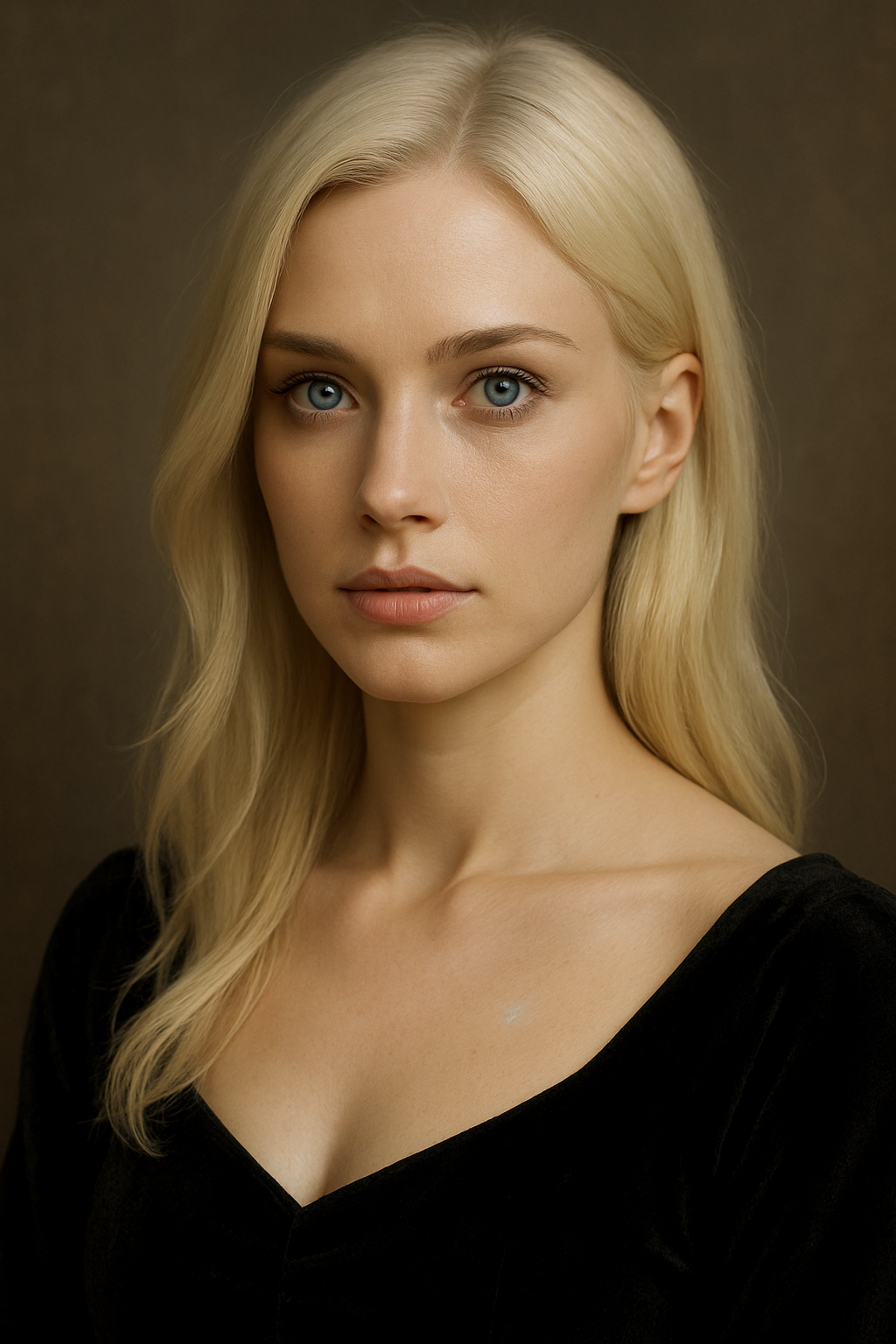
- Date of Birth
- 17th of September, 20 BFE
- Eyes
- Sapphire Blue
- Hair
- Long, sleek, Platinum Blonde
- Skin Tone/Pigmentation
- Sunkissed white, smooth,
- Height
- 5'6"
- Weight
- 134
Winters debuted independently with Starlight Dreams (4 BFE), before signing with Eclipsa Entertainment. Her breakthrough came with Beneath the Mask (3 BFE), part of the label’s Mythos Cycle, whose lead single “Siren’s Call” achieved cross-realm acclaim and established her as a critical and commercial force. She expanded her artistry with Veil of Fury (2 BFE), a rock- and metal-infused work praised for its dramatic intensity, and Born of the Abyss (1 BFE), a gothic and autobiographical concept album widely considered her magnum opus. Concurrently, she co-founded the idol supergroup AURA with Lyra Sterling and Tessa Rynell, whose debut album No Echo Returns (2 BFE) achieved pan-realm success and solidified their status as the defining act of the Reconnection Era’s twilight years.
Over her career, Winters released four Diamond-certified albums and became the only known performer to compose, produce, and sing in Ancient Alagorian. She sold out every concert she performed, with her largest solo audience recorded at 10 million attendees during the Mythos Cycle Tour in Avalon, the largest single-attended concert of the Reconnection Era. With AURA, she embarked on record-breaking tours spanning 17 realms, where governments established designated economic and security zones to accommodate unprecedented crowds; Avalonian authorities reported measurable economic growth associated with the group’s arrival.
Winters’ accolades include 10 Harmony Star Awards—among them Album of the Year (Beneath the Mask) and Song of the Year (“Siren’s Call”)—six Broadcasting Guild Awards, three Academic Cultural Honors, and a post-retirement Lifetime Achievement Medal from the Royal Conservatory of Alagoria. She is the most-awarded female artist in Harmony Star history and the only performer to receive formal recognition for the artistic revival of a dead language. Following the death of King Octavius Athomath at the Tournament of the Supreme in 0 AFE, Winters formally retired, citing burnout and mental health. Though largely reclusive since, she continues to influence modern music, fashion, and stage production across the Empire, and remains one of the most studied figures in Alagorian contemporary arts education.
Early Life
Seraphina Winters was born on September 17, 20 BFE, in the Kingdom of Athomathia, Alagor. Her birth occurred during the final phase of the Alagorian Civil War. Both of her parents are believed to have died in the Battle of Athomathia, leaving her orphaned in infancy. Following the conflict, she was placed under the care of the Ninym Memorial Foundation, an organization originally established as a wartime relief effort before being restructured into a foster network for displaced children.
Winters spent her childhood in foster care, moving frequently between guardianships across several Alagorian kingdoms. Reports from the Ninym Foundation described her as curious, emotionally intuitive, and musically gifted. She often experimented with instruments available in her foster homes, teaching herself to arrange simple melodies and create original songs. In later interviews, Winters recalled this period as “blurred, but always loud,” and noted she retained few clear memories of her early relocations.
At fifteen, Winters received a full scholarship to the Starlight Academy of Performing Arts through the Ninym Foundation’s artistic outreach program. Starlight operated as an intensive conservatory for gifted students, where Winters pursued studies in the Music and Dramatic Arts discipline. She completed the academy’s accelerated program, earning a Master of Dramatic Arts in Music by the time of her graduation. Faculty described her as “diligent, unpredictable, and exhaustingly brilliant.” While at Starlight, she gained local attention for her performances, which combined wide vocal range with a distinctive interpretive style. Several early versions of songs later included on her debut album Starlight Dreams were composed during this time.
Winters has not publicly acknowledged any surviving relatives, and attempts to trace her family lineage have either failed or been legally blocked. Her association with the Ninym Memorial Foundation remains the only documented element of her early upbringing.
Career
4–3 BFE: Career beginnings and Starlight Dreams
In early 4 BFE, Winters recorded her debut album Starlight Dreams in a home studio supported by the Ninym Memorial Foundation. She independently pressed 1,000 copies of the record and brought them to the Seator Summer Festival, where she performed as an unscheduled act. Her set drew a large audience, and all copies of the album sold out within hours. Talent scout Corvin Hayes, representing Eclipsa Entertainment, was in attendance and arranged her signing to the label shortly afterward.
Winters’ agreement with Eclipsa included a four-album contract under the label’s Eclipsa Records Division, overseen by A&R executive Helena Marrow. She was placed under the management of Livia Delacour, who coordinated her early promotional schedule. Starlight Dreams was re-released through Eclipsa in late 4 BFE, with expanded distribution and new promotional backing. Recording and remastering were overseen at Eclipsa Soundworks Studios by producer Adrian Veyra, who handled several of the label’s high-profile acts.
The album produced two notable singles, “Chasing the Horizon” and “Heartbeat Symphony,” both of which achieved strong radio play and became minor chart successes. “Chasing the Horizon” became her first top-ten entry on the Alagorian Popular Music Index, while “Heartbeat Symphony” established her as a rising figure within mainstream pop. Critics described the album as a bright, accessible collection of pop songs, highlighting Winters’ vocal presence and melodic instincts.
To promote the album, Winters embarked on the Starlight Showcase Tour, a short series of concerts across Alagor where she also appeared as an opening act for Eclipsa performers including Vex Nightshade and Crimson Echo. She made her first late-night appearance on The Lex Carter Show, in addition to performing on Realmwide Live, where her broadcast of “Chasing the Horizon” drew widespread attention.
Starlight Dreams peaked at number four on the pan-realm charts and remained in circulation for over 90 weeks. It later achieved multi-Diamond certification. Winters became the first Alagorian artist of her generation to write and perform every track on a debut album to reach Diamond status. The single “Chasing the Horizon” was credited with establishing her as a breakout artist, earning her a nomination for Best New Artist at the Harmony Star Awards in 3 BFE.
3 BFE: Beneath the Mask and breakthrough
Winters began developing her second studio album in late 4 BFE as part of Eclipsa Entertainment’s Mythos Cycle, in which artists were assigned mythological figures as conceptual frameworks. Drawing the Siren, she wrote and recorded Beneath the Mask with producer Adrian Veyra at Eclipsa Soundworks Studios. The album, released in early 3 BFE, incorporated themes of allure and hidden identity. Its lead single, “Siren’s Call,” introduced Winters’ first use of Ancient Alagorian and became her first number-one single on multiple broadcast charts, sparking debate over its cryptic lyrics.
Two additional singles, “Bound to Me” and “Dance in My Shadow,” expanded the album’s reach. “Bound to Me” became a major club hit across the Realm of Avalon, while “Dance in My Shadow” achieved broad radio rotation and was described as one of the year’s most memorable pop refrains. Beneath the Mask debuted at number one on the pan-realm charts, achieved Diamond certification within the year, and was hailed by critics as a defining release of the Reconnection Era.
To promote the album, Winters embarked on the Dark Mask Tour, her first realm-spanning headline concert series. The tour visited all seven kingdoms of Alagor and nine planets in Avalon, with every stop reported as a sellout. Her Avalonian concert drew over 10 million attendees, setting a record for the largest single-attended concert of the Reconnection Era. During the promotional cycle, she appeared on The Lex Carter Show, performing “Siren’s Call” live, and later performed “Bound to Me” on Realmwide Live. She also collaborated with fellow Eclipsa artist Lyra Sterling, whose Mythos Cycle entry was based on the Phoenix, and supported her signing to the label.
On December 21, 3 BFE, Winters performed at the Concordia Alagoria Stadium during the birthday celebration of Princess Irisa Athomath. The concert was targeted in a coordinated terrorist attack led by Alenya Clifton, later identified as a Loyalist of the self-declared heir to Aindranla Athomath, the Emerald Queen. The assault was carried out in protest of Aindranla’s imprisonment, with the stated aim of forcing her release and restoring her to the throne of Alagor.
During the incident, Winters and Princess Irisa were forced into a captors’ M.A.V. in an attempted abduction. Witnesses reported Winters shielding the princess until they were rescued by Centurion Legion officer Marcus Regan, who sustained injuries while breaking into the vehicle and pulling both to safety. Two Praetorian guards assigned to the princess’s security detail were killed in the attack, and several concertgoers and staff were injured.
The incident received widespread coverage across the realms, with images of Winters defending the princess becoming emblematic of her public image as both performer and protector. In response, Winters issued an apology for the event and pledged her personal earnings from the concert to relief and recovery efforts. The Alagorian Royal Family declined funds for the repair of the stadium itself, instead directing her to redirect proceeds toward victims’ families and other causes at her discretion.
On January 8, 2 BFE, Winters organized a benefit concert in collaboration with Lyra Sterling and Tessa Rynell. All proceeds were donated to victims and families impacted by the Concordia attack, and the performance marked the first formal collaboration between the three artists, later known as AURA.
2–1 BFE: Veil of Fury and AURA’s rise
In January 3 BFE, Winters, Lyra Sterling, and Tessa Rynell formally announced the formation of AURA during a benefit concert following the Concordia Alagoria attack. Their joint performance was broadcast across multiple realms and described by commentators as “the birth of a cultural phenomenon.”[1]
In early spring 2 BFE, Winters released her third studio album Veil of Fury, her first project following the Mythos Cycle. Departing from mainstream pop, the album adopted industrial and gothic rock stylings. Its lead single, “Razor’s Edge,” debuted at number one across multiple broadcast indices, nearly breaking records for fastest ascent before being displaced by her own reissued “Siren’s Call” EP. Winters became the first Alagorian artist to hold the number one and two chart positions simultaneously. The single was certified triple-platinum within its first month, and critics described it as “a startling reinvention.”
Two additional singles followed: “Chaos Rising,” which peaked at number three, and the title track “Veil of Fury,” which reached number five. Winters’ live performance of “Razor’s Edge” on The Lex Carter Show went viral and was widely praised for its theatrical presentation of her new gothic persona. The music video for “Neon Fury,” featuring Winters dancing in the ruins of a collapsing castle, broke records as the most-viewed video in its first 48 hours on EclipsaStream. Media outlets speculated about its imagery, with some suggesting references to the fallen palace of the Emerald Queen, though Winters denied political intent. Another track, “Shattered Throne,” faced criticism from royalist commentators for lyrics alleged to reference King Octavius Athomath and his daughter; Winters responded in a statement that the song was “personal, not dynastic.”
In May 2 BFE, AURA released their debut album No Echo Returns. The project heavily incorporated Ancient Alagorian and debuted with all eleven tracks charting simultaneously in the pan-realm top forty, a first for a female group. The lead single “Veil of Dominion” entered at number one, while “Eclipsed Fate” and “Eshara Vel’Karesh” peaked within the top five. Their performance of “Eshara Vel’Karesh” on The Lex Carter Show was praised for its vocal layering and choreography, and the appearance was later cited as the group’s breakthrough broadcast moment. AURA became the first Alagorian act to trend across every major broadcast board in the Realm of Avalon.
To promote Veil of Fury and No Echo Returns, Winters and AURA embarked on the No Echo Returns Tour, which ran from mid-2 BFE to early-1 BFE. The shows combined solo sets from Winters, Sterling, and Rynell with full AURA performances. Winters’ Veil of Fury material featured prominently, including “Razor’s Edge” and “Chaos Rising.” Attendance regularly exceeded 10 million per stop, with the Avalonian performance setting a record for the largest single-attended concert in the Reconnection Era. The tour also became the first to sell out New London’s Veeland Concert Hall within seconds, and one stop in 2 BFE was attended by the United Chancellor, highlighting AURA’s role as a cultural export.
At year’s end, Winters and AURA dominated award ceremonies. Veil of Fury won Harmony Star Awards for Best Rock Album and Best Female Performance, while “Razor’s Edge” was named Song of the Year at the Broadcasting Guild Awards. No Echo Returns earned AURA Group of the Year and Best Tour Production, and was cited by the Royal Conservatory as “a landmark in cross-realm musical diplomacy.”
Beyond music, Winters’ Veil of Fury aesthetic sparked a fashion movement dubbed the “Fury Revival,” defined by gothic veils, industrial metalwork, and leather corsetry. She partnered with Eclipsa Apparel for a limited clothing line, which sold out within days of release. Publications in Alagor and Avalon identified her as one of the most influential style figures of the Reconnection Era. During a press event in Avalon, Winters was asked which candidate she would support in the United Alliance chancellory elections; not a citizen and ineligible to vote, she declined to endorse anyone, stating: “My voice belongs on stage, not in the chamber.” The comment was widely praised as a tactful assertion of neutrality.
By the conclusion of 1 BFE, Winters had achieved critical and commercial dominance both as a solo rock artist with Veil of Fury and as the leading member of AURA with No Echo Returns. Critics described her dual trajectory as “unprecedented in Alagorian history,” and cultural historians later identified the period as the zenith of her career.
1–0 BFE: Born of the Abyss, accolades, and retirement
At the start of 1 BFE, Winters entered award season with multiple nominations at the Harmony Star Awards, including Female Artist of the Year and Album of the Year for Veil of Fury. At the Royal Conservatory Gala, she performed a medley previewing her next project—combining “Razor’s Edge,” an orchestral arrangement of “Siren’s Call,” and an early version of “Child of Darkness.” The performance drew praise from critics, who ranked it among the ceremony’s highlights and noted her shift toward a darker, narrative-driven style.
In spring 1 BFE, Winters released a charity single with Lyra Sterling and Tessa Rynell titled “Hold the Line,” with all proceeds directed to the Ninym Memorial Foundation’s youth arts program. The single debuted at number one on the Pan‑Realm Broadcast Index and set a then‑record on EclipsaStream for fastest track to 100 million plays. Later that season she appeared on veteran producer Caelum Veyra’s single “Ashes/Aurora,” which entered at number one and later earned Best Duo/Group Performance at the Broadcasting Guild Awards.
Winters released “Child of Darkness” as the lead single from Born of the Abyss in late summer 1 BFE. The track debuted atop multiple charts, becoming her third number-one debut, and its concert film–style video set a platform record for most views in the first 24 hours on EclipsaStream. Critics highlighted the song’s confessional lyrics and raw instrumentation, widely interpreting it as a meditation on orphanhood and early instability, themes Winters did not elaborate on publicly.
Born of the Abyss was released in late 1 BFE to widespread acclaim. It debuted at number one on the Pan‑Realm Albums Index, logged the largest opening streaming week for a rock‑oriented record, and became the first non‑pop title of the Reconnection Era to enter the year’s ten largest streaming debuts. Within two months, the album was certified Diamond across multiple realms. The second single, “Why Did You Let Me Go?,” arrived with a chamber‑metal arrangement and later peaked at number two after a broadcast performance at the Harmony Laurels tribute. A third single, “Winds in the East,” was sent to radio at the turn of 0 AFE, topping Airplay for seven weeks and replacing Winters’ own “Child of Darkness” at number one; she became the first artist to replace herself atop the index as the sole credited performer on both tracks.
Throughout 1 BFE, Winters remained a mainstay on broadcast and streaming platforms. She was named the most‑played artist on Starwave Audio networks with a cumulative audience impression surpassing 2.5 billion, and Born of the Abyss placed eight tracks simultaneously in the Pan‑Realm top 40. In early 0 AFE she released Winds from the Abyss (Live), a tour companion album culled from rehearsal‑stage recordings and stripped theater sets; it debuted at number one on the Live/Compilation chart. A concert film, Abyss: Ceremonies, premiered on RealmNet at the end of December 1 BFE and broke the service’s 48‑hour music‑film viewership record.
Winters continued a limited Slate of collaborations during the album cycle. In mid‑1 BFE she co‑wrote and appeared on Lyra Sterling’s single “Phoenix Ash (Abyss Version),” which reached the top five; in early 0 AFE she released “Echo/Resolve,” a duet with Tessa Rynell, which topped the Global 200‑equivalent Pan‑Realm Composite for two weeks and became Winters’ longest‑charting collaboration. That spring, she served as a lead mentor on Harmony Max, the highest‑rated performance competition of the period, reportedly becoming the show’s highest‑paid coach for the season; she did not return the following cycle.
Winters performed “Winds in the East” at the opening ceremony of the Tournament of the Supreme in early 0 AFE. A week later, after the formal commencement of the tournament, King Octavius Athomath died in a sudden accident during his 16th consecutive match. The tragedy led to the suspension of programming across the realms and overshadowed the remainder of the event. In the aftermath, Winters canceled all remaining public appearances, released a statement expressing grief and exhaustion, and privately funded bereavement grants for affected arts workers. She declined a subsequent invitation from Salena Athomath to join the royal household, citing a need for privacy.
Born of the Abyss dominated year‑end lists and ceremonies. It earned Winters Harmony Star Awards for Album of the Year and Rock Vocal Performance, and Broadcasting Guild honors for Best Concept Album. “Child of Darkness” won Song of the Year at the Conservatory Laurels, while Abyss: Ceremonies received Best Music Film at the Realm Vision Music Awards. As 0 AFE progressed, she announced an indefinite retirement from public performance and formally disbanded AURA alongside Sterling and Rynell. Critics and cultural historians retroactively hailed Born of the Abyss as her magnum opus and identified the period as the apex of Winters’ influence on cross‑realm music, fashion, and stagecraft.
By the end of 0 AFE, Winters’ combined solo and collaboration credits had produced multiple year‑end number ones and record‑setting streaming totals. Though reclusive afterward, she periodically authorized educational uses of Born of the Abyss in Conservatory curricula and continued to generate significant royalties from archival performances and catalog reissues.
0–8 AFE: Retirement and reclusion
Following her performance of “Winds in the East” at the opening ceremony of the Tournament of the Supreme in early 0 AFE, Winters announced an indefinite retirement from public performance after King Octavius Athomath died in an accident during the tournament’s formal commencement one week later. She issued a brief statement citing grief, burnout, and a need for privacy, and canceled all remaining public engagements. Later that year, she made a single ceremonial appearance at the coronation of Empress Salena Athomath, seated in a royal box alongside Lyra Sterling and Tessa Rynell—by then members of the Imperial Household as handmaidens—marking Winters’ final confirmed public sighting at a state occasion.
Within days of her retirement, Winters invoked a contractual clause compelling Eclipsa Entertainment to sell her master recordings at fair‑market value. Industry outlets described the move as unprecedented; the transaction closed the same week and immediately precipitated a boardroom sale of Eclipsa to a silent partner who had sat on the company’s board for five years. The new owner liquidated the label’s assets and rescinded its active rosters; Eclipsa Tower was decommissioned and, by year’s end, razed to clear ground for the Empress’s Imperial City redevelopment. Commentators framed Winters’ masters acquisition as the decisive event that ended Eclipsa’s cultural hegemony.
Although Winters refused requests for new interviews after 0 AFE, she authorized a controlled series of archival projects. In 1 AFE, No Echo Returns: Realmwide Live (AURA’s tour chronicle) and Abyss: Ceremonies — Final Cut (a concert film built from rehearsal- and theater-stage footage from the Born of the Abyss cycle) premiered on RealmNet and EclipsaStream’s successor platforms, each setting opening‑week viewership records for music films. A companion documentary, Starlight to Siren, compiled publicly available material from her student recitals through the Mythos era; Winters declined participation, and the film used no new interviews. The three titles kept Winters at the top of documentary and music‑film indices through mid‑2 AFE despite her inactivity.
In the months preceding the coronation, Winters granted two short-form print interviews focused on music education and stagecraft; she has not granted an interview since. From 3 to 7 AFE, Winters’ only public signals were sporadic, caption‑light social posts. Fans frequently attempted “geolocation hunts” using background architecture and starfields; Winters’ former manager issued a public request in 4 AFE asking supporters to refrain from doxxing and stalking behavior, a message amplified by AURA’s official channels.
Winters’ philanthropic activity during the early Imperial period emphasized youth welfare and arts training. In 2 AFE, documentation released by the Ninym Memorial Foundation confirmed Winters’ underwriting of foster‑to‑conservatory bridge programs across multiple realms and the establishment of the Winters Performing Arts Center at Starlight Academy, dedicated to students from wardship and foster systems. The center opened with endowments for tuition, instrument grants, and tour stipends; Winters did not attend the dedication. Analysts noted that the Empire’s economic reforms had guaranteed basic needs across much of the realm, and framed Winters’ contributions as targeted, long‑horizon investments rather than emergency aid.
The period also coincided with a shift in the status of Ancient Alagorian. In late 1 AFE, the Empress directed that Winters’ private notes be incorporated into restricted archives, designated Ancient Alagorian the operational language of the Sapphire Glaive, and prohibited civilian instruction of the language. Scholars criticized the loss of public access, but imperial sources argued operational necessity; Winters is the only confirmed civilian fluent in the language. Debates over the policy’s cultural impact persisted in academic journals throughout the decade.
Winters continued to receive institutional recognition despite her absence. Between 2 and 6 AFE she was honored with multiple lifetime awards from the Harmony Star Awards, the Broadcasting Guild, and the Royal Conservatory; Lyra Sterling customarily accepted on her behalf. Several arena acts in Avalon and Alagor incorporated Winters tributes into their tours, citing her as a foundational influence on gothic‑industrial stagecraft.
Commercially, Winters’ licensed fashion and cosmetics lines—initially seeded during the Veil of Fury era—remained fixtures of Reconnection‑era aesthetics. A limited Fury Revival capsule series in 5 AFE reignited corsetry‑and‑hardware stagewear trends; Winters’ level of day‑to‑day involvement was unclear, with operations handled by a Winters Holdings affiliate. Her catalog (now independently controlled) saw periodic surges in streams and archival sales tied to documentary releases, academic syllabi, and fan‑organized listening events.
In 8 AFE, Winters was photographed attending the Cascadian opera Gaylertal Kin’Venkinl alongside Virellia Irisa Athomath. The images—her first widely circulated photos since the coronation—prompted renewed public interest in her whereabouts and relationship to the Imperial family. Neither the Palace nor Winters’ representatives commented, and no additional appearances followed.
By the close of 8 AFE, critics and cultural historians described Winters as “the defining enigma of the Reconnection and early Imperial eras,” whose silence magnified the afterlife of her work. With her masters secured, her image licensed but sparingly used, and her public footprint reduced to a handful of sanctioned archive projects and one opera sighting, Winters’ influence continued to shape music, fashion, and pedagogy across the Empire.
Artistry
Musical style
Winters’ music is primarily associated with pop, rock, and gothic traditions, with later excursions into industrial, symphonic rock, and experimental electronic styles. While she began her career in mainstream pop, her work is noted for its fluid incorporation of disparate genres, frequent use of theatrical concepts, and innovative integration of language into performance. Critics have described her discography as “a progressive narrowing from pop universality toward personal mythology.”
She is particularly known for her use of Ancient Alagorian in lyrical composition, beginning with the single “Siren’s Call” on Beneath the Mask. The track was the first contemporary pop release in centuries to feature the language, sparking both academic study and wide popular fascination. Though Winters never clarified her lyrical translations, her decision to embed the extinct language into accessible pop and rock forms was described as “a reinvention of liturgy as spectacle.” She later incorporated fragments of Vethrani, a dialect based on clicking tones, in live interludes, though it never appeared in studio albums.
Winters’ debut album, Starlight Dreams (4 BFE), was praised for its accessible, brightly produced pop sound, with Concordia Today comparing its tone to “pan-realm chartcraft with an operatic undertow.” Her follow-up, Beneath the Mask (3 BFE), expanded into darker territory with influences of trip-hop, orchestral pop, and experimental layering. The album, produced under Eclipsa’s Mythos Cycle initiative, was praised for its conceptual cohesion around the myth of the Siren. Its lead single “Siren’s Call” integrated Ancient Alagorian in the outro, a choice described by The Avalonian Review as “both shocking and visionary.”
Her third studio album, Veil of Fury (2 BFE), marked a sharp turn into gothic rock and industrial textures. Tracks such as “Razor’s Edge” and “Chaos Rising” were characterized by aggressive percussion, distorted synth lines, and Winters’ darker vocal delivery. The Concordian compared her transformation to “a pop star discarding the veil of innocence for the mask of a war-priestess.”
In late 1 BFE, Winters released Born of the Abyss, which emphasized symphonic arrangements and gothic metal balladry. Songs like “Child of Darkness” and “Why Did You Let Me Go?” were widely interpreted as autobiographical explorations of orphanhood, grief, and estrangement. Critics praised the record as her most mature work, with Alagor Journal of the Arts calling it “a fusion of gothic allegory with personal confession.” Unlike her earlier projects, Born of the Abyss did not incorporate Ancient Alagorian, opting instead for stripped-down lyrical clarity.
As a member of AURA, Winters participated in No Echo Returns (2 BFE), a collaborative album that fused pop, rock, and choral traditions. The project featured extensive Ancient Alagorian harmonies, largely arranged by Winters, and was praised as “the apex of the Mythos Cycle’s ambitions.”
Lyrically, Winters’ themes range from identity, seduction, and allure (Beneath the Mask), to fury and resilience (Veil of Fury), to grief, memory, and personal loss (Born of the Abyss). She frequently employed motifs of water, sound, and silence, with Cultural Archives Quarterly noting that “her discography can be read as an extended allegory of drowning and resurfacing.”
Influences
Winters grew up exposed primarily to realm-pop and theatrical folk opera traditions that circulated in foster residences across the Alagorian kingdoms. She credited an early encounter with a touring performance of the Athomathian Canticles with inspiring her to pursue music seriously, recalling that “it was the first time I felt a stage could hold a whole world.”
She frequently cited the composer-poet Ilyen Karesh as her most direct artistic influence, describing Karesh’s work as “proof that lyrics can be scripture without ever being sacred.” Among vocal models, Winters admired the Cascadian contralto Valora Neyn, whose precise but emotionally raw timbre she later imitated in training sessions at Starlight Academy. She also mentioned the dramatist Serenya Talith as shaping her sense of stagecraft, particularly the use of masks and physical gesture to embody shifting personas.
During her early career, Winters expressed admiration for mythographers and linguists who attempted to reconstruct Ancient Alagorian, noting that their “willingness to sing in fragments of the past” emboldened her decision to incorporate the language into Beneath the Mask. Scholars later identified parallels between her phrasing and the chant-cadences of the Thalorian Lamentations, an obscure liturgical cycle preserved in fragments.
In interviews following Veil of Fury, Winters pointed to Avalonian industrial bands as influences on her turn toward harder rock textures. She singled out the group Ashen Dominion for its “ability to find melody in noise,” and credited conversations with producer Kael Deyric for encouraging her to abandon polished pop structures in favor of more chaotic layering.
Literary figures also shaped her output. Winters described being “haunted” by the tragedies of Elnira Veyrath, whose plays often centered on daughters estranged from their fathers, a motif echoed in Winters’ Born of the Abyss. Cultural critics later suggested that her consistent siren imagery was less about mythology than about her fascination with writers who “gave voice to silence.”
Peers frequently noted her admiration for contemporaries: she praised Lyra Sterling’s vocal clarity as “phoenix-like” and credited Tessa Rynell’s choreography with influencing her own approach to motion on stage. Commentators emphasized that while Winters drew on broad sources, her integration of linguistic study, mythic imagery, and gothic theatricality created a style regarded as uniquely her own.
Voice
Winters has been described as a mezzo-soprano possessing a three-octave vocal range, noted for her ability to sustain power and clarity during physically demanding live shows. Critics frequently highlighted her vocal stamina; despite touring extensively and incorporating strenuous choreography, Winters was never reported to suffer vocal strain or illness, which industry writers described as “virtually unrivaled among her peers.” With the release of Starlight Dreams, reviewers compared her tone and melodic phrasing to earlier Avalonian pop vocalists, while subsequent records drew attention to her capacity for darker, operatic registers. Linguists emphasized that her delivery of Ancient Alagorian lyrics in “Siren’s Call” required unusual technical precision, adding to her reputation as both a stylist and technician.
Mark Relven of Avalon Today named Winters “one of the Reconnection Era’s most gifted singers” and praised her “unrivaled vocal control.” In The Concordian, critic Halith Saren noted that her voice “could be silken or cutting, swooping in long ornamental lines or striking in percussive bursts; it was always supple and atmospheric, never forced.” Composer Lirian Jey described her as “an artist who could end every argument simply by opening her mouth — the sound itself became its own defense.”
Winters’ diction drew occasional criticism, particularly on her debut Starlight Dreams, where reviewers noted moments of blurred enunciation in faster passages. She herself acknowledged the issue in a 2 BFE interview, admitting that “clarity was something I sacrificed early on for mood.” However, several critics noted a marked improvement on Veil of Fury and Born of the Abyss, with some attributing her sharper articulation to the influence of Starlight Academy vocal coaching and her decision to move away from multi-language layering in later records.
Public image
Winters cited dramatist Serenya Talith and contralto Valora Neyn as early influences on her style. During her Starlight Dreams era she was characterized by modest gowns and restrained staging, which critics described as “age-appropriate” in comparison to other rising acts. By the Beneath the Mask cycle, she had adopted more theatrical costuming, incorporating flowing veils, aquatic motifs, and elaborate lighting schemes that reinforced her siren persona. With Veil of Fury, Winters debuted a darker, rocker-inspired aesthetic—corsetry, armored silhouettes, and heavy makeup—that critics credited with popularizing “Imperial gothic chic.”
Offstage, Winters became known for her scatterbrained personality. Crew members frequently remarked that preparing her for performances was “like dressing a child,” with Winters fidgeting, teasing, or freezing in place during hair and makeup sessions. She often rehearsed barefoot despite objections from her manager, later explaining on the Lex Carter Show that she “just didn’t like shoes.” These quirks, initially seen as unprofessional, became part of her public persona, embraced by fans who described her as both ethereal and absentminded.
Winters’ reluctance to attend award ceremonies became a defining feature of her career. Despite receiving multiple honors, she never appeared to accept them in person, often sending Lyra Sterling in her place. This fueled persistent rumors that Winters and Sterling were secretly romantically involved, rumors they repeatedly denied on the Lex Carter Show. During one widely circulated episode, Sterling quipped that if they were dating, “Tessy would’ve killed us already,” referencing their shared household, while Rynell deadpanned, “Wait, when did I leave the band?”—a joke that trended across realm-net for weeks.
Her time in AURA brought further scrutiny. Tabloids frequently speculated on friction between Winters and Tessa Rynell, alleging that Eclipsa executives considered removing Rynell from the group during the No Echo Returns era. The rumors persisted despite public denials from all three members, and the controversy became a recurring subject of late-night humor, with Winters herself joking on Lex Carter that “we apparently vote Tessa out every week and forget to tell her.”
Despite criticism and rumors, Winters became a style icon across the realms. Her “Fury Revival” line in 5 AFE reignited gothic corsetry trends, while her Siren Veil fragrance became one of the top-selling luxury scents of the decade. Her hairstyle shifts—from loose, unstyled waves in her early career to elaborate siren-inspired crowns in AURA’s peak—were widely imitated by influencers and stage performers. Fans coined the term “Siren Look” to describe her blend of veils, iridescent shimmer, and dark theatrical attire.
Her sparse social media presence further contributed to her mystique. Posts without captions or geotags spurred fan speculation, with communities attempting to identify her location from background details. Cultural Review wrote that “every silence became a presence, every absence became a statement,” framing her reclusion as deliberate myth-making.
Often regarded as a pop icon and cultural anomaly, Winters’ image was studied in university courses on celebrity and performance. Museums across Alagor and Avalon hosted holographic recreations of her concerts, and her quirks—from barefoot rehearsals to absentminded banter—became part of her legend. The Avalonian Review summarized her dual image as “the Black Hole of Pop: commanding, gothic, and inscrutable on stage; scatterbrained, playful, and oddly human off it.”
Recognition
Winters was named one of the Imperial Cultural Review’s “100 Most Influential Figures of the Reconnection Era” in both 2 and 0 BFE, and in 3 AFE she was included in the Concordian Herald’s “Icons of Transition” list for shaping the artistic climate leading into the early Empire. In a 1 AFE retrospective, Avalon Today wrote that of all major performers of the late BFE generation, Winters “made the most convincing leap from ingénue to cultural archetype.” The Alagorian Broadcast Guild described her as “the first pop star of the pan-realm media age,” citing her simultaneous dominance across all seven Alagorian kingdoms and multiple Avalonian markets, and sixteen other realm markets.
Regarded as a pop icon, Winters was nicknamed the “Black Hole of Pop” by critics and fans alike for her ability to draw disparate genres, audiences, and even other artists into her orbit. In 4 AFE, The Imperial Conservatory Journal credited her use of Ancient Alagorian with reviving linguistic study, while RealmBeat listed her Born of the Abyss track “Child of Darkness” among the “Top 200 Songs of the Pre-Imperial Era.” The same year, The Avalorian Review ranked Beneath the Mask number 14 in its “100 Greatest Albums of the Reconnection Era.”
By 5 AFE, Winters was the subject of multiple academic studies, with courses at the University of Avalon and the Royal Conservatory of Alagor treating her discography as a core text in comparative performance and linguistics. The Cultural Register of the Empire named her one of its “Platinum Voices” in 6 AFE, and she was later cited by Chancellor Adrian Velkil as “the singular artist who bridged the fracture of an age.”
Recording artists across the Seventy-Five Realms have cited Winters as an influence. The Cascadian electro-pop collective Mirrored Sky described her siren persona as a blueprint for their visual language, while Alagorian folk singer Relis Noren credited her “haunting tonal control” for inspiring his acoustic ballads. Idol artists in the post-AURA era, including Lirae Solenne, Vale Coren, and the Avalonian group Starlit Ashes, have pointed to Winters’ multilingual lyricism and theatrical staging as defining inspirations. Lyra Sterling and Tessa Rynell, her former bandmates in AURA, both acknowledged that Winters’ perfectionism and creative vision set the standard for collaborative idol groups across the early Imperial decade.
Achievements
Winters has sold over 15 billion records across the realms, making her one of the best-selling music artists of all time. All of her studio albums have been certified Diamond or higher by the Imperial Recording Council (IRC) and spent multiple years charting in Avalon’s Realm 200 and Alagor’s Kingdom Top 100. Her highest-certified album, Born of the Abyss, achieved quadruple Diamond in Avalon, while her longest-charting album, Beneath the Mask, spent 276 weeks on the Cascadian charts, the longest run of the Reconnection Era. Winters has accumulated more than 1.1 billion albums and 12.4 billion digital singles units across all realms, making her the highest-certified artist on the IRC’s Top Artists list and the first woman to achieve this milestone. With 13.5 billion combined units, she is ranked the third-highest-certified artist of all time, and the highest among women. In Avalon alone, she has moved 130 million album units and garnered over 87 billion streams under her lead credits as of 7 AFE.
Three of her singles have been certified Diamond by the IRC: Siren’s Call, Bound to Me, and Veil of Dominion. Winters is also one of the best-selling artists in Cascadia, with over 480 million certified units, and the most-certified foreign artist in Roxabor with 120 million units.
Having reached over 650 billion verified streams globally, Winters is one of the most-streamed artists in history and was the first female artist to surpass 500 billion streams across sanctioned platforms. She was the most-streamed female artist of the BFE decade in Avalon and Alagor, the only non-rapper included in the top five overall. In Cascadia, Winters became the first act to exceed one billion streams on a single album (No Echo Returns with AURA). As of 8 AFE, she remains the second-most-streamed artist ever archived in the Imperial Digital Library, with Bound to Me, Razor’s Edge, and Child of Darkness among the most-streamed songs of all time. Winters also became the first woman to have all four studio albums surpass 100 billion streams each.
All of Winters’ tours sold out, including her record-breaking Mythos Cycle Tour stop in Avalon, which drew over 10 million attendees, the largest confirmed concert audience in history. Her co-headlined No Echo Returns Tour with AURA grossed over $25 billion credits across 17 realms and became the first tour to require planetary economic zoning to accommodate its audiences. The group also became the first act to sell out the Veeland Concert Hall in New London, Earth, in under 30 seconds.
Winters has won 10 Harmony Star Awards, including Album of the Year (Beneath the Mask), Best Rock Album (Veil of Fury), and Best Pop Vocal Performance (Siren’s Call). She has also won 7 Cascadian Sound Prizes, 5 Avalonian Music Laurels, and was the youngest recipient of the Conservatory Medal of Cultural Excellence in Alagor. As of 8 AFE, Winters has received 43 Imperial Music Award nominations, winning 19, and is the only artist to have won across five different genre categories.
Winters has broken or set over 40 recognized interrealm records, including:
First female artist to debut at #1 simultaneously in Avalon and Alagor (Siren’s Call).
Largest concert audience in history (10 million, Avalon Mythos Cycle Tour).
Most-streamed female artist of the BFE era (650B+ verified streams).
First artist to hold the top three positions of the Avalonian Global 100 in a single week (Siren’s Call, Bound to Me, Dance in My Shadow).
Longest-charting Reconnection Era album (Beneath the Mask, 276 weeks).
First artist to sell out Earth’s Veeland Concert Hall in under 30 seconds.
By 8 AFE, Winters had become not only the most commercially successful Alagorian artist of the BFE era, but also a cultural figure whose achievements remained unmatched in the Imperial period.
Philanthropy
From the earliest years of her career, Winters was noted for redirecting portions of her touring and merchandise revenue into charitable causes, particularly those tied to youth care and musical instruction. Records show that by 3 BFE she had financed the establishment of three permanent youth homes across the Kingdom of Seator, supporting children who had grown up under similar circumstances to her own. She later funded small community music halls in Cascadia and Roxabor, enabling access to instruments and rehearsal space for students without formal academies.
Following the 3 BFE Concordia Alagoria Stadium attack, Winters organized a public benefit concert with Lyra Sterling and Tessa Rynell, which became the first official performance of AURA. All proceeds from the concert were directed to families affected by the attack, while Winters privately covered rebuilding efforts in several districts surrounding the stadium. The performance remains one of the most successful benefit events of the pre-Imperial period, with contemporary estimates citing over 12 billion credits raised in a single night.
During the height of her touring years (2–1 BFE), Winters frequently tied concerts in Avalon, Cascadia, and Roxabor to localized causes, donating receipts to hospitals, conservatories, and cultural guilds. Proceeds from AURA’s No Echo Returns tour were partially funneled into a trust that supported small-scale arts programs across all seven kingdoms of Alagor. Despite her reputation as scatterbrained in private, collaborators remarked that Winters was unusually meticulous about ensuring “every show left something behind for the local community.”
Her philanthropic efforts declined following the rise of the Empire in 0 AFE, as systemic reforms guaranteed free education, healthcare, and housing across the Seventy-Five Realms. Winters’ later contributions instead focused on cultural legacy projects. In 4 AFE, she endowed the Winters Center for Performance Arts at the Starlight Academy, a rehearsal and instruction wing named in her honor. She also established the Winters Music Bursary, a grant system that provided rare or specialized instruments to underfunded academies, even as most basic music education became universally accessible.
Unlike many of her contemporaries, Winters consistently avoided political or social issue advocacy, once remarking in an Avalonian interview, “I’m an entertainer, not a politician. Music is where I stand, and that’s enough.” Critics frequently noted that her avoidance of activism distinguished her from other stars of her generation, while supporters praised her focus on tangible, community-based giving. Her philanthropic legacy is widely regarded as understated but enduring, reflecting a career-long emphasis on youth, music, and cultural preservation.
Business and ventures
Products and endorsements
In 3 BFE, Winters partnered with the Avalonian luxury brand House of Kareth to release a limited-edition line of stagewear-inspired jackets and boots. The collaboration sold out in under four hours across the realm’s major markets. Later that year, she collaborated with Saphirion Jewels on a line of crystalline ear cuffs modeled after her onstage headdress from the Beneath the Mask tour; the release generated over 4.6 billion credits in its first month and is considered one of the most profitable single-artist merchandise launches in Avalonian history.
In 2 BFE, she launched Winterskin, a cosmetics collection distributed by Celestara Cosmetics in Cascadia. The brand’s first offering — an iridescent skin powder marketed as “stageproof under any lighting” — quickly became a staple for performers and audiences alike. Proceeds from its debut year were partly directed to community music halls in Roxabor. In mid-2 BFE, she partnered with VeyraTech, a leading entertainment hardware manufacturer in Avalon, to design limited-edition performance headsets inspired by her Veil of Fury aesthetic; advertisements for the collaboration featured her dancing in holographic ruins.
Her likeness appeared in the Avalonian holo-strategy game Legends of the Lattice as part of the AURA promotion cycle. Winters was added as a limited-time unlockable character, “The Siren of Masks,” whose ability set revolved around soundwave manipulation and crowd influence. The cross-promotion included a remixed version of “Siren’s Call,” and became the most downloaded event package in the game’s decade-long history.
By 1 BFE, Winters was a regular brand ambassador for Kessara Textiles, a Cascadian fashion guild, where she modeled flowing gowns interwoven with photoluminescent threads. Campaigns featuring her image were reported to have generated over 20 billion credits in media impact value across Avalon and Roxabor. She also appeared in endorsements for Lumea Crystalwear, Hespera Instruments, and Rynell Threads (founded by her bandmate Tessa Rynell), with products featured in multiple AURA music videos.
As of 0 AFE, Winters remained one of the most sought-after celebrity endorsers across the realms. Archival reports suggest she earned between 1.2 and 1.5 million credits per sponsored holostream post, placing her among the top ten highest-paid individuals on Avalonian social networks at the time.
Fragrances
Winters released twelve fragrances in collaboration with Celestara Luxuries between 3 BFE and 1 AFE. Her debut scent, Eternal Stage (3 BFE), was marketed as “a fragrance for the spotlight” and became the best-selling personal fragrance in Seator that year. It was followed by Nocturne Bloom (2 BFE), Veil (2 BFE), and Sapphire Flame (2 BFE), each tied to distinct stages of her career.
In 1 BFE, she launched the duo Dominion and Echo, reflecting her dual output as a solo artist and member of AURA. Echo was named Fragrance of the Year at the Avalonian Style Council awards in 0 AFE. Limited editions included Mask: Shattered (2 BFE, themed to her “Shattered Throne” video) and Aurora Veil (1 BFE, tied to AURA’s No Echo Returns tour).
By 0 AFE, Winters’ fragrance line had sold over 3.8 billion units realmwide, making it the most commercially successful artist-led fragrance franchise in pre-Imperial history. Market analysts reported that one bottle of Veil was purchased every 12 seconds during its launch week across Avalonian retail networks.
Winterswear
In early 2 BFE, Winters co-founded the clothing line Winterswear, initially conceived as a limited collection of tour merchandise for Veil of Fury. The line grew into a full-scale fashion label, emphasizing layered silhouettes, crystalline embellishments, and oversized jackets that mirrored her stage persona. Winterswear gained notoriety for selling out its inaugural “Neon Fury” jacket in under one minute on Avalonian retail platforms.
By 1 BFE, Winterswear had expanded distribution into Roxabor, Cascadia, and all seven kingdoms of Alagor, later opening flagship stores in Seator and New Avalon. It won “Best Emerging Fashion Label” from the Avalonian Council of Design in 0 AFE, and was regularly featured in cultural publications as defining youth style of the era.
Following the Empire’s foundation, Winterswear continued operations under anonymous creative directors, though Winters retained controlling stake. Even after her retirement, the brand remained one of the most profitable celebrity-founded fashion houses, with products still circulating in Imperial markets as of 8 AFE.
Personal Life
During the Beneath the Mask recording sessions, Winters developed a reputation for being scatterbrained and difficult to pin down in the studio. One producer recalled that she would occasionally disappear mid-session to “go look at the clouds,” returning hours later with half-written lyrics on scraps of napkins or pressed flowers. Another collaborator remarked that her eccentricity was often misunderstood, saying, “She wasn’t careless—she was simply always elsewhere.”
Winters was also known for her strong domestic interests, particularly cooking and gardening. She frequently hosted small dinners for friends and collaborators at her Athomathian estate, with attendees describing elaborate multi-course meals she prepared herself. Former stylists and assistants recalled that she often arrived to rehearsals carrying jars of homemade preserves or baked bread to share with the crew. Her gardens, reportedly spread across her estate, were rumored to contain rare hybrid plants gifted to her by fans. In later interviews, she admitted that she considered gardening her “quietest joy” and would often spend full days tending to her crops when not performing.
Though her artistry was highly public-facing, Winters herself remained reclusive. She rarely granted interviews outside of promotional obligations, and her refusal to attend award ceremonies became a defining trait of her career. Music journalists speculated on her absence, with some citing performance anxiety, while others argued she simply did not care for the trappings of industry culture. The speculation intensified as Lyra Sterling accepted multiple awards on her behalf, feeding public perception of Winters as enigmatic and detached from her own celebrity.
Accounts from her management team suggested Winters’ work habits bordered on self-destructive. She was known to practice for hours without breaks, often skipping meals entirely. In one incident during the Beneath the Mask rehearsals, security staff reportedly carried her out of the venue after learnig she was subsisting on little more than tea for several days. Sterling, in a later interview, recounted that Winters “thought exhaustion was just part of the job” and had to be reminded repeatedly to rest.
Winters’ quirks also extended to public appearances. She frequently mislaid items such as microphones, jewelry, and even shoes—leading to at least one instance where she appeared barefoot at a high-profile gala because she had misplaced her footwear minutes before curtain. Stagehands and event staff nicknamed her “the vanisher,” noting that objects seemed to disappear around her during preparations.
Relationships
Despite intense media speculation, Winters never confirmed any romantic partners throughout her public career. Her close relationship with Lyra Sterling was a frequent subject of rumor, particularly after Sterling began accepting Winters’ awards in her stead. Tabloids ran numerous stories framing them as a couple, though both denied any involvement. In several interviews, Winters described Sterling as “the person who understands me best,” while Sterling once referred to Winters as “equal parts sister and storm.”
Her dynamic with Tessa Rynell was more contentious. While the three members of AURA shared a home during their peak years, gossip outlets reported periodic tension between Winters and Rynell. Anonymous sources alleged disagreements over creative direction and living arrangements, with one widely circulated story claiming Winters locked herself in her greenhouse for three days after an argument. Neither Winters nor Rynell ever directly addressed the rumors, though the group occasionally joked about “temporary divorces” during interviews, further fueling speculation.
Unlike many of her contemporaries, Winters avoided addressing her personal life in her music. None of her lyrics explicitly referenced partners, and she declined to answer questions about relationships in interviews, usually steering the conversation back to her work or domestic hobbies. Critics suggested this deliberate silence only magnified curiosity about her private affairs. As of her retirement, Winters has no confirmed romantic partners.
Among the most persistent rumors surrounding Winters is her alleged ownership of an Avalight SVA-9, a limited-production M.A.V. produced by Aleris Enveera. Only thirteen units were constructed, each individually customized, though the company officially disclosed just twelve recipients. In 1 BFE, a matte-black SVA-9 'Velour' with angular modifications and obsidian plating was reportedly sighted in Athomathia. A grainy photograph circulated shortly thereafter appeared to show a serial inscription beneath the rear stabilizer; digital clean-up by fans suggested the engraving read “...SWR-AURA1.” The find fueled speculation that Winters was the unnamed thirteenth owner, with the suffix “AURA1” interpreted by some as a reference to her membership in the supergroup AURA.
Neither Winters nor Aleris Enveera have confirmed the vehicle’s provenance, and no further evidence has been produced. Nevertheless, the alleged sighting has remained a point of fascination within fan communities, often cited as emblematic of Winters’ association with exclusivity and her reputation for cultivating mystery.
Appearance
Mentality
Known Languages
Common Alagorian – Native fluency; primary language used in public performances and interviews.
Ancient Alagorian (AA) – Dead liturgical language of the pre-Empire dynasties. Seraphina is the only known modern artist to compose and perform original music in AA. Her use of the language in Beneath the Mask has been credited with reviving academic interest in Alagorian philology.
Common Alagorian – Native fluency; primary language used in public performances and interviews.
Vethrani Dialect – Full fluency. A language typically unpronounceable by species without split mandibles or specialized laryngeal folds. Seraphina’s ability to articulate Vethrani speech patterns with clarity is a topic of ongoing linguistic research, with speculation ranging from adaptive muscle control to resonance mimicry.
Realm Basic – Full fluency. The standard lingua franca across most of the Seventy-Five Realms, used in all formal interrealm interactions.
Crystalline – Full fluency. A tonal, pitch-resonant language spoken in harmonic overtones. Seraphina has demonstrated full command of its structurally layered vocal patterns during performances and interviews, even among native speakers.
Harmony – Full fluency. A purely harmonic, non-verbal language based on tone, pitch, and vibrational resonance, spoken by the Harmonic species. Seraphina is considered a rare human fluent in Harmony, capable of engaging in non-linguistic resonance “dialogues” and incorporating the language into live arrangements.
Gala Gonian – Full fluency. Spoken by the reptilian Gala Gonians of Avalon, the language is characterized by hissing fricatives and rhythmic tail-syllables. Seraphina’s comfort with the language earned her immense respect during her tours through the Avalon sector.
Thexan – Full fluency. A guttural, consonant-heavy dialect, typically used in military and border diplomacy. Though never used on-stage, Seraphina demonstrated conversational ease in several Thexan-region broadcasts.
Personality
Quotes & Catchphrases
"If you can’t hear the silence, you’re not listening close enough."
— from a 0 AFE interview, now quoted across thousands of tribute posts.



Social
Birthplace
Athomathia
Current Residence
Unknown