
Palace of Anastasius
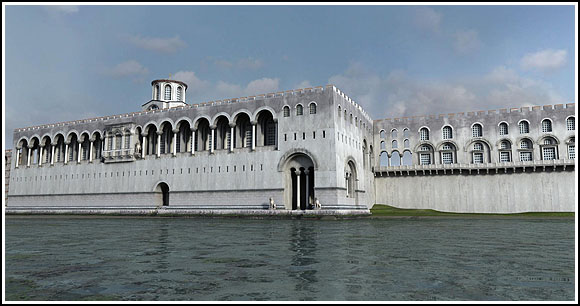
The palace of Anastasius is the summer residence of the Emperors of Blati and one of the most luxurious palaces on Yeia, rivalled only by their own Great Palace and the Palace of the Seris Emperors. Many , both locals and foreigners, have been captivated by the beauty of its mosaics, paintings, rooms, gardens and above all, its throne room, one of the wonders of engineering.
Other rooms, like the ones for the Imperial princes and princesses are decorated with famous works of art, for example one of these rooms is decorated with frescoes painted by the Oronai painter Thrasilus of Edimna in 651 AP.
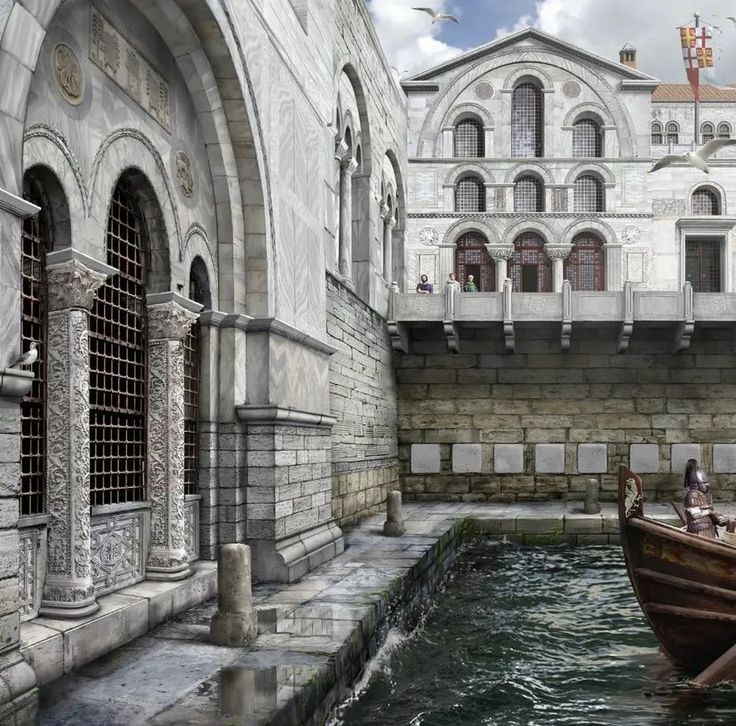 This gate provides access to either the imperial family's apartments or the throne room via a gallery connecting the two areas. Ambassadors and foreign princes arriving by sea to the capital, seeking an audience with the Emperor, often disembark here. It is also where the Emperor's pleasure boats and other vessels used by the imperial family to travel around the capital, to places like Lake Bareotis or to the provinces are moored. These ships are manned by detachments of sailors and marines from the Imperial Navy who had the privilege to transport and escort the legitimate Emperor of the Ikarians and its family, and for that they are very well paid!.
The origins of the palace
The site where the palace now stands was once the site of Sillius Salustinus, a famous senator of the 2nd century AP who built his summer villa taking advantage of the fact that the Emperor had declared Blati as his summer residence. The Sillii family owned that house, with its reforms and expansions, until the 4th century when the last member of the family, Sillia Aurora married Heraclius II and thus the villa became imperial property. The building was given to Heraclius and Sillia's youngest son, Anastasius. He demolished most of the complex, preserving just the dining room and some of the bedrooms, adding them more luxurious accommodations including gardens, statues and a library. In the 5th century it was owned by the first Emperor of Blati, Eutychius. He added even more luxurious rooms including the famous throne room designed by the famous architect Flavinus of Tomaris and the Imperial harbour where the Emperor's private ships and pleasure boats are located. Since then it has become the summer residence of the Blatian Emperors where they give audiences to nobles, Senators and foreign diplomats.Layout
The building, covered in marble with some decorations made of porphyry, has a rectangular floor plan with one side, the famous seafront with the Lions Gate and the large balcony, facing the sea. The private rooms of the Emperor and the Imperial family are located in the southern part of the palace, the one that faces the sea, while the throne room and the dining rooms are both located in the North-west. The oldest part of the complex. East of the dining rooms there is a magnificent garden, with statues, fountains and a magnificent colonnade who offers much needed shade during summer. Most of the statues of this garden are statues of previous emperors as well as mythical heroes of elves and human davidovian peoples. Water for these fountains, as well as for the rest of the palace comes from the nearby Servilian aqueduct, one of the 4 aqueducts that provide fresh water to the city of Blati. The north-eastern part of the palace complex is occupied by the barracks of the soldiers of the imperial guard, as well as a temple dedicated to the goddess Orbaia and to Fer, the goddess of fortune, where the Emperor makes sacrifices for the welfare of the country and his family. One of the reasons why this palace (and not other belonging to the Imperial family ) was chosen was not only its healthier climate (in comparison with the Imperial palace) but also its proximity to the Filomelium hunting grounds outside the walls of the capital.The Throne room
Perhaps the most famous feature of the palace. Though not as impressive as the Pompteianion at the Great Palace, the throne room at the Palace of Anastasius is still a powerful and majestic symbol of the Emperor's power and the achievements of the Empire. The most striking feature of this room is the throne itself, which can be raised or lowered thanks to a complex hydraulic system, and at the emperor's feet, there is a waterfall that flows into a nearby fountain. There is nothing like this in the known world, and it clearly symbolizes the emperor's power over the elements. The walls of this throne room are decorated with golden mosaics depicting mythological and floral motives while the corridors leading to this famous room are decorated with frescoes and mosaics showing members of the Imperial family accompanied by the Gods.
Dining room
This is the oldest part of the palace, as this area was already the dining room of the old villa, and it is also the largest one after the Throne Room. Its walls are decorated with 400 years old frescoes with architectural motives and it is accessed through a large bronze door. Here is where the emperor and his family held their banquets with other members of the court and members of the Senate. The furnishings consist of several sets of triclinia arranged in a U-shape around tables made of alabaster and other precious materials. Members of the imperial family dine together in the triclinia closest to the giant bronze door. Even at banquets, there is a kind of hierarchy in seating and reclining positions. The further you are from the door leading to the imperial beds and the tables of the imperial family, the less important you are. These banquets are also a way for the Rigas to ingratiate himself with the aristocracy, as well as to show the emperor's power through the shows offered during the banquets (dancers from exotic lands, mimes, musicians, orators) and through the copious and tasty food offered at them. The dining room is also connected by several doors to the palace gardens, where on hot days members of the reigning dynasty sit near the fountains and in the porticoes. One of the Emperors, Claudius V, a lover of gardening, planted several pear and cherry trees in the garden, the fruit of which was served to his family. Aside from his family and the affection shown to him by the people and the Senate, one of the things he was most proud of was the quality of the fruit from his garden.Bedrooms
The palace bedrooms are smaller than those in the Grand Palace, but their small size does not imply any less luxury. Many emperors and empresses have claimed, generation after generation, that the bedrooms in Anastasius's Palace are more welcoming than those in the main palace. The emperor and empress normally sleep in the same bedroom, although the empress also has her own apartments opposite the emperor's. It is there that she carries out her daily life, receiving visits from dignitaries, friends, or family. It is also not uncommon for the empress to work side by side with her husband on matters of government when the Privy Council meets. Most of the rooms face the sea, which is a welcome feature in summer when the sea breeze cools the rooms. The windows are covered with glass and wooden shutters, maintaining a comfortable temperature in the room during cooler nights. The imperial couple's rooms are decorated with golden mosaics on the walls depicting centaurs and the marriage between King Davidion and Iccida after the The Siege of Dorstulon, the city of the Ten Walls, while the floors are also made of mosaics depicting the court of the gods on their heavenly palace. Each morning, the palace servants prepare the bath for the monarchs and then dress them following an strict ritual before they have breakfast and do the morning religious rituals.
The Imperial Harbour
This area of the great palace is also very famous. Here stands the Lion Gate, a monumental gateway flanked by two golden lion statues, which, according to legend, were brought by Emperor Drusus the Elder in the 1st century from the Oronai city of Thyros, after he intervened in a civil war in that kingdom. These lions once adorned the entrance to the Forum of Peace, but were moved to their current location by Euthychius I in the 5th century. by Antoine Herbert
Other rooms and buildings
East of the dining room there is a small library with around 100 books covering multitude of topics such as history, politics, magic, geography, rhetoric, poetry and epic tales. Rooms for the Palace servants as well as the kitchens are located underground, as well as the cisterns where water is stored and heating system ovens from where the heat is distributed to the rest of the rooms.
Type
Palace
Parent Location
Ruling/Owning Rank
Owning Organization

Comments