

Michael Davis
⚠️ Content Warning
This article may contain mature themes, including homoerotic content, complex power dynamics, sexual encounters with vampires and anthropomorphic beings, as well as other adult material.
Reader discretion is advised.
Police Constable PC Michael Davis
TABLE OF CONTENTS is in the World Navigation
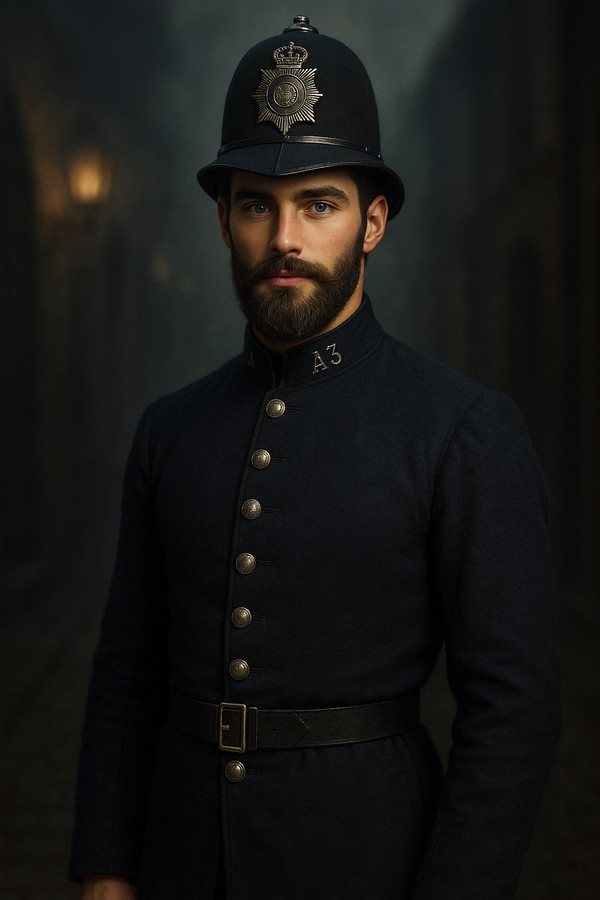
Two months into Whitechapel and already the boots know the cobbles. Dover-born, 28, tidy kit and kinder eyes than the district expects, Michael walks his beat the way some men say their prayers: steady, quiet, and with half an ear for the moment a street goes too still. He is methodical rather than showy—procedure first, judgement close behind—and he writes reports that read clean. Magic unsettles him, rules steady him: at Witch’s Hollow he holds the mouth of the lane and does not enter without an OFB Occult Constable, as briefed. For now he patrols alone, earning trust by turning up and keeping trouble small; a mixed pairing with the OFB is expected in due course. His measure of a good night is simple: neighbours asleep by midnight and a charge sheet that tells the truth in neat lines.
Physical Description
General Physical Condition
Fit and well-kept; the sort of strength built by miles rather than gymnasium tricks. He moves without fuss, but nothing about him is slack.
Body Features
Lean, workmanlike muscle; a butcher’s grip from his youth, a constable’s posture from the drill-yard. The seaside sun left a hint of colour that London rain hasn’t quite chased away.
Facial Features
Open, dark-blue eyes that put witnesses at ease; black hair parted cleanly and tamed with a comb. He has a full beard, which he keeps as well-groomed as his uniform.
Physical quirks
When the air turns odd, he squares his whistle chain and taps his notebook with the pencil .
Apparel & Accessories
Blue serge tunic with stand collar and bright buttons; duty belt, cuffs, notebook and two pencils (one always sharp). On nights he carries a bull’s-eye lantern that paints neat, obedient circles of light.
Mental characteristics
Personal history
Born 12 March 1865 above a butcher’s in Dover, Kent—a father of early mornings and clean steel, a mother with a steadier hand than most tailors. He was an average pupil, bright enough but too often pulled from lessons to haul sides of beef or mind the counter; the ledger taught him more arithmetic than the schoolroom, and the habit of neat columns never left him.
In his teens he learned there were other young men like him, though no one said it plain. He kept his counsel and his distance, but in time rumours gathered—the unspoken kind that meant “sodomite.” No charge, no complaint, only looks that lasted a fraction too long and a hush in doorways. He left to spare his parents the hearing of it, telling himself it was cowardice and mercy in one.
London gave him purpose. He sat the Metropolitan examinations—passed on his second attempt—and drilled through training, a short attachment on tidy West-End duties following. The posting that mattered was Commercial Street Police Station, H Division (Whitechapel): hard miles, harder nights, and work that needed doing. He is two months on the beat, presently patrolling alone and learning fast.
He writes clear reports, sends a sovereign home at Christmas, and keeps Dover out of his London stories. Magic unsettles him but rules steady him; each week he adds another small skill—how to read a market’s hush, how to take a statement without bruising a life—and builds the kind of reputation that closes mouths rather than feeds them.
Gender Identity
He identifies himselve as male and understands gender as a simple binary of men and women. Men who wear women’s clothing he considers “not quite right in the head” by his lights — a Victorian judgement formed more of habit than malice — yet he deems them harmless and often finds their company very pleasant. In public he keeps a courteous, steady manner so long as the peace is kept.
Sexuality
He is gay — not that he would ever name it so. From early on he knew something was “wrong” with him by the measure he was taught; the shock came when he found there were other young men like him. In certain establishments he can live whole, breathe easy, and be simple about what he wants. Beyond those doors he is meticulous: no hints, no risks, no talk — part of why he quit Dover, to outrun whispers before they reached his parents. The Met posting felt like a small mercy.
He once kept company with a man who fancied both sexes; the ease of that baffled and unsettled him. Women who love women puzzle him likewise. In truth he does not yet grasp how desire can run to one sex and not the other; he files it under “not my business” and minds his conduct with a constable’s caution.
Education
An average pupil at the Dover board school — bright enough, but too often pulled from lessons to haul sides of beef or mind the counter. The butcher’s books taught him more arithmetic than the classroom ever did, and the ledger hand stuck. He never quite had the chance to be a scholar, though the ability was there. The habit of neat columns never left him; his reports are a sergeant’s quiet joy. In the evenings he drilled himself in reading, writing, and figures; he passed the Met entrance on his second attempt and has been making up for lost lessons ever since.
Employment
Raised over a butcher’s, he learned early starts, steady hands and a clean ledger. London offered wages and purpose; he sat the Metropolitan examinations (passed on his second attempt), drilled through basic training, and spent a short attachment on orderly West-End duties before being posted where he was needed most: Commercial Street Police Station, H Division (Whitechapel).
Two months into his Whitechapel service, Michael is patrolling alone for now — no permanent partner assigned yet. He reports punctually, keeps a tidy charge-sheet and a tighter cordon, and has already earned a couple of quiet nods from market traders for treating rough nights without rough hands.
Shift Pattern & Supervision
Rotating Day (6–2), Late (2–10) and Night (10–6) reliefs. On Nights a station sergeant or an older constable will occasionally shadow his first hour; thereafter he checks in at the top of each hour unless engaged.
Beats & Territory
His circuit covers the Spitalfields approaches, Thrawl Street, Dorset Street/Miller’s Court, and the Hanbury Street spurs. It also includes Witch’s Hollow—a narrow, ward-prickled alley whose doors open more by consent than by law.
Standing policy: no entry into Witch’s Hollow without an OFB Occult Constable present.
When alone, Michael holds the mouth of the lane, keeps civilians moving, or calls, if necessary, for an OFB OC
Failures & Embarrassments
The worst of it wears no face. In Dover the whispers started without a source he could name: a look held a moment too long, a laugh in the wrong doorway, a taproom tale told third-hand and improved with each retelling. He cannot point to a man who began it, and most who might have borne him a grudge—men he rejected —had just as much to lose as he did. That made the rumours harder, not easier: nothing to confront, no apology to win, only silences.
Colleagues watched him with the sort of curiosity that spoils a meal; a constable who’d once shared night rounds stopped calling by; neighbours’ talk thinned when he turned the corner, then thickened again behind him. He could shoulder a fair word and even an unfair one; what he could not bear was the hush that said people had decided without asking him. He calls it his failure that he left rather than stood his ground, though in truth he left to spare his parents the noise. The train to London felt like retreat and rescue at once, and he carries the shame of both.
Intellectual Characteristics
Observational Habits: Michael watches the edges of things: doorways, hands, the way a market hush changes when trouble thinks of starting. On nights he measures quiet by the gaps between cart wheels and the click of a latch. He marks smells, too — tallow versus paraffin, wet hemp rope versus damp wool — and files them without fuss.
Memory & Method: Faces, routes and doorways stick. He keeps a mental map of his beat that updates with every shutter, lamp and shop-hour, and he can walk it in his head before his boots do. Notes are precise, quotes verbatim where possible; he timestamps instinctively and tallies small details in neat columns that make a sergeant smile.
Learning Style: Not a theorist; a patient imitator. He learns by doing, then repeating until the hands remember. With the OFB he is memorising red flags by rote — sigil forms, smells, temperature shifts, what to cordon and what to leave alone — and can recite procedures even when his nerves prickle.
Reasoning & Judgement: Prefers clear rules and steady steps; starts from procedure, checks against fairness, and only then moves. Good at patterning small facts into a commonsense picture; slow to leap, quick to ask the man who knows when the ground turns arcane.
Strengths in the Work: Patient interviewer (“let them talk; don’t hurry the silence”). Solid arithmetic from butcher’s books — weights, times, distances — useful for shop ledgers and witness timings alike. Keeps calm under noise and grows more precise as the street grows less so.
Limitations & Blind Spots: Not much of a bluffer; his honesty shows at the corners, which makes undercover talk difficult. Authority and tidy uniforms bias him for a heartbeat before he corrects. Magical theory leaves him cold; without a crib of procedure he can freeze for a breath at a fresh circle.
Reading & Study: Regular with Police Orders, the Police Code, and the Police Gazette; keeps a pocket list of shop names, landladies and night-porters with hours and tempers noted. In private he works at handwriting drills and simple ciphers so his reports stay legible even when written in a hurry.
Morality & Philosophy
First Principles: Rules are promises made public. They ought to shield the small and bind the strong. A good night is one where neighbours sleep by midnight and nobody’s pride needs tending in the morning.
Law and Mercy: The law is the law, and he enforces it without zeal. He favours warnings, cautions, and quiet dispersals over spectacle. Vice he reads as poverty and circumstance more often than sin; sermons shouted in the street do less good than steady wages and a warm room.
Force and Restraint: Voice first, presence second, truncheon last—and paperwork always. He will not humiliate a man to prove a point, nor strike one who is already held. Crowds make him wary of theatre; he keeps things small, chooses doorways over grand gestures, and minds the cordon.
Magic under Rules: Magic is not an exception. Cordons first, circles second; civilians before curiosities. He defers arcane matters to the OFB and expects procedure, warrants, and clear chain of command in return. Witch’s Hollow is respected as a place of quiet practice: no entry without an OFB OC, minimal intrusion, helmet off indoors, courtesy at every threshold.
Fairness in the Small Things: If two men quarrel, the bigger steps back first. Children lower his voice, not his standards. He keeps the same tone for a duke and a docker; nobody is beneath a “sir.”
Discretion and Privacy: Private life is private. He does not pry beyond what a case demands, does not repeat taproom gossip, and does not trade in names for sport. Notes are factual; when decency allows, he writes with initials rather than ruin.
Authority and Accountability: He respects the chain of command but keeps his own counsel straight. If a colleague oversteps, he gives a quiet word; if it repeats, he writes it up. Loyalty, to him, is to the badge and the people it promises to protect—not to anybody’s temper.
Class and Poverty: Hunger bends rules more than malice does. He will still act when he must, but he prefers remedies that mend a street rather than scar it.
Courage and Humility: He knows the difference between brave and foolish. When the ground turns arcane, he calls the man who knows the circle and holds the line until the city breathes easy again.
Personality Characteristics
Motivation
He wants a quiet beat and clean ledgers — neighbours asleep by midnight, charge sheets that read true, and the sense that his small square of London is better at dawn than it was at dusk. After Dover, he is set on building a life that will not shame his parents: steady pay, decent work, and a reputation that closes mouths rather than feeds them.
Professionally he means to master the craft — procedure first, judgement close behind — and learn enough of the occult rules to keep himself and others safe without becoming a spectacle’s extra. He would like, in time, to earn a sergeant’s stripes the old way: by turning up, writing straight, and bringing people home who ought to go home.
Privately his aim is breath: spaces where he can be whole, and the discipline to keep that life separate so the uniform stays useful. On patrol he tries to be the calm centre in mixed work with the OFB — the man who holds the line while circles are read — and in Witch’s Hollow specifically he wants the district to feel policed, not persecuted: law kept, doors respected, trouble met with proportion and courtesy.
Likes & Dislikes
Likes: Order that lets ordinary people sleep; neat kit put away properly; clear instructions and a charge sheet that reads clean. Hot tea on a wet kerb, the quiet of Night Relief, and the steady warmth of gaslight rather than glare. Ledger lines and sharp pencils (he keeps two), small courtesies at doorways, and market folk who remember his name. Honest work, letters from Dover, a well-kept pair of boots, and rooms where no one watches him think. He has a soft spot for music-hall ballads done without swagger and for the sea-salt smell that sometimes rides the wind up Commercial Street.
Dislikes: Swagger and cruelty, mortal or occult; rites performed like theatre; gossip and, worse, the hush that follows it. Sloppy paperwork, raised voices when a quiet word would do, and uncontrolled flame. Showmen-mediums who trade fear for pennies, landlords who bully, and crowds that want a spectacle. He is wary of electric glare indoors, prefers lamps trimmed low, and has no patience for uniforms used as licence.
Social
Family Ties
Parents still in Dover: a father of early starts and clean steel at the butcher’s block; a mother whose needle keeps half the street in shirts. Letters go every fortnight when the post behaves — his in a neat, economical hand, theirs cross-hatched to save paper. He writes of weather first and work in general, never of trouble; she replies with news of customers and who has taken ill, and tucks a prayer into the closing line without saying so.
He sends a sovereign at Christmas and whatever extra he can in lean months. Visits are rare and carefully timed to avoid talk; when he does go down, he arrives in plain clothes, helps on the counter for a day, eats too much, and leaves before the taproom remembers him. His father is proud in a quiet way — fewer words, more meat wrapped for the train. His mother reads more than he writes and worries between the lines; she never asks why he left, only tells him to keep a dry pair of socks and to “mind the men who don’t carry lanterns.”
They do not speak of marriage. She hints once, gently; he thanks her for the hand-stitched collar and lets the hint pass. Out of duty and love he keeps Dover clear of London: no names, no stories that could blow back. The only heirloom he keeps is a boning knife wrapped in oilcloth — not for use, but because it is the one piece of home that fits in a drawer.
Relationships
English (reading, writing, speaking)

Comments