
Avalon House
⚠️ Content Warning
This article may contain mature themes, including homoerotic content, complex power dynamics, sexual encounters with vampires and anthropomorphic beings, as well as other adult material.
Reader discretion is advised.
TABLE OF CONTENTS is in the World Navigation
Alterations
Avalon House has never been static. Within a generation of its completion the Duke commissioned a round-panelled council chamber on the piano nobile—an architectural set-piece that quietly alluded to Camelot without tipping into pastiche. In the 1730s, the principal apartments were refreshed to the new Georgian taste: bolection panelling was raised and painted in paler colours, damasks rehung, and several marble chimneypieces replaced earlier wood surrounds. Around the same time, the mews at the rear were rebuilt in brick with deeper stalls and a hay-loft to suit a growing household.
The later eighteenth century brought a scholarly library in walnut, inserted by sacrificing a secondary drawing room and binding two bays behind a run of bookcases. After the Napoleonic years, the house modernised: the service floor was rationalised, a new scullery range projected into the yard, and a discreet back stair was added for servants’ traffic. Gas lighting arrived in the 1820s, plumbing was overhauled in the 1840s, and a small lift for trunks was threaded through a former closet in the 1860s.
In the final decades of the century, the great stair received a conservator’s cleaning rather than replacement—its ironwork re-blacked and its oak treads re-waxed—while the saloon was rehung in a deeper crimson silk and fitted with electricity from a private dynamo housed in the mews. Throughout, the family’s heraldry and Round Table insignia were re-interpreted rather than multiplied: a new set of carved overdoors showing white stags and apple trees, a starry plafond in the Round Chamber, and etched-glass devices in the doors to the Presence Room. Subtler still are the protective measures that only the initiated notice—geomantic tracery chased into cornices and small apotropaic “knots” worked into the newel posts—restored whenever the house is redecorated.
Architecture
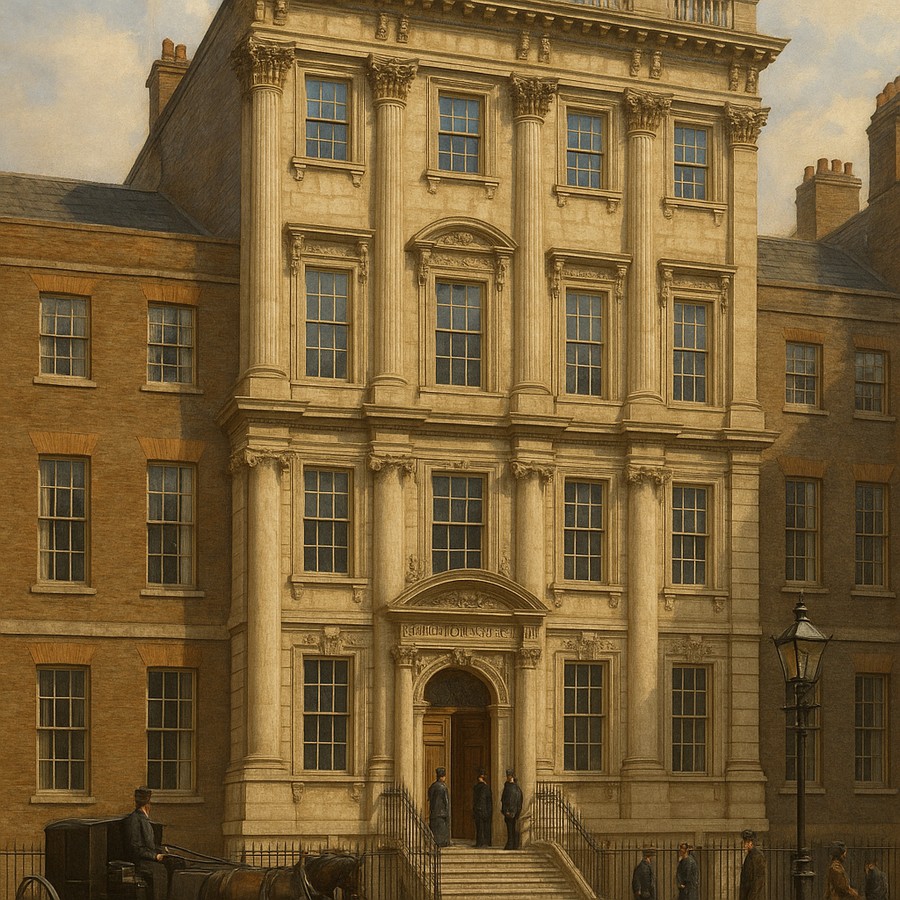
Designed by Sir Christopher Wren and raised at the end of the seventeenth century, Avalon House is an assured town palazzo in red brick with Portland-stone dressings. The front is formally composed—a nine-bay elevation with rusticated basement, bracketed cornice, and a restrained central pediment bearing the Lancelot arms. The entrance, a modest Doric porch, leads through a screened hall floored in chequered marble to the great stair that climbs in generous flights along the garden wall. Above, the piano nobile carries the ceremonial rooms, their tall sash windows set between stone aprons and keystones; a parapet conceals the hipped slate roof and dormers.
Inside, Wren’s measured baroque governs: oak and walnut for panelling and doors; plaster ceilings with disciplined relief, picked in leaf-gold at centres and ribs; chimneypieces in white and Siena marble; floors in oak laid herringbone or in black-and-white marble to the state rooms. The stair’s balustrade, wrought in the manner of Tijou, turns with a lively scroll and occasionally hides a heraldic flourish—a sword hilt here, a grail there. The Round Chamber, a later but sympathetic insertion, is a circular council room with a radial oak floor and a shallow dome faintly painted with constellations.
To the rear, a formal garden gives way to the mews: brick stables, a coach house, and—by the century’s end—a dynamo room tucked under the hay-loft. Adornment is never indiscriminate. The family’s symbols—white stag, apple tree, stars—are set into structure and craft: carved spandrels, cast-iron grilles, woven borders of tapestries. The effect is prestige held in check by proportion: Camelot transmuted into London stone.
History
Commissioned by the Lancelots, Dukes of Avalon and Stuards of Camelot, the house was set out in the spring of 1696 on a St James’s plot newly cleared and regularised after decades of West End growth. Wren’s office supplied the design; brickmakers from Middlesex and stonecutters from the Portland quarries supplied the fabric. By the autumn of 1697 the shell was roofed and glazed; the family took a cautious first residence late in 1698 while carvers, plasterers and painters completed the ceremonial suites. The full decorative programme—including the great stair’s ironwork and the first hangings of silk—concluded in 1699.
The eighteenth century saw refinement rather than upheaval. In the 1730s the public rooms were updated to the prevailing Georgian lightness; in the 1760s the library was formed; in the 1790s the mews were rebuilt to improve stabling and coach accommodation. The nineteenth century layered comfort onto ceremony: gas, then improved plumbing, then a service lift; in the 1860s a back-stairs realignment that eased the house’s daily rhythm without touching its formal enfilade. By the late 1880s, electricity illuminated the saloon, stair and library from a private generator, and the Round Chamber was given its present starry dome and new panelling—an homage to the house’s original spirit rather than a departure from it.
From foundation to finial, Avalon House has been tended as a living instrument of office: Wren’s disciplined frame preserved, its fittings renewed as each generation of Dukes balanced London fashion with the older weight of Camelot.

Comments