
Camelot
⚠️ Content Warning
This article may contain mature themes, including homoerotic content, complex power dynamics, sexual encounters with vampires and anthropomorphic beings, as well as other adult material.
Reader discretion is advised.
Purpose / Function
Camelot serves as the ceremonial and symbolic seat of the Crown, rather than a permanent royal residence. Originally constructed as a fortified stronghold, its role evolved over the centuries from a military and administrative centre into a place of ritual, continuity, and state symbolism.
By the late medieval period, Camelot had largely ceased to function as a defensive site, instead becoming the setting for formal audiences, investitures, oath-takings, and rites connected to the legitimacy of rule. While political governance gradually shifted to London, Camelot retained its importance as a space where authority is affirmed rather than exercised.
In the 19th century, Camelot functions primarily as a ceremonial complex, overseen by the Steward of Camelot. Its halls and chambers are maintained for state rituals, historical commemorations, and occasions where tradition, magic, and monarchy intersect. Though no longer central to daily governance, Camelot remains essential to the Empire’s sense of identity and continuity.
Architecture
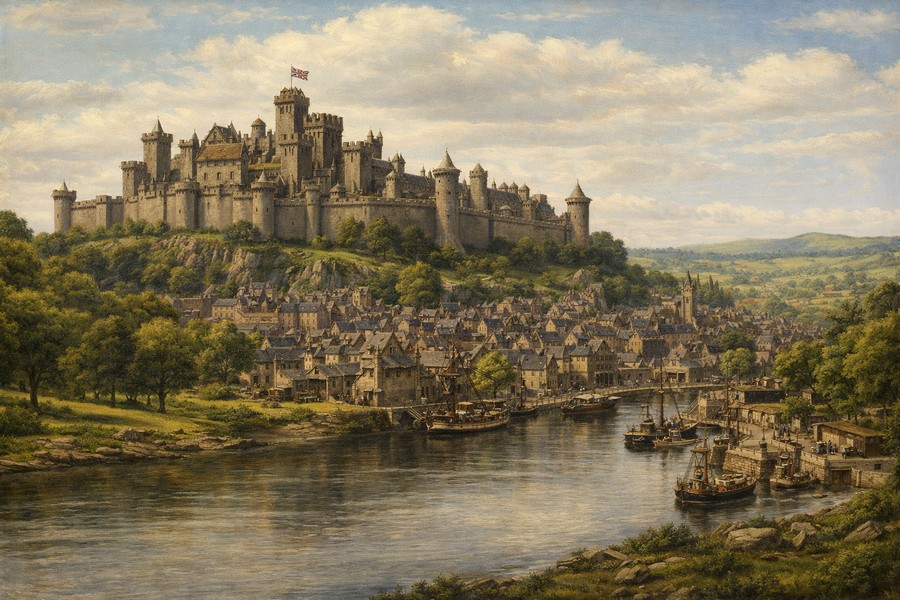
Camelot is a vast stone fortress complex crowning a natural elevation above the surrounding town and river valley. Its architecture reflects its layered history: originally conceived as a defensive stronghold, it has expanded over centuries into a monumental ceremonial site.
The castle follows a high medieval fortified style, characterised by thick curtain walls, multiple towers of varying height, crenellated battlements, and a dominant central keep. The layout prioritises visibility and presence rather than elegance, projecting authority across the landscape. From the river below, Camelot appears deliberately imposing—its mass and elevation reinforcing its symbolic dominance.
Construction materials consist primarily of locally quarried stone, giving the structure a muted grey-beige tone that harmonises with the surrounding hills. Subtle colour variation in the masonry suggests multiple building phases, with older sections displaying heavier, rougher stonework and later additions showing more refined cutting.
Ornamentation is restrained and purposeful. Decorative elements are largely confined to gatehouses, ceremonial towers, and inner courtyards, where carved reliefs, heraldic devices, and symbolic motifs appear. These embellishments are not ostentatious but deliberate, reinforcing Camelot’s role as a place of tradition and legitimacy rather than luxury.
In contrast to the town at its base—comprised of tightly packed stone houses, narrow streets, and river docks—Camelot does not follow the standard civic architecture of the settlement. Its scale, elevation, and enclosed design clearly separate it from everyday life. The town exists in its shadow, economically and symbolically connected, yet architecturally subordinate.
Camelot’s most distinctive feature is its visual coherence despite centuries of expansion. Rather than sprawling chaotically, the castle maintains a unified silhouette, suggesting careful stewardship and long-term planning—befitting a site whose purpose is continuity rather than adaptation.
History
The earliest structural foundations of Camelot are believed to date back to the late Roman period of Britain, likely between the late 4th and early 5th century. While later tradition attributes its founding to the age of Arthur, modern scholarship suggests Camelot predates the legendary narratives and was subsequently elevated into myth.
Camelot has been known by several names throughout its history, reflecting shifts in language, power, and perception. Early Brittonic sources refer to it as Caer Camelot, while later chronicles employ titles such as the High Hold or the Crown Hold. By the early modern period, the name Camelot had become the standard designation, shaped as much by literature and tradition as by historical continuity.
The Crown Hold

Comments