
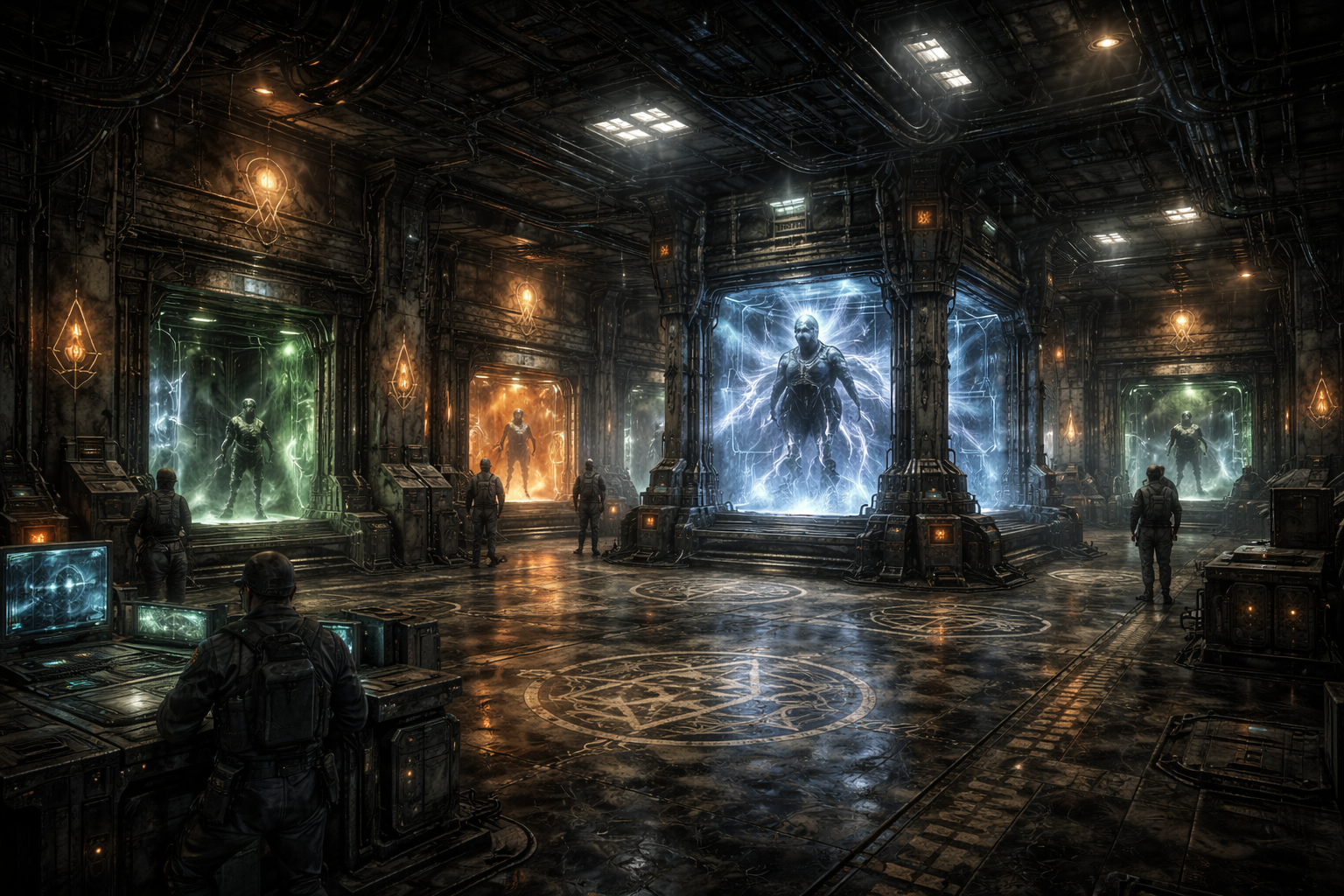
Shadow Containment Unit
Beneath the Shadow Investigations Headquarters, far below the reach of daylight and conventional authority, lies the Shadow Containment Unit, where reality is maintained through force, law, and ritual. Entities that defy the stability of the world are not destroyed or released, but instead confined, cataloged, and judged according to frameworks more ancient and enigmatic than those governing the city above. The air vibrates with containment fields and implicit warnings, and each corridor bears the certainty that some truths are too perilous to confront unprotected. This facility is not a conventional prison, but rather a scar beneath Seattle, sealed to preserve the illusion of order.
Nothing down there is evil because it chose to be. It’s dangerous because reality couldn’t agree on what it was supposed to be—and now it’s our job to make sure that disagreement never reaches the surface.
Containment Officer Fredrick White
Alterations
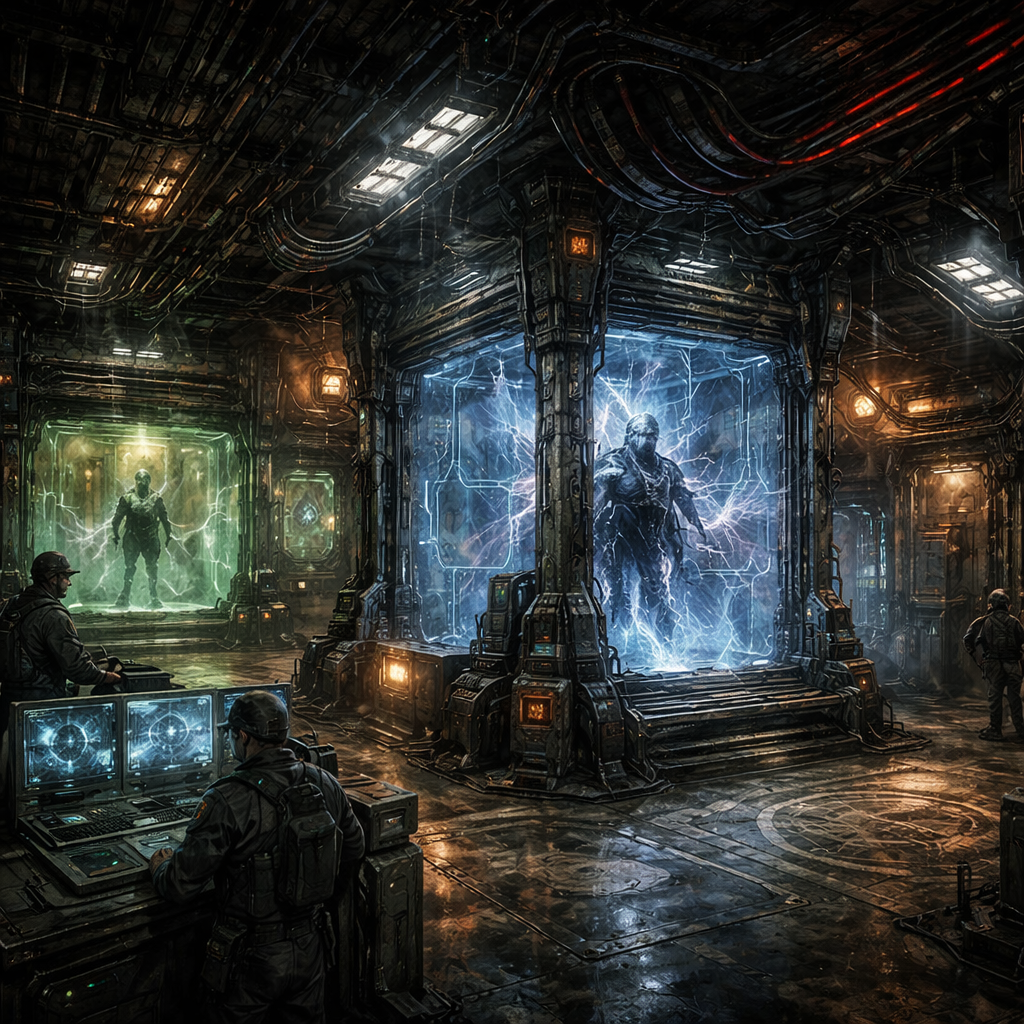
Over time, the SCU has undergone continuous modification, each layer reflecting hard-earned lessons:
- Structural Reinforcement: Floors and walls were thickened with layered mundane alloys, reinforced concrete, and thaumaturgically stabilized composites to withstand spatial distortion, impact events, and reality shear.
- Containment Retrofits: Former storage rooms were converted into modular containment cells, each configurable for physical, magical, psychological, or conceptual threats.
- Redundant Systems: Power, life support, and warding systems were duplicated and separated to prevent cascading failures during breaches.
Architecture
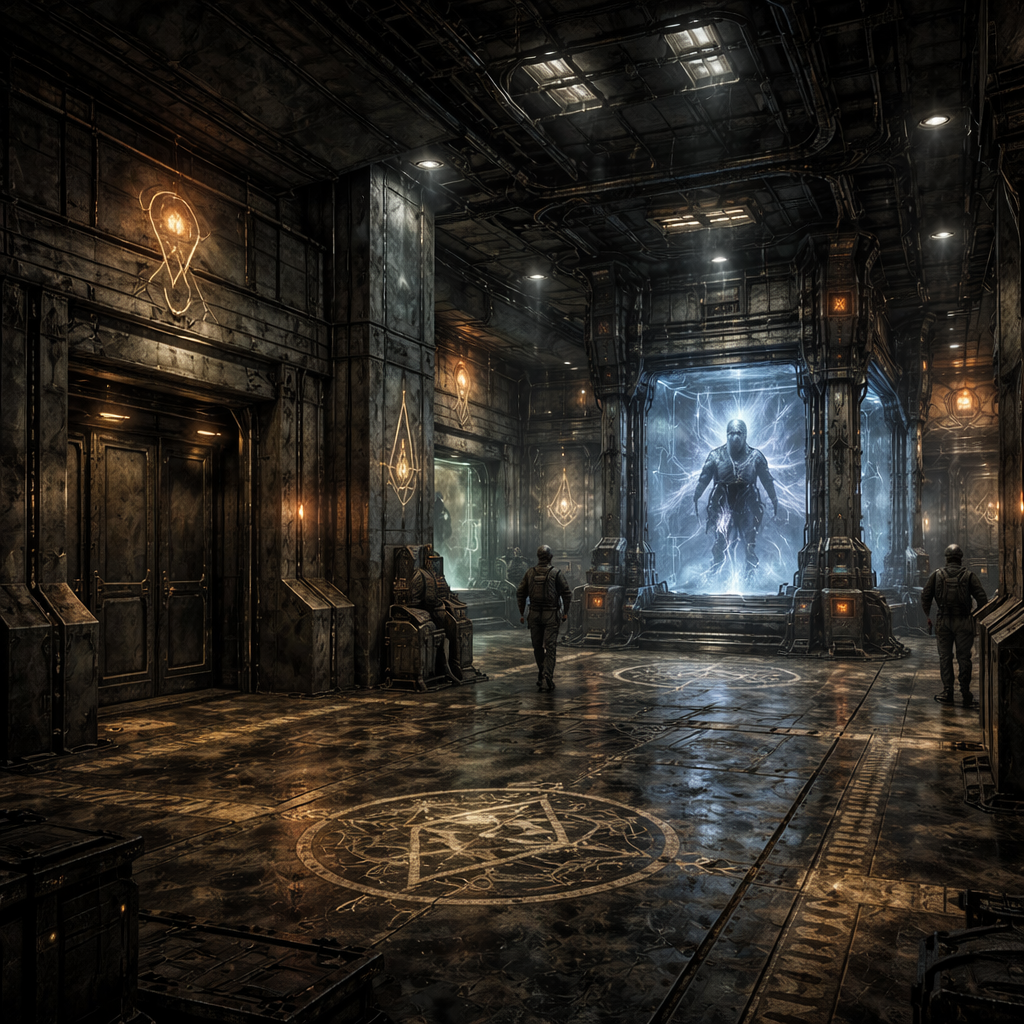
The SCU’s architecture is brutalist-industrial layered with occult minimalism. It favors function, intimidation, and clarity over ornamentation.
- Materials: Reinforced concrete, shadow-treated steel, basalt aggregate, and arcane-insulated glass composites.
- Walls: Thick, unadorned, often in matte black or gunmetal gray, with embedded ward lines faintly visible under low light.
- Design Language: Straight lines, heavy doors, recessed lighting, and modular geometry designed to prevent spatial ambiguity.
- Adornments: There is no decorative art—only warning glyphs, containment identifiers, and legal sigils burned or etched directly into surfaces.
History
The Shadow Containment Unit was formally established after early containment failures demonstrated that ad hoc holding cells were insufficient for Shadow phenomena. Several high-profile breaches (some erased from public record under the Veil Law) forced Shadow Investigations to centralize containment beneath Headquarters, where oversight, response time, and legal authority converged.
Since its creation, the SCU has expanded downward rather than outward, each new sublevel addressing newly discovered classes of threats. Certain sealed levels are no longer entered, their contents classified as permanently unresolved.



Comments