


Arin Spear
"The wall cracked. Something came through. We did not know what it was, but Velis kept striking until it stopped moving. We still do not know what it was. It does not matter."
It does not have the sudden violence of the chokuto, nor the hidden weight of the shillelagh. It is not built to impress or frighten. There is no ritual around it, no story sung in its honor. It is too short for parade use, too plain for vanity, and too honest for pretense. The short spear exists because something needed to be pierced at once, and someone had the sense to make a tool that could do it.


Mechanics & Inner Workings
"I was still falling when the spear caught the edge. If it hadn't, I'd be part of the valley now."
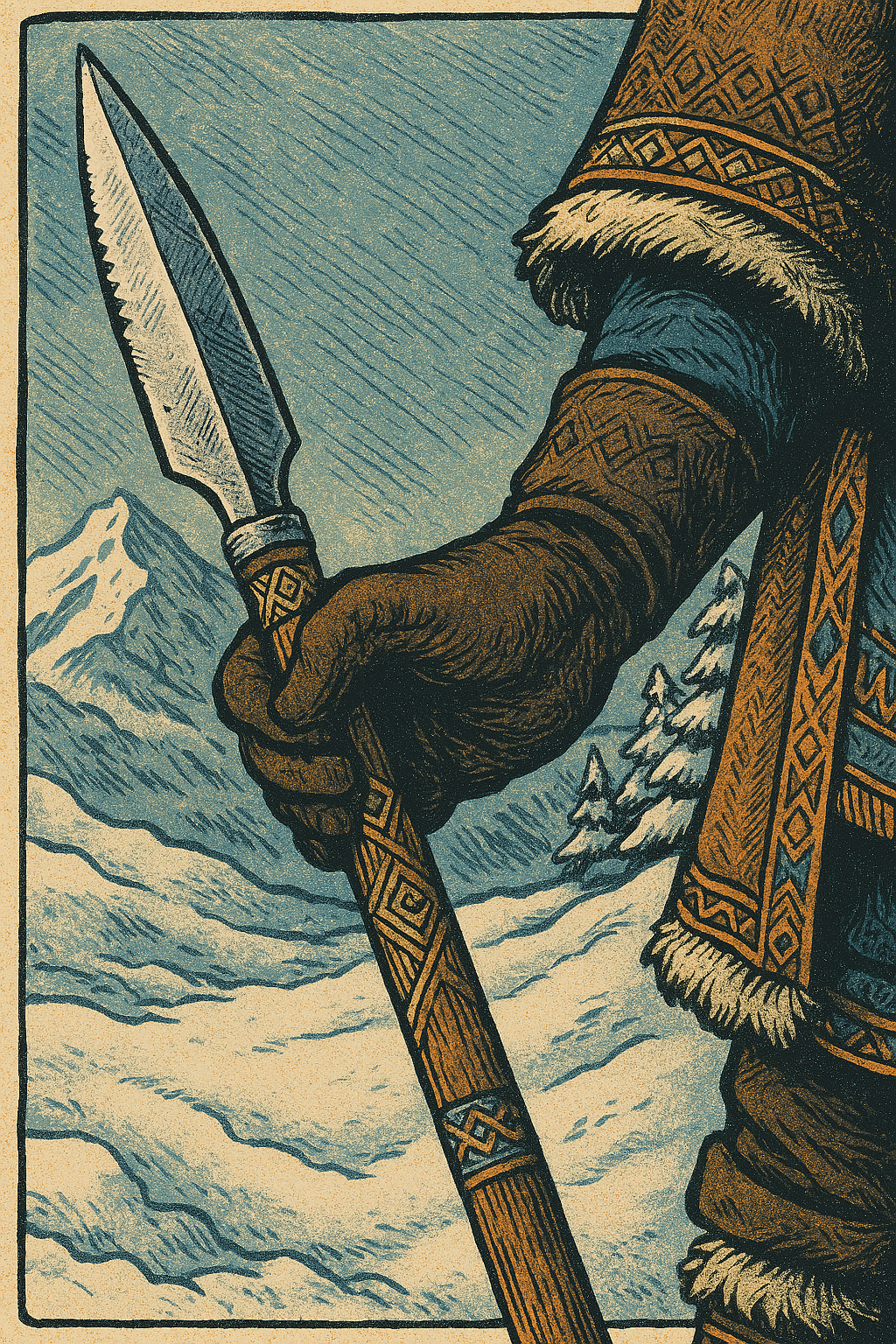
The Arin spear may appear simple, but its making is anything but crude. Beneath its plain surface lies a careful design refined through generations of need and experience. Every shape, every line, every fitting has purpose. Each has been tested in the field until it proved itself. In the Agriss Mountains, a spear is not only a weapon. It is a tool for living. It is a constant companion and a choice made from wood and steel. The blade is usually leaf shaped or wedge shaped, forged from cold hardened steel or an iron silver alloy, and set into a dense hardwood shaft. On one side of the blade, most often the right though not always, the edge is finely serrated. The cuts are shallow enough not to slow a thrust but sharp enough to saw through vines, rope, or sinew when there is no time to find another blade. Hunters use it for dressing game. Vault workers use it to cut free gear or clear tight spaces. Climbers use it to notch ice for anchors. The lower end of the shaft is capped with a spike of black iron or silvered steel ground flat to a chisel point. On mountain paths it steadies a traveler, biting into stone or ice for balance. In a fight, it becomes a second point, useful when the main blade is stuck or broken. Changeling smiths often build a hexagonal socket into the spike to serve as a tool for gear fittings or vault locks. The haft is sometimes hollow or lined with alloy depending on the maker and the region. Inside, craftsmen often build hidden spaces sealed by tight caps or twist locks. These hold small things for survival such as twine, waxcloth, a flint rod, or a scrap of map sealed in waxskin. More advanced work, often made for scouts or seasoned couriers, may include a compass ring just below the head that can be read by touch in darkness. Some spears carry reinforced lashings wound down the upper shaft that can be unwound for rope or tie straps. Others are carved with small marks at steady lengths, used by climbers to judge height or snow depth. Outsiders often mistake these for decorations. Rare custom spears can take a removable head fitted through a locking sleeve. This allows the blade to be replaced with a hook, a chisel, or a harpoon point. In the coldest cantons, a few smiths make heads with bronze ridges treated to hold heat for a short time, enough to melt ice or drive off animals that fear warmth. No feature is wasted. Every addition must serve a use or earn its weight. The Arin do not clutter tools with novelty. A spear that cannot be lifted and driven in one motion is a failure, no matter how fine it looks. Its skill lies in how little it shows. To outsiders, it is just a stick with a point. To those who know, it is a knife, a saw, a brace, a lantern rest, and the last thing left to rely on when the dark presses too close and the snow gives no path forward. No one who carries one thinks of it as a weapon. Until they must.
Manufacturing process
"People think you need a sword to kill a wyrm. You don’t. You just need to be beneath it when it lands and stab where the plates shift."
The crafting of an Arin short spear is not a ritual or display. It is a task done with discipline and care, not because the weapon is sacred but because failure is not acceptable. It must work every time, without exception. The work begins with the haft. The choice of wood is deliberate. It must be dense, resistant to weather, and strong enough to survive the snowmelt and freezing fog of the cantons. Firebirch and stonepine are most common, while vault shaped icewood is used in higher places or by changeling forgemasters. The shaft is cut to match the reach of its owner, usually between three and four feet. It is then smoothed, dried with heat, and sealed with a mix of linseed oil, beeswax, and powdered iron filings to tighten the grain and keep out moisture. If the spear is meant to carry hidden gear, the shaft is bored through the center and lined with alloy or layered hardwood. The space is sealed with a fitted cap or twist lock, sometimes disguised under a grip wrap. These are not decorations. They hold twine, cloth, tinder, or bone needles. They hold what someone might need when far from home and out of luck. The blade is forged separately. Its form depends on purpose. A leaf point gives balance for thrusting or throwing. A narrow wedge drives deeper into a target. Wider heads with slight serration are used by hunters or vault scouts to cut through sinew, rope, or overgrowth. The metal is cold hardened steel, though silver alloy is favored by wardens and House Guards who face the creatures that crawl from the vaults. The head is then socketed or riveted into the shaft and checked for alignment. It must stay true under pressure or it is not accepted. The lower spike is made in the same way or added after. It is shaped to a chisel or diamond point and sometimes hollowed for tool fittings. It is driven deep into the shaft and capped with a ring guard or steel collar to keep the wood from splitting when braced against stone or ice. The wrappings vary with the maker. Waxed fiber or leather cords are wound around the upper haft. These often hide markings or measuring lines. Changelings sometimes replace them with etched symbols that can be felt by hand in darkness, allowing silent reading of distance or direction. Testing is always the last step. There are no straw dummies or training stands. The spear is driven into frozen ground, pressed against rock, used to pierce bark, saw rope, and bear weight. Some fail. Those that pass are cleaned, sharpened, and passed on without ceremony. There are no prayers or speeches. Only the clear understanding that this tool may decide whether its owner returns from the ridge or disappears into it. It is not the weapon of a soldier. It is the promise of survival. And in Areeott, that is the highest kind of respect a tool can earn.

History
"They never teach you how to kill something when your hands are numb and the air is too thin to breathe. But a short spear does not need much, only the right angle and no second thoughts."
The history of the Arin spear is older than any single clan, older than the border trails, and older than the carved stories that line the inner faces of the vault doors. It did not begin as a weapon, and it has never tried to be anything other than necessary. It began as a stick with a sharpened end, and in the Agriss Mountains, that was enough. When the first settlers reached the cold highlands of the cantons, they did not need armor or banners or fine swords. They needed something to keep the wild from tearing at them. A pole to test the snow. A hook to pull someone free from a fall. A point to finish a wounded beast before its thrashing ruined the last good tarp. The spear followed them into the cold not as a weapon, but as a companion, simple, sturdy, and reliable when nothing else worked. The earliest examples, many still kept in museums or hearth collections, are little more than hardened shafts tipped with iron or bone, lashed with sinew. Yet even these rough forms show the signs of long use. The base is worn from bracing against stone. The tips have been reshaped and filed down through years of work, sometimes flattened entirely where they were used for digging or scraping ice. It was not a warrior’s tool. It was a worker’s hand. As metalwork advanced and weapons grew more complex, the short spear remained nearly unchanged. Its size and simplicity made it ideal for people who had to move through snowfields, switchbacks, and fractured ridges where two handed weapons were useless. Even when long spears disappeared from the battlefield, the short spear stayed in use. It was never the weapon of choice, but always the one that was there when everything else became a burden. Its role in survival grew from experience. In the high passes, it tested snow bridges. In the vaults, it cleared vents and probed unstable ground. The blade could cut lashings, shape wood, or pry stone seams. When crossing dragon scar valleys or the ice plains beyond them, no one left home without it. It was not something people decided to carry. It was something they never put down. Because it was always there, it became the natural answer in a fight. People already knew its reach. They already knew how to move with it. There was no stance to learn, no form to remember. It thrust forward, and that was enough. In time, the short spear found a place among border guards, scouts, and House auxiliaries. Not as a mark of rank, but as a tool that worked. Vault engineers paired them with climbing hooks. Monks practiced with them as extensions of their walking staves. Outsiders might call them crude, but they stopped calling them that when they saw who was left standing afterward. The spear was never glorified. Never given a name. It survived every shift in history not by changing, but by refusing to be replaced. It was never about killing. It was about living through what came next. And in Areeott, that has always been the greater skill.

Significance
"We found her curled in the rocks, spear broken, but blood on both ends. Three sets of tracks went in. Only one came out."
The Arin spear is not a mark of rank or ceremony. It is not a badge of honor or a family relic. It carries no blessings, no oaths, and no stories carved into its shaft. It does not hang on mantles or shine with gilded fittings. It is not meant to be admired. It is meant to be used. And in Areeott, it is everywhere. Its importance lies in how common it is and how naturally it fits into daily life. The spear is part of the landscape and part of the rhythm of survival. It stands behind doors, rests beside sleds, or lies within reach of a hunter’s bedroll. It does not need attention. It simply waits to serve. That quiet purpose is what gives it value. It is a tool that splits meat, clears brush, props open vault doors, tests the crust of snow, guards livestock, kills beasts, and saves lives. Every Arin grows up knowing how to hold one and when to trust it. No one praises it, but no one forgets it. When something lunges from the dark or breaks through the ice or rises from a hole that should have stayed closed, there is no thought. Only reaction. Reach. Brace. Strike. That is what the short spear was made for. The weapon reflects the people who use it. The Arin are not a people who posture or warn. They act. The spear fits that nature. It does not look deadly. It does not draw attention. That is its strength. It can be carried anywhere, seen by anyone, and forgotten until the moment it moves. And that is the moment it matters. Among House Guards and border scouts, the short spear is not something distributed. It is simply expected. Among ridgefolk and trailwalkers, it is passed from one to another without ceremony, like a practical lesson made solid. Changelings have made their own versions with hidden joints and compact shafts. Monks carry them in staff rigs that look harmless until they are not. The spear’s plainness gives it power. It does not need reverence to be respected. It reminds the Arin of a simple truth. The true danger is not what you see but what is ready. It does not warn. It waits. And when it moves, it moves once. The short spear is not sacred. It is essential. And in Areeott, that is what truly matters.

"I had a knife, but it was the spear I trusted. Longer reach. Cleaner strike. The kind of weapon you don't have to be brave to use. You just have to survive."
Item type
Weapon, Melee
Current Location
Related ethnicities
Owning Organization
Rarity
Uncommon
Weight
3 lbs
Dimensions
30 to 42 in
Base Price
5gp

"The dragon’s wing tore through the grain store. I don’t remember running. Just that the spear was already in my hand when the thing reared back. I aimed for the eye. I don’t know if I got it. I just know it didn’t come back."



Comments