

Arin Shortsword
"We are not meant to live beside danger, but within reach of a blade that remembers how to greet it."|Lira Trass, Shepard of the Vale
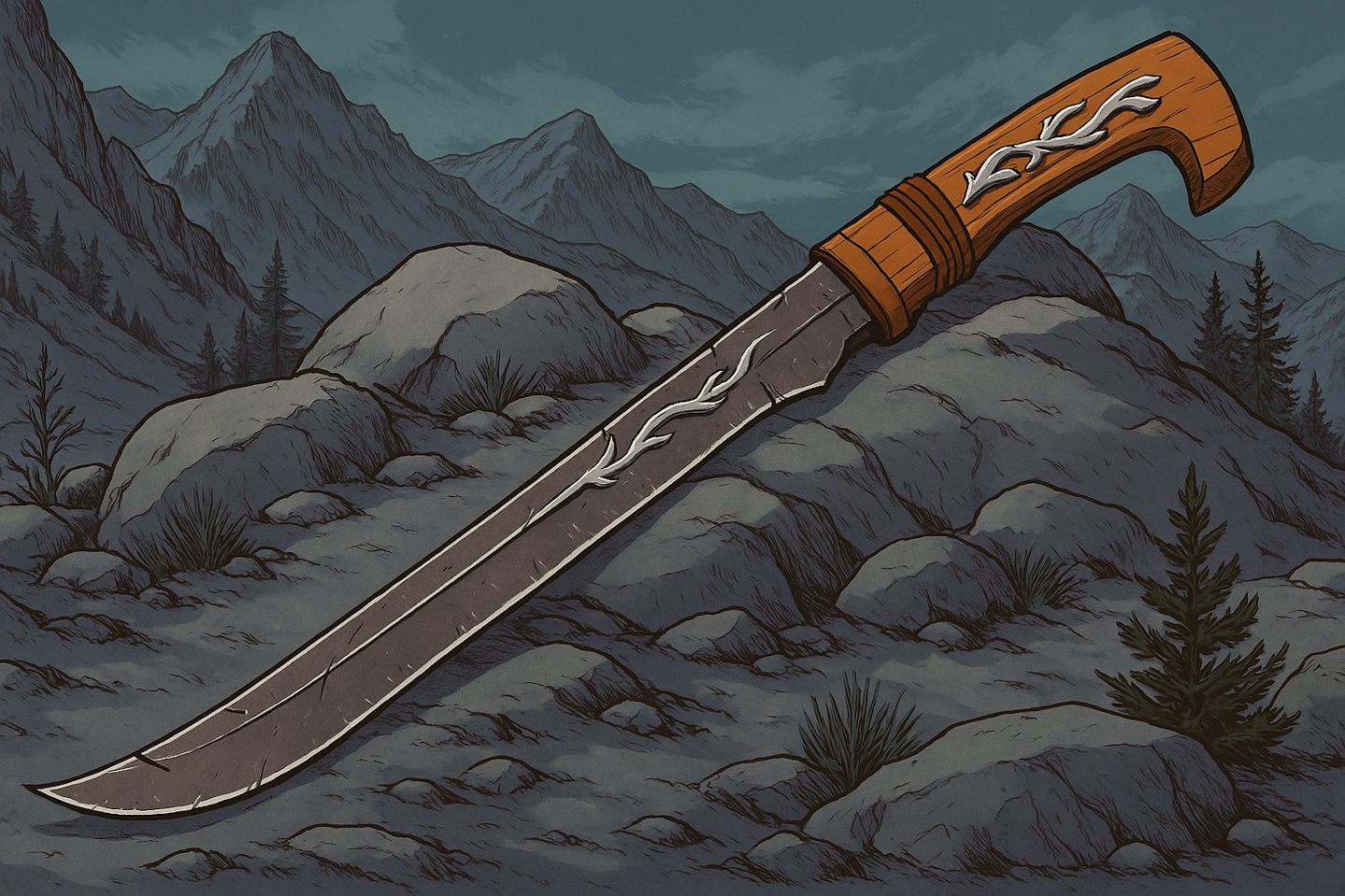
There is a kind of silence to it. Not the silence of stealth, but of normalcy. No ceremony surrounds the Arin short sword. No proud flash when it is worn, no special title when it is passed from hand to hand. And yet it is perhaps the most seen weapon in the whole of Areeott, not because it is shown off, but because it simply never leaves anyone’s side. It is not a soldier’s blade. It is not made for dueling, for ranks, or for battles with clear lines and simple motives. It is a worker’s sword, a companion, something built for use and wear, not for display. Short, heavy, and slightly curved, it is a blade meant to chop as well as slice, to hack through summer brambles and stubborn undergrowth, to split firewood or cut kindling on the side of a trail. Its profile sits somewhere between a short sword and a machete, wider than a chokuto, heavier in the hand, and far more forgiving when it meets green growth or bone. It has presence, but not pageantry. These swords are carried openly but not boastfully. Among the Arin, it would be absurd to mistake one for a threat on its own. You carry one for the same reason you carry flint, cord, or a water skin, because going into the wilderness without it is foolish. Even in the villages and upper cantons, they are kept behind doors, hung from pegs, stored in farm kits, or packed into sled compartments. Not everyone wears them every day, but everyone knows where theirs is. During spring and summer they are especially common. The newer growth that chokes the trails and creeps over mountain roads is too soft for an axe but too thick for a knife. A short sword makes clean work of it in one stroke. It remains useful all year. In winter, it cuts frozen tarp lines or pries open a frost locked hatch. In autumn, it carves hanging fruit or splits gourds. In summer, it fends off deer beasts or anything else foolish enough to wander too close to the sheepfold. Inside the hilt of most Arin short swords lies a second purpose. They are hollowed for survival essentials such as flint and steel, fish hooks, waxed thread, bone needles, folded oilcloth, or a few feet of cord. Whatever the owner thinks they might need when they are too far from home to go back. The cap is often twist locked, sealed in brass, with a waterproof lining and sometimes etched with trail signs or initials. The blade itself is forged from practical steel, not ornamental silver or layered alloys, though artisan versions exist, including some with changeling made fittings. Most are single edged, with a shallow curve and a thick spine that carries weight into the chop. A fuller may be ground into the flat to reduce weight without weakening the blade. It is made to be used, not admired, and resharpened many times through its life. The scabbard is usually wood or boiled leather, reinforced with brass or iron, and often carved or painted in the personal style of the owner. Some feature curling mountain motifs or stylized animals such as rams, bears, vultures, or wyverns. Others are marked with family symbols, harvest scenes, or private designs no one else would recognize. Some are completely plain, worn smooth by time. There is no tradition for this. It is a matter of personality. Some Arin decorate. Others simply need it to work. No one names these swords. They do not need names. If they have a story, it is worn into the edge and the grip, marked in the way they fit the hand. It is not a last line of defense or a grand answer to the dark. It is simply the thing that is there when you do not have time to reach for anything else. Sometimes it saves lives. Sometimes it just cuts lunch. Either way, it is always where it needs to be.
There is a kind of silence to it. Not the silence of stealth, but of normalcy. No ceremony surrounds the Arin short sword. No proud flash when it is worn, no special title when it is passed from hand to hand. And yet it is perhaps the most seen weapon in the whole of Areeott, not because it is shown off, but because it simply never leaves anyone’s side. It is not a soldier’s blade. It is not made for dueling, for ranks, or for battles with clear lines and simple motives. It is a worker’s sword, a companion, something built for use and wear, not for display. Short, heavy, and slightly curved, it is a blade meant to chop as well as slice, to hack through summer brambles and stubborn undergrowth, to split firewood or cut kindling on the side of a trail. Its profile sits somewhere between a short sword and a machete, wider than a chokuto, heavier in the hand, and far more forgiving when it meets green growth or bone. It has presence, but not pageantry. These swords are carried openly but not boastfully. Among the Arin, it would be absurd to mistake one for a threat on its own. You carry one for the same reason you carry flint, cord, or a water skin, because going into the wilderness without it is foolish. Even in the villages and upper cantons, they are kept behind doors, hung from pegs, stored in farm kits, or packed into sled compartments. Not everyone wears them every day, but everyone knows where theirs is. During spring and summer they are especially common. The newer growth that chokes the trails and creeps over mountain roads is too soft for an axe but too thick for a knife. A short sword makes clean work of it in one stroke. It remains useful all year. In winter, it cuts frozen tarp lines or pries open a frost locked hatch. In autumn, it carves hanging fruit or splits gourds. In summer, it fends off deer beasts or anything else foolish enough to wander too close to the sheepfold. Inside the hilt of most Arin short swords lies a second purpose. They are hollowed for survival essentials such as flint and steel, fish hooks, waxed thread, bone needles, folded oilcloth, or a few feet of cord. Whatever the owner thinks they might need when they are too far from home to go back. The cap is often twist locked, sealed in brass, with a waterproof lining and sometimes etched with trail signs or initials. The blade itself is forged from practical steel, not ornamental silver or layered alloys, though artisan versions exist, including some with changeling made fittings. Most are single edged, with a shallow curve and a thick spine that carries weight into the chop. A fuller may be ground into the flat to reduce weight without weakening the blade. It is made to be used, not admired, and resharpened many times through its life. The scabbard is usually wood or boiled leather, reinforced with brass or iron, and often carved or painted in the personal style of the owner. Some feature curling mountain motifs or stylized animals such as rams, bears, vultures, or wyverns. Others are marked with family symbols, harvest scenes, or private designs no one else would recognize. Some are completely plain, worn smooth by time. There is no tradition for this. It is a matter of personality. Some Arin decorate. Others simply need it to work. No one names these swords. They do not need names. If they have a story, it is worn into the edge and the grip, marked in the way they fit the hand. It is not a last line of defense or a grand answer to the dark. It is simply the thing that is there when you do not have time to reach for anything else. Sometimes it saves lives. Sometimes it just cuts lunch. Either way, it is always where it needs to be.

Mechanics & Inner Workings
"He cut down the snarl root, split it for tinder, cleaned the blade on his pant leg, then used the same sword to slice the last apple. Didn’t flinch once."
The Arin short sword is a survivalist’s tool that happens to take the shape of a blade, and every part of its construction serves that truth, beginning with the grip. Most have hollow handles, not for appearance, but for survival. The pommel cap screws tight with a firm seal of brass or steel, made to withstand cold, grit, and moisture. Some are plain and simple. Others are built with precision, their threads deep and clean, their rings pressure fitted or locked with collars that can be opened even when fingers are stiff from frost. Inside, there is just enough space for a few essentials. Not everything a person might want, but everything they might need when home is far behind and danger is close. Each person packs their own version of necessity. A flint and striker for fire. A coil of twine or sinew for lashing. A strip of oiled cloth to keep a spark alive. Some include a fish hook. A bone needle and waxed thread. A twist of line. A cube of hard tallow. A small piece of sweet root wrapped in cloth for warmth or comfort. Others hide personal tokens inside, a carved sign from a trail, a bead from a shrine, or a sliver of wood from a family hearth. None of it is meant for display. None of it is meant to impress. It exists for one reason, to keep someone alive when the world turns against them. The blade is thick in the spine, curved just enough to draw weight through a swing. It is not a duelist’s weapon. It is built to hack, to clear, to break what stands in the way. It cuts through bramble, sinew, and bone with the same blunt certainty. The back edge is often left dull for hammering or prying. Some blades are notched near the base for cutting rope or bark. Others are ground flat on one side to split branches or open frozen panels. Certain versions have shallow hollows in the center to make them better for skinning or cleaning. The work of changeling smiths goes further still, with hidden compass marks along the grip, folding striker blades built into the guard, magnetized thread wraps, or sealing caps that snap instead of twist. These are rare, and expensive, but always practical. They do their job. Nothing more is needed. Even the scabbard is built for purpose. Most are made of wood or hardened leather, their tips banded with metal and their sides cut with vents for air and grip. Some include a sharpening plate pressed into the mouth so the blade is honed a little with each draw and return. A few are built with small tinder pockets hidden under braided wraps for emergencies in the cold. No one notices these details unless they know to look, and that is the intent. The Arin short sword is never only a weapon. It is a walking stick, a fire starter, a tool for bone and bark, and the final answer when nothing else stands between life and death. Every part of it earns its place. Nothing on it is wasted. It does not ask for respect or remembrance. It simply endures. When the night is cold, when the blood will not stop, when the last flame has gone out, it will still be there. It will open what must open. It will cut what must be cut. And in that moment, it will keep something breathing. It carries no name. It does not need one. It exists for a hundred reasons, and each of them is enough.
Manufacturing process
"The Arin short sword. Heavy, curve weighted, gut sharp. Not for show. Not for sport. A working edge for a working world."
The process of crafting an Arin short sword is not an art of indulgence. It is not for ceremony or for tradition. It is a matter of necessity, carried out with the same deliberate hand that repairs a roof before the first snow or patches a boot before a long walk. Like nearly everything in Areeott, its construction is defined by need and by a refusal to accept failure as an outcome. It begins, almost always, with the blade. The smith chooses a high carbon steel or a local alloy known to hold an edge in wet and freezing conditions. The metal is heated and drawn out by hand, not folded for show but worked by heat, by muscle, by memory. The blade is thick along the spine, slightly curved along its length, and tapered to a utilitarian point that can puncture hide, split wood, or saw through overgrowth without bending. One side gets a full edge. The other may remain flat or dull, depending on the client, sometimes grooved for improvised prying or scraping. The balance is deliberately forward weighted. This is not a duelist’s weapon. It is a chopper. It needs to swing through things, wet thicket, frozen brush, tangled cord, bone, and bark. If the smith gets it right, the swing does most of the work. If they get it wrong, the user must add strength they may not have at a moment they cannot afford to hesitate. Once the blade is shaped and cooled, it is honed and tested. Arin smiths test blades the way a farmer tests a fencepost, with hard strikes and sudden turns and no illusions. If it chips too soon, it goes back into the forge. If it warps, the billet is thrown out. A weak blade does not get fixed. It gets replaced. The hilt is another matter. Built from hardened wood, horn, or reinforced brass tube depending on purpose, it is hollowed with care to conceal a small cache of tools and emergency gear. The inside must be watertight or close enough. The inner cavity is lined with wax or a thin metal sleeve. The pommel is made to screw in or to twist lock cleanly, with threading fine enough to resist snow grit and the wear of years. Changelings have refined this further in the vaults. Some include locking pressure compartments, shock resilient caps, even small inset alignment ridges to keep contents from rattling when the blade is drawn. These variants are expensive not for beauty but because they will not fail. The grip is wrapped last. Some are corded. Some are leather bound. Others are left bare and scorched to raise the grain. Every part is built to take a beating. Decorative touches, if they exist, are added after the fact: a carved band near the guard, a burn mark of a family crest, a hand painted trail sign on the sheath. These are personal, never required, and always earned. The sheath is often made alongside the blade, not as an afterthought but as part of the whole. It must be tight, weather sealed, and built to ride easily along the hip or across a pack. If the blade is sharpened on draw, the throat is lined with metal or stone. If it must carry extras, flint, cord, or tinder, the sheath is shaped to hold them without compromising weight or noise. No part of this process is ritualized. No part is sacred. But it is respected. Because when the snow hits too early, or a trail collapses, or something comes crawling up from a vault where no one thought anything still lived, it is not the masterwork blade that saves you. It is the short one. The quiet one. The one you did not leave behind.
History
"Every year the bramble thickens, and every year the blade returns to meet it. This is how we live, we cut back what encroaches."|From The Quiet Bloom, seasonal almanac poem
The Arin short sword has no founding legend, no battlefield of origin, and no lone smith whose vision reshaped the world. It simply happened the way snow happens, the way a ridge folds over time. It was the natural result of a people who needed something stronger than a knife and smaller than a sword. Its earliest known examples did not come from armories or vaults but from tool racks and sled kits. These were worn, wide blades with no guard and no ornament, only a reliable curve and a grip wrapped in whatever cord or hide was at hand. Some were forged by blacksmiths, others reshaped from broken weapons or old scythe blades. The line between tool and weapon was never distinct, and the Arin never saw a reason to make it so. For generations, these blades were called by whatever name suited the moment. Some said simply the blade, others called it that old thing or my short. Whatever it was called, it stayed close. Farmers used it to clear chokevine. Herders carried it to cut loose trapped animals. Vault scouts kept it ready when their spear was lost. In the border cantons, it became a regular part of any traveler’s kit, not from fear, but from understanding. Even in the earliest House Guard journals, the short sword appears again and again, listed not as an issued weapon but as a personal sidearm or field tool. Some guards carried one beside their chokuto, knowing that in the close, muddy terrain of the high passes, the lighter, broader blade might be the only one they could draw in time. Changelings in the vaults later refined the design. They hollowed the grips to store essentials, built in fire tools, collapsible fish rigs, and folding bone needles. These refinements spread quickly. Soon even surface dwellers began requesting grip storage and adjusted balance for trail carry or heavier impact. None of this changed the blade’s character. It was never glorified or enshrined. It was never used to mark rank or ceremony. It became something everyone had, something practical. Something you gave to your child when they were old enough to hike alone. Something you lent to a neighbor when theirs broke on a frozen root. Something that stayed behind the door until the day came to trim branches, open a stuck trap, or stop a fight that came too close. Its story is not one of wars. It is a story of endurance. The notches along its edge come from bark, bone, bread, and bandits alike. Its history is one of presence, not power. And in Areeott, that is what makes it one of the most enduring blades ever forged.
The Arin short sword has no founding legend, no battlefield of origin, and no lone smith whose vision reshaped the world. It simply happened the way snow happens, the way a ridge folds over time. It was the natural result of a people who needed something stronger than a knife and smaller than a sword. Its earliest known examples did not come from armories or vaults but from tool racks and sled kits. These were worn, wide blades with no guard and no ornament, only a reliable curve and a grip wrapped in whatever cord or hide was at hand. Some were forged by blacksmiths, others reshaped from broken weapons or old scythe blades. The line between tool and weapon was never distinct, and the Arin never saw a reason to make it so. For generations, these blades were called by whatever name suited the moment. Some said simply the blade, others called it that old thing or my short. Whatever it was called, it stayed close. Farmers used it to clear chokevine. Herders carried it to cut loose trapped animals. Vault scouts kept it ready when their spear was lost. In the border cantons, it became a regular part of any traveler’s kit, not from fear, but from understanding. Even in the earliest House Guard journals, the short sword appears again and again, listed not as an issued weapon but as a personal sidearm or field tool. Some guards carried one beside their chokuto, knowing that in the close, muddy terrain of the high passes, the lighter, broader blade might be the only one they could draw in time. Changelings in the vaults later refined the design. They hollowed the grips to store essentials, built in fire tools, collapsible fish rigs, and folding bone needles. These refinements spread quickly. Soon even surface dwellers began requesting grip storage and adjusted balance for trail carry or heavier impact. None of this changed the blade’s character. It was never glorified or enshrined. It was never used to mark rank or ceremony. It became something everyone had, something practical. Something you gave to your child when they were old enough to hike alone. Something you lent to a neighbor when theirs broke on a frozen root. Something that stayed behind the door until the day came to trim branches, open a stuck trap, or stop a fight that came too close. Its story is not one of wars. It is a story of endurance. The notches along its edge come from bark, bone, bread, and bandits alike. Its history is one of presence, not power. And in Areeott, that is what makes it one of the most enduring blades ever forged.

Significance
"Any man may carry one. Any woman may use one. The law does not consider it a weapon until it leaves its sheath with intent."
The Arin short sword carries a quiet and practical meaning that needs no declaration, because it has never required one. It is not sacred. It is not a badge. It is not sung about or glorified in story. Yet it is known, as a hand tool is known, as the scent of wood smoke is known in winter, as the sound of boots is known on frozen ground. It is part of daily life in Areeott, and that in itself is a form of respect. Among the Arin, it is one of the few weapons that civilians carry openly, not to show strength or provoke fear, but because it is an extension of readiness. A farmer may wear one while cutting back brush. A courier may strap one to a pack. A grandmother may keep one beside the back door, resting among the firewood, its grip visible. Its presence draws no notice. Its absence does. The short sword stands for preparedness rather than aggression. In a land where cold can kill faster than a wound, and where the ground itself can betray a careless step, it is part of how people survive. It is the thing you take with you when the day ahead is uncertain. It is not the weapon you reach for when danger comes. It is the one that is already in your hand when it does. Within families and workshops, it takes on a more personal weight. Some decorate the grips or scabbards, not out of ritual, but from familiarity. The sword becomes a companion, a tool that bears the mark of its owner. A herder might carve a goat mark. A courier might paint a trail sign. A gardener might add curling vines. These are not embellishments meant to impress. They are quiet claims of belonging, simple marks that say this one is mine. It is not a weapon of pride or rank. It is a weapon of trust. When someone lends theirs, or leaves one at another’s bedside while they heal, it is a gesture that carries meaning. It says they expect you to return. It says they believe you will need it, and that you will know how to use it when the time comes. In the end, the short sword’s meaning is found in its constancy. No one boasts about owning one. No one jokes about being without one. It does not belong to the theater of war. It belongs to the steady work of staying alive. And that makes it, to the Arin, one of the most honest and valuable tools a person can keep.


"It’s the sort of thing you don’t appreciate until it saves your fingers. Or your life."
Item type
Weapon, Melee
Current Location
Manufacturer
Rarity
Uncommon
Weight
2 lbs
Dimensions
28 to 32 inches
Base Price
10 gp

"Oh little blade beside the fire
You cleave the meal
you cleave the mire
No feast nor field without your steel
No path too dark, no cut can't heal."



Comments