Geography
Before you stand at the foot of the World tree that forms the Great tree city, it can be hard to comprehend just how enormous it is. It towers far above the tallest of the Wood’s other trees. Folks say this extraordinary was the very first thing to grow on the feywild from a seed gifted by the gods themselves.
Nobody is quite sure of the World tree’s origins, but what’s certain is that Domhrann is alive with powerful magic. Citizens of Color forest will tell you that many of the trees of their forest home are old and wise but that the world tree is a whole other story. It’s thought that the World tree might be as old as the feywild itself.
Those gifted with plant-speech have managed to converse with the world tree, and they are quick to let you know that the tree has its own will. Many a tree-shaper has a tale about having to put their work on hold because the world tree just wasn’t in the mood to change that day.
Description
The Great Tree City has something for everyone. From the upscale avenues in the Canopy, the cozy interior of the Trunk, to the winding tunnels of the Roots, each level has its own stories, attractions, and sights. You haven’t truly experienced the city of Domhrann until you’ve seen what each of its three levels has to offer.
As Domhrann is massive, it is often difficult for visitors to tell they are in a tree at all. Domhrann is divided into three main levels where people live, work, and go about their lives: the Canopy, the trunk, and the roots.
Travel within the world tree
Navigating Domhrann can be overwhelming at first. The Great Tree City, with its branching roads that reach not only across the city but also up and down, can feel like a maze. Don’t worry too much; although Domhranites often give an impression of bustling haste, they frequently stop to help bewildered travelers find their way.
Getting In and Out
Most visitors enter through the Trunk’s Entry Junction, where paths from the Feywild converge. There are no guards, no gates, and no customs agents — only watchful eyes hidden in bark and leaf.
Travelers are expected to know the rules, or bring someone who does. A guide is not required, but those without one often find themselves walking in circles, talking to trees, or forgetting why they came in the first place.
Leaving is just as simple. Step onto a branchroad and walk until the air shifts. Most will find themselves back where they belong — though not always where they started.
Getting Around
Domhrann is built for those who fly. Most residents have wings or magic to carry them from root to canopy with ease. Paths of branch and bloom twist between homes and halls, but they are rarely walked. To walk when you can fly is seen as shameful, a quiet mark of low status.
For the grounded, giant moths offer rides for a melody. Signs rarely show directions, but the trees whisper guidance to those who listen. Strangers may ask a dragonfly, a dandelion, or the wind itself. But they must be polite.
The Canopy
The Canopy crowns the World Tree like a blooming crown of wonder. It is the oldest and most beloved part of Domhrann, and the heart of faerie life.
Drifting through its tangled skyways, with soft winds humming through leaves and petals, one almost forgets there’s a ground at all. Vast boughs spread wide and safe beneath tiny feet, thick with blossom and moss. This is where the first faeris made their homes, and the forest remembers.
Here, time flows differently. Trees twist themselves into walkways and dwellings. Nectar drips from petal-roofs. Lanterns glow with bottled moonlight, and the air itself shimmers with laughter. Old-timers call it “the first dream,” and to many, the Canopy is still the true city.
Skywells catch falling rain and morning dew, channeling it into floating basins carved into petals and curled bark. When snow comes, the trees warm themselves from within, as if the World Tree refuses to let its children thirst. No one worries about coin or status here. Everything is shared, traded, or gifted with whimsy and pride.
Observatories
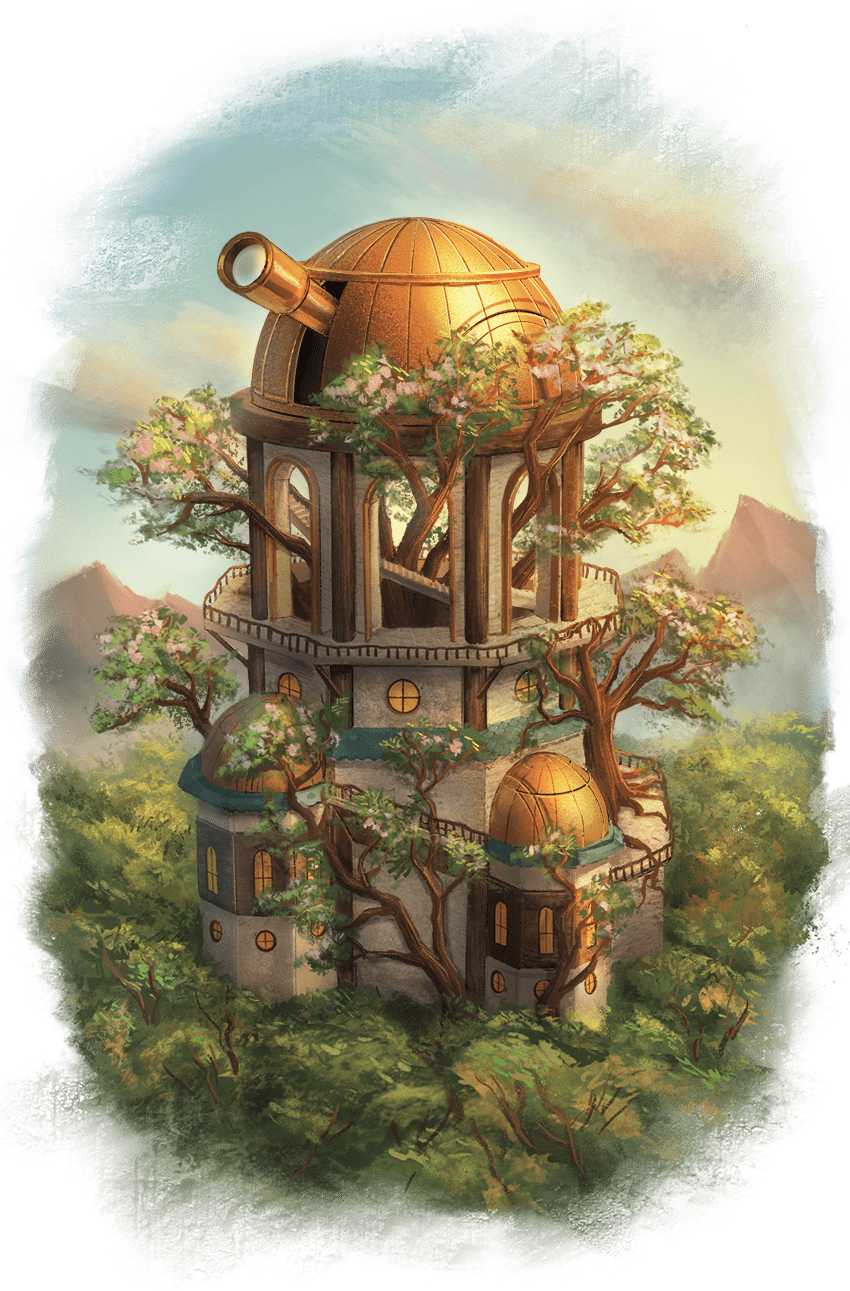
High above the rest of the Canopy, where the branches thin and starlight drips like honey through the leaves, three observatories perch in silence. No paths lead here—only flight will reach them.
Each is woven into the tree itself, grown from shaped wood and glowing sapglass. Long ago, the faerie dragons bent the branches into place, sealing the structures with magic that still hums beneath the bark. Even when the World Tree shifts and groans, the observatories stay rooted—an old pact between sky and limb.
The stars speak often here. One observatory watches clouds and moods in the sky, foretelling the turning of seasons or the arrival of wild weather. Another listens for celestial songs—comets, constellations, and distant omens. The third looks outward, toward the forest and the edge of dreams, where threats sometimes stir. Each observatory is tended by a watcher.
Messages are not sent with courier. Each observatory have spell scrolls of sending so they can quickly report dangers to their commanding officer.
The Boughs
The Boughs district stretches along the great branches around Mainstay, the main branchroad of the Canopy. It's a residential area formed from hollows in the bark, woven leaf-cocoons, and shaped wood. Each home is simple, beautiful, and built for flight.
Every pixie, sprite, or fairy born here blooms from the World Tree’s flowers — not raised by parents or tradition, but by the city itself. No family lines, no inherited homes. Residents shape their dwellings as they shape their lives, through growth, curiosity, and shared work.
Mainstay Manors
Mainstay curves through the Boughs like a spine, wide enough for group flights and clear glides. Many of the city’s largest homes rest along this stretch, though size carries no special meaning here. What matters is craft and care.
Dwellings take on many forms: a knot of branches holding a warm-glowing pod; a spiraled chamber made of twining leaves; a still pool of dew framed in petals. Some residents favor clean, minimal spaces; others decorate every inch with soft light and living color. There is no style more correct than another — only what fits.
haping in this residential area is minimal. In the rare instances where shaping is used, it’s mostly for support structures. While some residents claim that less shaping is “better for the World Tree,” others say this is nothing more than an excuse to build ever more extravagant homes and one-up their neighbors.
Boughs Gardens
The Boughs are home to three public gardens, kept open and tended by those who live nearby. They serve as gathering places, quiet spots for reflection, and homes for rare plants that grow only in high air.
Panfloria is the largest, filled with plants from across the Feywild. It grows freely and changes often. No one plants here — seeds arrive by wind or bird, and stay if they’re welcome.
Domhrawood Garden grows only what the World Tree offers. Old roots and low canopies form quiet shelters, good for those seeking stillness.
Gracelia is shaped. Its winding hedges and trimmed moss paths form a gentle maze, often used for small celebrations or quiet walks. Leaf-bridges connect viewing platforms and clearings in the air.
All three gardens are open to any who enter with care. Nothing is locked here. Those who try to claim space quickly find it slips away — flowers close, paths turn, or leaves simply fall.
Canopy Market
At the heart of Domhrann lies the Canopy Market, an open circle of smooth bark and soft moss, shaped where several major branchways meet. This is not a market in the material sense—no coin changes hands, and no prices are fixed. Here, trade is guided by want, wonder, and mutual need.
Offerings range from the practical to the peculiar: a thimble of healing nectar, a breeze bound in silk, a story told only once, or a tune that stirs memory. Those who bring useful tools or crafted wares leave them in woven hollows or floating platforms, trusting that something of equal value will be left in turn. Magic and craft are traded as often as goods.
Along the edges of the market, performers gather. Dancers skim the air, lightweavers bend color, and songsmiths offer verses in return for secrets, riddles, or company. Most deals here are sealed not with signatures, but with a nod, a wingbeat, or a promise.
The
Feather's Friend Inn can be found next to the canopy market.
The Council Plaza: Heart of the City
High above the Canopy Market, the Council Plaza spreads across a wide braid of branches, strong enough to bear the weight of the Spring Court’s ruler herself. When Tasmiira, the moonstone dragon, descends, the branches lean and widen, creating space for her body and wings. Her presence silences birdsong and brightens every petal.
Most days, however, Tasmiira does not appear. She rules by will, not habit, and leaves the daily tending of Domhrann to her chosen voice: Fania, a sharp-minded fairy whose small frame carries the full weight of the city's decisions when needed. Fania listens more than she speaks, and when she speaks, things change.
The Council Plaza itself is formed from interlocking limbs, shaped into a soft ring where fae gather to share concerns, settle disputes, or announce wonders. There are no thrones, no formal offices. Those who are heard often become speakers. Those who speak poorly are soon ignored.
Behind the ring rises the Council Hall, shaped like a split seed. Inside, the air is still and silver-lit. When Fania calls a gathering, the walls pulse with slow light, and the chamber hushes without command. All may enter, though the tree seals its doors during matters not meant for all.
To the side lies the Guardring, a crescent of open roosts and quiet chambers where Domhrann’s wardens dwell. They carry no badges, swear no oaths. Each holds a sending stone, which sings their thoughts to others in times of trouble.
Near the far edge of the plaza rests the Hall of Balance. Its doors are never shut. This is where fey come when they are in conflict. The hall grows new rooms when needed, and gently closes them when the matter is done.
Crafting Circles
South of the Canopy Market, nestled along the lower boughs, lies a cluster of open glades and shaped hollows known as the Crafting Circles. This is where the fey of Domhrann gather to share work, shape beauty, and pass on skills.
There are no guilds here — no ledgers, dues, or masters. Instead, each craft keeps a space: a branch or hollow tuned to its work. Those drawn to shaping, brewing, stitching, or growing find their way naturally. Knowledge is passed in the open — by demonstration, through memory, or in song.
In one hollow, sprites might bind new wings to broken toys. In another, fairies weave air-silk into cloaks that ripple with moonlight. Faerie dragons carve spirals into wood, humming low tunes to steady their claws.
Some circles are seasonal, vanishing when their purpose ends. Others have persisted since the first bloom of Domhrann. All are open. If you wish to learn, arrive with patience. If you wish to teach, offer what you know. No one keeps count.
The Branches
Beyond the wide roads of the Canopy, where the World Tree narrows and bends with the wind, lies a loose scatter of homes and glades known as the Branches. These are not districts in any formal sense — just quiet places at the edge of the city, where the bark thins and the sky feels close.
Many fey find peace out here. The light is softer, and the air carries fewer voices. Homes cling to twigs and smaller boughs, shaped with care and kept light — a single petal roof, a nest of vines, a small hollow cupped in bark.
Flight is essential here. There are no paths, only airways and touchpoints: mushroom steps, leaf landings, and the occasional loop of web or vine. Faerie dragons often roost along the sunlit sides, while pixies and sprites favor the inner shade.
Eldrow Spiral
The Eldrow Spiral traces the curve of the World Tree, circling the Canopy like a wind-carved ribbon. From here, smaller branches stretch outward, each hosting a handful of glades or single dwellings. It serves as both path and meeting place for those who live along the edge.
While no maps mark the Branches, most locals can guide you by scent, sound, or leaf pattern alone. Visitors are welcome — though those who come with loud voices or heavy footsteps may find the trees less willing to support them.
The Fall
At the furthest edge of the Branches lies a place called The Fall. It hangs on the thinnest limbs, where the wind never rests and the ground is a distant idea. The fey who live here value solitude, risk, and height. Their homes are often exposed, held by thread and shaped with stillness.
If you are uneasy with heights, this is not a place to linger. The branches do not catch those who fall.
Even so, The Fall holds a kind of pride. It is said that dreams fall here before they reach the rest of the tree — and that the songs sung in the Fall are always heard by the stars first.
The Trunk
The Trunk forms the heartwood of Domhrann — a wide, living corridor that spirals through the World Tree’s massive core. Here, the branches draw close and the light softens. Moss lines the bark, and the air carries the slow, warm rhythm of the tree’s breath.
Unlike the Canopy, the Trunk is accessible to all. Platforms and ledges curl from the inner walls, shaped into steady walkways and rest-glades. Small openings connect the Trunk to the outer bark, allowing sunlight to filter in at intervals. While most fae fly, this level welcomes those who do not — visiting fey and travelers from other courts.
It is here that Domhrann tends its deepest tree shaping magic.
The Trunk does not rely on skywells as the Canopy does. Instead, waterways shaped into the Trunk use the World Tree’s natural channels to draw water up from the ground and funnel wastewater back into the earth. Clean water from this system can be accessed from wells using hand pumps located throughout the Trunk.
Entry Junction
Carved into the side of the World Tree’s vast trunk, the Entry Junction is where most ground-bound travelers arrive in Domhrann. It is one of the few places in the city where paths from the outside meet solid footing. A wide hollow, naturally formed and gently shaped over time, serves as the landing threshold between the rest of the Feywild and the heart of the Spring Court.
Inside, the bark gives way to smooth wooden passages lit by pale lichen and drifting light-motes. Newcomers are guided toward the Trunk Market or offer rest in nearby hollows. Brightbeetles float around the top of the hall, feeding on a fungus grown on the ceiling to attract them. They provide light during the evening, like a sky full of living stars.
Trunk Market
Where the Canopy Market moves with color and wind, the Trunk Market grows quiet and slow. Sheltered within wide knots and hollows of the World Tree’s core, this market serves those who do not fly, who live below, or who pass through from distant lands.
Here, products rest in carved bowls, moss-lined shelves, or grown-in-place alcoves. Nothing has a price. There is no coin. Instead, trade flows through understanding — needs spoken, gifts offered, memories shared.
Many items here are strange to outsiders. Seeds that sing in moonlight. Threads that never tangle. Bottled laughter. Bark etched with sleeping spells. Dream-draught gathered from Pow Blossoms petals. Occasionally, one finds something from the Material Plane.
The
Wooden Flagon can be found next to the trunk market.
The Warrens
Woven deep into the inner bark of the World Tree, the Warrens form a labyrinth of winding tunnels, alcoves, and secret hollows. These are the quiet homes of Domhrann’s folks — hidden not by walls, but by scale and stillness.
No doors mark the entries. Instead, soft passages open into rounded chambers shaped by the tree and lined with glowing moss, folded leaves, or petalcloth. Pixies, sprites, and fairies who seek calm or solitude often dwell here, away from the brighter paths of the Canopy or the open glades of the Roots.
Each warren is different. Some are full of stacked books made of bark-slips. Others echo with music played into hollow fruit shells. A few remain empty for years, until someone dreams of needing it.
Visitors are not forbidden, but they rarely linger. Outsiders get lost quickly, not through magic, but through design. The Warrens are not meant to be mapped. They grow and shift with time, gently and without warning. Some say the tree forgets paths when they are no longer needed.
Bright Hollows
Where the heartwood bends with light, you’ll find the Bright Hollows — a ring of open chambers carved naturally into the inner trunk, glowing with soft golden and cyan light. This is where the Pow Blossoms grow.
Each blossom blooms only after a death. When a fairy, sprite, or pixie returns to the tree, a Pow Blossom unfurls from the bark — petals warm with memory, fragrance heavy with dreams. Its fruit, golden or cyan, holds the form of a new fey. They emerge fully grown, born of dream and root, with no parents, no past, and no name but the one they choose.
The Bright Hollows are tended with care, but not ceremony. No midwives, no overseers. When a Pow Blossom opens, others gather nearby, not to claim the new fey, but to welcome them — gently, and only if wanted.
Petals from spent blossoms are steeped into sleep draughts. Consumed with care, they allow shared dreams, or travel through them. Such magic is not common, nor dangerous — but delicate. Misuse fades the memory. To eat a Pow Blossom petal is to step briefly into shared dreams. When taken in ritual, the blossom allows dream-travel — a crossing into the minds of others, or into distant realms bound by thought. The Faeris have a strong aversion to this practice and will fiercely resist it, even resorting to battle if necessary.
The hollows are quiet, but never still. Light shifts, petals fall, and the scent of dreams lingers in the air. Many come here to sleep, to remember, or to say goodbye.
Maker’s Way
Tucked behind spiraling roots and bark-folded paths, Maker’s Way is the craftwork quarter of Domhrann. Workshops bloom like fruit off the inner trunk. Some are woven from silk, others grown from bark, fungus, or hornet-paper.
The fae build what they need and unmake what they don’t. Tools drift in and out of use, shaped by purpose rather than permanence. Music boxes that hum only at dusk. Doors that only open for laughter. Cloaks spun from night air. Maker’s Way is not a place of trade. Most crafts are gifts, made with someone in mind — or made because the tree wanted them made. Sometimes the fruit of a Pow Blossom carries a memory that leads a new fey straight here, as if they were always meant to make.
Visitors are welcome, but expected to observe. There’s no rush, no noise, and no wasted motion. Only the slow rhythm of creation, guided by whim, need, and wonder.
The Roots
Where the boughs of Domhrann dazzle with whimsy and light, the Roots lie vast and hushed in the deep. Here, the World Tree plunges into the endless soil of the Feywild, its tendrils thicker than towers and braided with glimmering moss and pale mushrooms the size of houses. The Roots are cavernous—not burrowed or carved, but grown—spaces shaped by time, fungi, and the weight of ancient lives.
Everything is bigger here. Doors stretch wide enough for moonstone dragons. Archways bloom like petals across canyons of bark. Even the smallest rooms might dwarf a cathedral above. It is a place built for old things and heavy silence.
Though overlooked by the Spring Court’s glittering eyes, the Roots sustain the city. Rainwater caught by the canopy trickles down and pools here in sapphire-blue springs. Gardens spiral across the root-veins, fed by bioluminescent composts and ancient irrigation spells. From here, food, water, and fungi rise to nourish the fair folk above—who often forget what lies beneath their wings.
The Underfall
The Underfall is the heart of the Roots—if anything here can be said to have a heart. It lies where the great root-arteries converge, just beneath the trunk’s deepest arteries, and where the runoff from the canopy’s rains pours down in glittering veils. Channels carved by water and shaped by old wood shaping-magic gather here into sunless pools, waterfalls that hum with sleeping spells, and mist-wreathed grottos where glowmoss breathes.
Its ceilings soar high enough to accommodate Tasmiira herself, though she rarely descends this far. Vast archways yawn into echoing halls, and high above, suspended walkways wind through the limbs like spider silk spun from bark.
Carts wheel in from deeper districts bearing fungal bread, dew-touched fruit, smoked beetle, or luminous cheeses. Travelers trade memory-crumbs and storm-lanterns for food and shelter. It is here that the pulse of the Roots is strongest. Not with wealth, but with memory and motion, with stories passed hand to hand, cup to cup, face to face.
Bee's Burrow can be found in the underfall.
Pestlehaven
Pestlehaven is the garden and the grindstone of the Roots.
It sprawls through soft hollows and terraced grottoes, where massive mushrooms rise like towers and root-grown paddies shimmer with filtered light. Farmers here tend to crops that feed the entire World Tree: syrupbulbs, dewleaf, cloudberries, whispergrain, and nightwort. Some fields are tilled by hand, others by enchanted tillers made from bug shells and vine cord. Every harvest is shared among the courts.
The name comes from the mortar-like pits where food and medicine are ground, dried, and sung into shape. Singing is as much part of the labor as tool or hand. Songs knead dough, ripen fruit, distill potions, and soothe the groaning of overworked bark. Old farmers hum to the soil as they walk.
Here, agriculture is not separate from magic. A pact between grower and plant. Some crops trade stories or lullabies instead of water. Others bloom only when fed lies or dreams. Fey children often apprentice here to learn how to bargain with the stubborn crops.
Though Pestlehaven is humble, the Spring Court watches it closely. A failed harvest echoes all the way to the throne.
Rootbraid
Rootbraid is where the World Tree knots and tangles on itself, forming vast, vaulted chambers and winding paths large enough for giants. It is here that the moonstone dragons lair.
Ancient dragons make their dens inside root-caves the size of keeps, their hoards half-forgotten under moss and fungus. The air shimmers faintly from dreamlight and breath. When they sleep, time slows. When they stir, the whole Root shifts. Even the fey tread lightly here.
Among the braids grow starcap fungus, feeding off dragon slumber. Some fey harvest these in secret, though such acts are dangerous. To touch a dragon’s rootbound garden is to risk their ire—or a bargain.
The dragons of Rootbraid are not rulers, but ancients apart. The Spring Court honors them, and occasionally consults them. Visitors must sing their names aloud before entering a lair. A whispered name is a slight; silence, a challenge.
Rootbraid is less a neighborhood than a sacred wild, where power coils in sleep and memory.
Cutter’s Coil
Cutter’s Coil is a spiral gorge where exposed roots wind downward like a great staircase, carved by ancient fey blades and clawed tools. Its name comes from the root-cutters—hulking moth-winged laborers and mushroom-shelled beasts—who still trim and tend the Tree here, feeding rot to the compost pits.
This district hums with purpose. Bioluminescent fungi are cultivated in layered terraces, glowing gently under the moist, root-filtered light. Mycelial tunnels twist below, housing entire fungal villages. Crops like nectarbulbs, velvet kelp, and sugarstalks grow alongside living mushrooms that sing when picked.
Yet Cutter’s Coil bears scars. Some roots were overharvested in past centuries, leaving hollowed groves where things now whisper and flicker. Keepers of oral memory warn against going too deep into old scars, where stories twist and forget themselves.
Wilder Places
Beyond the tended gardens and glowing groves, the Root stretches into shadow—into the Wilder Places. Here, the roots thicken and twist in silence, gnarled as ancient limbs. Some tunnel into black, damp stone. Others pierce bubbling underground lakes or spiral around forgotten ruins.
No maps are kept of these wild reaches. Strange creatures roam—silent, moss-covered hulks that follow you for a time, then vanish. Moonstone dragonlings sometimes nest here, born alone among the root-shadow. There are stories of ancient, dreaming dragons who sleep deeper still, their minds tangled with the Root’s own will.
Few fey live here. Those who do are drifters, root-singers, and memory-lost exiles. They trade in forgotten names, plantless seeds, and dreams caught in crystal vials. The Wilder Places are not forbidden—but they are respected. Even the bravest fairies speak softly when they speak of them,.
Society
Law
The city boasts a military forces. Use the Guard Arrival Times table to determine how long it takes for the Guards to arrive at a location after a crime or similar incident is reported.
Biology
The Pow Blossoms that grow on the World Tree give birth to faeris of all kinds—sprites, pixies, and fairies. Other races see them as the children of the World Tree, but in truth, they are part of it.
Faeris do not age naturally. As long as the World Tree stands, they can live indefinitely. Their belief that they are reincarnations of the World Tree’s spirit drives them to attempt daring feats and risky experiments, even at the cost of their lives.
When a fairy dies, a new fairy, sprite, or pixie emerges from a Pow Blossom—a magical flower whose petals, when consumed, allow shared dreaming and dream travel. These blossoms form golden or cyan fruit pods that hang from the branches of the World Tree. Faeris emerge from these pods fully formed. They do not have individual souls; instead, they share a single, collective soul with the World Tree. Because of this, their passing never leads to rebirth on other planes—they are always reborn as faeris, as long as the tree endures.
When a faeris dies and its soul is reabsorbed by the World Tree, the knowledge and memories it has gained are added to the tree’s own awareness. Through this slow accumulation, the World Tree continues to grow.
Before emerging from their pods, faeris experience the Seasonal Dream—a shared dreamscape within the World Tree. Here, the developing faeris is touched by the tree’s consciousness and the vast store of knowledge from all faeris before them. Upon emergence, a fragment of this wisdom remains: basic understanding of the world and faint impressions from the lives of others. Specific memories are rarely retained. After birth, the bond with the tree fades but never vanishes, linking all faeris in a subtle, ever-present connection.




Comments