
Stellar Giant
Ervenian Era, 1051 AB
You are my children; the first of them. You shall guide the lesser out of the darkness; you shall hold the line, until the greater lights will alleviate you of your duties. And then, when the lesser will find their way with you stars, I shall give you the astral sea. You are my children; the first of them, and my most trusted.Stellar Giants, commonly known as Stars, are a sub-species of giants that inhabit the Astral Sea. Stellar giants are enormous, some too big to see across, and some allow other creatures to live on their body, with quite a few known astral port towns being on the body of a stellar giant. Also nicknamed Psiants by scholars, these giants possess psionic affinity which is unmatched by most known creatures; as native inhabitants of the astral, this gives them power envied by many demigods, able to change reality around them into their own liking. Aside from their size, stellar giants also differ from their kin by emitting light.
Life Cycle
Stellar giants reproduce asexually in a unique fashion that differs greatly from other sapient species. The first stellar giants were black giants; a black giant may develop through the main sequence or the secondary sequence.Main Sequence
Main sequence giants are the most common of stellar giants, encompassing circa 70% of the species. Stellar giants reproduce via the main sequence: a black giant grows into a red giant over a period of 12,000 to 14,000 years; when a red giant reaches old age and dies, they collapse into a white giant, which live for some 70,000 years, after which they die and slowly fade into nothingness. The formation of a white giant also creates two new black giants as a byproduct, which each may then begin the cycle anew.Secondary Sequence
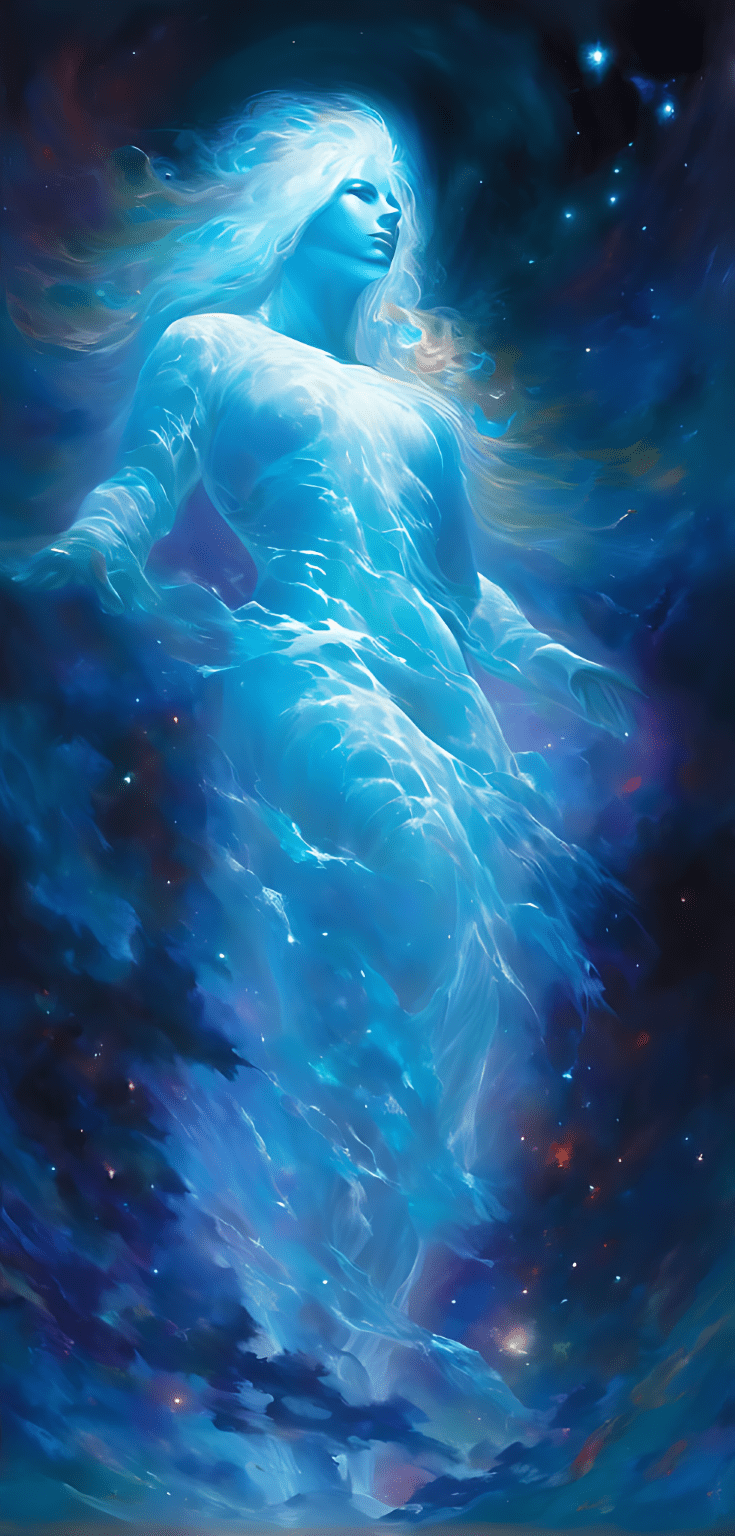
Secondary sequence giants are black giants who for one reason or another do not join a constellation (see below). When such black giants reach 8,000 to 9,000 years of age, they form into a blue giant, also known as a nebula. Blue giants live as long as red giants, but are free to roam the astral plane without constellations; when blue giants reach old age, they die and reform into wandering giants, which are immortal.Diagram
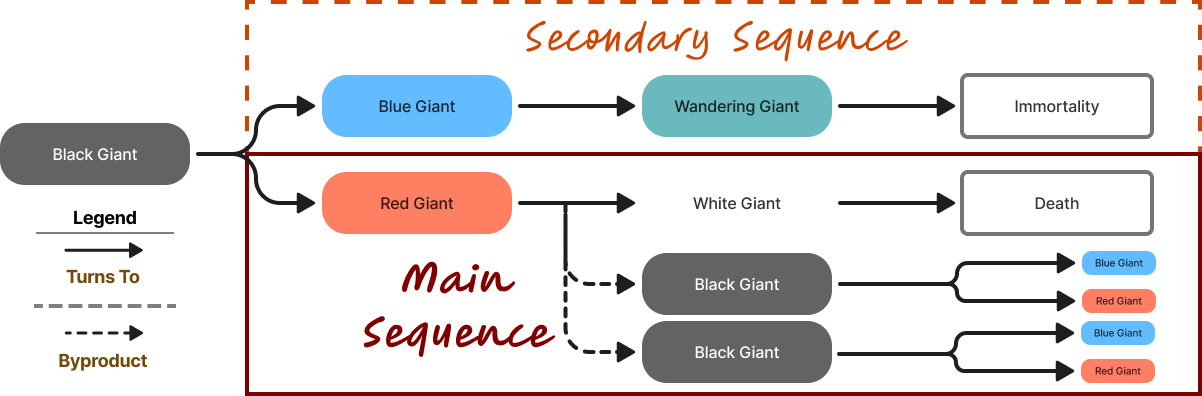
Genetic Ancestor(s)
Lifespan
Black Giants: 13,000 years
Blue Giants: 25,000 years
Red Giants: 25,000 years
Wandering Giants: immortal
White Giants: 70,000 years
Blue Giants: 25,000 years
Red Giants: 25,000 years
Wandering Giants: immortal
White Giants: 70,000 years
Average Height
Black Giants: 2,000 m
Blue Giants: 7,000 m
Red Giants: 12,000 m
Wandering Giants: 21,000 m
White Giants: 1,000 m
Blue Giants: 7,000 m
Red Giants: 12,000 m
Wandering Giants: 21,000 m
White Giants: 1,000 m
Average Weight
Black Giants: 74-100 Kilotons
Blue Giants: 907-1,225 Kilotons
Red Giants: 2,600-3,600 Kilotons
Wandering Giants: 9,600 Kilotons
White Giants: 18-25 Kilotons
Blue Giants: 907-1,225 Kilotons
Red Giants: 2,600-3,600 Kilotons
Wandering Giants: 9,600 Kilotons
White Giants: 18-25 Kilotons
Geographic Distribution
Blue Giants: Chaotic Neutral
Red Giants: Lawful Neutral
Wandering Giants: Lawful Neutral
White Giants: Neutral Good
This star chart from the 9th century AB was used for navigation, and displayes the night sky as they are from Port Valor.
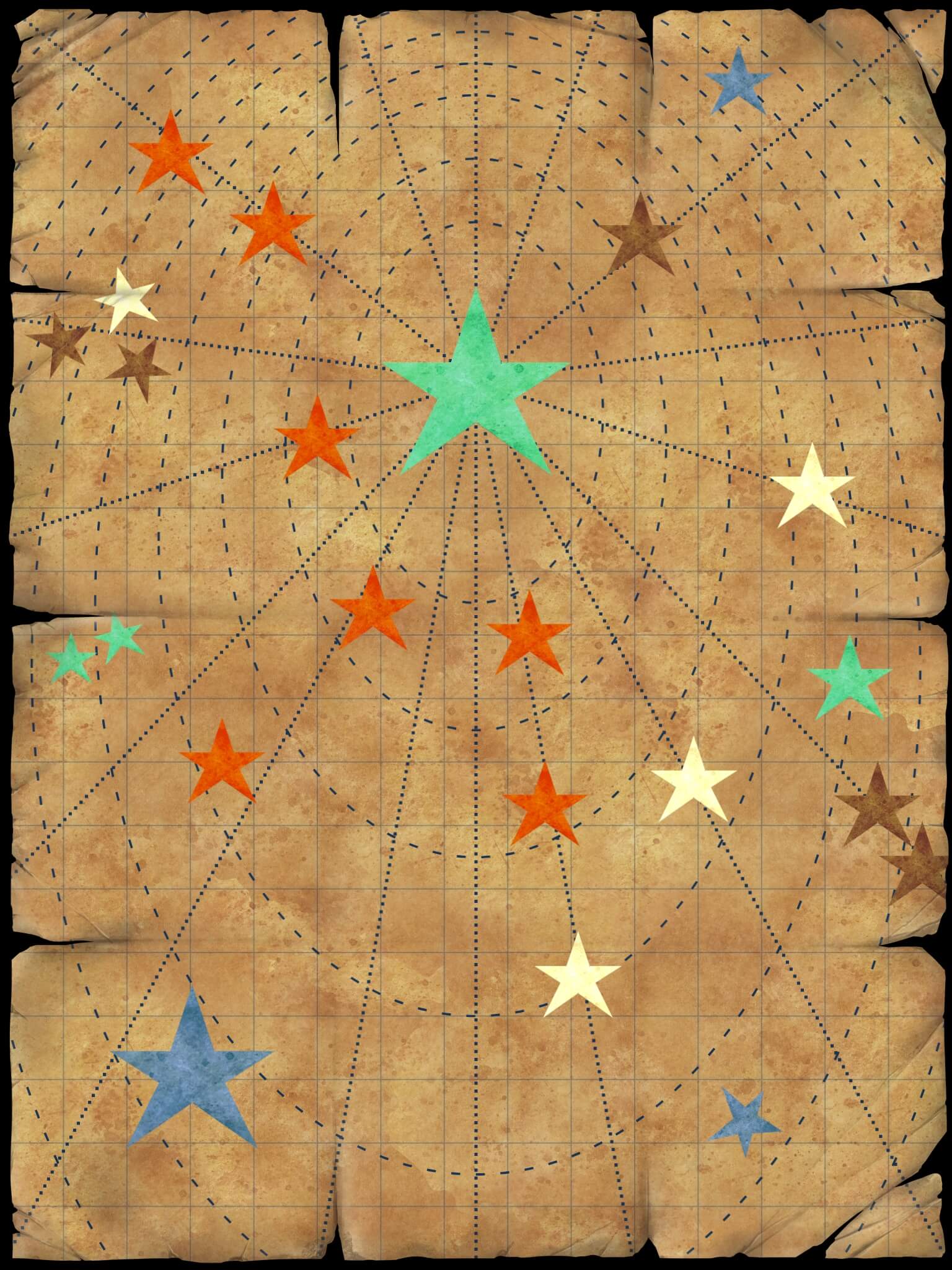
Note the appropriate color coding of the stars; Argeuse and Iopa can be seen to the middle left, right below the crease.
History and Culture
Names and Classifications
Due to their unique life cycle, not all psiants have a proper name; black giants, most notably, do not bother to name themselves until they join a constellation or expand into a nebula. Even if a star has a proper name, there isn't a way to know said name without the use of scrying or analogous means. This behavior, compounded with their nature as celestial objects, means that most stellar giants are known by more than a single name, as astronomers also tend to give them a name that follows a classification system.
Though they are the favored and first children of Annam, the goddesses Sehanine Moonbow and Lune are currently the deities most assosciated with the stars. There is much speculation regarding how, why, and when this happened; both the historical and theological debates are yet to be settled. However, some details are certain.
The very first among the stellar giants was Sehanine, who was cherished and appreciated by both Annam and Othea. As the eldest and most powerful, Sehanine was trusted with great responsibility and power, and Annam bestowed her with the portfolio of stars.
Constellations
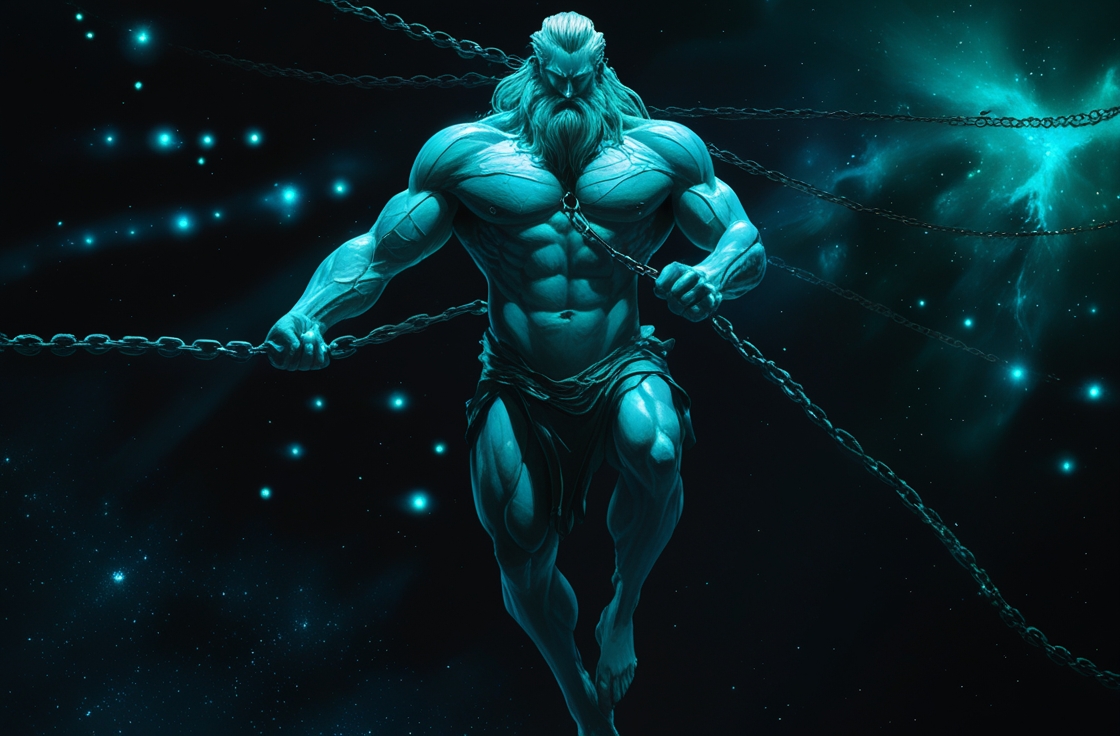
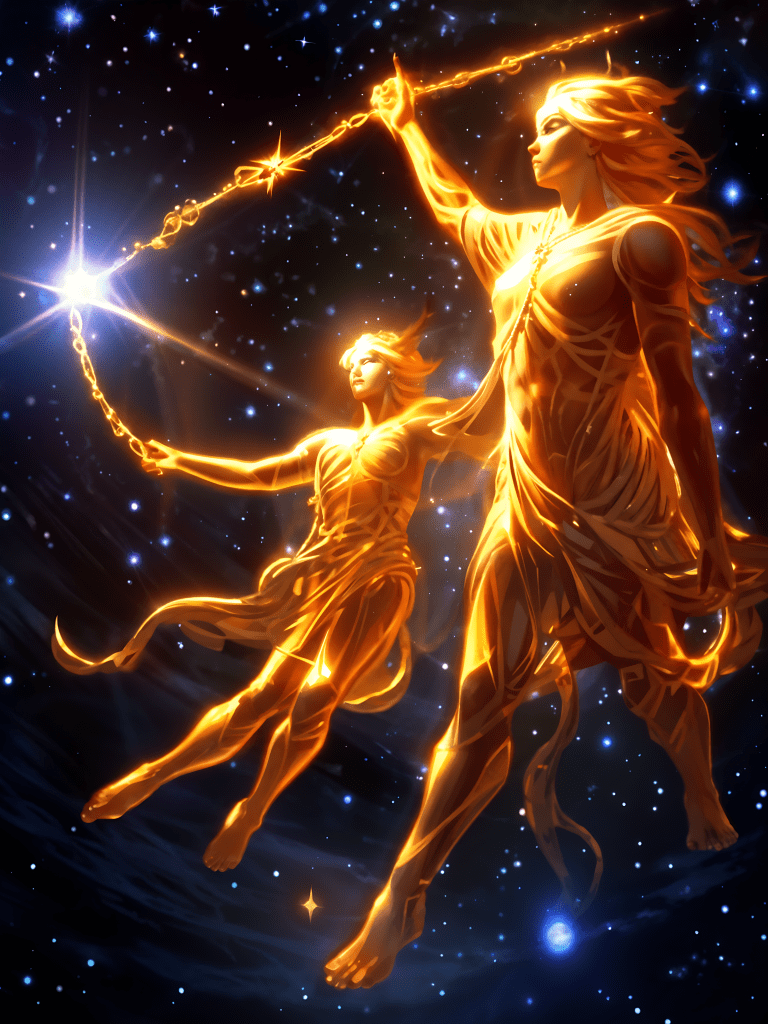
Stellar giants, with the exclusion of blue giants, form constellations; over millennia, wandering giants forge millions of rings using their divine-like powers, linking them into stellar chains that stretch for thousands of kilometers. While doing so, they wander the astral plane, picking suitable main sequence giants and invite them to hold on to those chains. The wandering giant pulls on those chains, with the main sequence stars tugging along; from the Prime Material Plane, the wandering giant is seen as a the brightest star of the constellation, known as a leading star. The direction of movement of a constellation is subject to the wandering giant's whim, though the older they get the more they tend to develop a fixed path in the sky.
The oldest constellations are used for navigation, but are unreliable without some other navigation method, as most constellations cover no more than roughly 5° of the night sky. Since the Fourth Azaraki Peace Wars and as of the Ervenian Era, the Kadian Dominion is the only polity known to possess the sufficient astronomical knowledge required to traverse The Red Ocean by constellar navigation alone; this greatly contributed to the suddenness of the Kadian Invasion of Rakion, as most other navies considered crossing The Red Ocean infeasible. However, constellar navigation is indispensable for astralnauts and travelers lost throughout the endless sea that is the astral plane, where they can be seen for much greater distances, and some giants actively guide such individuals.
The trajectory of every star in a constellation can be calculated through the leading star:
1. Treat the desired star in the constellation as a point mass ma=M/3.
2. Treat the leading star of the constellation as a point mass mb=M/3.
3. Treat the rest of the constellation as a rigid body comprised of four point masses mi=M/12.
4. Measure the current velocity of the desired star.
5. The leading star is connected to md=MAX|rmi-rmb|, and md is connected to the desired star.
6. The leading star is accelerated by a force of magnitude ⅖Mμ.
- The scalar μ is the stellar giant's specific stellar index and is measured in m/s2.
- The location of each mi is the geometrical center of any four mutually exclusive groupings of red giants.
Cosmic Role
It is speculated that the constellations have a grander role in the cosmic scale: to act as a secondary grid which allows Divine Magic to flow into the Material Planes in case Nyx ever manages to sever the astral plane from other planes.Gallery
Black Giant |
|
|
Wandering Giant |
Red Giants |
|
|
Blue Giant |
Comments