
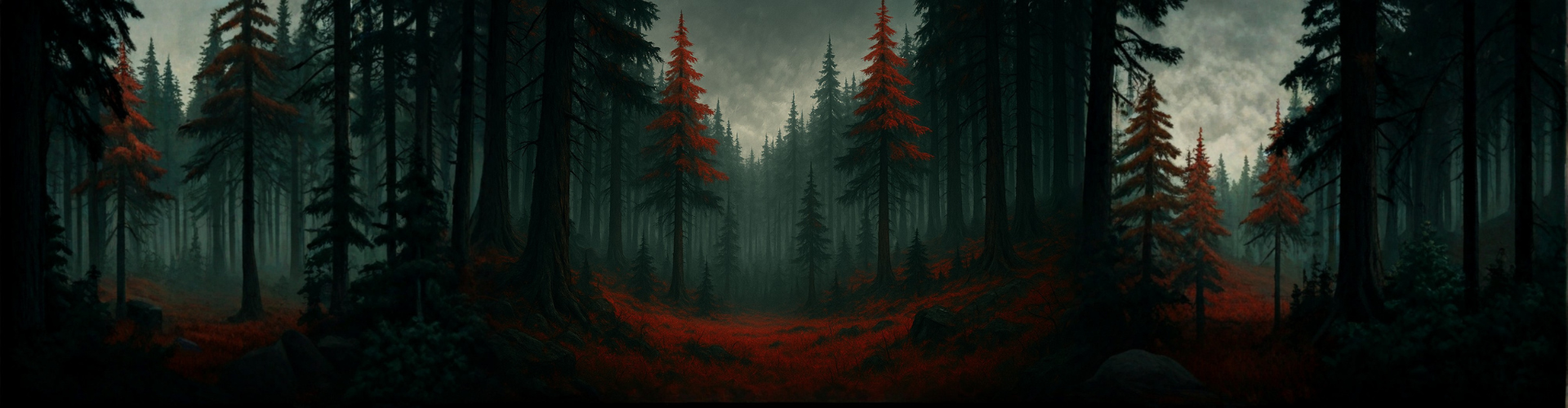
Sylve Sanglante
The Bleeding Wood stretches in a long, uneven band a mile or two inland from Aquitaine’s southeastern coast, a dark margin between settled land and the treacherous low country beyond. Its conifers are unlike any others on the Leitan Peninsula: native pines with red-tipped needles that weep a thick crimson sap when broken, staining bark, soil, and hands alike. From a distance the forest appears perpetually bruised, as though wounded and never allowed to heal. Southward lie mangroves, marshes, and coastal wetlands thick with rot, insects, and unseen movement; northward, the land rises toward Lac du Chagrin and the hills near Les Trois Demi Tasses, where civilization once again asserts itself. Between these regions, the Bleeding Wood stands untamed, watchful, and old.
The name is not owed to the trees alone. Monsters are drawn to the forest in numbers well above what reason would suggest, as if the land itself invites them. Predators patrol established paths, aberrations nest in sap-choked clearings, and things without proper names stalk the edges at dusk and dawn. Travelers report the sensation of being observed even in silence, and ranger patrols rarely pass through without incident. It was here that Skettle—long before his observations were bound into It’s Just Skettle and Other Facts—felt most keenly the absence of his older brother, who had left him behind to pursue arcane study. Enlisted young among the rangers, Skettle learned quickly that the Bleeding Wood tolerated no complacency. He was uneasy beneath its canopy, not from superstition, but from experience: too many eyes, too many tracks, and far too many monsters moving with purpose through the trees.
Geography
The Bleeding Wood curves inland in a broad, irregular horseshoe, its open end facing north toward the higher ground near Lac du Chagrin and Les Trois Demi Tasses. Along the upper eastern tip of this arc, the forest thins and gives way to the Eastern Salt Marsh, a brackish expanse where fresh water from inland streams mingles uneasily with the tides of the Jangtel Ocean. The ground there is treacherous—mud that appears solid but shifts without warning, pools crusted with salt and reed-choked channels that conceal both predators and deeper water. Fog rolls in from the sea with little warning, blurring the boundary between marsh and forest until even experienced guides lose their bearings.
Southward, the land sinks into a broad stretch of forested low country that presses against most of the southern curve of the horseshoe. This lowland is dense, wet, and slow to yield its secrets, its trees rooted in dark soil fed by seasonal floods and creeping tides. It forms a natural barrier between the Bleeding Wood and the open coast beyond, muting the sound of the Jangtel Ocean even when it lies only a few miles away. Monsters move freely between these regions, using the low country as cover and corridor, and few patrols willingly linger there. Skettle noted that the forest, marsh, and low country together formed a single predatory system—different faces of the same danger—each feeding the others and ensuring that the Bleeding Wood never truly stood alone, nor ever truly slept.
The western reach of the Bleeding Wood presses hard against a vast coniferous rainforest, older and darker still. Here the forest wall rises in towering ranks of ancient trees whose interlocked canopies admit little more than a dim green twilight. Sunlight rarely reaches the forest floor, and what little does is quickly swallowed by shadow and mist. The air is heavy with moisture and the scent of resin, rot, and living wood, lending the place a hushed, oppressive stillness broken only by distant calls and the soft drip of condensation from needle to needle.
At ground level, centuries of fallen pine needles form a thick, muffling carpet, tangled with ferns and shelf-fungus that cling to trunks and roots alike. Pale mushrooms glow faintly in the deeper shadows, and broad mats of moss creep steadily over stone and bark. Movement here is slow and uncertain; sound carries poorly, and shapes emerge only when they are already close. To rangers like Skettle, this western border marked a transition from danger to something more primordial—a realm where the forest no longer merely bled, but watched, waited, and endured, indifferent to the passage of men and monsters alike.
The Bleeding Wood iteslf rises along a spine of high ground, a broken ridge that mirrors the forest’s horseshoe shape and lifts it subtly above the surrounding lowlands. This elevation grants the forest its dry footing despite the wetlands that hem it in, yet the ridge is far from smooth. Stone outcroppings thrust through root and needle, their faces split by narrow caves and shallow hollows. Most are too small for comfort or long habitation, but they offer shelter enough for beasts, smugglers, or worse—facts not lost on the rangers who mark such places with quiet caution.
Beneath the forest floor, the land is restless with water and metal. Springs emerge unexpectedly from fractured stone, feeding streams that slip downslope toward marsh, low country, and sea. The same geology that channels this water also bears veins of common metals, enough to tempt prospectors but rarely enough, or safely enough reached, to reward them. Though vegetation grows thick and wild, the soil itself is poor for husbandry—thin, rocky, and stubborn, better suited to trees that claw for survival than crops that demand patience and care. Skettle noted more than once that the Bleeding Wood was rich without being generous, offering just enough to lure the hopeful, and just enough danger to punish them for trying.
Ecosystem
The ecology of the Bleeding Wood is strained, its balances bent but not yet broken. Skettle observed early that the sheer density of monstrous creatures could not be reconciled with the visible abundance of prey. Predation exceeded any natural cycle he had studied elsewhere on the Leitan Peninsula, suggesting an external pressure rather than a simple overpopulation. Tracks overlapped unnaturally, territories were poorly defined, and many predators showed little fear of one another, as though drawn by a common source rather than competing for dwindling resources.
That source revealed itself only after years of careful ranging: a narrow, expertly concealed shaft hidden among the ridge’s stone outcroppings. The opening was old, its edges worn smooth by time or deliberate craft, and it descended steeply into the earth. Skettle followed it as far as he dared, nearly a full day’s descent by rope and cautious footing, yet found no terminus—only darkness, damp air, and the unmistakable sense of depth without bottom. Ill-equipped and alone, he marked the location and withdrew, convinced that the creatures of the forest were not merely born there, but arriving from below.
Among the natural fauna, survival has favored the evasive. Birds, bats, and other flying creatures thrive in unexpected numbers, as do animals adept at concealment—burrowers, climbers, and those with muted coloration or nocturnal habits. Larger prey species tell a different story. Elk, deer, and bears grow increasingly scarce the closer one ranges to the shaft, their old paths abandoned and grazing grounds reclaimed by undergrowth. Even signs of carrion are rare near the depths, as if the land itself has learned that lingering invites attention. In Skettle’s estimation, the Bleeding Wood persists not through balance, but through adaptation—an ecosystem reshaped around an intrusion it cannot expel, only endure.
“Even on my best days, with a full pack and clear weather, the Bleeding Wood never felt like a place that wanted me there. The trees watch too closely, the ground remembers every step, and the monsters walk their routes as if they were patrols. I kept smiling, kept telling myself it was just another forest—but I never once stopped listening for what was behind me.”
-Skettle in It's Just Skettle and Other Facts/i]


Comments