
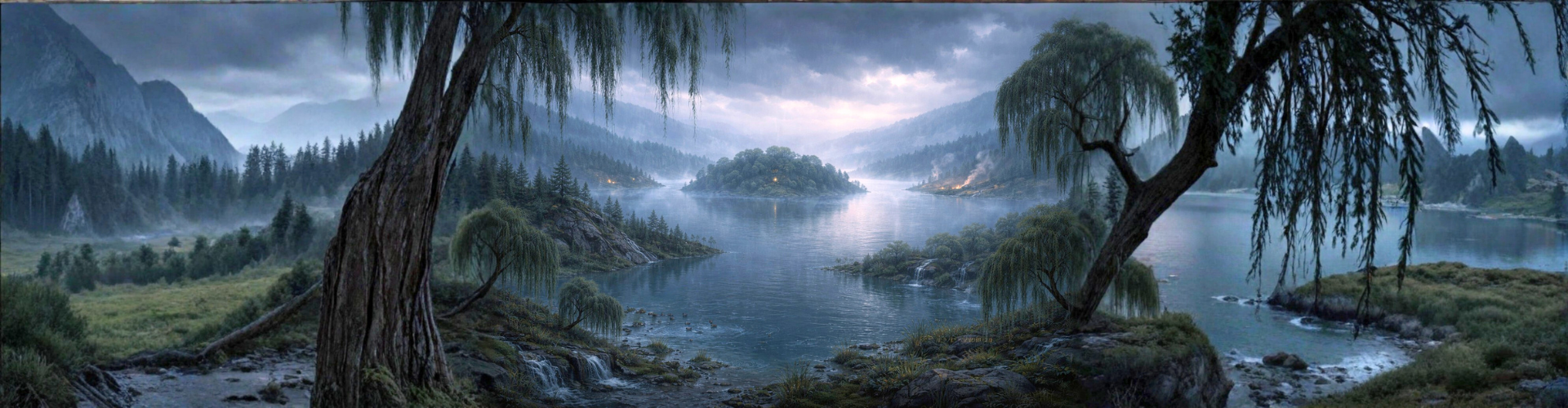
Lac du Chagrin
Lac du Chagrin occupies a broad, shallow basin cupped within the Aquitaine Provence, its elliptical waters stretching some fourteen miles east to west and twelve miles north to south. The lake’s margins are soft rather than abrupt, with long, gently shelving shores that reinforce its reputation as a place of lingering moods rather than sudden drama. Along the eastern rim, the dark boles and bleeding hues of the Sylvie Sanglante lean close to the water, their roots drinking deeply from the saturated soil. To the west, the land opens into the plains south of Les Trois Demi-tasses, where grasses and low scrub roll down toward the lake in long, shallow gradients broken only by stone and reed.
Geography
Near the lake’s center rises Taggert Isle, a low, wooded mass of roughly four square miles. Its shores are irregular and marsh-fringed in places, with higher ground toward the interior where older trees take hold. The island subtly alters currents and wind patterns across the lake, creating calmer waters on its leeward sides and eddies that gather reeds, driftwood, and the occasional wreck of a small fishing craft. Beneath the surface, the lakebed is generally uniform, descending to no more than seventy feet across most of its extent—until it abruptly breaks away west of the island.
There, Smirksimmen Deep opens like a wound in the earth. This narrow chasm drops precipitously to depths exceeding seven hundred feet, a stark and unsettling contrast to the lake’s otherwise modest proportions. The water above it is darker and colder, and even seasoned locals avoid lingering there. Some claim subtle currents pull downward, while others speak of sounds rising from below during still nights. Whatever its origin, the Deep anchors the lake’s more ominous reputation and fuels countless legends tied to older powers beneath the peninsula.
On the western shore, Big Taggert Ridge thrusts upward for nearly three miles, its jagged stone rising as though wrenched from far below the surface. The rock here is ancient and dense, largely bare of soil, with sharp angles and fractured faces that catch the light at odd hours. North of it, Little Taggert Ridge mirrors the same upheaved character on a smaller scale, but its stone is riddled with caverns and hollows. These openings breathe cool air and moisture, hinting at extensive subterranean networks that may connect to deeper structures beneath the lake itself.
Opposite these stone spines, on the southeastern shore, the land grows restless. Heat bleeds up through the crust in the form of hot springs, intermittent geysers, and a shallow caldera whose slopes are stained with mineral deposits. Steam drifts across the nearby water, mingling with the lake’s perpetual drizzle and giving this stretch of shore a ghostly, half-veiled appearance. Though unnamed as yet, this volatile region stands apart from the rest of Lac du Chagrin—an unmistakable reminder that the forces shaping the lake did not all come gently, nor have they fully gone quiet.
Ecosystem
The ecosystem of Lac du Chagrin is shaped as much by moisture and light as by soil and stone. The constant drizzle and frequent mists create a liminal wetland environment around much of the shoreline, blurring the boundary between open water, marsh, and forest. Weeping willows dominate the immediate banks, their fallen leaves enriching the shallows with tannins and organic matter that darken the water and slow decomposition. Beneath them thrive dense beds of reeds, sedges, and water grasses, which provide spawning grounds for fish and nesting cover for waterfowl. Insects are abundant—midges, lake flies, and pale moths—forming the base of a food web that hums quietly but persistently through the damp air.
Within the lake itself, life favors adaptation over diversity. Fish species tend toward hardy, slow-growing varieties that tolerate cool temperatures and low light, feeding on insect larvae, mollusks, and detritus stirred up from the shallow bottom. The generally uniform depth allows plant life to extend far from shore, with submerged grasses and broad-leafed aquatic plants forming wide underwater meadows. These in turn shelter crustaceans and eel-like creatures that vanish into the silt at the slightest disturbance. Over Smirksimmen Deep, however, the ecosystem changes abruptly: plant life thins, the water grows colder, and only specialized or poorly understood creatures are said to inhabit the depths, rarely venturing into the brighter, shallower reaches above.
Taggert Isle supports a notably richer and more balanced ecology than the surrounding shores. Its partial isolation has preserved older growth patterns, with mixed woodland giving way to mossy clearings and fern-choked lowlands. Birdlife is especially dense here, including species rarely seen on the mainland shores, while small mammals and amphibians flourish in the absence of large predators. If the legends of a tended sacred grove hold any truth, subtle signs remain in the island’s ecology: unusual plant vigor in certain clearings, trees that seem resistant to blight, and a general sense of equilibrium that contrasts with the heavier, more oppressive mood of the lake’s perimeter.
Along Big and Little Taggert Ridges, the ecosystem shifts once more. Sparse soils and exposed bedrock limit surface growth to hardy shrubs, lichens, and wind-twisted trees, but the caverns of Little Taggert Ridge host a thriving subterranean biosphere. Fungi, blind insects, and pale cave-adapted amphibians are common, feeding on nutrients washed down from above or carried in by water seepage from the lake. Warm, mineral-rich runoff from the southeastern geothermal region further complicates the lake’s ecology, creating localized zones of elevated temperature and chemistry that support algae, thermophilic plants, and uniquely adapted invertebrates. Taken together, these overlapping systems make Lac du Chagrin less a single ecosystem than a convergence of many—interlocked, uneasy, and quietly resilient.
Climate
The lake’s atmosphere is as defining as its shape. Weeping willows crowd much of the shoreline, their trailing branches perpetually brushing the surface, and a faint, near-constant drizzle hangs in the air even when the surrounding countryside lies dry. Mists gather at dawn and dusk, blurring the far shore and lending the water an illusion of greater size and depth than it truly possesses. Though fed by freshwater streams and rainfall, Lac du Chagrin feels enclosed and inward-looking, as if reluctant to give up its waters or its secrets.


Comments