
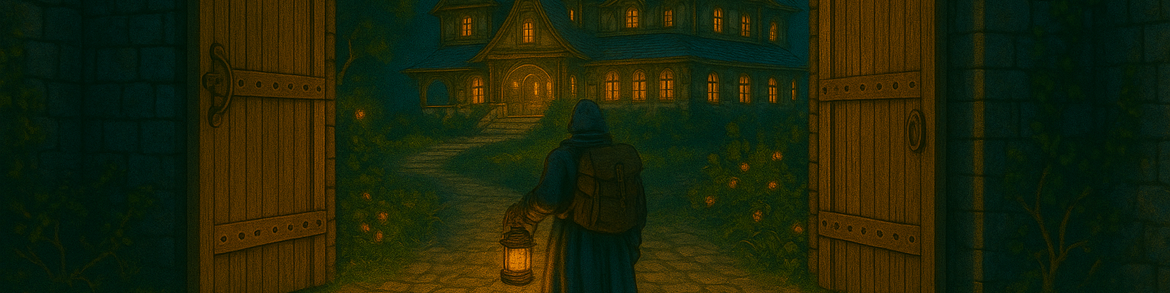
When the Inn Pretends to Belong
“The Inn has never belonged anywhere. It simply pretends it does, and the Pattern is polite enough to play along.”
Every so often the Last Home drifts too close to a world. A gate creaks open in a hedgerow. A cellar door leads somewhere it did not yesterday. A stone wall grows a doorway overnight, and no one questions it.
Villagers swear they have always known of an inn at the crossroads, only lately reopened. Travellers recall stopping here years ago, though the place is new to them. The Inn pretends to belong, and the Pattern obliges.
Until it moves on, of course.
On Doors (And Other Poor Decisions)
From the Inn side, doors are always doors—wooden, hinged, entirely ordinary. What they open onto is less reliable. A cellar hatch in some village, a hedge-gate, a hollow tree: the Pattern decides, and the Inn rarely argues.
Some doors linger for years, others for hours. Some lead both ways, some only one. It is the reason Hearthstones exist—for those the Inn claims as patrons, a way to return even when the door decides it no longer wishes to be a door at all.
Festivals Stolen, Festivals Invented
The Inn keeps no festivals of its own. It borrows them. Arrive in autumn and you will find masks and lanterns; arrive in spring and the gardens insist they have always been home to ribbons and eggs. Patrons are pulled along regardless, mistaking borrowed rites for ancient traditions.
The Pattern smooths it over. Monsters become costumes, chaos becomes celebration, and by dawn the festival has always belonged to the Inn.
The Inn and the World (And Vice Versa)
Worlds bend to meet the Inn. Roads adjust themselves, villages remember gatehouses they never built, and locals accept the intrusion without protest.
The Inn, in turn, reshapes itself. Gardens sprout cactus in deserts, frost in mountain hamlets. Each appearance leaves its mark, woven into the Library’s memory.
Memory, Obliging as Ever
The Pattern despises contradiction. If the Inn insists it has always been here, then it has. When it leaves, the world forgets, and only half-remembered tales remain—of a roadside inn that cannot be found twice.
Patrons, of course, remember. But then, patrons are rarely trustworthy.
Final Thoughts
The Inn does not travel. It imposes itself. The Pattern adjusts, the locals adapt, and everyone insists it was always meant to be so. Only when the doors vanish and the gardens are gone does the lie unravel.
By then it hardly matters. The Inn has already convinced you it belongs. And perhaps, by the time you realise otherwise, it does.
Contents
Known Events
“Your continued reading is more valuable than coin. However, the author assures me that Ko-Fi support assists in ‘keeping the kettle on.’ I am told this is a metaphor. I remain unconvinced.” — Seraphis Nightvale Ko-Fi: #madmooncrow


Comments