
Spirehorn
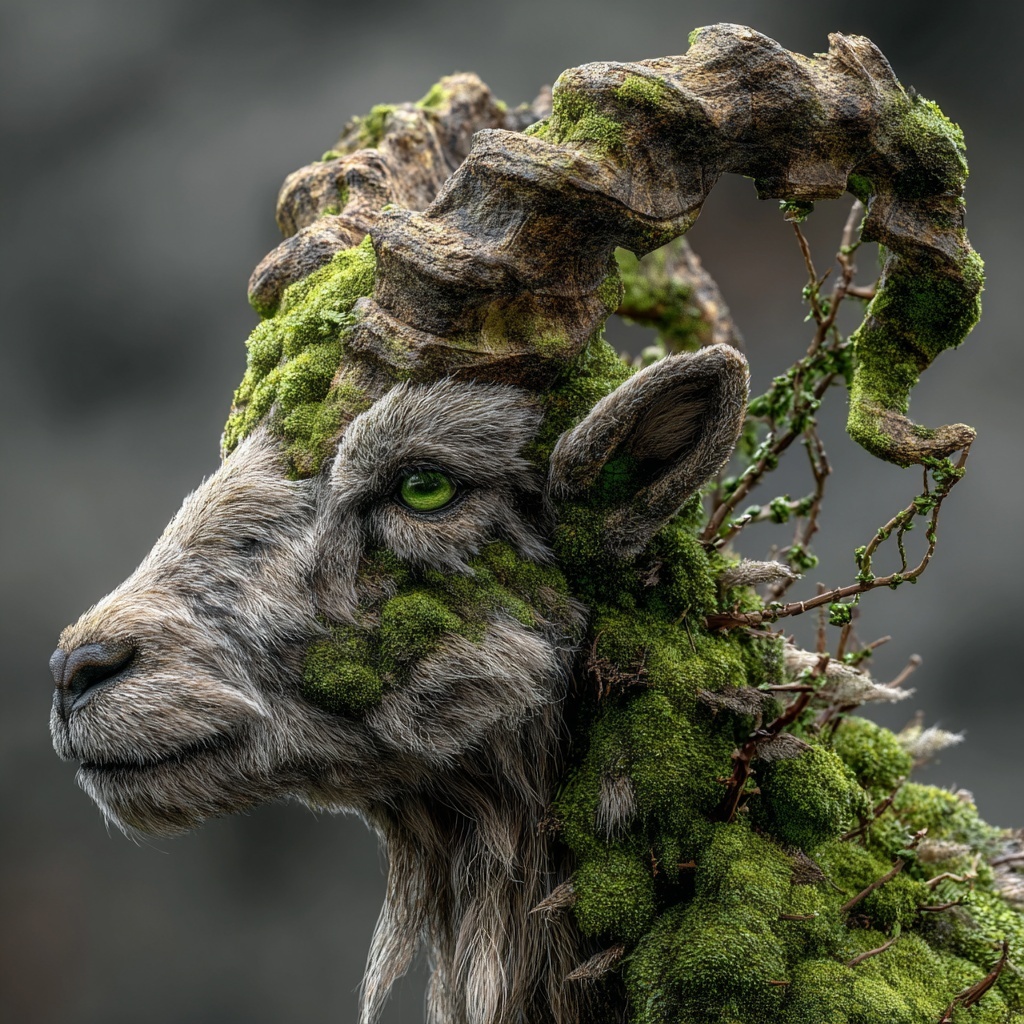
A Verdant-mutated bighorn sheep that was first spotted in The Rocky Mountains near Grapevine Station by Silvan Langford. Its horns have mutated to host some form of thorny moss and has prehensile hooves for scaling overgrown cliffsides. Spirehorns are taller than regular bighorn sheep, with gaunt and muscled bodies. Their fur is often matted with snow and their coats look like lichen have begun colonizing the hide underneath. Unlike bighorn sheep, their horns spiral upwards in jagged, asymmetrical spirals that twist and split like antlers that are choked by thorns. Thorny vines curl around the horn structures, pulsing softly with a green bioluminescence. Verdant spores cling to the vines in thick, fuzzy clusters. Its eyes are green and glassy, like a pong choked with a blanket of algae. Verdant spores trail faintly in its wake like ash being spat from the embers of a crackling campfire.
The Spirehorn is a haunting fusion of mammalian anatomy and botanical colonization. The creature's face retains the noble bearing of its bighorn ancestry, with the characteristic strong jawline and alert expression, but the transformation brought by Verdant symbiosis is immediately apparent. Its most striking feature is the complete transformation of what were once the animal's curved horns. Instead of the natural spiral formations that are typical of bighorn sheep, its horns have become a twisted architectural marvel of bone and plant matter combined. The bone structure of the horns appear to have grown in response to its botanical passengers, creating platforms and channels that support an intricate network of thorny vines and moss colonies. The vibrant green colouration of the moss patches appear to almost glow against its weathered bone and grey fur. These aren't simple surface growths, but integrated biological systems that have altered the horn structure, creating hollow chambers and branching passages where the original solid keratin once existed. Its green and glassy eyes suggest deeper Verdant influence in neural chemistry, its gaze appearing alert yet distant, as if it perceives frequencies of information beyond normal mammalian senses.
The moss colonization extends beyond its horns onto the animal's hide, creating patches where fur gives way to Verdant growth. The symbiosis is progressive, gradually transforming more of the host organism over time. The thorny vines trailing from its horn structure appear almost tentacle-like in their ability to move and respond to environmental stimuli.
The Spirehorn is a creature that is caught between two evolutionary kingdoms. It is still recognizably mammalian, but increasingly something else entirely.

Comments