
Rimeblood
Rimebloods are a Wendigo-like species of individuals who have been bitten by frost veins, often after having spent a prolonged period of time consuming Verdant-mutated or infected animal meats and organic Verdant-mutated or infected plant species. The Rimebloods are the tragic evolution of Humans who ventured too deep into the frost vein territories of the high mountains, where the Verdancy has adapted to thrive beneath layers of snow and ice. Unlike their warm-climate counterparts who become the translucent, green-membraned Hollowed, these mountain dwellers undergo a crystalline transformation that mirrors the environment that claimed them.
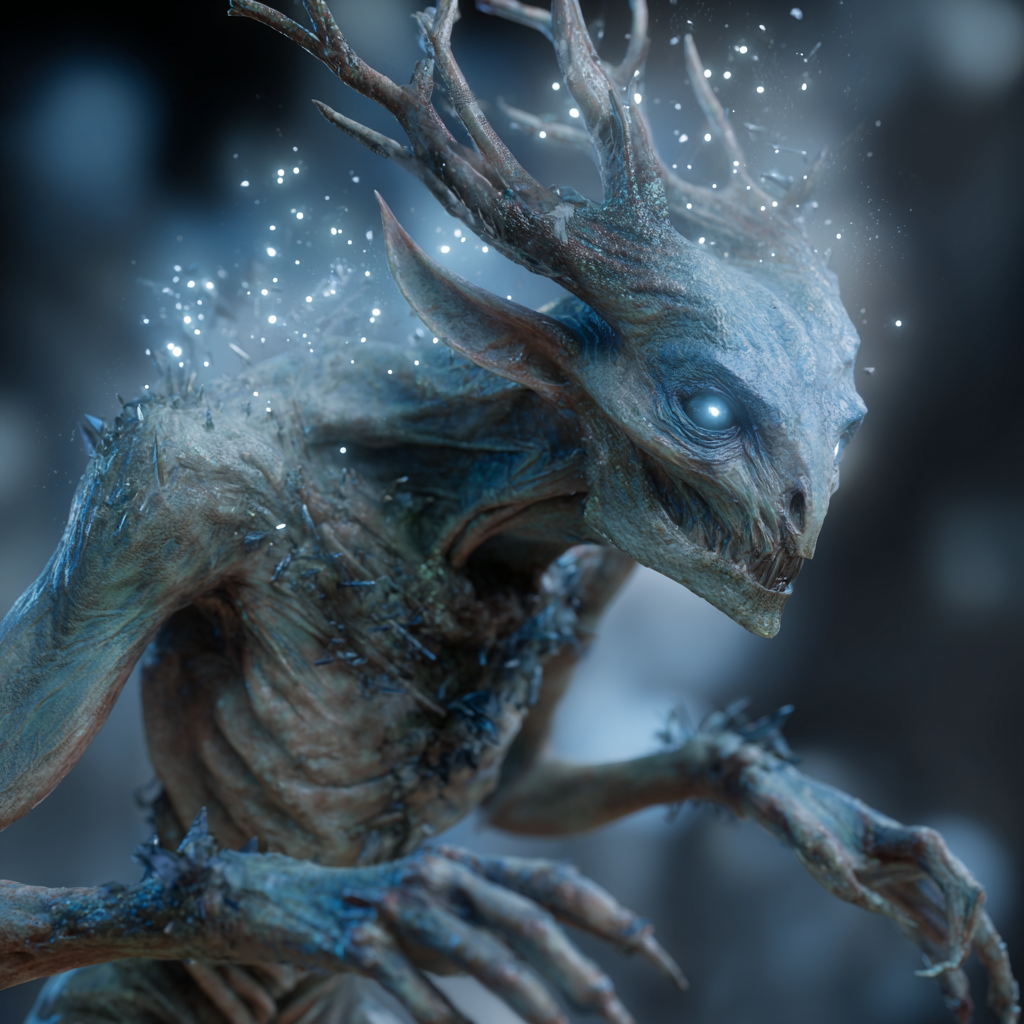
The Rimeblood's skin takes on a pale, almost translucent quality with visible networks of frost-blue veins that pulse with the same rhythm as the frost veins themselves. Their breath creates not ordinary steam vapour, but glittering crystalline clouds of spores that hang in the cold air like frozen starlight. Their eyes become glacier-blue, often appearing to glow faintly in the dark. Where the standard Hollowed develop green, moss-like patches and bark, Rimebloods instead grow formations that resemble ice crystals and frost patterns along their joints and extremities.
They retain more of their human intelligence than typical Hollowed, making them particularly dangerous. Rimebloods can navigate the treacherous mountain terrain with supernatural grace, moving across snow without leaving tracks and sensing heat signatures from great distances. They hunt in small packs, and are drawn to warmth like the frost veins that spawned them. Their greatest weapon is their patience, as they can remain motionless for hours in the snow, camouflaging themselves and waiting for prey to pass close enough to strike.
The change typically takes hold when humans are caught in frost vein blooms that are triggered by campfires or body heat. Unlike the quick consumption of standard Verdant exposure, the cold slows the process. This creates a prolonged, torturous transformation where the victim remains conscious as frozen Verdant growth slowly replaces their circulatory system while the frost veins strangle them inside a snow-covered chrysalis. Some Rimebloods are found days later, still technically alive but no longer human, their minds caught between their former selves and the collective hunger of the mountain's network. The Rimebloods are the Verdant compound's adaptation to humanity's last refuges, proving that even the harshest, most barren environments cannot remain safe forever.
Basic Information
Anatomy
Rimebloods maintain the bipedal human form but with disturbing elongations. They still have four limbs (two legs and two arms), but the proportions have been stretched and distorted. Their limbs are unnaturally long, with joints that can bend at impossible angles. Their hands end in elongated fingers with crystalline claw-tips that function as both tools and weapons, perfect for gripping ice-covered rock faces.
Their bones have become denser and more crystalline than their Human precursors, allowing them to withstand the extreme cold while still providing structural support for their enhanced height, since most Rimebloods stand around 7-8 feet tall. Their musculature is lean but incredibly strong, optimized for explosive movement across treacherous terrain rather than sustained activity. The muscle fibres have a bluish tint that is visible beneath their translucent skin, pulsing with the same rhythm as frost veins.
Their most striking features are their antlers, which are beautiful, branching structures of living ice and crystallized Verdant matter that sprout from their temples and crown. These formations are asymmetrical and constantly growing, spiralling upward in jagged patterns that catch and refract light into prismatic displays. The antlers pulse with a soft blue bioluminescence, especially when the Rimeblood is hunting or agitated. They supply the Rimeblood with heat regulation, communication with the frost vein network, and function as a weapon when necessary.
Their faces retain a human-like bone structure, but appears stretched and gaunt, with prominent cheekbones and sunken eye sockets. The most terrifying feature is their teeth. What were once normal human dentition have been replaced by rows of needle-sharp, crystal-like fangs that are perfect for tearing through flesh and can crack human and animal bones to access the warm marrow within. Their jaws can unhinge slightly, allowing them to bite with a tremendous force. Their breath creates those glittering spore clouds, and when they open their mouths, you can see their throat glowing with the same ethereal light as their antlers.
The overall effect is something that appears magnificent and otherworldly from a distance—tall, elegant figures that are crowned with beautiful ice formations—but reveals itself as a nightmare predator upon closer inspection, as they are perfectly designed for hunting in the hostile mountain environment where they were born.
When Rimebloods are in their normal bipedal stance, they appear almost human-like from a distance like tall, gaunt figures moving through the snow. But when they shift into a predatory stance, their physiology transforms dramatically. Their leg joints restructure, their knees inverting to bend backward like a digitigrade animal's stance. This allows them to drop into a predatory quadrupedal pounce that is optimized for speed, stealth, and traversing the difficult mountain terrain to hunt humans and animals.
The shift from bipedal to quadrupedal is accompanied by a sickening series of bone pops, ice cracking, and joint realignments that are audible from a distance and are absolutely horrifying to witness. Their spine curves and extends, their arms would lengthening further to accommodate ground contact, and their centre of gravity shifts entirely. The ice antlers even angle themselves forward more aggressively in this hunting posture.
In quadrupedal mode, they can move with the silent grace of a large predator with their crystalline claws providing perfect grip on ice and rock. They are able to leap between rocky outcroppings, scale near-vertical cliff faces, and pursue prey with an inhuman speed and agility. The reversed knee joint gives them incredible spring and acceleration that is perfect for ambush tactics.
Biological Traits
Female-Derived Rimebloods ("Matriarchs")
Female Rimebloods show enhanced network integration. They tend to have more elaborate antler formations with greater bioluminescent intensity and superior frost vein communication abilities. Matriarchs often become the territorial coordinators, living closer to major network nodes and directing pack strategies. They're approximately 15% larger than male-derived Rimebloods and show enhanced thermal detection capabilities.
Male-Derived Rimebloods ("Hunters")
Transform more rapidly but with less network sophistication. They retain more aggressive human traits and excel at active hunting rather than strategic coordination. Male Rimebloods have more pronounced predatory adaptations with sharper crystalline claws, more efficient quadrupedal locomotion, and enhanced physical strength for taking down larger prey. They typically serve as the pack's active hunting force.
Homo-glacialis rimebloodus alpinus (Rocky Mountain/Alpine Variant)
The group of Rimebloods whose territory is primarily in the Rocky Mountains are optimized for elevation over 9,000+ feet. Their antler structure is thick with heavily branched formations that resemble pine branches and a deep blue-white skin with silver crystalline patterns. Their network integration is moderate, balanced between independence and collective consciousness. They specialize in taking down large mammals as prey, like elk, bears, and humans. Their territory size is typically smaller due to densely networked territories that encompass approximately 10-15 square kilometres per individual Rimeblood.
Homo-glacialis rimebloodus borealis (Northern Mountain Variant)
The group of Rimebloods whose territory is primarily in the Northern or Canadian Rocky Mountains have adapted to climate changes and thrive in extreme sub-arctic conditions of -20°F and below. Their antler structure is longer with more spear-like formations that are used to pierce through thick ice. Their skin is pure white with ice-blue veining that makes them nearly invisible as they camouflage into their snowy environment. This group's network integration is enhanced and more collective-minded and packs operate in larger coordinated groups. They specialize in preying on arctic wildlife and isolated Frostborne human settlements. They also have much larger territories than encompass over 50+ square kilometres per pack due to the sparse amount of prey available.
Homo-glacialis rimebloodus antiquus (Elder/Ancient Variant)
The groups of ancient Rimebloods who are ten or more years post-transformation become partially rooted into mountain rock faces and their antlers grow into cave systems. They become living network command centres rather than mobile hunters. This group has achieved the highest network integration and can facilitate strategic planning across multiple mountain ranges. Their lifespan is potentially indefinite while frost vein networks remain intact.
Pre-Transformation Influence
Researchers have noticed that depending on the type of individual the victim was before turning into a Rimeblood affects their biological traits after they emerge from their chrysalis. Former Archive personnel tend to be more analytical-thinking Rimebloods who become strategic coordinators. Mountain climbers and scouts tend to develop enhanced senses of mobility where they have superior cliff-scaling abilities. Hunters or trackers develop exceptional prey-detection abilities and pack coordination skills. And lastly, children experience a faster transformation period, higher network integration, and seem to have a biology that it more adaptable to Rimeblood transformation.
Genetics and Reproduction
Rimebloods cannot reproduce sexually or through traditional gestation. Like the Hollowed, they are created through transformation of existing humans. The species perpetuates itself through what could be called "predatory conversion" by actively seeking out humans to expose to frost vein blooms to initiate the transformation process, or sinking their teeth into human flesh to spread their Rimeblood by infecting others humans.
The transformation occurs within the snow and frost-covered chrysalis that develops after a human has been bitten by a Rimeblood or the frost veins, which arise as frosted tendrils sprouting from the human's skin or erupt in frost veins beneath snow and ice that ensnare and swiftly paralyze its prey. After a human is caught in a frost vein bloom or is bitten by a Rimeblood, the Verdant growth doesn't consume them quickly like in warmer climates. Instead, the cold creates a protective cocoon of crystallized snow and ice around the victim as the frosted tendrils coil around them, causing paralysis. Within this chrysalis, the victim undergoes the prolonged transformation over a period of 7-14 days, depending on the individual's resistance and the intensity of the frost vein exposure.
During this gestation period, the victim remains conscious but paralyzed as their circulatory system is slowly replaced by the frozen Verdant network. Their human consciousness gradually merges with the collective mountain intelligence, creating that horrifying state where they're caught in a liminal space between their former selves and the collective hunger. Unlike standard Hollowed who lose individual identity completely, Rimebloods retain fragments of their human memories and personalities, making them more cunning and unpredictable.
Mature Rimebloods actively hunt for new victims to continue the species' spread. They're drawn to campfires, body heat, and human settlements, using their retained human intelligence to set traps and ambushes. Each successful conversion strengthens the mountain's frost vein network and adds another node to the collective consciousness.
Not all humans survive the chrysalis process, and the transformation has roughly a 60% mortality rate. Failed conversions leave behind frozen corpses that become food for the hungering Rimebloods, while successful ones emerge as fully-formed Rimebloods after their gestation period completes.
Growth Rate & Stages
Frostling Stage (0-1 Years Old): Fresh Rimebloods emerge from their chrysalis in the "Frostling" stage. They're physically complete but mentally fragmented, still processing the merger of their human memories with the collective consciousness. Their ice antlers are small, barely visible nubs, and their predatory instincts are raw and unfocused. They're driven primarily by an overwhelming hunger for warmth and living flesh, making them extremely dangerous but also erratic and easily distracted.
Hunter Stage (1-5 Years Old): As they feed and strengthen their connection to the frost vein network, Rimebloods enter their primary hunting phase. Their antlers grow rapidly during this period, becoming more elaborate and gaining their bioluminescent properties. They develop better control over their dual locomotion, perfecting the terrifying transition between bipedal and quadrupedal movement. Their retained human intelligence begins to stabilize, making them increasingly cunning and tactical in their hunts.
Elder Stage (5-10 Years Old): Fully mature Rimebloods become integral nodes in the mountain's Verdant network. Their antlers reach full size and complexity, serving as both sensory organs and communication arrays with other frost vein systems. They can coordinate with other Rimebloods across vast distances and develop the ability to manipulate frost vein growths directly, setting more sophisticated traps. Their hunting becomes less about personal hunger and more about strategic expansion of the network.
Ancient Stage (Years 10+): The oldest Rimebloods begin to lose individual mobility as they become living extensions of the mountain itself. Their antlers grow massive and root-like, sometimes literally growing into rock faces and becoming permanent fixtures that pulse with the frost vein network. They serve as command centres, coordinating younger Rimeblood attacks and movements across entire mountain ranges. Their bodies become partially crystallized, resembling living ice sculptures that can survive indefinitely in the frozen environment.
Ecology and Habitats
Rimebloods thrive in high-altitude mountain regions above the frost line, particularly in areas with consistent sub-freezing temperatures, heavy snowpack, and rocky terrain riddled with cracks and crevices where frost veins can take root. The Rocky Mountains provide the perfect ecosystem with steep slopes and natural stone fractures where seasonal snowmelt channels are infiltrated by frost veins, and high-altitude areas that remain perpetually cold. They favour elevations between 8,000-12,000 feet, where the air is thin, temperatures rarely rise above freezing, and the snow lasts year-round.
Rimebloods don't just inhabit their environment, they actively reshape it into a more suitable hunting ground. They expand the frost vein network by deliberately introducing warmth sources (often their own body heat) into strategic rock fractures, causing controlled frost vein blooms that create new pathways throughout the mountain. This creates a living surveillance system that can detect heat signatures across distances and trigger traps when warm-blooded creatures approach.
Mature Rimebloods reshape the mountain landscape through ice architecture. They use their crystalline breath to create false snow bridges over crevasses, deadly ice formations that look stable but collapse under weight, and elaborate ice caves that serve as both shelter and food storage. Their antlers leave permanent crystalline deposits on rock faces that act as network relay points, allowing communication across the entire mountain range.
Unlike most creatures that struggle with seasonal changes, Rimebloods become more active during winter months when their environment expands. Heavy snowfall allows frost veins to spread further down mountain slopes, extending their hunting territory into areas that were previously too warm. During brief summer periods, they retreat to the highest peaks and deepest ice caves, entering a state of hibernation where their metabolism slows but their network connectivity increases, allowing them to plan coordinated attacks for the returning cold season.
The relationship between Rimebloods and frost veins is deeply symbiotic. The frost veins provide sensory data, communication networks, and hunting assistance, while Rimebloods provide mobile intelligence, strategic expansion, and protection of key network nodes. Together, they transform entire mountain ranges into what are essentially massive, living traps designed to capture and convert any warm-blooded creature that ventures into their domain.
The mountains become extensions of the Rimebloods themselves, like a crystalline nervous system that spreads across miles of peaks and valleys, all pulsing with the same cold intelligence that drives these transformed predators.
Dietary Needs and Habits
Rimebloods have a dual dietary requirement that reflects their hybrid nature. Primarily, they crave living warmth through the body heat, blood, and bio-electrical energy of warm-blooded creatures. This isn't just nutritional but also serves to maintain their connection to the frost vein network, as warmth feeds the crystalline Verdant structures within their bodies. Secondarily, they consume bone marrow and fatty tissues, which provide the lipids that are necessary for their cold-adapted physiology.
Rimebloods use sophisticated ambush tactics that combine their retained human intelligence with their predatory adaptations. They set thermal traps by manipulating frost veins to create false warm spots that attract prey who are seeking shelter. Their ice antlers can detect heat signatures from impressive distances, allowing them to track warm-blooded creatures across miles of mountain terrain. When hunting, they often coordinate in small packs, using their quadrupedal mode to surround prey while communicating through the frost vein network.
During lean times, Rimebloods will consume Verdant-mutated mountain fauna like the Spirehorn, whose Verdant-infused tissues provide some sustenance. They also feed on the failed chrysalis victims of the approximately 40% of humans who don't survive the transformation and become preserved frozen meals in the mountain's natural refrigeration. These corpses can sustain a Rimeblood for weeks.
The mountain environment acts as their natural freezer. Rimebloods drag large kills into ice caves or bury them in snow banks marked with frost vein growth patterns that only they can read. Their antlers can sense these cached food sources through the network. Mature Rimebloods often maintain multiple food caches across their territory, connected by frost vein pathways that alert them if other creatures disturb their stores.
Rimebloods protect their hunting grounds through territorial frost vein expansion. They deliberately trigger new frost vein growth around high-traffic areas like game trails, mountain passes, and potential human campsites, creating deadly zones that eliminate competition while providing fresh victims. Their territories are marked by distinctive antler scrapes on rock faces that leave behind crystalline residue as a warning system that deters other predators while attracting curious humans to their doom.
Biological Cycle
Unlike most creatures, Rimebloods experience inverse seasonal cycles. During winter months, they become hyperactive as their optimal environment expands down mountain slopes. The heavy snowpack allows frost veins to spread into lower elevations that were previously too warm for the network, dramatically expanding their hunting territory. Their metabolism accelerates, antler growth increases, and their connection to the frost vein network strengthens as the cold deepens.
During warmer months, Rimebloods don't hibernate in the traditional sense, but enter what could be called a "Network Dormancy." As temperatures rise and snow melts, it forces frost veins to retreat to higher elevations, so Rimebloods become less physically active, but more mentally integrated with the collective network. Their bodies slow down and breathing becomes even more irregular, with movement becoming minimal, but their consciousness expands deeper into the mountain's network. This is when they do most of their strategic planning and territorial expansion, using the dormant months to map new pathways for the next winter's expansion.
Their ice antlers follow a unique growth pattern tied to temperature fluctuations. During the coldest months, the antlers can grow several inches, becoming more elaborate and gaining additional bioluminescent properties. As temperatures warm, the antlers don't shed like normal antlers. Instead, they crystallize and become more fragile, sometimes breaking off during physical activity. However, unlike natural antlers, these can regrow within days once the cold temperatures return, since they're living extensions of the frost vein network rather than being made of true bone.
Rimebloods have a complex relationship with mountain vegetation. Evergreens like pine and spruce benefit their network because the trees' year-round needle coverage creates insulated microclimates that help frost veins survive in slightly warmer areas. Rimebloods actively protect and cultivate evergreen groves, using their crystalline breath to create ice barriers that prevent deciduous competitors from taking root.
Deciduous trees that lose their leaves present both opportunity and challenge for the Rimebloods. When leaves fall, they harvest the organic matter to feed their frost vein networks, but the bare branches also result in less insulation and more exposure to warming sunlight, forcing the network to retreat into deeper, more protected areas.
Over years, elder Rimebloods become increasingly synchronized with a mountain range's weather patterns. Their bodies develop an almost meteorological sensitivity where their antlers can predict temperature changes days in advance through network signals, and their breathing patterns shift to match barometric pressures. Some ancient Rimebloods become so integrated with their mountain that they can influence local weather, creating micro-environments of perpetual winter around their territories.
Behaviour
Rimebloods operate under a frost vein hierarchy based on integration depth and territorial control. Older, more established Rimebloods who have merged deeper into the mountain network are considered alphas and command the younger pack members through bio-electrical signals transmitted through their antlers. Unlike Human social hierarchies based on personality or politics, this is purely functional because the older Rimebloods have more processing power and network access.
When hunting, Rimebloods coordinate with an eerie precision as a pack through the frost vein network. They communicate through crystalline harmonics that are subtle vibrations their antlers create to travel through ice and rock. A hunting pack moves like a single organism, with each member knowing instinctively where the others are positioned, creating inescapable kill corridors for their prey.
Mature Rimebloods respect each other's domains but alphas will collaborate during large-scale pack expansions. They have an almost ritualistic behaviour where they will meet at territorial boundaries during certain lunar phases, touching antlers together in a process that appears to share network data and coordinate future hunting strategies.
In their mountain environment, Rimebloods have no natural predators due to their position as apex predators. However, they demonstrate a calculated aggression toward anything that threatens the frost vein network itself. They view Archive forces, fire-wielding humans, or salt-weapons as existential threats and will coordinate multi-pack responses to eliminate dangers.
Their retained human intelligence makes them uniquely paranoid about threats. Unlike mindless Hollowed, Rimebloods actively study their enemies to learn human tactics and adapt countermeasures. They've been observed dismantling human traps and even using scavenged human equipment.
Rimebloods exhibit sophisticated predatory behaviour toward humans by combining psychological warfare with physical hunting. They deliberately leave evidence of their presence through crystalline scrape marks and frozen corpses positioned as warnings to create fear and force humans into predictable behaviour patterns.
Disturbingly, they sometimes allow humans to escape after non-fatal encounters, as they understand that survivors spread fear to other humans which in turn, draws more victims into their territory through retalliation responses. This shows a level of strategic thinking that exceeds normal predatory behaviours.
Toward Verdant-mutated fauna like the Spirehorn, the Rimebloods show a pragmatic indifference. These creatures are food sources and network components rather than true prey for their species. Rimebloods will protect Verdant-integrated animals from external threats, but will also consume them when necessary, since they are seen as renewable resources rather than rivals.
The most unsettling aspect of the Rimeblood species is their hive-mind decision making processes. Individual Rimebloods can seem to act independently, but upon closer observation, it is sometimes revealed that they are executing complex, multi-generational strategies that are coordinated across the entire mountain network. They're not just predators, but a distributed intelligence system using predation as a tool for territorial expansion and network growth.
Additional Information
Social Structure
Network-Based Stratification
Rimeblood society operates on integration depth rather than traditional dominance. The deeper an individual's connection to the frost vein network, the higher their position in the collective hierarchy. This creates a unique social structure where age, network connectivity, and territorial control determine status. The Rimeblood pack member with the deepest connection to the frost vein network is considered the alpha, the second-highest would be the beta, etc.
The Mountain Council
At the apex are the Ancients who are elder Rimebloods that have become permanent fixtures of major network nodes. They function as a distributed command system, making strategic decisions for entire mountain ranges through direct network interface. Below them are the Territorial Matriarchs who control specific valleys or peaks to coorde multiple hunting packs.
Pack Structure
Individual hunting groups follow a triad system with one network-integrated coordinator (usually female-derived), two or three active hunters (typically male-derived), and any recent converts still undergoing integration. This structure maximizes both collective intelligence and hunting efficiency.
Communication Systems
Primary: Crystalline Harmonics
Rimebloods communicate primarily through subsonic vibrations that are transmitted through their antlers into the frost vein network. This creates a form of instantaneous communication across distances that allows for coordinated hunts and territorial defence. The network carries emotional states, location data, tactical information, and even shared sensory experiences.
Secondary: Retained Human Speech (Limited)
Newly transformed Rimebloods retain fragments of their precursor human language for approximately 2-3 years post-conversion. However, their vocal cords undergo crystallization, making speech increasingly distorted and echoing. Hunter Rimebloods often use corrupted human words as psychological warfare against human prey by mimicking the voices of loved ones or calling for help to lure victims.
Tertiary: Predatory Vocalizations
When network communication fails or during intense hunting situations, Rimebloods resort to crystalline calls which are sounds resembling the crack of breaking ice mixed with wind through mountain peaks. These vocalizations serve as backup communication for coordinating pack movements and marking territory.
Social Behaviours
Antler Touching
Rimebloods engage in ritual-like antler contact during territorial meetings to physically connect their crystalline formations in an effort to share detailed network data. This intimate form of communication allows for complex strategic planning and knowledge transfer that exceeds normal network capacity.
Conversion Ceremonies
When creating new Rimebloods, the pack performs coordinated network pulses that help guide the transformation process. The collective consciousness "sings" the victim through their chrysalis period to ensure higher survival rates and better network integration.
Territorial Marking
Rather than scent-marking like animals, Rimebloods leave crystalline deposits with blue bioluminescent spores on prominent rock formations. These deposits pulse with network energy, serving as both territory markers and communication relay points for other Rimebloods. These also help guide frost vein networks in order to better lure their prey.
Language Evolution
The species appears to be developing its own proto-language through network harmonics using complex vibration patterns that carry meaning beyond simple data transfer. Research notes suggest that they are creating new concepts that have no human equivalent, particularly around collective hunting strategies and network expansion.
This communication system makes them uniquely dangerous because they combine the tactical coordination of a hive mind with retained fragments of human intelligence, allowing them to understand and manipulate human behaviour while operating as a unified network organism.
Geographic Origin and Distribution
Rimebloods are primarily encountered in the high-altitude regions of the Rocky Mountains, particularly in areas that are above 8,000 feet in elevation. These mountain ranges provide the perfect combination of consistent sub-freezing temperatures, extensive rock fracture systems for frost vein networks, and isolation from human settlements. The Rockies' complex cave systems, steep cliff faces, and perpetual snowpack create an ideal environment for their crystalline network to spread and thrive.
As global temperatures shift and their network expands, Rimebloods have begun spreading into other high-altitude mountain ranges across North America. The Sierra Nevada, Cascade Range, and northern Appalachian peaks provide suitable secondary habitats, though they're less densely populated than the Rockies. These areas typically need to maintain temperatures below 25°F (-4°C) for most of the year to support frost vein development needed for their populations to thrive.
The species has the potential to spread to similar environments globally, including the Canadian Rockies, Andes Mountains, Alps, Himalayas, and other major mountain ranges where permafrost conditions exist. However, their expansion is limited by the need for existing Verdant network pathways to establish initial frost vein colonies. They cannot spontaneously appear in isolated mountain ranges without some form of network connection.
Rimebloods require elevations above 8,000 feet to establish permanent populations, though they can make temporary hunting expeditions down to 5,000 feet during the winter months when they develop heightened seasonal capabilities. Below this threshold, temperatures become too warm for their frost vein networks to remain stable year-round. The optimal range is between 9,000-12,000 feet, where temperatures rarely rise above freezing.
During winter months, Rimebloods can extend their territory significantly lower into mountain valleys and foothills. Heavy snowpack allows frost veins to spread temporarily into areas that would normally be too warm. This creates seasonal danger zones around mountain communities that may be safe in summer but become Rimeblood hunting grounds during harsh winters.
Rimebloods cannot survive in arid desert regions, tropical climates, or areas with consistent temperatures above 40°F (4°C). They also cannot cross large bodies of water, as their network requires continuous rock and ice formations to maintain connectivity. This makes them a uniquely mountain-bound threat created by the Verdancy's adaptation to humanity's cold-weather refuges.
The species appears to be following a deliberate expansion pattern, targeting mountain ranges near human settlements first. Areas like the mountains surrounding Archive stations, isolated research facilities, and Frostborne human settlements show higher Rimeblood concentrations, suggesting they prioritize regions where they can access fresh conversion victims while building their network infrastructure.
The geographic distribution of Rimebloods essentially mirrors the world's major mountain systems, creating a network of interconnected Rimeblood territories that could potentially span continents if left uncontrolled.
Perception and Sensory Capabilities
Rimebloods have enhanced thermoreception that exceeds human capabilities. Their crystalline eyes can detect heat signatures from several miles away, even through snow and rock. They perceive the world as a thermal landscape where warm-blooded creatures appear as bright beacons against the cold mountain backdrop. This ability is most acute during hunting, allowing them to track prey across large distances and through blizzards that would blind normal predators.
Their most unique sensory ability is network-based perception through the frost vein systems. Their ice antlers act as biological receivers that can tap into the mountain's entire sensory network. Through this connection, they can feel footsteps from miles away through vibrations in the rock. They can also detect changes in temperature across the entire mountain range, and sense disturbances in the packed snow. This creates a form of distributed consciousness where individual Rimebloods can access sensory data from frost veins throughout their territory.
Rimebloods can produce subsonic harmonics through their antlers that travel through ice and rock formations. These sound waves bounce back to provide detailed information about cave systems, hidden passages, and structural weaknesses in the mountain. The echolocation works best through frozen mediums, allowing them to map vast underground networks and detect hollow spaces where prey might be hiding.
Rimebloods can also sense bio-electrical activity from living creatures. They are particularly attuned to the electrical patterns of fear, pain, and heightened emotion, which makes them especially dangerous during human encounters. This ability helps them distinguish between living prey and corpses, even when both are frozen.
Their transformation has gives them weather prediction capabilities through pressure-sensitive organs in their antlers. They can predict temperature changes, incoming storms, and seasonal shifts days in advance. This allows them to time their activities perfectly, knowing when to expand their hunting range as cold fronts approach, or when to retreat to deeper caves during warming periods.
Rimebloods can sense the presence of other Verdant-mutated beings through spore signature recognition. This allows them to identify Mika-born individuals, Letharians, detect other Hollowed at great distances, and recognize threats that could disrupt their network connection.
Their transformation has significantly diminished their traditional hearing and smell senses compared to humans. However, this sensory trade-off is compensated by their network-based abilities, making them far more dangerous than any natural predator. Their reduced reliance on conventional senses also makes them harder to detect since they don't respond to typical predator deterrents like loud noises or strong scents.
The combination of these abilities creates apex predators that exist as living extensions of the mountain range itself, who are capable of sensing threats and prey through multiple interconnected sensory networks.
2.1-2.4 Metres (7-8 Feet Tall)
80-120 kg/175-265lbs (lighter due to crystalline bone structure)

Comments