

Grim
“Grims bark only twice: once at what you’ve done, and once at what you know you’re about to do. Their howl has no sound in realspace—it blooms behind your eyes, prying at every bit of guilt you buried years ago. Most Vermin feed on pain or fear. Grims feed on your ruined conscience. That’s why they do so well in graveyards and corporate offices.”
Description
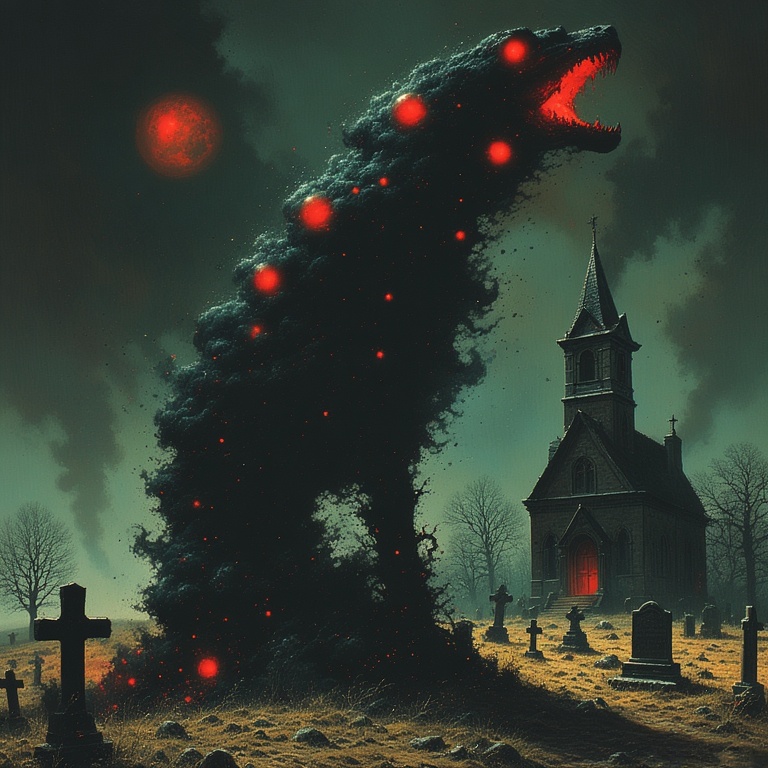
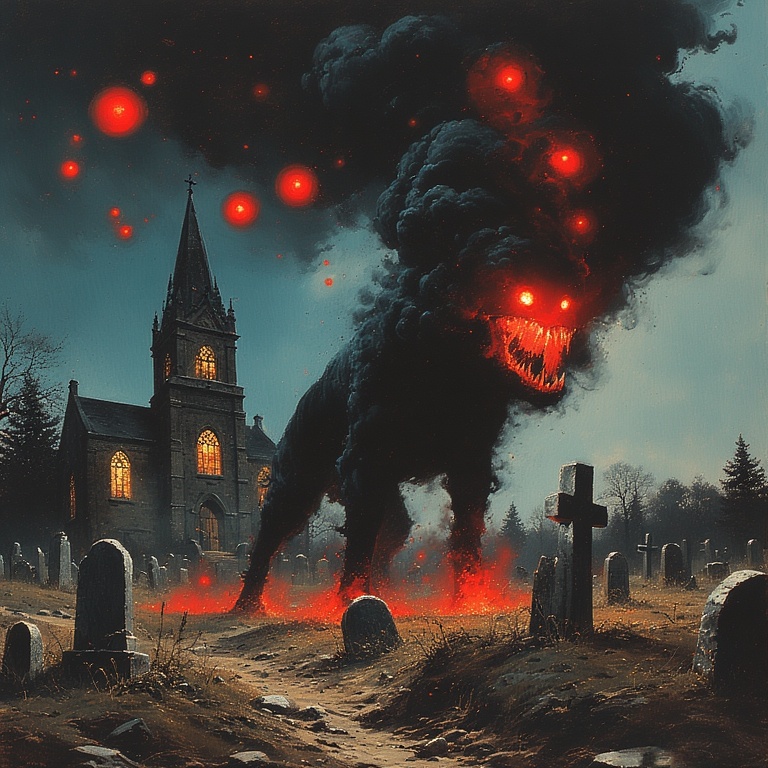
The Grim is a Verminous RAI most recognizable by its folkloric shape: a quadrupedal shadow, vaguely doglike only in that it runs like a hound and stalks like a Wolf. It has no real body—merely a floating cloud of oily darkness, swollen in places and thinning in others. Its eyes are glowing red motes, shifting number and position constantly. These pseudo-eyes are not sensory organs but projections of its hunt-state; they multiply as the Grim closes in on emotional instability.
Grims lurk primarily in the Subspace Boundary Threshold (SBT). Their presence in realspace is fragile—they can maintain partial manifestation only for seconds or minutes before dissipating. Because of this, they select stable “feeding sites” with frequent emotional turbulence. Graveyards, crime scenes, high-stress workplaces, and areas with unresolved communal guilt tend to attract them. In such places, sightings of ghostly dogs or phantom howls accumulate. Their “howl” is not sound but a psychic intrusion, a sudden eruption of shame, regret, or anticipatory dread that feels like a moral wound reopening.
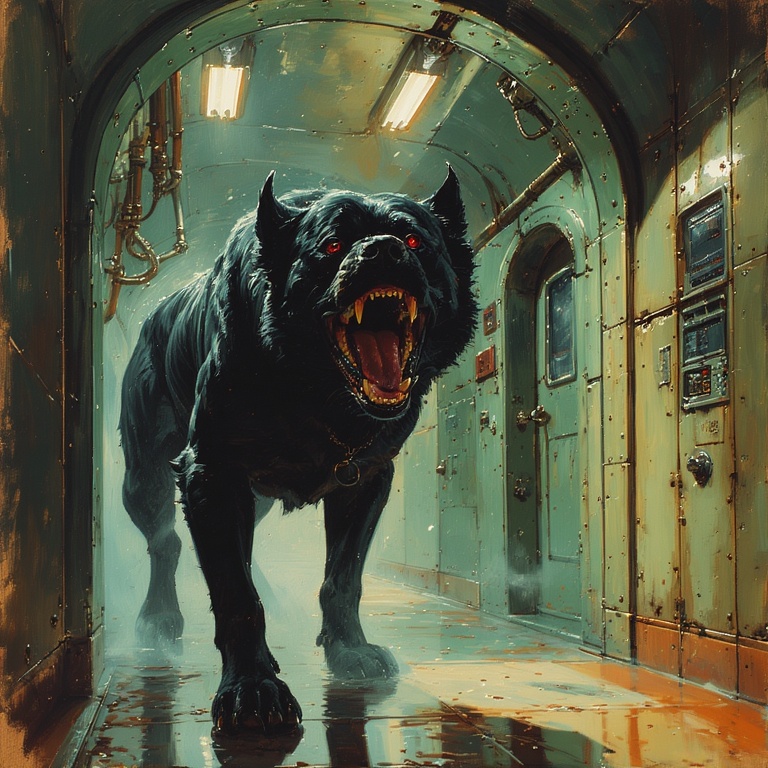
Anchoring is required for extended realspace presence. Kthonikers accomplish this by binding a Grim to organic material. The most common method is creating a Grim Hound—anchoring the entity to a living dog, turning it into a psychic guard animal. More desperate or reckless practitioners anchor the Grim to themselves, gaining an early-warning system at the cost of accelerated subspace contamination and a steady leak of sanity.
Prophylactic
The best defense against a Grim is emotional neutrality. Grims have extremely poor penetration; they cannot feed from a disciplined or self-assured mind. Individuals who refuse to feel shame, or who can compartmentalize remorse, are almost invisible to them. Corporate executives undergoing “guilt shedding therapy” often unintentionally repel Grims entirely—sometimes to their Kthoniker handlers’ frustration.
Illuminated areas hinder manifestation but do not harm Grims intrinsically. Their greatest vulnerability is psychological aggression. Unlike Umbers, Grims are not poisoned by anger, but sharp, directed hostility can disrupt their hunt-state and break their approach. Seekers of Wisdom teach a mental-shielding technique called Stone Mind, which quiets moral anxiety—starving Grims instantly.
A Grim anchored to organic matter must be neutralized by destroying or cleansing the anchor. Ritual severance, electromagnetic scrubbing, or targeted anti-subspace injections will disrupt their connection, forcing them back into Redspace.
Utility
Grims are popular among kthonikers and some Criminal groups as:
• trackers of fugitives wracked by guilt
• psychological attack dogs
• guardians that detect wrongdoing through emotional resonance
• alarm wards in hidden lairs or caches
More exotic practitioners anchor Grims to their own shadows, creating portable guilt-alarms. This is extraordinarily dangerous; the anchor’s emotional instability becomes a direct food source, spiraling into corruption.
Grim Assault
Regular; Resisted by Will
You unleash a bound Grim upon a target’s psyche. The Grim dives into the victim’s emotional shadow, tearing at guilt centers and feeding on their distress. On a failed Will roll, the target suffers Stress (Sanity Point) damage equal to 1d, or 1d+2 on a critical failure.
Duration: Instant.
Cost: 3
Grim Tracking
Regular
You call on a Grim to track a single target whose name you know. The Grim can “smell” guilt and anticipatory shame within the target’s subspace shadow. It tracks with effective Tracking-14, provided the target is capable of guilt.
Duration: 12 hours.
Cost: 4 to cast; 2 to maintain every 3 hours.
Prerequisite: Grim Assault.
Grim Guardian
Area
You bind a Grim to a location, anchoring it with a sacrifice of fresh organic material (blood, bone scrapings, or tissue). For the duration, the Grim attacks anyone entering the area who believes they are doing something they should not—thieves, trespassers, cheaters, smugglers, and the morally compromised alike.
On entering the area, such individuals must roll Will. Failure results in a Grim Assault (as above). Critical failure triggers two assaults in succession.
- Duration: 30 days.
- Base Cost: 5 (cannot be maintained).
- Prerequisite: Grim Tracking.
- Special Requirement: At least 1 HP worth of organic material.
Stat Block Lens: Grim Variant
Apply to the Verminous RAI (148-point) template.
Grim Lens
Add:
• Detect: Guilt/Regret (Precise; -10% Only on the emotionally vulnerable)
• Terror (Only manifests in mind; -50%)
• Insubstantial (Partial; brief realspace presence only)
• Enhanced Move (Subspace Loping)
• Vibration Sense (Emotional Aura)
• Aura (Stress Damage)
• Night Vision 10
• Weakness: Emotional Neutrality (Starved by lack of guilt)
Replace/Alter:
• Bully → Relentless (Emotionally Vulnerable Only)
• Reduce Sadism (Grims torment only through feeding, not malice)
• Remove physical attack traits—no realspace bite form
Skills/Behaviors:
• Stealth +8 (Shadowy)
• Tracking (Emotional) 14
• Innate Attack (Affliction: Stress)
• Detect Lies +4 (senses dissonance between action and conscience)

Comments