

Kha'zadun
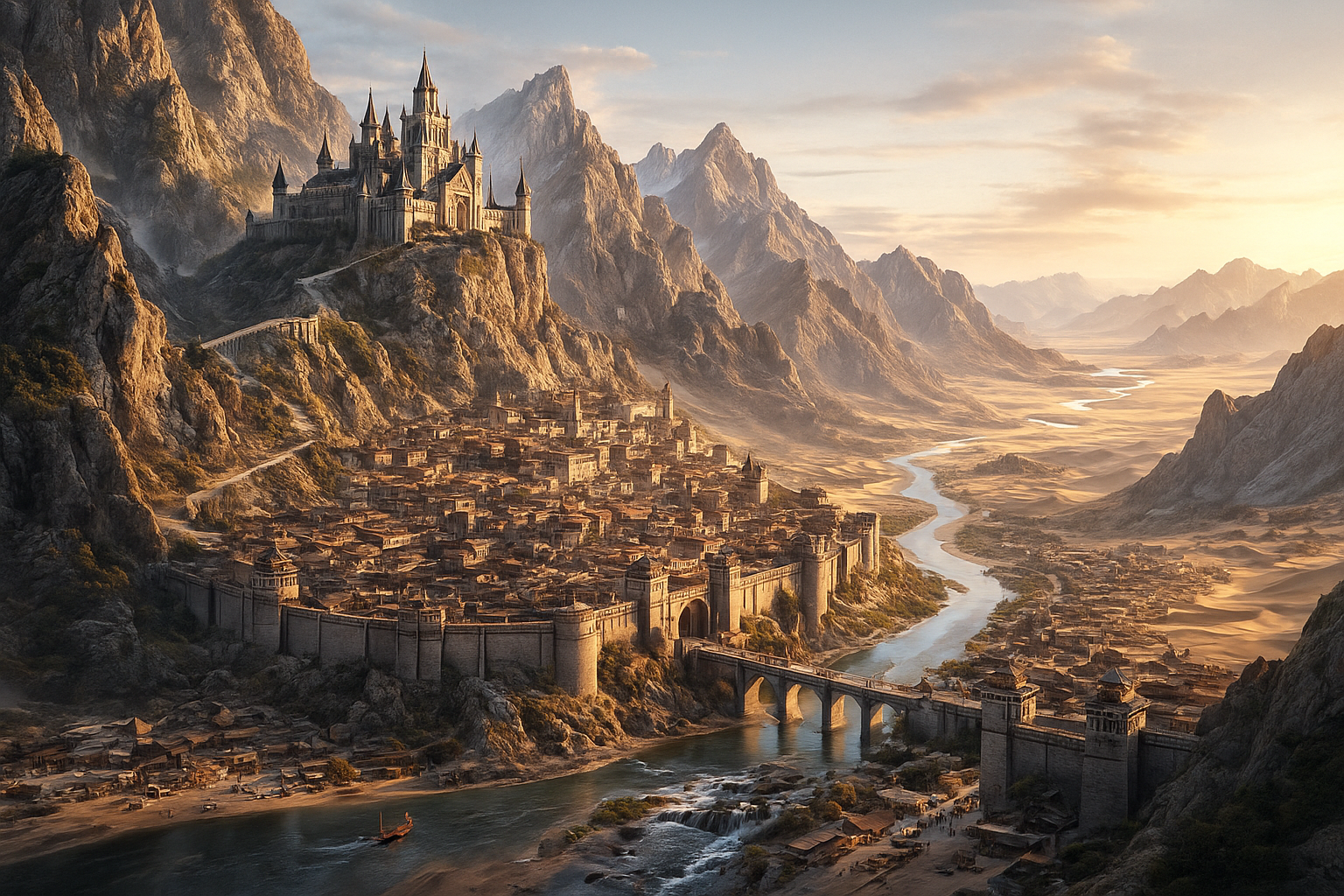
Kha’Zadun is one of the great urban giants of Dhuma, a city where sand, stone, and steel converge under a banner of hard-won unity. Built at the crossroads of several ancient caravan routes and nestled against a series of wind-carved mesas, the city grew from a cluster of war camps into a permanent stronghold of diplomacy, trade, and martial discipline. Today it stands as one of Dhuma’s most influential power centers — not because of its size alone, but because it houses the Temple of Unity, the headquarters of the Order of Arelian.
Though Dhuma is a land where leadership is won through strength, cunning, and merit rather than birthright, Kha’Zadun manages to blend this ethos with a rare streak of idealism. The Temple of Unity attracts warriors, mediators, chosen champions, and those seeking atonement or purpose. It is here that members of the Order of Arelian are tested, trained, indoctrinated, or purified — depending on which story one believes. The Order’s influence shapes the city’s identity: its streets are lined with sparring arenas, meditation halls, tactical academies, and shrines dedicated to discipline and clarity of purpose.
Kha’Zadun’s population reflects the diversity of Dhuma itself. Orcs, humans, Leonin, reptilian folk, caravan nomads, and even the occasional desert-adapted beastfolk call the city home. However, unity does not erase tension. The city is famous for its strict laws, structured dueling culture, and the fierce pride of its inhabitants. Conflicts are common, but chaos is not, every fight has rules, every warrior has a place, and every citizen understands the weight of living beside the Order that holds Dhuma’s factions together.
Architecturally, Kha’Zadun is a hybrid of desert practicality and monumental ambition. Towering sandstone citadels dominate the skyline, connected by bridges carved directly from the mesas. Markets sprawl across tiered terraces, shaded by colorful awnings and cooled by deep cisterns beneath the city. The Temple of Unity itself rises at the city’s heart: a massive structure of pale stone, etched with ancient script, whose central dome is said to echo like a heartbeat during sacred rites.
Kha’Zadun is a city of contrasts, harsh yet hopeful, disciplined yet diverse, shaped by conflict yet devoted to greater harmony. It is a place where Dhuma’s fractured clans find common ground, where warriors sharpen both their blades and their purpose, and where the Order of Arelian watches tirelessly to ensure that unity, once forged, is not lost.
Founding Date
318 CE (Calamity Era), formalized as a city in 27 HE (Harmonium Era)
Alternative Name(s)
Zadun, The Lower Sanctuary
Type
Large city
Population
85,000–110,000 permanent residents
Inhabitant Demonym
Kha’Zaduni
Among locals, the shortened form Zaduni is common, especially among soldiers, caravaners, and those who live closest to the mountain. Outsiders often use “Zaduni” to refer to the city’s people collectively.
Among locals, the shortened form Zaduni is common, especially among soldiers, caravaners, and those who live closest to the mountain. Outsiders often use “Zaduni” to refer to the city’s people collectively.
Location under
Ruling/Owning Rank
Owning Organization
History
Long before Dhuma laid claim to the region, the Zandari Mountains were largely uninhabited — a harsh, wind-scoured spine of stone that offered little to travelers beyond danger. It was the early Arelian explorers, guided by visions, arcane sensing, and the call of Velmorra’s threads, who discovered the divine convergence hidden high in the peaks. There, they established the first incarnation of the Temple of Unity, carving sanctuaries, halls, and ritual chambers directly into the living stone.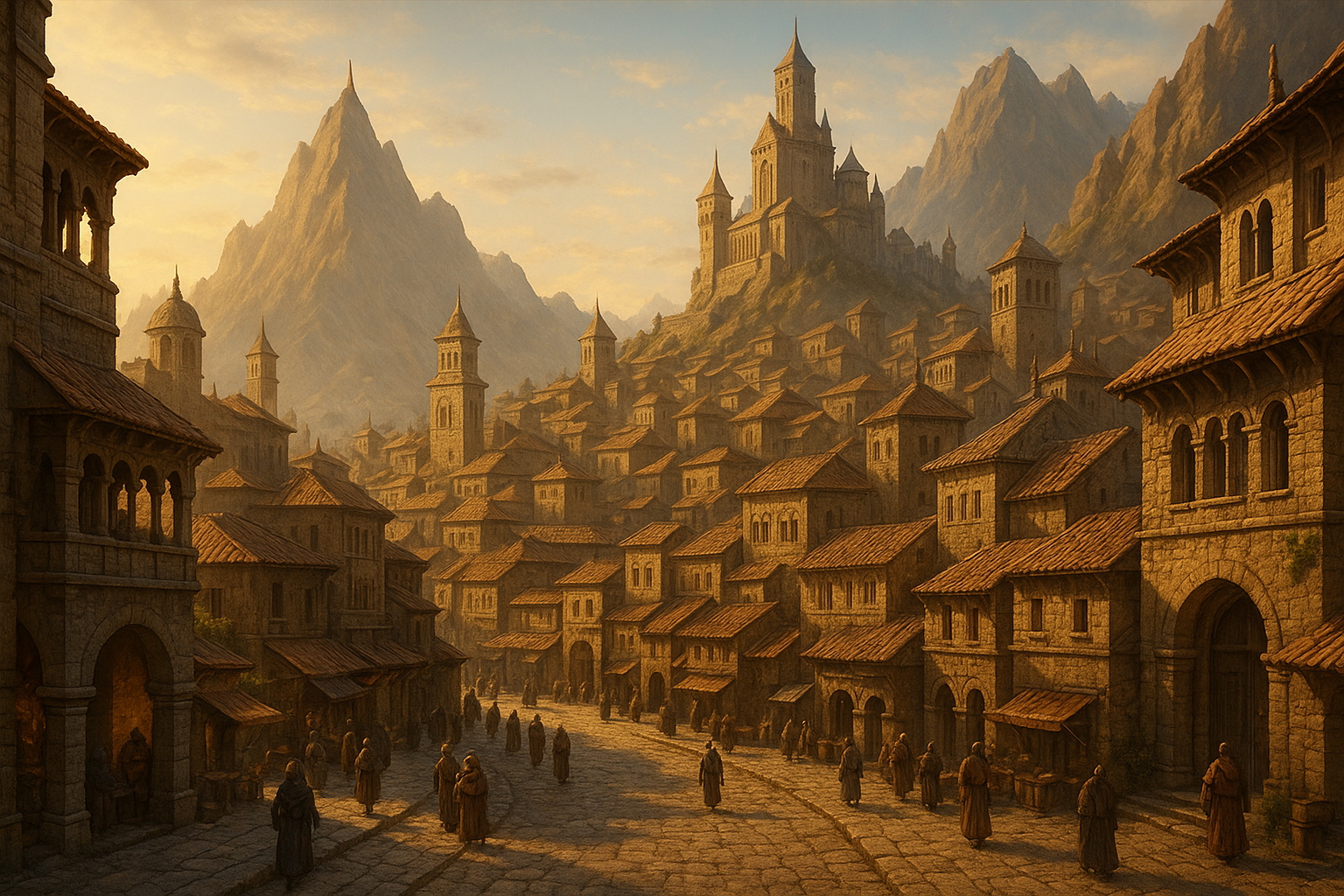
Demographics
The city’s demographics reflect Dhuma’s diverse and merit-based society. Orcs make up the largest portion of the population, followed closely by humans who settled around early clan encampments. Leonin families form another significant community, especially in the warrior districts and trade hubs. Smaller but notable populations of reptilian folk, Gnoll tribes, half-breeds, and various nomadic peoples live throughout the city, alongside a transient population of scholars, monks, and initiates visiting the Temple of Unity. Though varied in culture, the inhabitants share a deep respect for strength, discipline, and the ideals of unity promoted by the Order of Arelian. Clan identity remains central to many residents, but Kha’Zadun’s environment encourages cooperation and structure over rivalry.Demographic Breakdown
- Species Distribution
- Wealth & Social Class
- Clan Nobles / Arelian Officials — 6%
- Merchants, caravaneers, skilled artisans — 22%
- Soldiers, guardians, temple personnel — 31%
- Laborers, miners, builders — 28%
- Pilgrims & transients — 13% (fluctuates seasonally)
- Professional Distribution
- Warriors, guards, militia — 25%
- Trade professionals (sellers, caravan leaders, crafters) — 21%
- Religious roles (priests, threadmasters, acolytes, scholars) — 11%
- Manual labor (construction, mining, hauling) — 26%
- Service workers (taverns, guides, healers) — 10%
- Specialists (scribes, diplomats, medics, arcane experts) — 7%
- Ethnic / Cultural Backgrounds
- Desertborn Dhuma natives — 62%
- Mountain clans & Zandari ridgefolk — 14%
- Pilgrims from other Dhuman regions — 9%
- Foreign visitors — 8%
- Order-affiliated outsiders (Arelian trainees, scholars, diplomats) — 7%
Government
Kha’Zadun operates under a hybrid system that blends Dhuman clan governance with the stabilizing oversight of the Order of Arelian, creating a political structure unlike any other in the desert kingdom. The city is formally ruled by the Council of Clans, a body composed of representatives from the dominant Dhuman tribes who established the original settlement. Each representative earns their seat through merit, combat trials, acts of service, or political victories, ensuring the council reflects Dhuma’s cultural emphasis on strength, capability, and adaptability. While the Council of Clans handles day-to-day governance, law, and civil organization, their decisions are made with constant awareness of the power that rests in the mountains above. The presence of the Temple of Unity is a silent but profound influence: the council consults regularly with envoys of the Order, and no major decision is made without consideration of how it might affect the monastery’s security, secrecy, or sacred functions. The arrangement is unofficial yet unbreakable; the Order does not seek to rule Kha’Zadun, but everyone understands that the Order could if the city ever jeopardized its mission.Law & Order
Kha’Zadun’s civil law follows traditional Dhuman principles: direct, pragmatic, and focused on maintaining order in a land shaped by trial and merit. Duels, structured challenges, and public arbitration are common means of resolving disputes. Punishments tend to emphasize service, restitution, or public accountability over imprisonment. However, crimes involving the Temple, its initiates, or the secrecy of the Bonding rites are handled with extraordinary severity. In these rare cases, representatives of the Order may intervene directly, treating threats to the Temple as threats to the balance of Tanaria itself.Taxation & Civic Support
The city’s taxation system is minimalistic and practical, reflecting Dhuma’s nomadic traditions. Residents contribute through:- trade tariffs on caravans passing through the city,
- market fees for merchants within the bustling districts,
- service levies for large construction or civic works,
- and ceremonial offerings during Arelian festivals or temple-aligned observances.

Defenses
Kha’Zadun is one of the most secure cities in all of Dhuma, protected through a rare marriage of Dhuman martial tradition and the quiet, formidable presence of the Order of Arelian. Though the city maintains its own guard forces and militia, the true strength of its defense lies in the layered systems of vigilance shaped both by mortal steel and divine purpose.City Guard & Clan Militias
Primary defence of the streets and walls is handled by Kha’Zadun’s city guard, a disciplined force drawn from local clans. Leonin and orcish warriors form the backbone of this contingent, supported by reptilian scouts accustomed to navigating the rocky Zandari terrain. Clan militias rotate responsibility for the outer districts and caravan gates, ensuring that every major tribe maintains a direct investment in the city’s safety and stability. Dhuman martial culture prizes merit and readiness, so even common citizens are trained to respond to raids or desert threats.Fortifications & Mountain Architecture
The city’s architecture doubles as defence. Built at the base of the Zandari Mountains, Kha’Zadun is sheltered by natural stone ridges that limit direct assault. Narrow switchback roads and elevated terraces force attackers into chokepoints, while sandstone battlements provide ideal vantage points for archers and skirmishers. The mountain itself creates a natural barrier on one side of the city, turning any approach toward the Temple of Unity into a gauntlet of rock, narrow passes, and fortified lookouts.Protection of the Temple of Unity
Because Kha’Zadun lies directly beneath the Temple of Unity, its defenses are intimately tied to the monastery above. The sacred mountain paths leading to the Temple are guarded not only by city forces but by wards, sigils, and silent watchposts maintained by the Order. These protections ensure that no threat can ascend the mountain without being detected long before reaching the temple’s gates. The city serves as the first shield of the Temple, and the Temple in turn serves as the final, unbreakable bastion above.The Order’s Quiet Watch
Though the Order of Arelian rarely interferes in the city’s mundane affairs, their presence is an immense deterrent. Arelian initiates, Sahar, and Guardians routinely patrol the higher mountain paths, and their movements create a psychological buffer that prevents organized threats from even considering an assault on the region. The Order’s neutrality does not allow them to serve as Kha’Zadun’s army, but everyone knows the truth: if the Temple were endangered, the Order would respond with overwhelming force. Several subtle defensive measures, arcane wards carved into stone, protective inscriptions, and fate-aligned sigils, extend from the temple’s influence down into the upper terraces of the city. These are not openly discussed, as many are secrets known only to the Order, but their effects are unmistakable. Storms break more softly over Kha’Zadun. Malicious magic falters near the mountain’s base. Assassins and saboteurs often speak of “being watched” even when alone.Mutual Protection Pact
Kha’Zadun benefits from an unofficial but ironclad understanding: the Order will never allow the city below their sacred temple to fall, and in return, the city’s leaders ensure the Temple of Unity retains absolute autonomy and protection. This creates a stabilizing force unlike any other in Dhuma. Enemies rarely test Kha’Zadun’s defences—not because of its walls, but because of the monastery looming above them, carved into the stone like a divine sentinel.Districts
Kha’Zadun is large, old, and shaped by two dominant forces: the Desert Kingdom of Dhuma’s governance and the shadow-presence of the Order of Arelian, whose mountain monastery and the Temple of Unity define the city’s identity. The city’s layout presses against the Zandari Mountains, spreading outward in walled rings that follow the natural stone slopes. The districts reflect this dual nature: political power in the low city, spiritual and arcane influence climbing toward the mountains, and trade arteries radiating from its gates.1. The Mountain Gate District (Upper City)
- Closest to the Zandari cliffs, this elevated district serves as the formal threshold to the Arelian Path, the stone road leading upward to Arelian Keep.
- Populated by Order-aligned families, retired knights, scribes, magical artisans, and quartermasters.
- Architecture blends Dhuman stonework with Arelian minimalism: clean lines, pale stone, golden inlays.
- Heavily patrolled — the Order doesn’t rule here, but its presence is unmistakable.
2. The Temple District
Centered around the Temple of Unity, this district is the spiritual heart of Kha’Zadun.- A constant flow of pilgrims, scholars, and political envoys moving between temple courts.
- Order representatives and Dhuman officials often interact here — carefully.
- The Temple grounds include healing gardens, scriptoriums, meditation halls, and public forums where disputes are arbitrated.
- The architecture has a pale-gold shimmer, echoing the Temple’s iconic light displays.
3. The Grand Bazaar of Kha’Zadun
The beating economic heart of the city.- A massive, chaotic, brilliant market square fed by river docks and desert caravans.
- Filled with spice merchants, metalworkers, Arelian charm-smiths, leatherworkers, and foreign traders.
- Wealth ranges from extreme opulence to ragged survival — the Bazaar shows the true diversity of Dhuma.
- The Order rarely enters this region; Dhuman guards maintain order instead.
4. The River Quarter
Built along the river flowing from the mountains.- Home to fishermen, boatwrights, dyers, and river guild workers.
- Watermills and irrigation channels feed the city, making it the most vital working district.
- The river is fast and cold, fed directly from the Zandari peaks.
- This district intersects with the farmlands outside the walls, making it a lifeline for food production.
5. The Forgeward
Kha’Zadun’s industrial and martial district.- Smithies, foundries, and armories — many contracted by both Dhuma and the Order.
- Produces weapons, armor, magical metalwork, and stone tools.
- Run by a mix of orcish and leonin clans who maintain centuries-old craft dominance.
- Heat, smoke, and the ringing of steel define this area day and night.
6. The Hearth Warrens (Residential Districts)
The largest portion of the city, spreading outward in compact clusters.- Housing varies: mudbrick rows for workers, stone homes near the Bazaar, and larger compounds for clan families.
- Population is very mixed — humans, orcs, leonin, ailouron, gnolls, and reptilian folk live shoulder to shoulder.
- Small shrines to various Dhuman spirits and gods stand between homes.
- The Warrens are lively at all hours, known for festivals, firelight celebrations, and street food culture.
7. The Outer Ring / Gateward District
The first line of trade and defense.- Tall desert walls reinforced with stone imported from the Zandari Mountains.
- Includes caravanserais, stables, foreign inns, and inspection posts for desert travelers.
- A rough district but essential — everything entering Kha’Zadun flows through here.
8. The Arelian Path
Not technically a district but impossible to ignore.- A long, winding, fortified road carved into the mountain face.
- Leads from the Mountain Gate District to Arelian Keep, the Order’s mountain monastery.
- Guarded by both Dhuman forces and Arelian sentinels — a joint-control symbol of their mutual respect.
- Merchants travel it only with permission; commoners rarely see the Keep up close.


What a fascinating city. I love that it grew from the existance of a temple. I would enjoy walking the markets and down by the river for sure.
Explore Etrea | WorldEmber 2025