
Little Moscow
Industry & Trade
Like Little Italy, Little Moscow is a mixture of residential and retail areas. A tightly-packed string of light manufacturing or shipping processors continue to operate along the Lackawanna River waterfront. Businesses such as combination delicatessens with ethnic grocery store, neighborhood dives, folk pottery or lacquered tray shops, and specialized heritage restaurants predominate in the retail areas, not to mention the occasional refurbished electronics or handmade fibercraft carts. Polite tourists in groups of not less than eight, eager to spend cash, ready with a "Spasibo" however greatly mangled, are tolerated with varying degrees of amusement.
History
From its official annexation into the young city of Metropolis, Pennsylvania in the latter half of the nineteenth century, through the aftermath of The Great War, immigrants arrived daily from the northern Mediterranean Sea area and southern European continent. Thousands of them settled into the Lackawanna North Bank district; comparatively few moved onward to other communities in other cities. By the Roaring Twenties, however, that trend was overwhelmed by refugees from the Bolshevik Revolution's chaos. Traumatized by violence in their former home, the waves of newcomers all followed their Balkan predecessors to the Graham neighborhood. Soon Il Giornale referred to that area as "Moscow West", rather than "Graham". Once The Daily Planet adopted that same moniker, City Hall was sure to follow.
The neighborhood’s population grew and changed in the years leading up to and immediately after World War II as numerous Jews fleeing Nazi and Soviet oppression made it to Metropolis and settled down there. Thanks to their bravery and hard work, Moscow West today has several lovely temples and renowned Hebrew libraries; it’s also the home of the Hebrew University of Metropolis (see below).
Moscow West’s population remained steady or decreased in the years leading up to the late Seventies. At that point, Russian immigration to the area took an upswing.
Many of the refugees who succeeded in fleeing Soviet-controlled areas of eastern Europe and northern Asia brought with them what precious representations of their original cultures their community had managed to preserve. This turned some parts of the neighborhood into brightly colored, brashly flavored mosaics. Those who had withstood homogenization attempts were determined to be respected and uplifted among their new neighbors -- which ultimately required that they return respect in kind.
Unfortunately, the simplest means then available for refugees to emigrate was to be involved in a criminal organization. Too many of the new residents from 1978 through 1991 were hardened criminals. They shifted the local power structure heavily toward a polarized split: the would-be criminal overlords, a statistically small minority … and the traumatized citizenry on whom they preyed. Neither group cooperated with local law enforcement, nor the much less official Metropolis masked metahumans. The criminal set distrusted anyone they could not control, especially not mutants or mutates of the Metropolis Rogues. As for the targets of crime? They had learned too well in the early and mid 20th century that government authority might turn upon the people, or worse still: champions of justice can all too easily be crushed by the forces of evil.
For more than twenty years, Little Moscow's street crime statistics were close to nil. Imported criminal pros mingled with homegrown bully bands to victimize all residents of the neighborhood, whether they be Russian, Slovak, Kazakh, Nokhchiy, Crimean, Kumandin, Pole, Nanai, Latvian, or any other culture that faced Russification in its original lands. Crime happened in private, indoors and away from long sightlines, often in code. Official law enforcement worked hard to catch the villains in the act. They rarely found success.
Sometimes, even Metropolis SCU suffered heavy injuries without material results.
The tide turned slowly. It started near the end of the century, when Little Moscow became home to its own hard-hitting champion.
No reliable sources reported early hints of a masked mystery man in a trenchcoat and fedora. Those first trademark strips of litmus paper were discarded or dismissed.
Litmus earned the trust -- and, more importantly, the cooperation -- of the Little Moscow citizenry one deed at a time. He kept promises, whether kind or threatening. He spotted hidden cruelties that a less perceptive White Mask could never comprehend, and then he moved in to halt them. He listened to mumbled laments. He rescued missing neighbors. He tracked stolen merchandise. He never gave away any hint as to his true sources. He shouldered the blame for small acts of defiance.
He dismantled shipment-theft gangs.
He restored local access to the city wifi grid.
He stood up to the most terrifying masters of malice.
He made the Organizatsiya retreat … in fact, he may have turned them upon themselves!
As 2009 drifts into 2010, Litmus is still mistrusted by the forces of Law and Order through the rest of Metropolis. Here in Little Moscow, he is the only force for good that the citizens accept -- all others are the ones to labor under a blanket of Mistrust, whether they wear masks or no.
Points of interest
Landmarks that will get further adaptation!
Landmarks
Hebrew University Of Metropolis (6300 Cayuga Street):
Founded in 1948 by Simon ben Eshel, a rabbi born in Germany, HUM has grown from a small, little-known rabbinical college into a world-renowned institute for the study of Torah, Talmud, Jewish history and philosophy, and related subjects. Some of its professors are ranked among the most respected Jewish scholars in the world, and its library contains many rare and valuable texts. The HUM’s Board of Visitors is currently negotiating with the city for support and funding to expand the university.Slavic Languages Institute (6452 Oneida Street):
Half a school and half a translation service, the SLI was founded in 1981 to study Russian, other Slavic languages, and their literature. Unfortunately, scholarly study alone didn’t pay the bills, so the Institute slowly and painfully transformed itself into a paying business. In addition to teaching Westerners Russian, as a community service it teaches English as a second language to Russian immigrants.Shopping
Most of the shops and stores in Little Moscow are the typical small, family-run businesses you’d find in almost any big-city neighborhood. But a few stand out from the crowd.Iron Curtain Imports (northwest corner of Meade Avenue and Huron Street):
The motto under the sign reads “Bringing the Biggest Yard Sale in World History Direct to You!”, and that’s a pretty accurate assessment of the situation. Owner Leon Alexandrov buys surplus Soviet military and government goods, ships them to this country, and puts them on sale as Cold War curios. Given the way the kleptocrats in Russia are selling off their country piecemeal for a quick buck, he can get just about anything if the price is right and it’s legal to export and import. He also occasionally deals in genuine Russian art and antiquities for selected customers. Most of his business is by mail order, but his store in Little Moscow allows for plenty of walk-in shopping.Lukin Tobacconists (southwest corner of Coyle Avenue and Huron Street):
Smoking is one of many vices that many Russians indulge in to excess — and some who’ve come to this country miss their favorite brands from back home. Lukin Tobacconists carries not only common American brands of cigarettes, but a wide variety of smokes from the Old Country.On the Town
If you find yourself in Moscow West with a desire to wet your whistle or have a bite to eat, try these places.Red Square (346 Graham Avenue):
Russian cuisine isn’t exactly the most popular ethnic food in Metropolis, but there are some — including many in Little Moscow — who enjoy it. And the best place in town to get it is Red Square, an understated but refined restaurant opened in 1989 by Russian emigre Alyosha Chernyshev and his wife Stepanida. Decorated in a style that mixes traditional Russian motifs with modern American flair, it appeals to native and immigrant alike.White And Black (244 Joyce Avenue):
Dark and a little dank, this bar is a lot like many in Russia — and that’s the whole point. It caters mainly to residents who want to drink in familiar surroundings, not to visitors or tourists. Most tables have a chess set on them in case anyone wants to play a game; some of Little Moscow’s old men — including, rumors say, some mafioski — sit here nearly all day, every day playing chess and sipping vodka.Steven S. Long, reporting in HC:tUA, page 74
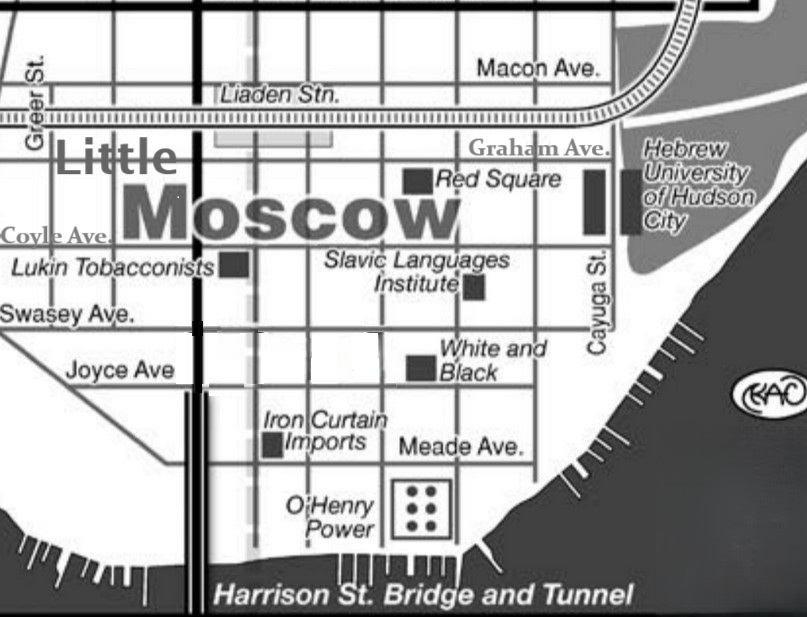
by Keith Curtis
North-South Streets
from west to east:- Greer St.
- Cornwallis St.
- N. Harrison St.
- Huron St.
- Iroquois St.
- Algonquin St.
- Gneida St.
- Seneca St.
- Cayuga St.
East-West Avenues
from north to south:- LeMastre Ave
- Macon Ave
- Lackawanna North Elevated Loop
- Graham Ave
- Coyle Ave
- Swasey Ave
- Joyce Ave
- Meade Ave
Disastrous Cultural Appropriation
Over the half-century and more that this neighborhood has been known for its Eastern European atmosphere, five distinct costumed metahumans have announced themselves as "Baba Yaga".
In each case -- regardless of intent toward heroism or villainy -- their costumed career came to a disastrous end after exactly four public forays.
A lesson might be hidden here: do not impersonate an old Power!
(Or it might be, simply, that a meta determined to skate through via premade identities is unlikely to have prepared for the challenges they will face after their flashy debut.)

Comments