Hidalgo's Troupe
Hidalgo’s Troupe is one of the most iconic floating performance companies of Espen’s ash-ridden archipelago. Born in the aftermath of The Burn, it is equal parts circus, travelling theatre, musical caravan, and—whisper it—smuggling operation. To many settlements, their arrival is still a rare spark of colour and hope. To others, it is the herald of trouble.
The troupe’s legacy is inseparable from the short, brilliant, and ultimately tragic life of its founder, Hidalgo Rodolfo Herreira—whose murder in 1868 still casts a long shadow over the Painted Barge.
Origins
Hidalgo Herreira was born on Mirar Island, the son of a rope maker. When The Burn ravaged Espen, famine and disease claimed his entire family before he turned sixteen. In the desperate, lawless months that followed, young Hidalgo did the unthinkable:
He stole an unfinished barge straight from the Mirar shipyards.
Barely more than ribs and planking, it was half-built and slick with pitch. Under cover of ash-fog, Hidalgo dragged it into open water and vanished. He rebuilt it by hand, learning carpentry through scars and splinters. Then he painted it in wild, defiant colours that made it unrecognisable.
Having grown up installing rigging with his father, he was already a gifted rope runner—swinging, climbing, vaulting, and performing stunts that seemed impossible. At first he performed simply to survive, trading shows for food scraps at scattered survivor settlements.
But Hidalgo was clever.
He realised performance gave him a reason to travel—and that the floating settlements of Espen were hungry not just for food, but for stories.
And for a courier who could pass unnoticed beneath the guise of art.
Thus, in 1824 AF, at the age of sixteen, Hidalgo officially founded Hidalgo’s Troupe.
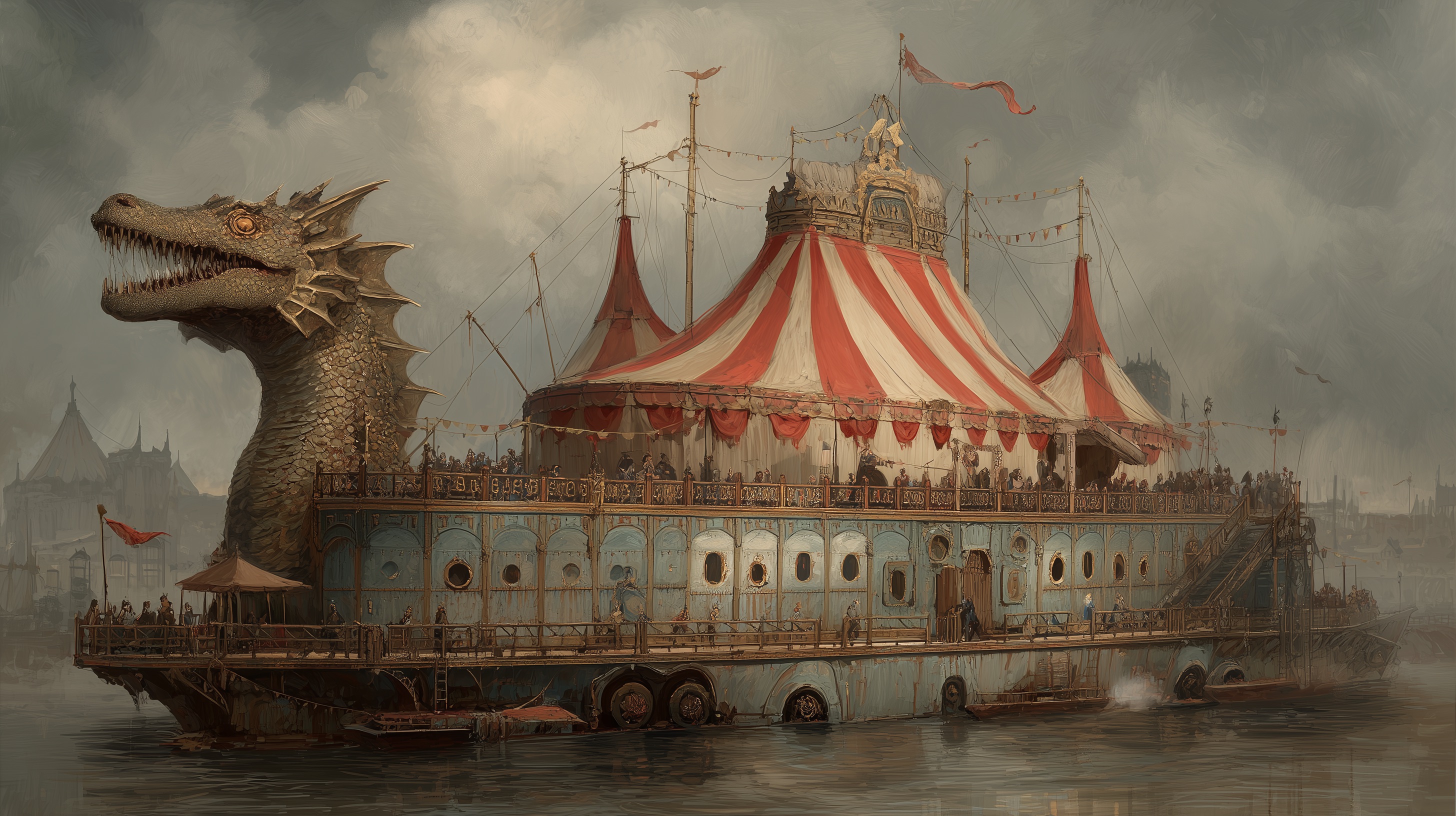
The Painted Barge
The Painted Barge was never meant to become a legend. It began life as a half-finished frame in the Mirar shipyards—no more than a ribcage of timbers, leaking pitch, and loosely hammered planks. When sixteen-year-old Hidalgo Herreira stole it under cover of ash and famine, even he couldn’t have imagined what it would one day become. But like its creator, the barge refused to die quietly. It grew, changed, and took on a strange sort of soul.
In its earliest years, the barge was held together by stubbornness and rope. Hidalgo replaced missing planks with scavenged driftwood, patched cracks with tar scraped from abandoned ships, and repainted the whole vessel in the brightest pigments he could find. Locals joked that it looked like a carnival had run aground. But the colours were a deliberate choice: a defiant scream of life against a world choked by ash.
Over the decades, the barge expanded. What was once a simple deck became a labyrinth of collapsible platforms, swinging stages, and pulley-driven rigs that folded and unfolded like a mechanical flower. Every new performer added something—an anchor point for acrobatics, a hidden hatch for illusions, a fire-proofed platform for flame dancing. By the 1850s, the barge was less a vessel and more a floating theatre complex, rebuilt so many times that no one—not even Hidalgo himself—remembered which pieces were original.
At the heart of it all was the Rigging Tower, a spiralling scaffold of salvaged masts and crossbeams rising from the centre of the deck. It was here that Hidalgo performed his most daring rope acts, climbing as easily as breathing. After his death, performers claim the tower creaks differently, as though aware of its loss.
The living quarters below deck were narrower and more crowded than any land dweller could tolerate, but to the troupe it was home: a warren of fabric-draped alcoves, warm lamplight, mismatched furniture, and walls plastered with handbills from decades of performances. Every morning smelled of smoke, saltwater, and Trusk’s questionable cooking. Every night pulsed with music.
Hidden deep within the hull were compartments known only to a few—narrow spaces built during Hidalgo’s early smuggling years. Some held contraband. Others stored costumes or delicate props. One, according to rumour, held a locked chest that only Hidalgo ever opened.
The barge’s most iconic feature, however, was the Bow Dragon: a massive figurehead salvaged from a wrecked pre-Burn ship. Its wooden scales were repainted every year in shimmering colours that caught the sunlight like oil on water. Children who watched it approach from the shore swore the dragon blinked. Old sailors claimed it protected the troupe. A few whispered that it demanded payment.
By the time of Hidalgo’s murder in Nether 1868, the Painted Barge had become more than a vessel or a stage. It was a floating myth—a symbol of survival, defiance, and artistry carved from the ruins of The Burn. When the troupe drifts into a settlement, the barge still draws crowds long before the performers take the stage. Something about it—its riot of colour, its creaking rigging, its dragon-painted prow—suggests that even now, long after Hidalgo’s death, the barge remembers every mile it has travelled… and every secret it still carries.
Growth of the Troupe
In the beginning, Hidalgo performed alone. A single boy on a half-rebuilt barge, swinging from homemade rigging and telling ash-soaked stories to half-starved survivors who paid him in old biscuits and rumours. But as the years passed, the Painted Barge became a beacon—a rare flicker of colour drifting through the grey waters of Espen—and it began to attract kindred spirits.
The first to join was Julietta Morán, though she insisted for decades that she had recruited him. Hidalgo met her in a collapsing tavern on the western side of Mirar where she was singing for a bowl of soup. Her voice, cracked by famine but still fierce, stilled the room. Hidalgo approached her after the show, intending to offer a partnership; Julietta interrupted him with, “You need someone who can sing. And keep you alive. I do both.”
She boarded the barge the very next morning.
With Julietta’s presence, the shows grew in complexity and ambition. Word spread quickly. Soon others began drifting toward the Painted Barge—drawn by music, firelight, or simply the promise of a place to belong.
The troupe coming together
The creation of the troupe is a legend the troupe propagates as part of their regular performance. Branding themselves as a family of misfits that over the years grew to become a family tied together in the stormy seas.
Maribel “Miri” Cloudstep joined during a storm that should have drowned her. The troupe spotted her clinging to a broken spar, spinning on the waves like a scrap of silk. They hauled her aboard expecting a frightened castaway. Instead, Miri stood, wrung out her hair, and asked, “Do you have a mast? I dance better in storms.”
She began performing aerial silks that very night, swaying over the deck as lightning forked across the sky. From then on, she was family.
Tessa and Timo Blayke were found pickpocketing audience members during a performance in the settlement of Three Ropes. Hidalgo invited them to watch from backstage in the hope of discouraging their thievery. Instead, the twins were mesmerized by the show—especially the juggling—and returned the stolen goods voluntarily. Then, in unison, they said:
“We could juggle knives.”
Hidalgo gave them a chance. The next morning they performed a perfectly timed knife routine… using blades they definitely had not obtained legally.
Old Arko arrived claiming he could lift “a full-grown bull and two stubborn wives.” No one believed him until he hoisted a water barrel over his head with one hand and carried it the entire length of the deck. Hidalgo hired him on the spot. Arko has been eighty for at least forty years and continues to insist he is “mostly cartilage now.”
Saffron Lyre, the fire-eater, came to the troupe after accidentally burning down a fish market in a northern fishing settlement of Lilianth . Pursued by angry merchants, she dove straight into the Painted Barge’s water drums during a performance. She climbed out steaming, bowed, and improvised a fire act using embers from the cooking pit.
Julietta lectured her about safety. Hidalgo hired her immediately.
Pip the Tiny, the contortionist, was discovered inside one of the barge’s storage crates—no one knows how he got in or when. They found him curled atop the folded costumes during a storm. Instead of panicking, he simply stretched, smiled, and asked if he could stay. The troupe has been unable to get rid of him ever since (not for lack of trying).
Dorian Mads joined after Julietta spotted him manipulating shards of mirror light to create illusions during a barter market. His show was crude, but the idea was brilliant. When locals accused him of witchcraft, he fled onto the Painted Barge, knocking over three crates and a goat in the process. Hidalgo offered him refuge; Dorian repaid the kindness by inventing some of the troupe’s most iconic illusions.
Ishka Veld, the sword-dancer, came aboard after challenging Hidalgo to a duel—apparently he had “stolen the heart” of a girl she’d been courting. Hidalgo had no idea who the girl was, but Julietta stepped between them, laughed, and invited Ishka to perform instead. Her first dance was so beautiful, the audience wept. By morning she had a bunk and a place on the roster.
Granny Oxa appeared without warning one fog-heavy morning, sitting cross-legged at the prow as though she had always belonged there. No one had seen her board. No one knew her name. She simply smiled and said, “Hidalgo, you’ll need someone who can see ahead.”
He kept her on, partly out of curiosity—and partly because she unnerved him. She still unnerves everyone.
The Smudge Brothers came as a set. They had been chimney-sweep apprentices who turned to charcoal pantomime after The Burn erased their trade. Their act was already polished, but it was their comedic timing—chaotic, uncanny, and occasionally dangerous—that won Julietta over.
Yani of the Drifts joined when his floating percussion raft broke apart beside the Painted Barge. He salvaged his instruments, fashioned three new ones from driftwood on the spot, and performed a rhythm so hypnotic that audience members threw coin at him before he had officially joined the show. Hidalgo called it fate; Yani called it “a lucky tide.”
Cerise Lantó, the costume-maker, appeared after a show in which half the troupe’s garments were ruined by a surprise drizzle. Cerise marched aboard, insulted everyone’s sewing skills, and remade five costumes overnight using nothing but scraps. No one dared refuse her boarding.
Filo Reed, the flutist, wandered onto the barge sleepwalking during a moonlit night. He played a tune so haunting that the fish surfaced to listen and even the waves seemed to quiet. In the morning he claimed not to remember any of it, but the troupe refused to let him leave.
The Crew Behind the Curtain
Copper Marn joined after jury-rigging a lighting rig from broken lamps and an Electrum shard during a blackout. His genius was undeniable; his temper was legendary. The troupe accepted both.
Glinna Hobbs, the animal trainer, was followed aboard by two trained cormorants, three ash-cats, and a goat named Pringle. Hidalgo hired her because he feared she’d bring the animals back even if he said no.
Sootie simply appeared one morning, sweeping the deck. No one knows where he came from. No one can recall inviting him. When asked, he just shrugs. After Hidalgo’s murder, some whisper that Sootie knows more than he lets on.
Current Artists of Hidalgo’s Troupe
Below is the troupe’s known roster around the time of Hidalgo’s death in 1869.
Leadership & Founding Family
- Julietta Morán — Lead performer; singer and negotiator. Now the de facto leader after Hidalgo’s death.
- Mateo Herreira — Eldest son; pyrotechnics master and stage Engineer.
- Rafaelo Herreira — Acrobat and charismatic crowd-pleaser.
- Silvio Herreira — Quartermaster; oversees goods, coin, and supplies.
- Nico Herreira — Youngest son; magician, sleight-of-hand artist, and habitual troublemaker.
Performers & Specialists
- Maribel “Miri” Cloudstep — Aerial silks performer who dances above the sea.
- Tessa & Timo Blayke — Knife-juggling twins who often switch roles mid-show.
- Old Arko — Strongman with a legendary (and possibly mythical) age of 112.
- Saffron Lyre — Fire-eater known for blue and green flame techniques.
- Pip the Tiny — Contortionist capable of fitting into baskets and barrels.
- Dorian Mads — Illusionist using salvaged pre-Burn mirrors.
- Ishka Veld — Sword-dancer whose performances reenact storm myths.
- Granny Oxa — Blind fortune teller claiming she foresaw Hidalgo’s murder.
- The Smudge Brothers — Charcoal-clown trio performing slapstick pantomimes.
- Yani of the Drifts — Water-drummer using floating percussion.
- Cerise Lantó — Costume master and quick-change illusionist.
- Filo Reed — Flutist whose haunting tunes can lure fish—and silence crowds.
Stagehands & Crew
- Copper Marn — Lighting master; expert with Electrum glows and precision mirrors.
- Jeb and Jori — Stage constructors famed for their speed and complaints.
- Martha Coils — Rope-runner and rigging caretaker.
- Trusk — Cook whose food always tastes faintly of smoke.
- Glinna Hobbs — Animal trainer with cormorants and ash-cats.
- Sootie — Silent odd-job worker of unknown origin.

Is this your RPG group that I watched? I love stuff like this!
Learn about the World of Wizard's Peak. Visit my Worldember 2025 Hub as I work on 50,000 words in December!