Lilianth
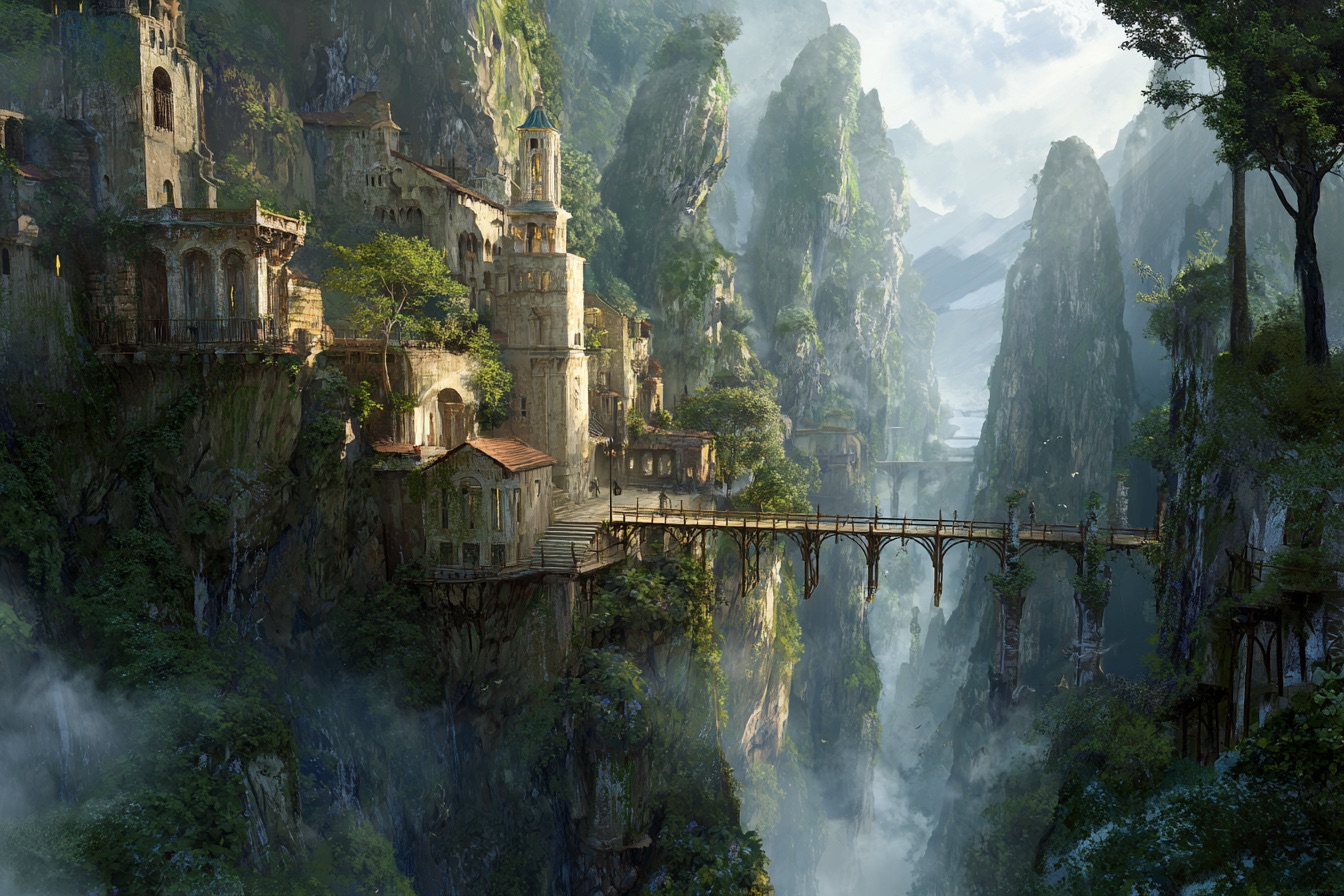
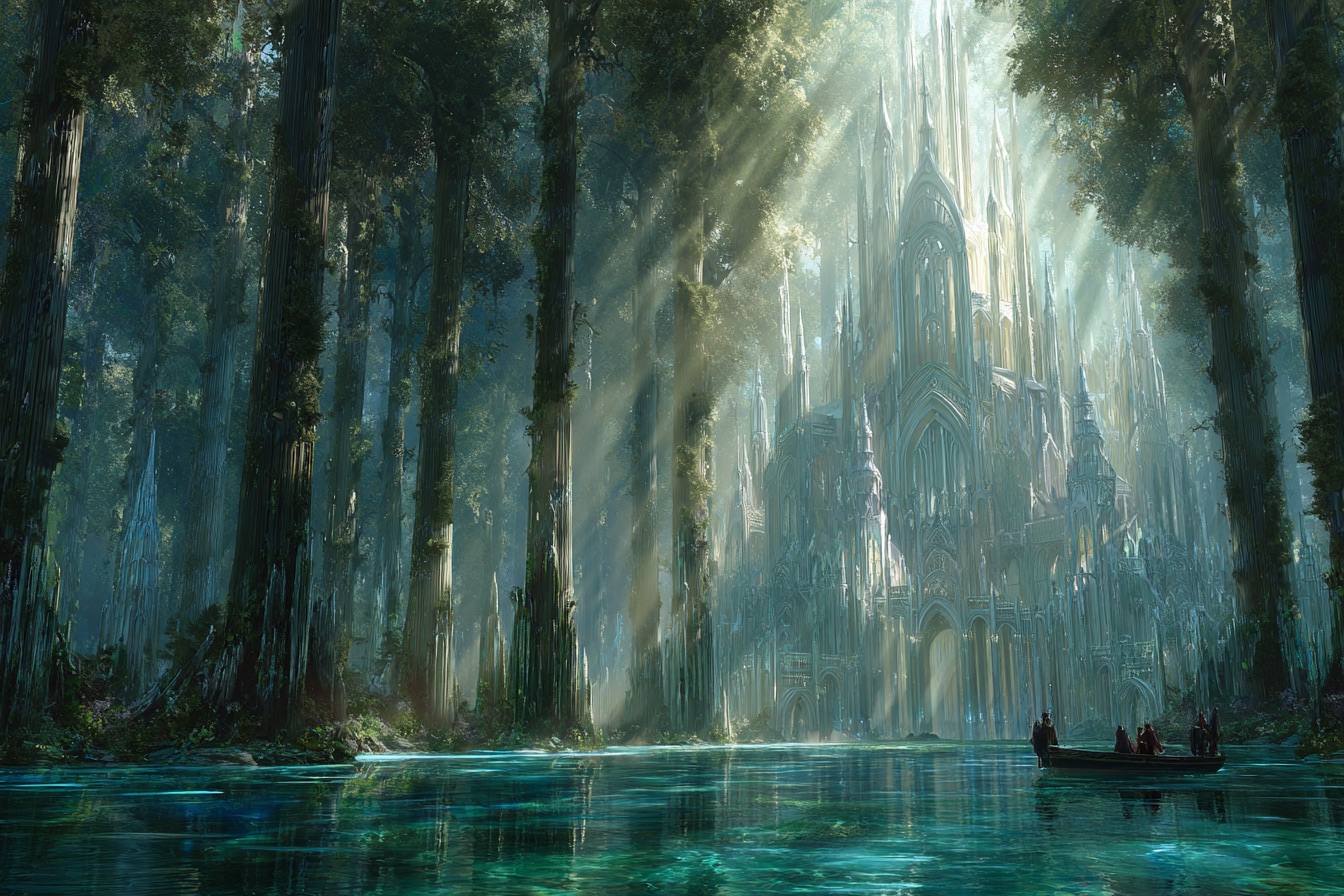
Lilianth rises like a dream from the misted crown of an ancient forest—one of the last untouched high-altitude groves in all of Nyria. To walk its airy streets or pass beneath its vaulted bridges is to witness a rare pact between nature and civilization, forged over centuries and upheld with almost religious devotion. Here, metallic columns gleam like silver trunks between real ones, lifting whole districts gently above the forest floor so that not a single root of the sacred groves must be disturbed. The city neither crushes the ancient woodland nor hides from it; instead, Lilianth weaves itself through the massive trees, spiralling around them, rising over them, and embracing the sheer cliffs and ridges that break through the canopy like stone leviathans.
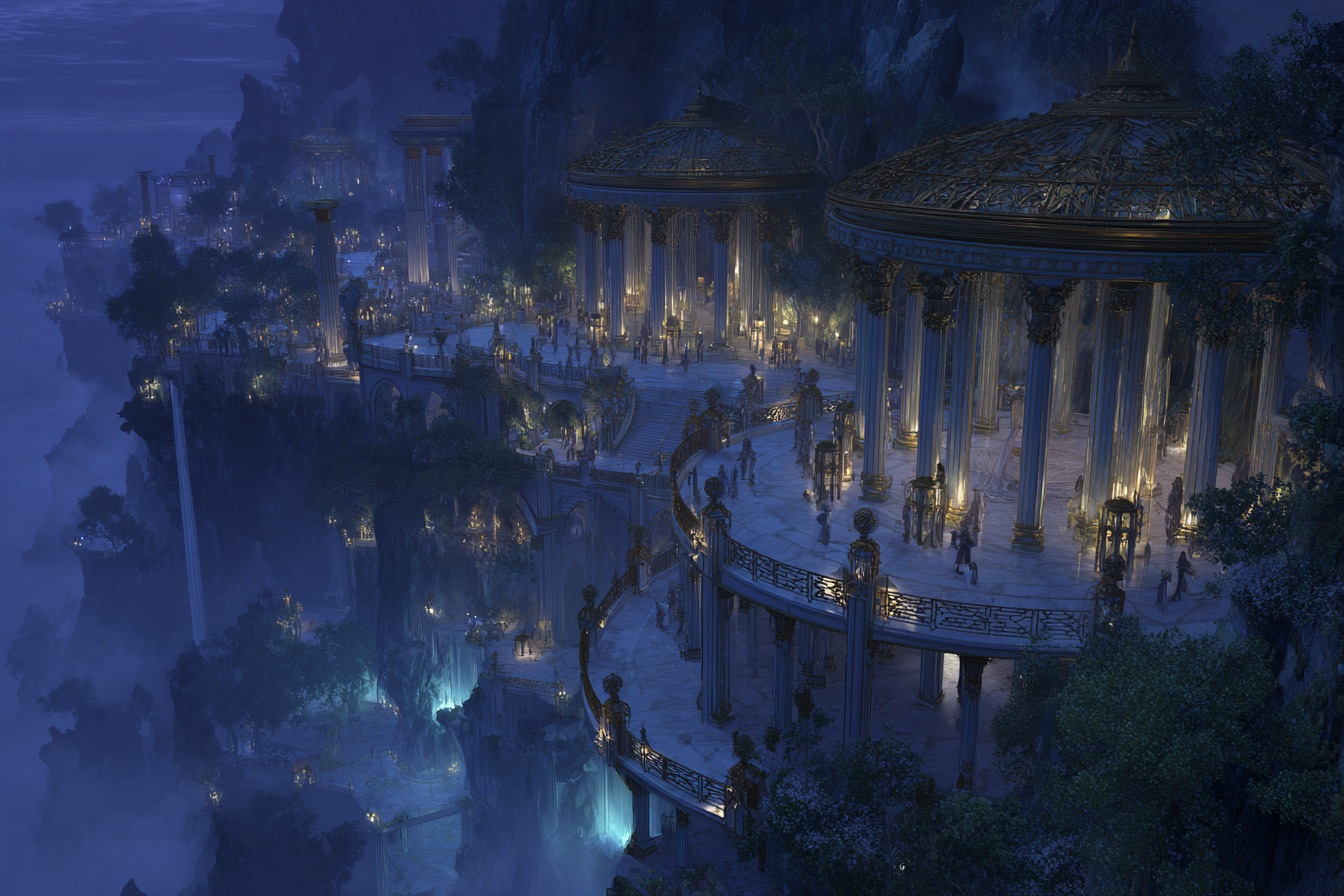
The result is a metropolis suspended partly in the air, partly anchored in living earth, and partly hanging from the sheer faces of the mountains that cradle the grove. Homes and public halls cling to precipices; open plazas look out over chasms filled with drifting cloud; and above it all rise white marble structures from an age so old that their makers are known only through guessing. These temples were standing long before Lilianth was ever a city—back when this forest was a sacred highland sanctuary dedicated to Eldi. Pilgrims once climbed narrow mountain paths to worship in the rime-lit mornings, and their offerings still lie buried beneath the marble floors. The modern city was built around these remnants, never over them, and the people of Lilianth still treat the old stones with a quiet reverence.
Beyond the forest’s heart, the drowned spires of Lílitu—an ancient city swallowed by the sea—still break the waves that surround Lilianth’s island. Their slender silhouettes create a jagged white crown visible from many of Lilianth’s skywalks and balconies. On calm days, when the waters lie smooth as glass, the shapes of whole avenues can be glimpsed below the surface, as if waiting for the world to remember them.
Today 325,000 souls call Lilianth home, making it by far the most cosmopolitan place in the entire Altian Ocean. Merchants from the Ardent Coast, scholars from the Leidenstein Consortium, diplomats from the Espen Kingdom, and wanderers from every corner of Nyria mingle beneath its suspended walkways and sun-dappled canopies. As the capital of the Thierry Free States, Lilianth also hosts the new Parliament, installed here during the Aladan occupation of 1867 AF, when the former seat in Alada fell under the control of the Leidenstein Consortium. The parliament chambers—neither fortress nor palace, but an open-roofed ring of marble and bronze—symbolize the wishes of the Free States to conduct governance in the light of day.
Despite its size and importance, Lilianth is strikingly free of heavy industry. The city’s air remains sharp and clean, perfumed by pine, wild resin, and mountain wind. The thunder of factories is found elsewhere: on Reliana Island, far to the east, whose foundries and shipworks serve the capital without ever intruding into the forest that gave Lilianth its soul.
The city itself occupies the second-largest island of a sprawling archipelago of twenty-five. The largest, Aleera, is a gentle expanse of terraced farmland and orchards, feeding both the capital and the islands nearby. Celia Peak rises as a narrow spine of cliffs and dense habitation, seamlessly extending Lilianth’s urban sprawl across clustered bridges and wind-hung platforms. Reliana, the industrial outlier, broods further away than the others, its furnaces glowing faintly at night like a second string of stars on the horizon. The remaining islands dot the sea like scattered emeralds, each small enough to support a fishing hamlet or a quiet cluster of agricultural families whose livelihoods orbit the capital as faithfully as the tides.
Lilianth is a city where old gods watch from broken stone, where the forest breathes beneath steel supports, where sea and sky frame every avenue, and where the future of the Free States is debated every day above the whisper of ancient leaves. It is a place that feels both impossibly old and defiantly new—a sanctuary that became a city and a city striving never to forget it is a sanctuary.
Places of Interest in Lilianth
The Hanging Forum of Eldi is the spiritual and civic heart of the city, suspended between three colossal sequoias whose trunks are older than recorded history. Bronze walkways curve between the trees like living veins, converging upon a central platform large enough to host hundreds. Here, the citizens of Lilianth gather to hear philosophical debates, public announcements, and celebrations of the equinoxes. Wind chimes made from polished electrum sing softly in the mountain air, giving even the most heated arguments a strangely tranquil backdrop.
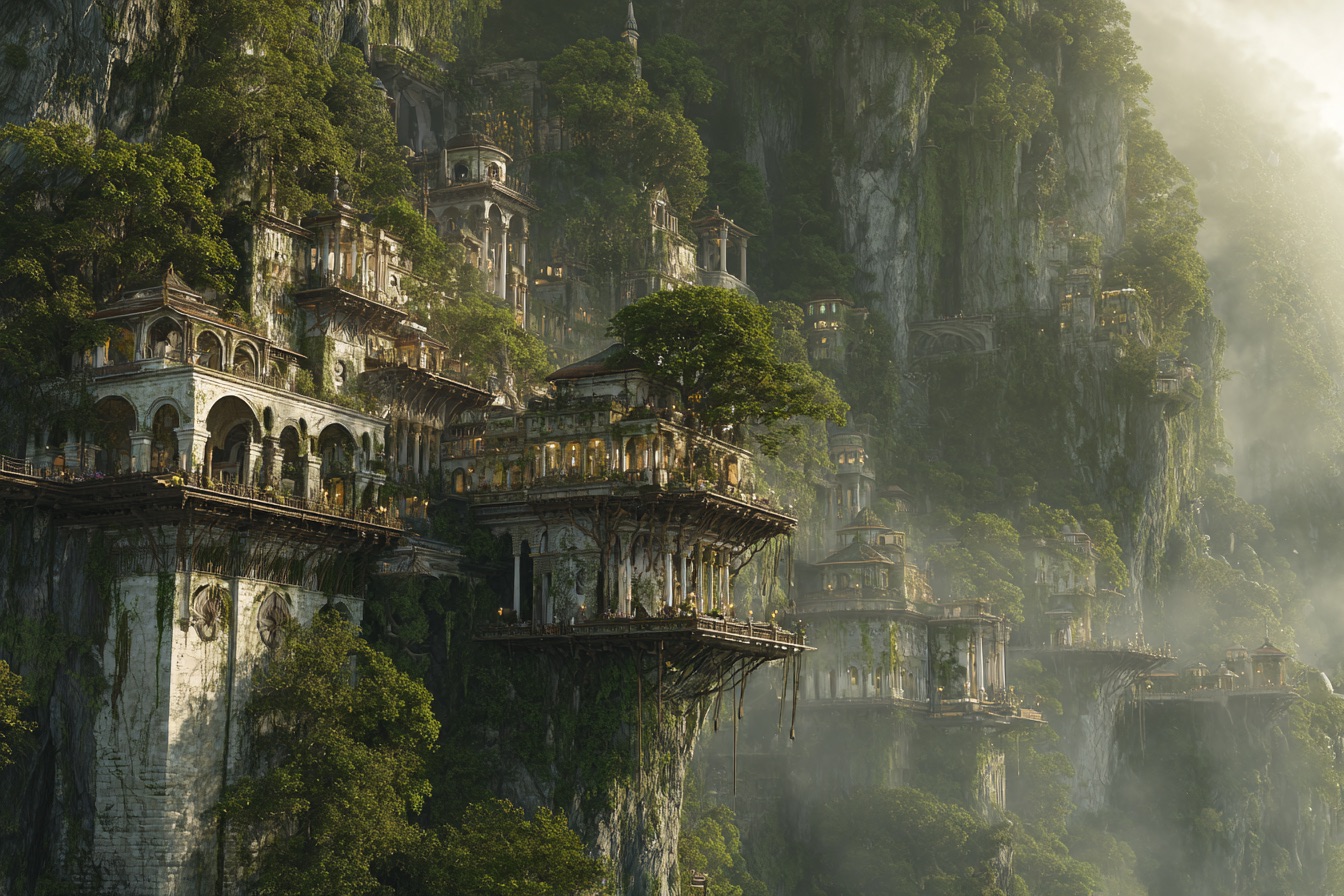
Further into the depths of the forest lies the Marble Path of Lílitu, a winding promenade carved from the white stone that once paved the ancient, drowned city. These slabs were lifted from the sea floor generations ago and repurposed with careful reverence. The path glows faintly at night, catching the moonlight in a way no modern craft has been able to replicate. It leads pilgrims, scholars, and the simply curious from the lower city up toward the oldest temples and shrines, each turn offering views of submerged towers shimmering beneath the waves.
The Temple of Silent Echoes rises from a cliff edge overlooking the forest canopy, a remnant of the original Eldic high-grove. Its interior is famously quiet—so quiet, in fact, that distant waves can sometimes be heard breaking on the shores far below. Lilianth’s inhabitants believe that the silence inside the temple is not merely architectural but intentional, as if the air itself refuses to disturb the meditations of those who enter. Pilgrims come here seeking clarity and leave unsettled by how clearly they can hear their own fears, desires, and half-formed hopes.
Near the parliamentary district stands the Spiral Archives, an immense cylindrical tower built around the trunk of a massive living tree. Inside, the floors rotate slowly—driven by wind mechanisms—so that librarians and researchers can access the countless alcoves carved into the walls without needing ladders or lifts. The Archives house everything from pre-Burn manuscripts to treaties drafted in the wake of the Aladan occupation, making it one of the most carefully protected repositories in the Free States.
Perched along the cliffs facing the western sea is the Skyglass Quarter, a district famed for its vibrant artisans and airy studios. Many structures here feature translucent skyglass windows that catch the morning light and scatter it into colorful patterns across streets and terraces. Sculptors, painters, and instrument-makers cluster in this elevated warren, where the view is so overwhelming that some visitors find themselves dizzy with inspiration—or vertigo. It is here that the annual Festival of Winds begins, releasing thousands of colored kites that rise over the forest canopy like migrating birds.
At the city’s northern edge, where the cliffs plunge sharply toward the sea, stands the Lílitu Beacon, a lighthouse built atop the tallest surviving spire of the drowned city. The structure merges ancient stone with modern electrum mechanisms, casting a steady blue-white light across the archipelago. Sailors swear the Beacon sings on stormy nights—low, resonant tones that seem almost like the voices of those who once lived in the sunken city below.
And finally, no visit is complete without stepping into the vast Canopy Market, a sprawling bazaar built across a network of aerial bridges woven among the highest boughs. Merchants from all corners of Nyria gather here, offering everything from fine Leidensteel tools to iridescent shellwork from the far Altian coast. The market sways gently with the wind, giving newcomers the illusion of walking on air. For Lilianth’s citizens, though, this perpetual motion is simply the rhythm of home.

Sounds like a beautiful place. I love the contrast between the metal trunks and the natural ones, and I love the idea of the gently swaying Canopy Market. I hope you write more about the drowned city. I am intrigued.
Explore Etrea | WorldEmber 2025