
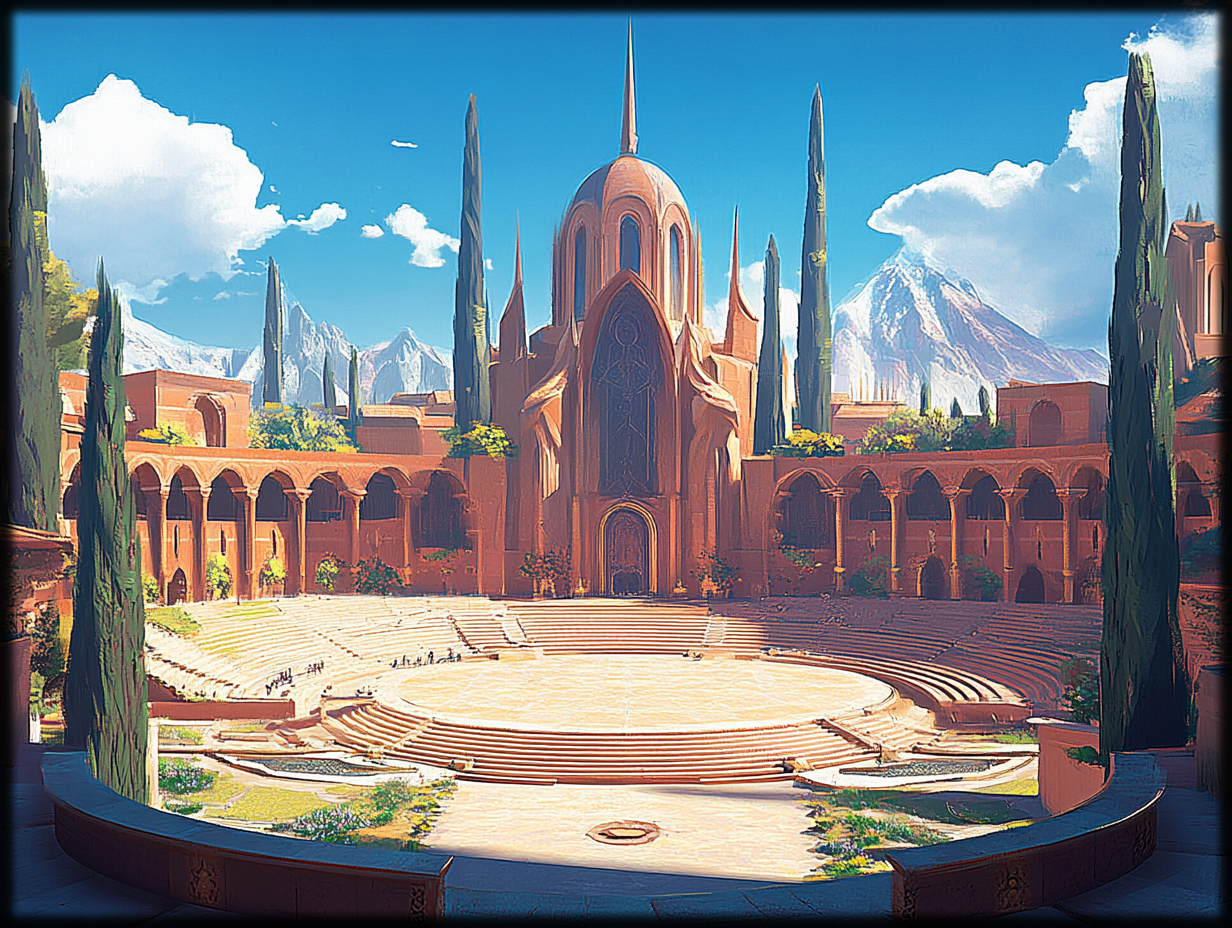
Bahar Amphitheater
If there was a soul or center to the cultural heart of the city, it was the Bahar Amphitheater, an immense rotunda at the heart of the Amana district, named for the Graceful Founder, Samira Bahar. Here, the city gathered to dream and to remember. The amphitheater itself was a marvel of smooth vermilion stone and river-polished granite. Its stepped seating could cradle an entire quarter of the city, and on windless days the sound of the orchestra’s highest note would ripple out across the whole of Shal’Azura, floating over rooftops and echoing from the small peaks of nearby Jamin District. At the center, the stage was a luminous disk inlaid with veined lapis, a blue so deep it seemed the surface of an ocean glimpsed through a crack in the world.
It was here that the famous bards and master poets of Shal’Azura, the irrepressible dancers and the prodigal painters, made their trembling debuts before audiences drunk on expectation. For the children of the city, the Bahar Amphitheater was a place of pilgrimage; on festival days, families packed the amphitheater from the lowest edge to the highest ring, pressed close with anticipation, eager to witness the birth of a legend or the collapse of an ego.
But the amphitheater was more than a stage for the arts. Since its founding, it had served as a pivot point for ambition and public ascent. Many of the city’s most formidable politicians and diplomats—those who would later stand before the Erudite Triad and bend the fate of the city—had first earned their mettle here as nervous novices. In the trembling hush before a speech, in the quicksilver wit of a debate, in the trembling confession of a first song, the future courtiers and ambassadors of Shal’Azura learned to shape a crowd and ride the wind of opinion. For over two centuries, the Bahar had been the crucible from which the city’s fame and future were poured.
It was said that even some of the Founders of the Ascension, had knelt on the blue-black disk and spoken their oaths before a listening city. The old chroniclers told how on that day, the stage’s lapis shimmered brighter, as if lit from within by a star. No one could prove it, of course, but the city believed it, and that belief was as good as truth.
In the present day, the Bahar Amphitheater pulsed with a different kind of energy. Each night was a celebration or a contest, a grand recitation or a pageant of costumes and masks. On the first night of every season, the alleys would empty and the bridges would throb with the footfalls of the crowd, all streaming toward Bahar Amphitheater’s gates, eager to witness the next miracle. And in the hush before the curtain rose, every heart in Shal’Azura beat as one, united by hope, by memory, and by the certainty that whatever happened on that stage would shape tomorrow.
It was here that the famous bards and master poets of Shal’Azura, the irrepressible dancers and the prodigal painters, made their trembling debuts before audiences drunk on expectation. For the children of the city, the Bahar Amphitheater was a place of pilgrimage; on festival days, families packed the amphitheater from the lowest edge to the highest ring, pressed close with anticipation, eager to witness the birth of a legend or the collapse of an ego.
But the amphitheater was more than a stage for the arts. Since its founding, it had served as a pivot point for ambition and public ascent. Many of the city’s most formidable politicians and diplomats—those who would later stand before the Erudite Triad and bend the fate of the city—had first earned their mettle here as nervous novices. In the trembling hush before a speech, in the quicksilver wit of a debate, in the trembling confession of a first song, the future courtiers and ambassadors of Shal’Azura learned to shape a crowd and ride the wind of opinion. For over two centuries, the Bahar had been the crucible from which the city’s fame and future were poured.
It was said that even some of the Founders of the Ascension, had knelt on the blue-black disk and spoken their oaths before a listening city. The old chroniclers told how on that day, the stage’s lapis shimmered brighter, as if lit from within by a star. No one could prove it, of course, but the city believed it, and that belief was as good as truth.
In the present day, the Bahar Amphitheater pulsed with a different kind of energy. Each night was a celebration or a contest, a grand recitation or a pageant of costumes and masks. On the first night of every season, the alleys would empty and the bridges would throb with the footfalls of the crowd, all streaming toward Bahar Amphitheater’s gates, eager to witness the next miracle. And in the hush before the curtain rose, every heart in Shal’Azura beat as one, united by hope, by memory, and by the certainty that whatever happened on that stage would shape tomorrow.

Comments