

Captain
A half-elf, adorned in the ribbons and medals of a high-ranking commander, sits astride an armored warhorse. To her right, a powerfully built orcish man in more pedestrian attire sits atop his own horse, shouldering a hefty greataxe. They set down the road together, accompanied by blaring trumpets and banging drums, which announce their approach.
Puffing on a pipe and eyeing the room, a halfling guildmaster in a fitted suit twirls a dagger between his fingers. A crowd of thieves, crooks, and bandits are arrayed before him, all studying blueprints laid out on a candlelit table. Tonight, their chapter of the Thieves’ Guild becomes rich, and their guildmaster goes down in history.
Kobolds swarm left and right, scampering across piles of gold pieces, only to be met by the dwarf ’s greataxe. Arrow after arrow, a human archer looses shots that merely plink off the enraged dragon’s crimson scales. A gnomish mage gathers crackling arcane might in his hands for a devastating magical blast. Across the chamber, amidst the chaos, a plan crystallizes in the adventuring company’s leader. She begins shouting orders, and the party sets into motion.
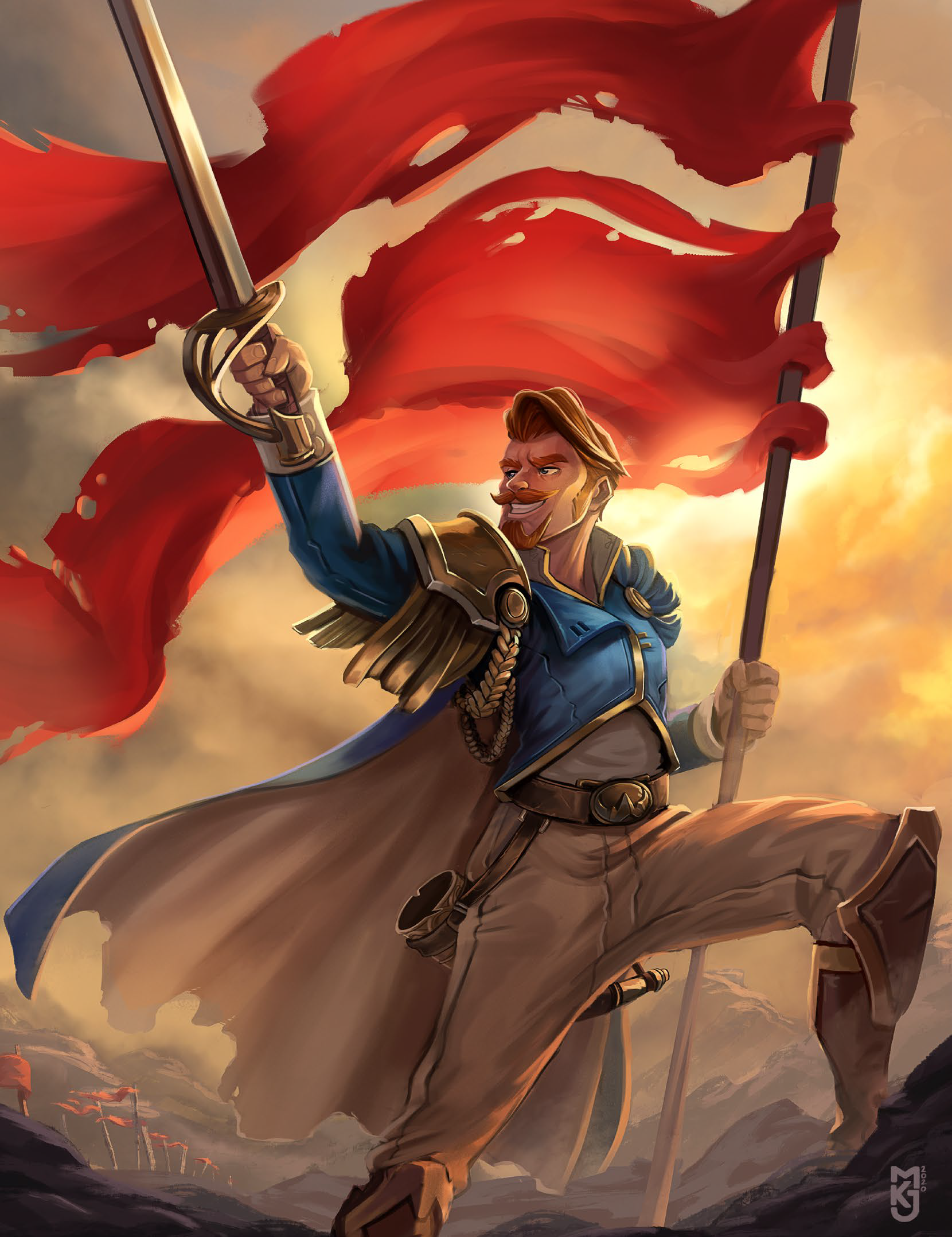
Decisive leaders and brilliant strategists, captains inspire their allies to greatness. Invariably, they stand alongside their cohorts—their devoted lieutenants, whom they entrust with their lives. Captains out-strategize their enemies, ensuring that, while they rarely deal the killing blow, they’re always on the winning side.
The Captain Class Features
Level 1: Born Leader
Your competence and commanding personality lend you a knack for leadership. Common folk defer to your authority and influence, especially in times of crisis. As a result, you have advantage on any Charisma (Persuasion) check you make to convince someone to let you take charge of a situation or to give someone orders in a dangerous situation.
Additionally, you can use your Charisma modifier, instead of your Intelligence modifier, for any ability check you make related to planning, strategy, or tactics.
Level 1: Fighting Style
You adopt a style of fighting as your specialty. Choose one of the following options. You can’t take a Fighting Style option more than once, even if you later get to choose again.
ARCHERY
You gain a +2 bonus to attack rolls you make with ranged weapons.
DEFENSE
While you are wearing armor, you gain a +1 bonus to AC.
DUELING
When you are wielding a melee weapon in one hand and no other weapons, you gain a +2 bonus to damage rolls with that weapon.
PROTECTION
When a creature you can see attacks a target other than you that is within 5 feet of you, you can use your reaction to impose disadvantage on the attack roll. You must be wielding a shield.
Level 2: Cohort
You gain a loyal cohort who carries your banner and follows your lead.
Initiating a Cohort
Select a companion from the Cohort section; following an 8-hour initiation period, that creature becomes your cohort. You can have only one cohort at a time.
If your cohort is ever slain, you can raise them from the dead by the usual methods, such as the raise dead spell, or you can spend 8 hours initiating a new cohort. If you do so, your previous cohort loses all abilities granted by this ability, even if it is later returned to life.
Your cohort obeys your commands as best it can. Your cohort takes its turn immediately before or after your turn each round (your choice), and you determine its actions, decisions, attitudes, and so on. If you are incapacitated or absent, your companion acts on its own.
Your cohort obeys your commands as best it can. Your cohort takes its turn immediately before or after your turn each round (your choice), and you determine its actions, decisions, attitudes, and so on. If you are incapacitated or absent, your companion acts on its own.
Cohort Features
At 2nd, 6th, 10th, 14th, and 18th levels, your cohort gains new abilities based on its archetype.Hit Points
For each captain level you gain after 2nd, your cohort gains an additional Hit Die and increases its hit points accordingly.Ability Scores
Whenever you gain the Ability Score Improvement class feature, your cohort’s abilities also improve. Your cohort can increase one ability score of your choice by 2, or it can increase two ability scores of your choice by 1. As normal, your companion can’t increase an ability score above 20 using this feature, unless its description specifies otherwise.
When you improve a cohort’s ability scores, remember to also increase other relevant statistics, such as skill bonuses, bonuses to hit and damage, and spell save DCs.
Proficiencies
Your cohort gains proficiency in skills listed in its statistics. It also gains proficiency with simple weapons, martial weapons, light armor, medium armor, heavy armor, or shields if its statistics contain weapons or armor from that category. Your cohort uses your proficiency bonus rather than its own. Because cohort statistics already include a +2 proficiency bonus, you need only adjust the attack bonus and skill proficiency bonus starting at 5th level.
Alignment
Your cohort’s alignment is within one step of your own, and has a personality trait and flaw determined by the GM. Its bond is always, “I will follow my commander into any fray, and I will gladly fight by their side until my death.”level 3: Banner
You adopt a banner which you fly in combat, emblazon on your armor, and fix to your seal. You can select from the banners which are detailed at the end of the class description. Your choice grants you features at 3rd level, and again at 7th, 13th, and 17th level.
Level 3: War Tactics
You have a pool of battle dice that you can use to bolster your allies or perform special maneuvers in combat. You begin with 2 battle dice, which are d8s. You regain all expended battle dice when you finish a short or long rest, or when you roll initiative.
Your battle die changes and more battle dice become available when you reach certain levels in this class, as shown in the Battle Dice column of the Captain table.
Saving Throws
If one of your maneuvers calls for a saving throw to resist its effects, the saving throw DC is calculated as follows:
Maneuvers
You can spend battle dice to use the following maneuvers:
Brace. As a bonus action on your turn, you can expend a battle die to bolster your allies. Each allied creature within 30 feet of you that can see or hear you adds the battle die to all saving throws it makes until the end of your next turn.
Rally. As a bonus action on your turn, you can expend a battle die to choose one allied creature other than yourself within 60 feet of you who can see or hear you. That creature regains hit points equal to the number rolled + your Charisma modifier. You can’t use this ability to heal a creature who has 0 hit points.
Staggering Strike. As a bonus action when you make a weapon attack against a Large or smaller creature, you can expend a battle die to attempt to daze the target. On a hit, the target must succeed on a Constitution saving throw or be incapacitated until the start of your next turn.
Level 4: Ability Score Improvement
When you reach 4th level, and again at 8th, 12th, and 16th, you can increase one ability score of your choice by 2, or you can increase two ability scores of your choice by 1. As normal, you can’t increase an ability score above 20 using this feature.
Level 5: Blitz
As a bonus action on your turn, you can direct your cohort or a friendly creature within 60 feet of you that can see or hear you to fight alongside you. The chosen creature can use its reaction to move up to its speed or make a single weapon attack.
Level 9: Advanced Tactics
Your maneuvers improve in the following ways:
Brace. Allies can also add the battle die to their ability checks until the start of your next turn.
Rally. Whenever you spend a battle die to cause a creature to regain hit points, that creature also gains temporary hit points equal to your captain level.
Staggering Strike. When you hit with a staggering strike, you add the battle die to the damage roll.
Level 11: Coordinated Strike
You and your cohort fight as a perfect fighting unit. Once on each of your turns, when you hit a creature with an attack, you can deal an extra 2d8 damage to the creature if your cohort has also hit that creature with an attack since the end of your last turn.
Level 15: Lead by Example
Whenever you roll a 20 on an attack roll, ability check, or saving throw, each friendly creature within 30 feet of you has advantage when it makes the same type of roll (attack roll, ability check, or saving throw) before the start of your next turn.
Level 19: Epic Boon
You gain an Epic Boon feat or another feat of your choice for which qualify. Boon of Truesight is recommended.
Level 20: Legendary Commander
You have 3 legendary actions. At the end of another creature's turn, you can spend a legendary action to take an action of your choice, or allow a friendly creature that can hear or see you to take an action of their choice. If a creature takes the Attack action as a legendary action, it can attack more than once if it has a feature, like Extra Attack, that gives it extra attacks.
You regain all expended legendary actions when you finish a long rest.

Comments