

Zabrak ([zæbræk])
Basic Information
Anatomy
Zabraks evolved to be tough due to the nature of their homeworld, Iridonia. They had two hearts, which allowed them to pump oxygenated blood around their systems more quickly than other species, meaning they could go faster for longer.
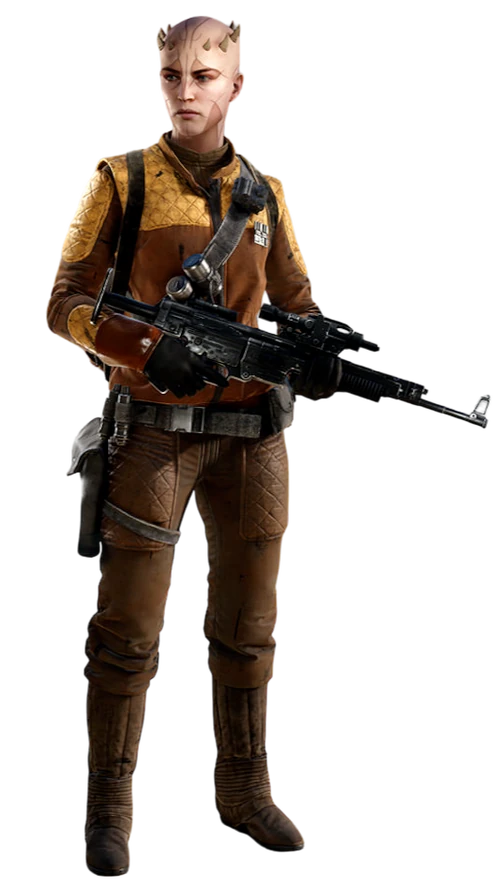
Some Zabraks possessed a ring of small, vestigial horns that ran from high on their brow around to the back of their head. The horns of males were generally more developed than those of females, although horn placement, length, and thickness varied enormously across the species. Dathomirian females exceptionally had no horns at all.
Zabraks could also have a wide range of colourations.
Iridonian Zabraks typically had a human-like skin tone, with some exceptionally having pale blue colouration. Dathomirian Zabraks exhibited significant sexual dimorphism, with females typically having pale grey, blue or white skin and males having red, orange or yellow-coloured skin.
Dathomirian Zabrak males evolved with natural striping on their bodies to help them camouflage themselves in the wilderness of their planet, which they later accentuated with tattoos.
Genetics and Reproduction
Zabraks were known to be able to reproduce with humans.
Ecology and Habitats
Zabraks were known to adapt to any environment they settled in.
Dietary Needs and Habits
Zabraks are a carnivorous species.
Behaviour
Zabraks are proud, self-determined, and considered arrogant by some. They were one of the most independent species in the galaxy and often did not trust off-worlders.
Additional Information
Facial characteristics
Some Zabraks possessed a ring of small, vestigial horns that ran from high on their brow around to the back of their head. The horns of males were generally more developed than those of females, although horn placement, length, and thickness varied enormously across the species.
Most Zabraks wore facial tattoos, which often indicated familial ties but could also be based on an individual's personal taste.
Geographic Origin and Distribution
Zabraks were a colonial species, having migrated and adapted to dominate many worlds.
The Iridonians were commonly seen travelling across the galaxy as Jedi, bounty hunters, mercenaries, or in other professions.
Perception and Sensory Capabilities
Zabraks could be Force-sensitive.
Civilization and Culture
Major Language Groups and Dialects
Iridonian, Dathomirian, Paecian
History
The first sentients to leave Peridea did so before artificial hyperspace travel existed, meaning they relied on purrgil migration to reach the known galaxy. These early Perideans were explorers who willingly rode the purrgil in search of new worlds. This group eventually settled on Iridonia, where they adapted to their new environment over generations and evolved into the Zabraks. They had left Peridea by choice and never returned, severing their connection to their ancestral world.
Over millennia, the Zabraks established clan-based societies that valued strength, honour, and personal autonomy. They avoided large-scale centralized rule, instead organising into regional clans that governed their own affairs. Despite this, they were not anarchic—Zabrak culture emphasized unity in times of war, and conflicts between clans were typically ritualized rather than chaotic.
As they expanded across Iridonia, the Zabraks refined their martial traditions, perfecting hand-to-hand combat and weapon-based fighting styles. They believed that battle was not just about conquest but also a means of self-expression and personal growth. These values led to the emergence of warrior societies, whose teachings would later influence the Iridonian Jedi, mercenaries, and soldiers who became feared throughout the galaxy.
Interspecies Relations and Assumptions
All Zabraks were fiercely independent, usually taking on roles in society that minimized their need to be ordered around by others. This was often mistaken by other species for aloofness or arrogance, which was erroneous, although Zabraks were unashamedly proud of being survivors.

Comments