

Everkingdom
Geography
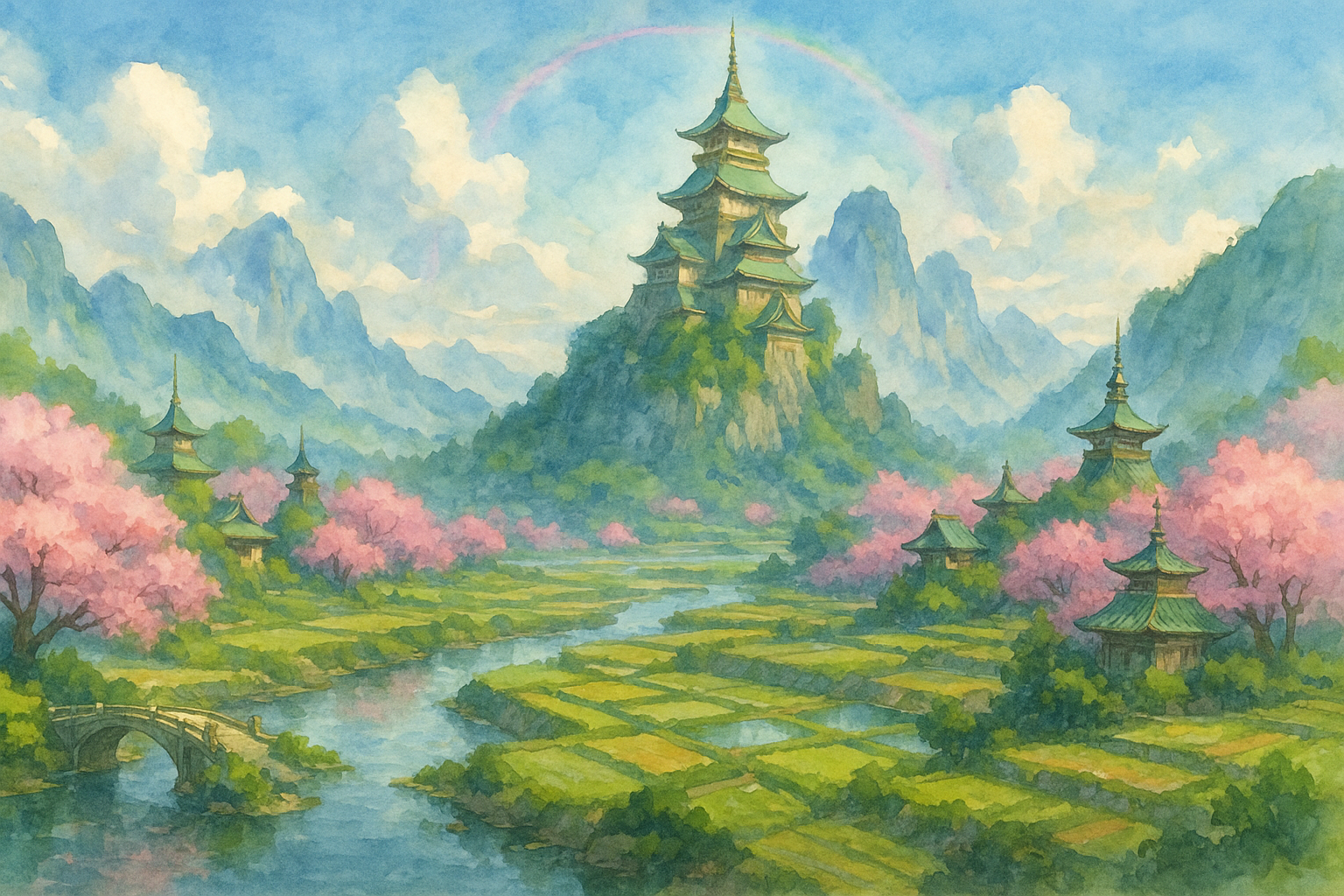
The imperial mainland of the Everkingdom lies in the far East, a continent-spanning heartland of rivers, mountains, and fertile plains bound together by Suijin’s unseen hand. Here, endless waterways form a lattice across the land, canals carved with ritual precision so that cities gleam like mirrors of the heavens. Vast terraces climb the mountainsides, their fields glowing red and gold beneath banners of the Everking, while fortress-citadels rise along every major river crossing. In the north, forests bend beneath the weight of shrines and ancestral groves, their trees grown into arches of living wood shaped by ritual chants. In the south, coastal deltas bloom into jade-colored wetlands, feeding fleets that patrol the empire’s seas as if the waters themselves were claimed by decree. It is a land where geography does not merely exist but serves—the rivers run straight to the capital, the mountains stand as walls against invaders, and even the sky takes on the faint halo of the Everking’s barrier.
From this radiant mainland the empire’s reach extends across the black oceans to the far West, where expansion has painted new coasts in crimson. These claimed territories differ in character, wild and untamed, yet slowly girded by the empire’s order. Along the western shores, basalt cliffs and storm-riven forests echo with the cries of native Beastkin, but already fortress-bastions gleam with phoenix standards, and terraced farms claw into the rock as if the land itself bends to foreign hands. Inland, wide plateaus serve as staging grounds for legions ferried from the mainland, their drill chants carried on winds once ruled only by predators and storm. Here the Everkingdom is less a homeland than a declaration—an expansion of the spirit barrier’s promise across seas and continents, carving dominion where wildness once reigned.
Between these twin dominions lies the ocean, now scarred by imperial ambition. Black waters roll with trade fleets, convoys, and warships whose prows bear carved phoenixes that gleam even under stormlight. The very center of this crossing is marked by myth: an aurora-lit sea-gate where the barrier is said to burn brightest, forbidding horrors from rising between the mainland and its distant holdings. Islands along this route bristle with citadels, some serving as shrines, others prisons, each one a living testament to the empire’s control of sea and sky. Geography itself bends into empire here—rivers, mountains, coastlines, and oceans woven into a single order that declares the Everking’s dominion not only over land, but over the very bones of the world.
Ecosystem
The Everkingdom breathes in patterns set by a hand seldom seen, its winds and waters taught to move in measured lines. A vast unseen ward rims the borders like a low song, blunting what prowls from the outer dark and quieting the tempers of restless things that cross it. Under that claim, the Tōbu do not fear the clutch of wandering spirits the way other peoples do; possession slides from them like rain from lacquer, and even hostile miracles find poor purchase. Cities answer this calm with order—streets laid straight as blades, thresholds squared and lintels kept clean, the geometry itself a way of shooing off stray hungers. Over all, the Phoenix Guard move with the loyalty of embers, stepping in only when the river of offices clogs, their raised ring-token enough to still a whole province until danger passes. Water gardens stitch courtyards to canals, and in their green hush drift descendants of Gyokuryu, the Imperial Jade Koi, kept as living mirrors for patience and clear thought. The land is not quiet because it is empty, but because it has been taught to listen; the smallest shrine, the simplest ditch, and the broadest parade-ground all keep that lesson. Trained hands prune the chaos from hedgerow and harbor alike, so favors from the unseen have a place to land and things without names have fewer corners to hide. Even the hush itself has a word in the people’s mouth, a soft oath spoken when the night is darker than ink.
Across the empireal mainland the so-called Eternal Blossoms break in great veils of pink and white, their fall timed not by a lantern in the sky but by the season’s breath and the turning of cold rivers. The moon of Tilith sits blackened and reduced, more absence than lamp; most eyes never find it, and the night belongs to stars. The people call that quiet “Illun’s hush,” and flowers bred for it open to starlight alone, dusting orchards with a pale, patient glow. Irrigation walks the contours like writing, terraces step down the shoulders of low mountains, and the soil keeps its manners beneath disciplined hands. Pools lie under stone bridges where jade-scaled koi move as if thinking, and gardeners learn virtue by watching how a ripple slows. In such places the unseen does not shout; it tastes of cedar, wet loam, and the soft draft through a paper door. Farmers speak to roses the way accountants speak to ledgers, and both respond when kept in order. Even the storms know their routes here, guided by tree-lines planted for the purpose generations ago.
North, the mountains stand with their brows in cloud and their ribs crossed by old roads that remember iron. In the long mists, herds move as if they were weather, hooves ringing on stone where lightning has written its jagged script. Ravens learn the names of passes and trade them for salt; deer wear crowns that spark in sleet and are left undisturbed at calving-time. The cliffs breathe slowly, exhaling cold that tastes of copper, and caves keep a dry hearth for any who arrive with clean hands and a quiet voice. Watch stations cling to saddles of rock, their courtyards raked smooth so fresh tracks tell their own stories by dawn. The Phoenix Guard cross here lightly when they must, their charter a blade that trims only what threatens the body of the realm. Alms for the shrines take the form of stacked cairns and repaired footbridges, because mended stone is better than incense in places that freeze. Even the snow shows discipline by how it drifts—never enough to bury the waystones, always enough to teach respect.
At the Everkingdom’s green heart, the Ethernal Grove stands older than most words for time, its trunks ribbed with histories that do not need ink. Moss makes a low sky for small creatures and answers the twilight with a light of its own, the ground glimmering as if embers had cooled there without dying. The folk say that voices live along those ribs, not haunting but advising, and that to walk there with a clean purpose is to hear the past clear its throat. Paths bend around roots that never took a wrong oath, and streams make law by choosing who drinks first. Children learn to bow to the first shade that falls across their faces, as if saluting an elder arriving late. It is common to see a student speak to a tree and uncommon to see the tree refuse to answer. Even here the great ward is felt as a warmth on the back of the neck, a reminder that the empire’s edge holds. Those who leave the Grove do so with feet that know how to be quiet on gravel.
South and west, plains roll out like unrolled silk, their gold turning the air brassy when the heat stands still. Herds move as if they were columns on parade, and the grass lies back with the same obedience the people expect from themselves. In certain seasons the sky darkens at noon when bodies pass before the sun, and warriors stop mid-form to read omens in the ring of light. Hawks cruise those margins like judges, and their screams are stitched into training songs so courage will rise with the same rhythm. Horses graze on a diet of wind and valor and come to the rail snorting as if they have discovered news. Camps leave nothing but square patches of flattened grass and a cleaner well than they found, because discipline is a kind of harvest. Children first learn to run there, where the world is wide enough to teach how small steps matter when taken together. Old duels seldom need markers; a certain hush in the wind is memorial enough.
At the empire’s far lip the dunes speak in a voice fine as ground glass, and the horizon is a blade that never dulls. Oases hide behind folds of heat and are sworn to by caravans that count their debts in water, not coin. Night blooms wake in the cool and show their lights like small harbors, so a traveler can read the dunes by color when the stars alone would fail him. Ruins lift from sand like knuckles, and their shadows teach travelers to ration pride first, then breath, then steps. There is a kind of mirage that deals fairly here; it does not lie, it only shows you what you would have found if you had chosen differently. Pilgrims cross the Flats of Reflection with faces wrapped not for secrecy but to spare the sand their answers. Scorpions keep temples better than priests when left to it, and the law of the place is that nothing waste a mouthful of shade. When dawn finally lifts its blade from the dunes, the world looks newly shaved, and every footprint is a confession written where wind can read.
Ecosystem Cycles
Spring breaks clean and quick, and the lowlands answer first. Orchards leaf out, terrace paddies flood, and tea hills give their first tender pick. Koi and carp spawn in temple pools and canal shallows, drawing otters and herons to easy meals. Cloud-hares kindle in furrows at dawn, then vanish into hedges when ward-chimes stir. Boar leave the forest edge to nose fallen blossoms and root new shoots from field margins. River dragons start their courtship runs upriver, testing gates and weirs as they go. Lantern kirin appear on foggy mornings, crossing fields without breaking a single row. By the time mountain snow softens, seed is in the ground and watchtowers have counted the first storms.
Summer is heavy with water and noise, and work turns from sowing to guarding. Monsoon bursts swell the canals, and lock crews move like clockwork to keep banks from failing. Thunderhoof deer ride storm lines in the north, their antlers singing when lightning walks the ridges. Cloud-tigers hunt closer to cedar spines, using heat shimmer the way other beasts use brush. Reflection leeches peak in drought pockets and are scraped from mirrors and cistern lids at dusk. Jade tortoises estivate in marsh shallows, surfacing only at night to graze lily pads. Sea serpents follow warm currents along the southern straits, and pilots hang prayer-ribbons to keep them curious, not hungry. Festival smoke brings name-moths to alleys, so sweepers wash walls at dawn before rumor finds legs.
Autumn pulls the land tight, and everything moves with purpose. Cranes ride the canal winds south, stopping at every fourth lock where grain boats feed them by custom. Herds shift on the Golden Plains as boar rut and patrols reroute to leave them room. Tea hills give a second, sharper flush, and orchard crews hang noise-boards to keep cloud-hares from the late fruit. River dragons drop back to deep channels, and fisheries close those reaches until eggs harden. Breaklings thin after the first hard cold, and wardens re-measure shadow at midday to set winter routes. Mountain cats follow the thaw line downward, then climb again when the first snows fix the passes. Winter finishes the round: roads stiffen, cairns are mended, stores are tallied, and the realm breathes out before the next planting.
Localized Phenomena
The Everkingdom is orderly land set against unruly forces. People from many walks of life share one habit here: keep things straight, clean, and well-lit so the unseen has fewer places to gather. Shrines, canals, and streets are laid like stitching that keeps the world from fraying. Markets cap their wells at dusk; homes wash thresholds and cover mirrors at night. Wind chimes of iron eat at heavy corners with their soft bite. Pale festival clothes show any ghostly smear so it can be beaten out with reeds. None of this is superstition to the locals; it’s weatherproofing for the soul. Wonder is welcome—but it follows the rules.
Spirit Breaks
Spirit Breaks are roving thinnings of the world’s skin. They travel slow, swallow districts or valleys, and then vanish to reappear elsewhere. Their “hearts” are inhuman cores hidden inside the surge; still the heart, and the Break closes. They favor old roads, rivercourses, graves, and places with long-spoken names; straight avenues and clean walls make them flow instead of branch, buying time. Omens arrive first: door charms rattle without wind, films form on tea like tally marks, shadows turn the wrong way at wells, animals balk at clean water, bells answer themselves. Breaks are predators of Ruin—they eat corruption wherever they find it, which helps the land—but they also kill the living as they pass, so letting them hunt unchecked saves fields at the cost of families. The worst escalation, called the Black Ledger Surge, follows the death of someone weighty to the realm—great leaders, those bearing imperial blood not yet born, or souls knotted to major rites; the Break swells vast, splits into offshoots, and returns sooner than any map can track. Response is strict and simple: wardens map the front, lay ash-salt lanes to narrow it, cover reflective faces, and only hunt the heart when the ledger says the risk is worth the breath.Everyday countermeasures
Settlements are drawn in clean lines to channel Breaks and calm lesser hauntings. Lintels are washed and pinned with ward-metal; wells are hooded after sundown; basins are emptied before sleep. Shoemakers stitch iron into soles so steps ring true. Midday shadows are measured during the Tithe of Lingering; households with “long shade” pay in offerings or public work. Quiet Houses lock away written fears and debts so they cannot be used as lures. None of this invites heroics; it keeps hands free when trouble comes. When wardens arrive with shrine-wagons and bells, streets clear and doors open—because order moves faster than panic.Other stable marvels
- Starlit Rebirth (Blossom Country). Rare stellar alignments pull at orchard sap; hills glow softly and the air lifts old grief for a night. People walk slow patterns between trees, leaving lighter than they arrived.
- Whispering Shadows (Ethernal Grove). At twilight, moving shade writes quiet lessons on moss that glows; those who enter with clear purpose often leave with a clearer one.
- Celestial Convergence (Southern Archipelago). Once in long cycles, islands line up and a bright path hangs over the sea; travelers return steadier, as if trimmed of pride and full of listening.
- Sands of Reflection (Western Deserts). Dunes answer the heart; colors and curls mirror a traveler’s intent. Nomads treat the script as counsel and change course when it tightens.
- Thunderhoof’s Resonance (Northern Bastions). During hard storms, antlered herds hum with the strike of lightning; stone hums back, and those who hear it walk away braver.
- Golden Vigil (Central Plains). When the Daystar veils, noble flames circle training fields; veterans call it a quiet lesson in courage, and the young remember the silence more than the light.
Fauna & Flora
Orchards and groves shape the mainland like careful handwriting. Spirit-cherry trees shed pale petals that glow softly under starlight, guiding travelers along canal paths. Plum, pear, and persimmon stand in laddered terraces, their roots stitched with ward-grass that keeps pests and small hungers away. Tea camellia climbs the hillbacks in clipped waves, its leaves steamed with salt to hold blessings longer. Ink-cedar and red pine anchor shrines, their resin burned in thin coils to steady a restless room. Riverbanks wear lotus and water-shield, and their broad leaves calm the wind that skims a city’s surface. Jade bamboo rows serve as living palisades; cut joints are hung over doors to click when spirits press. In the west, night-bloom succulents open like lanterns after heatfall, marking safe wells with slow perfume.
Everyday life moves on hooves, paws, and wings taught by long habit. Red-crowned cranes pick at paddies and bow toward bells at dusk out of learned comfort. River otters work the locks with clever paws and trade fish guts for warm stones near the washer piers. Boar run the forest edge like black storms, and foresters read their paths the way scribes read ledgers. Cloud-hares graze terrace rims at dawn and freeze when ward-chimes stir, then vanish between furrows. Mountain cats keep to ledges where the snow thins, watching caravans with calm, amber eyes. Carp and jade koi turn in temple pools like slow thoughts, accepting offerings of grain and silence. Jackdaws haunt watchtowers, stealing seal-string from inattentive clerks and teaching recruits to keep pockets closed.
The realm’s great wonders do not hide; they choose their moments. Thunderhoof deer crown the northern passes, their antlers singing when storms walk the ridge. Lantern kirin drift the prairie borders on misted hooves, leaving dry ground where they step and never breaking a farmer’s row. Cloud-tigers prowl cedar spines and vanish into fog as if the hill swallowed them to spare a fight. Jade tortoises rise in marsh shallows like old stones and decide, with slow dignity, which nets may pass. River dragons coil along deep channels, more judge than tyrant, and lift their whiskers when offerings are honest. Paper phoenix flare from brazier ash during great rites, circle once, and fall back as warm cinders on waiting palms. In the southern straits, sky-swimming sea serpents keep to the blue miles; pilots hang prayer-ribbons so they stay curious rather than hungry.
Not all that lives here loves the living. Breaklings sometimes linger after a Spirit Break recedes, smearing light where they pass and learning doors by touch. Reflection leeches flower on water skins and mirrors, drinking the face that leans too close and leaving the owner light-headed and lost. Name-moths ride whisper drafts in alleys and copy spoken names in dust; sweepers chase them at dawn so rumors do not grow legs. Bell-hollows sit in unused shrines as cool rings of air, answering any chime with a second, colder note that calls the timid to step outside alone. Ash hounds trail kiln smoke and bury their muzzles in warm hearths, snuffing coals unless house-rites are kept. Salt spiders lace city corners; break a strand, and it sings, bringing wardens faster than a shout. In the western deserts, sand-lamias write lies in the dunes with their tails, and licensed guides stamp truth-lines across the script so caravans pass untroubled.
History
The world broke, and new shapes rose. The Cleansing remade land and sky, while Gor and Lumar clashed in a long, bitter struggle. In the quiet that followed, Beastkin were first to knit tribes into living polities and stake the open places. Among those early powers walked the Kitsune, speaking in riddles and roads, guiding trade as much as rule. Their borders were rivers, orchards, and hidden paths rather than walls of stone. They preferred masks over banners, and bargains over sieges. When pressure mounted, they vanished between breaths and reappeared elsewhere, still watching. The Pridelands’ Beastkin memory of those first formations endures in their own chronicles of scattered tribes rising toward councils and city-states.
The Kitsune learned early that survival meant misdirection. When heavier hands arrived, they folded their flags and hid their names. A valley city, Tsukimori, took root behind illusions and loyal couriers, sheltering clans who chose secrecy over open challenge. Old clan tales speak of a nine-tailed patron who hated serpents and taught healers to carry light blades and longer mercy. Those tales kept scattered bands from turning on each other when fear of shapeshifters spread. Witch-hunters in nearby realms made the roads cruel; the Kitsune made the roads theirs. They traded smiles for safe passage and favors for a winter’s grain. To outsiders they were gone; to those in need they were exactly where they must be.
Long before the river-crowned folk stepped into daylight, another bunker opened. The Hikaru woke first and built quietly, shaping a golden era under watchful sight. They raised Tsumenori where markets and shrines shared the same air, and hunters could cross a city by greenway at dusk. Their seers read more than faces; their artisans wove more than cloth. The peace was real because it was guarded by careful distance and closed gates. When neighbors knocked, they answered with trade, not trust. In time the name Tsumenori was taken from them and the city was called Han’Jiin, but its bones still remember the old pattern.
The Tōbu emerged later and chose a single banner. Suijin Everlight gathered wandering households and made them one people with one purpose. A spirit barrier took root at their borders, a hush over hostile things and a signal to all who watched the horizon. Streets ran straight, shrines faced inward, and drill yards filled with steady breath and steady hands. Their ruler withdrew from sight, his will carried by the Phoenix Guard and his innumerable children set as stewards across the provinces. Titles and ledgers spread like canals, and the land answered to new names. In maps and mouths alike, the Everkingdom became the word used for home.
Expansion began with quiet agreements and ended with fixed borders. Some Hikaru circles lent counsel to early campaigns, steering columns along the safest lanes and binding feuds before they bloomed. The Akimoto, once nameless in the ledgers of larger beasts, were given a name and a mirror, and found in both a reason to stand. Their uprising burned like a grassfire—fast, bright, and everywhere at once. The Everking’s hosts broke the worst of it, and Huan Kkonch rose from the cinders with five Petals to share burdens: Just, Glory, Valor, Wisdom, and Harmony. Trade resumed under new rules, and Tōbu envoys made sure the rules held. It was order bought with scars, and everyone remembered who paid.
The Beastkin at large watched the change and weighed costs. Some bowed to the new maps and kept their flocks moving under tax, not sword. Others hid their best paths and sold their worst advice to strangers. The Kitsune chose deeper shadows and fewer risks, trusting quiet work over loud defiance. In the Pridelands, councils hardened and caravans learned new fees at new gates. Memorykeepers wrote both the insults and the truces, and those records kept old angers alive. Borders held because too many rivals distrusted each other more than the Everking. The land settled into a tense rhythm that no one mistook for peace.
The first Vision War began when sight and scripture pulled in different directions. Seers said one path; stewards read another in the Ledger; soldiers were asked to obey both. Rumor claimed an imperial prince aimed to fix the contradiction with knives and closed doors. Hikaru circles suffered most, because truth seen with the wrong eyes was called treason. The war ended not with victory but with rules about who could speak and when. After this, visions traveled only on approved tongues, and those tongues were counted nightly. Nothing changed on the surface; everything changed beneath it.
The Ruin War came like rot behind paint and stayed longer than any oath. Ruin burned crops into ash that would not grow and turned brave men into empty echo. When the tide slowed, new customs hardened: no unchecked witchcraft; no friendly bargains with the wrong planes; no mercy for things that fed on collapse. Arkinia raised blackholds to lock the worst away, and witch-hunters followed in a later generation to keep the locks honest. The Everkingdom built its own fences in mind and stone and taught its people how to breathe through fear. The price was vigilance as a way of life and suspicion written into law. The border with ruin did not move, but the hearts behind it did. Even today, harvest songs carry lines about checking shadows twice.
The second Vision War flared when commanders learned to use prophecy like a spear. Each victory claimed a vision; each loss blamed silence. Scribes began to mark “licensed sight” beside supply tallies, and officers learned which seers kept morale steady. The fighting burned itself out when Phoenix Guard auditors cut through both camps and filed orders that could not be ignored. Afterward, visions were weighed like grain and stored like it. The empire called this prudence; the countryside called it fear. Either way, fewer prophecies left the room they were born in.
Arkinia stood across the map like a mirror that refused to flatter. Their faith, their crafts, and their habit of turning enemies into partners ground against Tōbu isolation and control. Skirmishes and tariffs gave way to the War of Light and Flame, a campaign that ended with both sides too bloodied to claim more than honor. The draw held because each had something the other did not wish to spend. Between wars, their borders learned the feel of “simmering hostility” and diplomats learned to talk with hands open and knives sheathed. The Everkingdom measured patience in roads, fleets, and heirs; Arkinia measured it in guilds, markets, and vows. Neither forgot, and neither forgave. The map lived as much by glare as by ink.
The third Vision War never quite ended; it simply learned to move softly. Disputes over whose sight sets policy now break in courts, not fields, but the blades are still real. Han’Jiin still carries the old Hikaru bones under its Tōbu skin, and that memory matters when orders come down. The Kitsune still vanish when pressed and appear when needed, trading safety for time. The Akimoto still argue loudly and forgive slowly, yet their Five Petals keep their house standing. Arkinia still circles in the east, testing hulls and tempers. The Pridelands still lean into their own councils and their own storms. And the Everkingdom still breathes behind a barrier that has not fallen since the day it was raised.
Tourism
Tourists come for safety first, then for wonder, because the Everkingdom teaches both to walk in step. Cities run on straight streets and clean water, so first-time visitors feel steadier before they know why. The spirit barrier hushes the worst of the world, and ward tokens at the gates make outsiders part of that calm. Guides point them toward Han’Jiin’s markets where Hikaru and imperial styles meet without shouting. Blossom country is close enough for a day’s ride, where orchards and canals make the air taste patient. Tea houses teach quiet etiquette faster than any handbook could manage. Bell teams and shrine-wagons pass like clockwork, reminding guests that order here is more than talk. By night, river lights and guarded promenades keep footsteps confident without pretending danger has vanished.
Most travelers follow the pilgrim loop, trading noise for meaning one stop at a time. The Ethernal Grove offers hushed paths with caretakers who teach where to stand and when not to speak. Training fields on the Golden Plains open their railings, and visitors watch formations move like a single breath. Garden districts along the rivers display koi and carved stone as lessons in patience more than decoration. Han’Jiin sells craft rather than spectacle, so lacquer, ink, and woven silk carry the city’s history home in a satchel. Caravans push west to the reflection dunes with licensed guides who read sand like a ledger. Southward ferries skirt the island chain, where observatories time rare alignments and inns sell windows more than beds. Invitations sometimes reach a select few for hidden halls tied to old Kitsune roads, and those who go rarely speak carelessly afterward.
Tourism is welcomed here, but only if it follows the rules that keep the realm breathing evenly. Route markers change without debate when wardens close a road for Break activity, and guides reroute as if that were the weather. Inns wash thresholds and cover basins at dusk, and guests are expected to help rather than watch. Market law forbids prying at shrines, pocketing ward pebbles, or speaking true names near wells. Border trips into the Pridelands hire local councils by custom, not by bargain, and poachers are treated as thieves of breath. Arkinia crossings work when papers are precise and tempers are left at the ferry, which is how both sides prefer it. Those who draw, measure, or map must hold a license, because lines can mislead as easily as they can guide. Most leave with lighter bags than planned and heavier habits, walking straighter without quite knowing when they started.
Alternative Name(s)
Nâvren-ha (“River-Crowned Folk”), The Empire of the Everking
Type
Territory
Location under
Included Organizations
Owner/Ruler
Additional Rulers/Owners
Ruling/Owning Rank
Owning Organization
Related Ethnicities
Contested By
Inhabiting Species

Comments