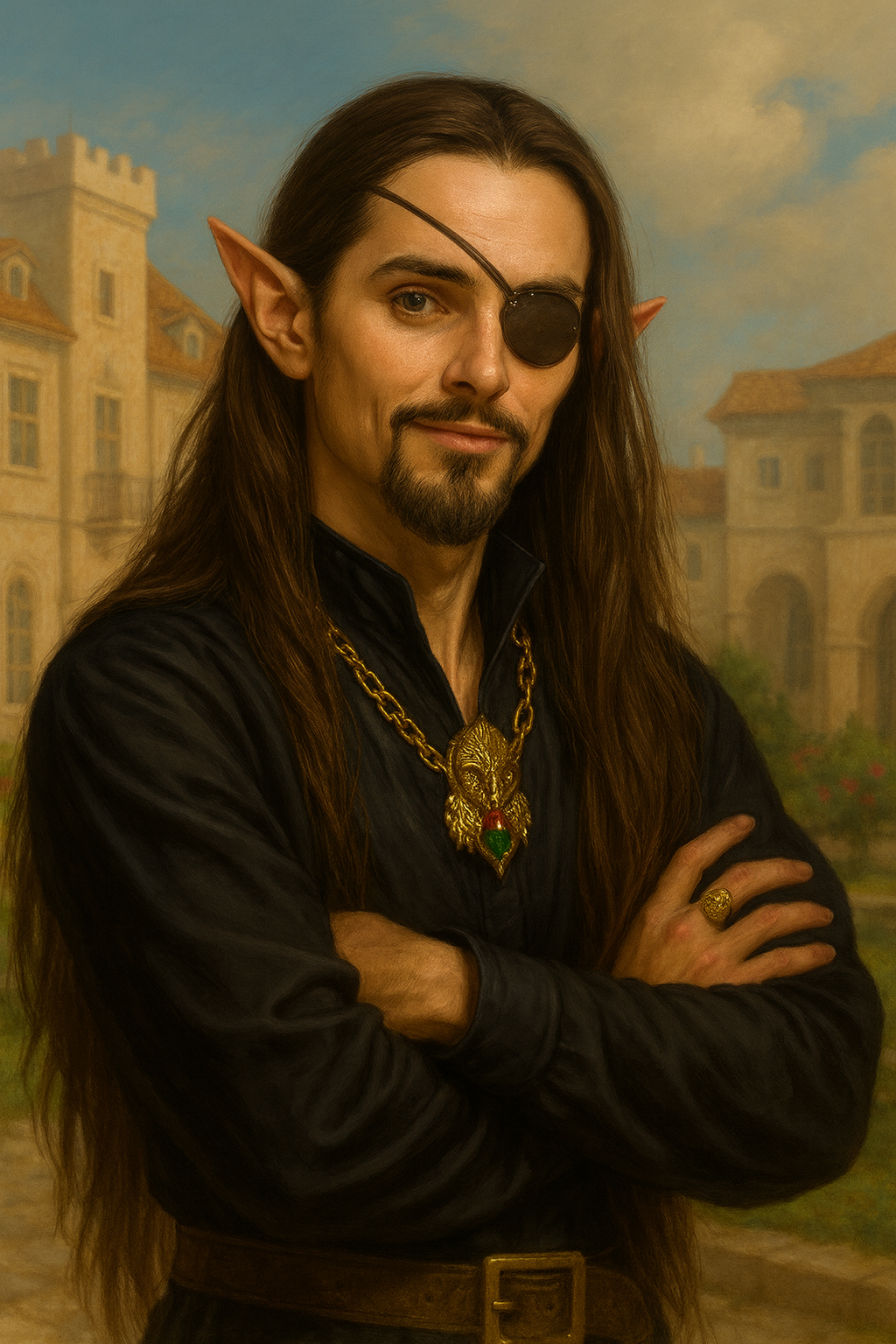
Lucien Vipère IV
Lord Lucien Vipère (a.k.a. IV)
Current head of House Vipère. Serves on the Tudor Council.
Married Lady Cyranel Voss, an elven diplomat from Vindhan — re-infusing the bloodline with elven ancestry.
Basic Details
- Full Name: Lucien Vipère IV of House Vipère
- Titles: Lord of Embermoor and Dinkawal, Master of the Council of Thorns, Warden of the Western Marshes
- Race: Half-Elf
- Date of Birth: 573 PR
- Faith: Secretly devoted to Drevrena, Goddess of Night, Dreams, and Shadows
- Appearance:
Tall and pale, with faintly pointed ears and silver eyes like mercury. His black hair, streaked with ash-grey, is always immaculately combed. He dresses in black silk trimmed with gold, perfumed with alchemical oil that masks the scent of poison. - Motto: “A viper smiles before it strikes.”
Early Life (573–592 PR) — The Child of Ash and Blood
Lucien was born in Embermoor Keep, amid the sulphurous mists of the moor. His father, Rhael Vipère II, was already a man steeped in both wealth and paranoia; his mother, Veyra Maulden, was a cunning human noble of the Tudor court. Their marriage was one of strategy, not affection, and Lucien grew up studying deceit as other children studied letters.
As a boy, Lucien was frail. His tutors noted a fascination with serpents and toxins. He collected marsh vipers and dissected them in secret, seeking to understand how something so small could command fear.
He studied alchemy under the reclusive Magister Orran of Blarget, mastering the synthesis of Venefic Gold—a rare poison that glows faintly under moonlight but leaves no taste. By sixteen, Lucien had already killed his first man: a tutor who had sold Vipère secrets to a rival house. His father covered the crime and whispered only, “Good. You will survive in Tudor.”
Rise of the Viper (592–610 PR) — The Poisoner’s Court
When his father Rhael died mysteriously during a banquet (rumoured to have sipped his own concoction by mistake), Lucien inherited the seat of Embermoor at nineteen. Few expected him to last a year—Blarget’s vassals were restless, Dinkawal’s poppy guilds rebellious, and the Tudor Empire’s court had begun to fracture under whispers of God Hand cults.
Lucien, however, was no soldier. He was a strategist.
He formed the Council of Thorns, a clandestine network of spies, merchants, and physicians who served his interests under the guise of a medical guild. Each Thorn bore a tattoo of a blooming rose that concealed a serpent within its petals. They controlled alchemical trade routes, manipulated debtors in the capital, and kept rival nobles in a perpetual state of uneasy alliance or silent terror.
His motto spread among the Tudor aristocracy: “Better a Vipère as an ally than an antidote in your cup.”
The Shadow Alliance (610–618 PR) — The Alchemist Lord of Tudor
Lucien’s mastery of diplomacy and subterfuge earned him a seat on the Tudor Council of Thorns, the Empire’s inner circle of noble advisers. There, he proved invaluable.
- During the Fenraith Rebellions (611–613 PR): he provided alchemical weaponry—mists that blinded and burned—to crush uprisings in the swamplands. Survivors called it “The Grey Rain of Embermoor.”
- In the Ashen Riots (615 PR): Lucien negotiated peace by poisoning both rebel and loyalist leaders in the same night, leaving none to question who truly controlled the moorlands.
- Alliance with the Church: publicly, he pledged loyalty to the Tudor Faith; privately, he sponsored secret shrines to Drevrena, using shadow priests to gather dreams of nobles for blackmail and prophecy.
Lucien’s methods drew both admiration and dread. Some called him “The Empire’s Venom”—a man who could end wars without unsheathing a sword.
Rumors and Secrets — The Serpent’s Experiments
In the depths of Embermoor Keep lies the Glass Menagerie, a subterranean laboratory filled with living poisons, blood crystals, and preserved beasts. There, Lucien is said to work with captured scholars and unwilling alchemists. His goal: to create a potion that halts aging—an echo of the forbidden Elixir of Zonid.
Whispers claim he succeeded partially. His reflection is said to move slower than his body, as if time itself resists touching him. His blood, when spilled, runs black for moments before reddening.
Certain spies of the Order of the Silverbrand suspect Lucien has dealings with Handdite cults—specifically the followers of Geardaz, god of aberration and trickery—trading alchemical secrets in return for time-dilation elixirs. None have lived to confirm it.
The Modern Lord (618–620 PR) — The Serpent of the Court
In recent years, Lucien has become one of the most powerful lords in Tudor. His holdings produce:
- 60% of the Empire’s medicinal exports,
- 80% of its refined poppy tinctures,
- and nearly all its official “poison licenses.”
He is both indispensable and untouchable. The Emperor himself relies on Vipère serums to maintain vitality in old age.
Yet rebellion brews. The House of Valecrest accuses him of assassinating their heir. The Inquisition of the Silverbrand has begun sniffing around Blarget’s markets. And within his own family, his daughter Aradel Vipère and son Nerin quarrel over succession—Aradel favoring intellect and experimentation, Nerin dreaming of reform and truth.
Lucien merely smiles, saying,
“A serpent that sheds its skin must first taste its own venom.”
Personality
Lucien Vipère is a man of measured menace. Every gesture is deliberate, every silence purposeful. He speaks softly, never twice, and can end conversations—or lives—with the same calm tone.
He despises unnecessary cruelty, not out of morality but inefficiency. “Pain wastes time,” he once told a prisoner. “Fear does not.”
Those who serve him either prosper or disappear. Those who cross him often simply… stop waking up.
Legacy and Threat
In the chronicles of Tudor nobility, Lucien Vipère IV stands as the perfect reflection of his house: half-elf, half-human; half-healer, half-poisoner; savior and serpent in equal measure.
If he truly discovers the secret of eternal youth—or the means to manipulate time as the God Hands do—then the Tudor Empire will no longer own House Vipère.
House Vipère will own Tudor.
Relationships