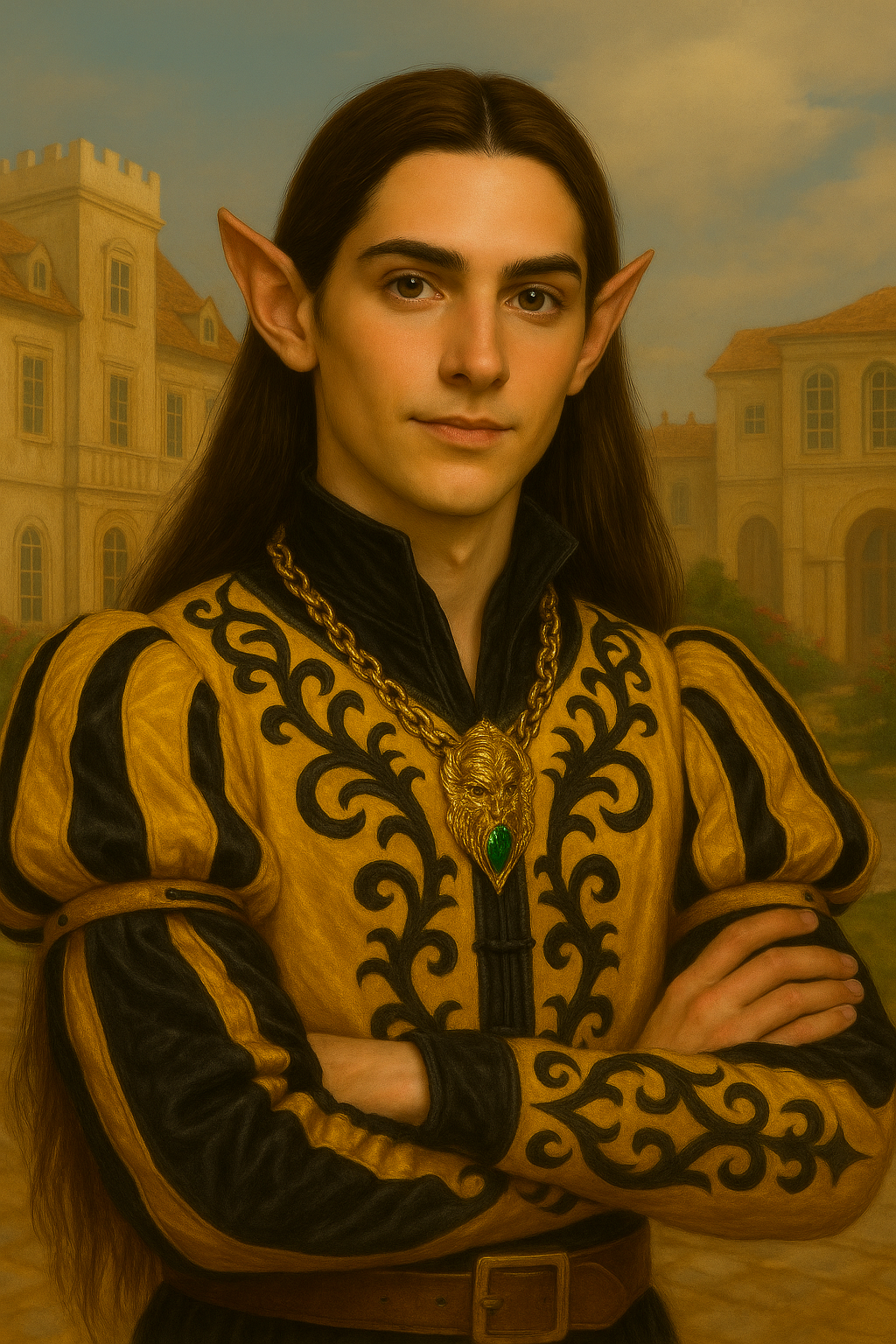
Cyris Vipère
Cyris Vipère — The Dream-Touched Heir of Blarget
Third Child of Lucien Vipère IV and Cyranel Voss | “The Boy Who Sees Tomorrow”
⚜️ Basic Details
- Full Name: Cyris Vipère of Embermoor
- Titles: Young Lord of Dinkawal, Dream-Seer of the House
- Race: Half-Elf (¾ Elf by blood)
- Date of Birth: 610 PR
- Age (as of 620 PR): 10 years
- Faith: Follower of Luna and Dykenta
- Appearance: Delicate and pale, with hair of dark brown hair, eyes dark blue eyes. He wears yellow and black tunics embroidered with lunar motifs and rarely speaks above a whisper.
Child of the Eclipse (610 PR)
Cyris was born under a total lunar eclipse above Embermoor—a rare celestial event that the Vipère astrologers called “the Night of the Silver Veil.”
When he first cried, every candle in Blarget Keep went out for exactly three heartbeats, and his mother, Cyranel, claimed she heard whispers not of this world saying:
“He will dream of what others dare not see.”
Unlike his siblings, Cyris was not meant for politics or alchemy. He was frail at birth, his pulse faint, his body small. Yet his eyes opened wide and stared at the world with eerie calm—as if he recognized it already.
Lucien ordered his astrologers to record every sign of his birth, believing the boy’s life would hold prophetic importance. Cyranel, however, feared it. She saw too much of her own bloodline’s mystic curse—the Morvael ancestry that traced back to the Weavers of the Veil—those who walked between the living and the dead.
Whispers in the Dark (611–616 PR)
By the age of two, Cyris was found sleepwalking into places he could not reach awake: the upper library, the tower balcony, once even the catacombs beneath Blarget. When questioned, he would only say, “The walls were open.”
At four, he began drawing things that hadn’t happened yet. The sketches were crude but unmistakable: the death of a servant by falling glass, a tower fire that would later occur in Embermoor, and once—a rough sketch of a white serpent encircling a black heart, which Lucien took as a sign from the family’s unseen patrons.
Lucien encouraged the boy’s dreams, seeing a potential weapon for House Vipère. Cyranel forbade it, locking Cyris’s journals away. The boy became the quiet center of their conflict—his visions the thread that pulled both closer to ruin.
The Glass Menagerie and the Moon’s Gift (616–619 PR)
Cyris began spending time in Aradel’s laboratories, surrounded by vials and crystal alembics that glowed under moonlight. Though his sister saw him as fragile, she recognized in him something deeper than madness—clarity beyond their father’s comprehension.
He once told her, watching mercury flow in a glass tube:
“When you mix dream and poison, sister, the truth rises to the top. But only if you drink it.”
At eight, he accidentally uncovered one of Lucien’s forbidden experiments—a mirror crafted to capture souls. Instead of shattering, the mirror reflected Cyris’s dream-self: a shadow with his face, whispering to him from behind the glass. Since that night, he has carried a fragment of the mirror around his neck, believing it “keeps the dream out.”
His dreams grew stranger:
- The Silver Bridge: a path of bone and moonlight connecting Blarget to something beneath the moors.
- The Three Hands of Smoke: visions of five dark figures that speak in riddles.
- The Drowned Garden: a place where roses bleed and the stars fall into water.
Lucien’s alchemists recorded his words obsessively. Cyranel burned their notes.
Faith, Night, and the Goddess of Dreams
Cyris claims that during one of his fevers, a woman made of moonlight appeared at his bedside. She touched his chest and said, “Your heart is not yours—it belongs to the dream.”
He awoke whispering her name: Dykenta—the Goddess of Night, Dreams, and Death.
Since then, he prays to her in secret, believing she protects him from the darker entities that stalk his visions. He also reveres Luna, the Good Moon, saying that Luna guards him in waking while Dykenta guards him in sleep. The duality mirrors the old Morvael teachings of Syl’thir and Vael’thir, the twin spirits of the swamp—light and shadow in balance.
Cyris’s dreams are often warnings. In 619 PR, he dreamt of his brother Nerin standing in a garden of burning poppies, reciting poetry to a crowd with no faces. The next month, Nerin dueled a noble whose poisoned blade nearly killed him. Cyris’s cries had been ignored.
The Dream-Child of House Vipère (620 PR)
Now ten, Cyris is both beloved and feared in Blarget and Embermoor. Servants whisper that he speaks to ghosts. His father’s allies call him “the Moon’s Mistake.” But Lucien himself protects the boy fiercely, saying he is “the final evolution of the Vipère curse.”
He spends his nights writing in dreamscript—a language only readable under moonlight. Aradel secretly translates these writings, finding in them fragments of prophecy: warnings of tides of blood from the south, of a “Rose that bleeds under a Silver Crown,” and of “the serpent that devours its own reflection.”
When questioned, Cyris only says,
“I dream of our end. But in the dream, I am smiling.”
Personality
Gentle, melancholy, and hauntingly calm. Cyris sees life as a lucid dream—he rarely fears anything, yet everything touches him deeply. He speaks softly, often in riddles. When frightened, he hums lullabies no one has taught him. He adores Aradel, calling her “the sister who bottles stars.” He loves Nerin’s poetry, saying it “sounds like dying beautifully.”
He avoids mirrors. He never dreams in silence.
Legacy and Symbolism
Among the people of Blarget, Cyris is whispered to be “the sleeping heir.” Some believe that if he ever dies, his dreams will not. That they will walk the halls of Embermoor, whispering warnings to the next generation.
To the scholars of Tudor’s arcane towers, he is an anomaly—a seer born of alchemic and divine lineage, a child bridging the mortal mind and the dreaming veil.
Lucien sees him as the key to transcendence. Cyranel fears he will be the end of the Vipère line.
And in truth, perhaps both are right.