
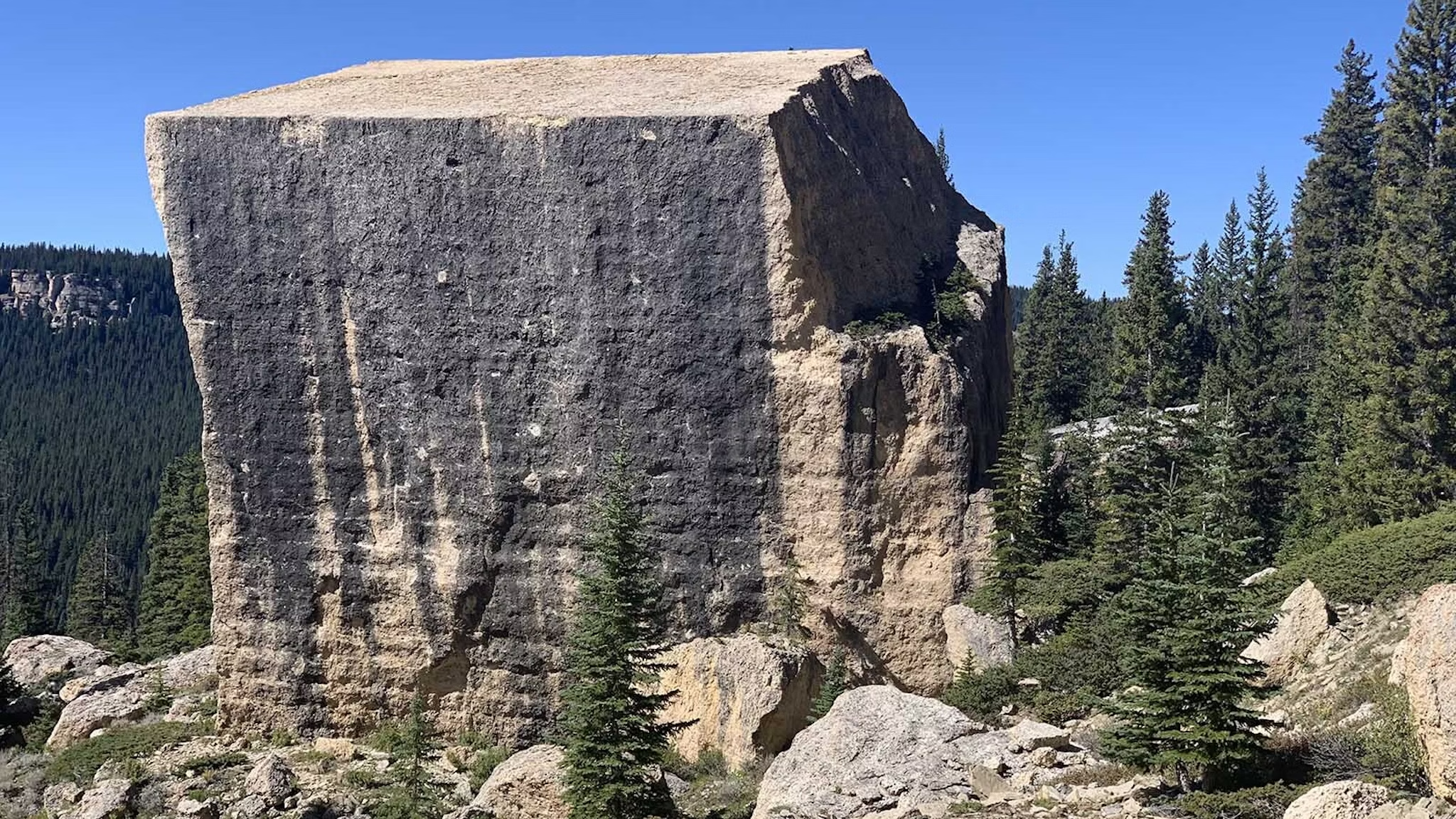
The Thoughtyard
The Thoughtyard, known by those indigenous to Plentius as Eir Bandoth, is a series of megalithic structures in the Hickerwick Wilds of the continent of Plentius and home to the magical phenomenon known as Termisosis, or more commonly Quintessence Bleeding. The site was first discovered in 6015 by Pillarin explorers searching for a way into the Plentius interior. The structures are situated at the end of a gully roughly 85 miles inland from Plentius' southeastern coast and have perplexed scholars from Pillarin and The Didacy alike. The builders of the Thoughtyard are unknown, as is the site's purpose or significance.
Due to the onset of Termisosis when in proximity to the Thoughtyard, it has been considered taboo by local tribes and has been deemed a hazard by Pillarinian colonists. The Reliquary Accords were signed by a majority of the Free Cities in Pillarin in 7017, officially prohibiting further expeditions to the site.
For a time in the 9020s, the Harwick Trade Company and Gunkleton Industries were granted legal access to the Thoughtyard in the Treaty of Bigton (9018) by various Free Cities for research purposes. The companies made attempts to find a potential way to harness the magic responsible for Termisosis to accomplish the inverse effect in those experiencing dementia or similar ailments, as well as attempt to understand the origin of the ruins. The findings that have been published by the corporations have been deemed inconclusive. Didacy review of the findings deemed the methods inadequate, but all petitions for access to the Thoughtyard were denied, citing Didact Cassius III as an erratic element that would compromise any expedition's integrity.
During the Fen invasion of Plentius, the research teams were evacuated. Now under the control of the Diocese of the Fen, the current status of the Thoughtyard is unknown.
Geography
The site sits at the far end of Whispered Plea Gully, 85 miles inland from the coast. The rims of the gully are surrounded on all sides by dense old growth coniferous forest. Vortallax' Tears Creek runs through the gully; it extends from its origin point, Weeping Memory Spring, to Mournful Sound on the coast. The creek's flow is weak, but remains clear and clean year-round. A fog regularly forms in the gully in spring and autumn, disorienting those who find themselves within it. The fog has earned the name Quiet Cloud of Dannispough, named after the famed explorer Adrien Dannispough of Aywikrax who was found dead during an expedition in 6034.
The structures are made from immense carved stones measuring 17 feet on all sides. The stones are believed to be carved from tuff, a type of compressed volcanic ash. It is unknown where the stones were quarried as the nearest active volcano is located in the Broken Hilt mountain range, 2000 miles to the west. The cubic stones are arranged in a rounded oblong pattern with rings radiating out from the center of the gully, 900 ft long and 300 ft wide at its maximum outer limit. The rings at irregular intervals reach their terminus over-top Weeping Memory Spring. The structure immediately atop the spring is a four sided pyramid, three cubic stones tall with a pyramidion of polished malachite capping the topmost stone.
The perimeter rings of stones have niches of roughly 3 ft carved within them, most filled with a layer of topsoil. Expeditions to the area have found spear heads and stone carving tool remains buried in these niches of a make that is unknown to scholars at this time.
Between each main ring is a minor ring of 12 ft tall tablets made from limestone. These appear to have at one point bore writing of some kind, but have been worn down by erosion over time.
Localized Phenomena
The condition known as Quintessence Bleeding or Termisosis exclusively occurs within the perimeter of the Thoughtyard. Termisosis, upon onset, leads to confusion, personality drift, peer memory exchange, and eventually becoming fully catatonic. The memories and personalities are said to magically "bleed" into peers nearby or simply out of the individual until nothing remains.
If the condition befalls a larger group, it has been observed that the collective decends into a form of group psychosis, with individuals often descend into violent exchanges with one another. Other instances of mutual self harm or suicide have also been observed, with any survivors eventually becoming catatonic from prolonged exposure to the effects of the Thoughtyard. The amount of time it takes for full loss of one's faculties has been observed to directly correlate with the number of individuals simultaneously in the Thoughtyard.
The only way to survive the condition is to immediately vacate the Thoughtyard before its effects cascade. Individuals who return from expeditions or wanderings into the Thoughtyard typically complain of strange feelings of dread and difficulty thinking. Many have reported feelings of 'thought fog' becoming a regular occurrence in their daily lives, experiencing difficulty forming complete thoughts or feeling as if time is passing rapidly. Some have described regular dreams of returning the Thoughtyard, only to wake before plunging into the spring beneath the central pyramid.
The magic at fault is not understood and is considered extremely dangerous. Many speculate that the Thoughtyard is located on a leyline for the Heartbeat of Perradin so intense that souls cannot survive in immediate proximity. However, many Didacy scholars have disputed this, as no leylines in Perradin have been observed to have even remotely similar characteristics.
Fauna & Flora
No plant life is seen in the immediate vicinity of the Thoughyard, with the gully floor in the inner area of its structures completely barren, only with the dense forest on the perimeter of the gully. Animals, save for occasionally spotted rotten carcasses of birds, are equally vacant from the Thoughtyard. Strange creatures have been spotted in the gully leading to the site, but they rarely match the description of known animals or monsters. Often, they are said to resemble trolls in size, moving rapidly in the distance or periphery of explorers' vision. Their appearance is often described as shadowy with many orange eyes of varying sizes covering the surface of their bodies, bearing no visible upper limbs or heads of any kind. These sightings have all been from individuals experiencing Termisosis or its after-effects, and are considered one of its many symptoms. However, the consistency of descriptions between sightings is unexplained.
Alternative Name(s)
Eir Bandoth (local lizardfolk and tabaxi tribes), Dannispough's Folly (sailors and explorers)
Location under
Contested By

Comments