

The Forge and The Anvil
Outer Chamber
The cavern ahead opens into a broad chamber, its ceiling rising nearly thirty feet overhead. Networks of copper and brass pipes crisscross the upper reaches, running in all directions before vanishing into the stone. Dust and the faint metallic tang of old steam linger in the air, and the floor beneath is cracked where age has worn away the stone.
To the right, an alcove houses a massive brass-and-iron container of some sort, its broad face sealed with riveted plates and a darkened button inset in the center. To the left, in another alcove, stands a sprawling steam machine: a lattice of gears, pipes, and valves built into the cavern wall like the ribs of some ancient beast. And ahead, near sealed white-stone doors, sits a colossal construct of dwarven design. Motionless, it rests slumped yet imposing, as though it has been waiting there for ages.
Scattered across the chamber, other brass-clad shapes lie still upon the stone—strange machines of varying size, slumped or folded in place as if abandoned long ago. Their forms catch faint reflections from your light, but they make no sound or movement.
The chamber is silent except for the echo of your movements, the stillness of centuries broken now by your presence.
Environmental Trap! - As a player moves down the left hallway toward the Steam Machine:
- As you move forward, the pipes underfoot clatter and shift, sending vibrations up into the walls. Above, a section of corroded pipe bulges and bursts, releasing a hiss of pressure before spilling a cascade of steaming water and rusted grit down into the passage!
Effect: Scalding water mixed with rust and grit showers down in a 10-foot radius.
- Dexterity Saving Throw: DC 15
- On Failure: 2d6 fire damage (from the heated water) + 1d6 poison damage (from rust, grit, and chemical residue).
- On Success: Half damage, and the character avoids the worst of the toxic grit.
Constructs in the Outer Chamber
Within the outer chamber are five dormant constructs—three Forge Scarabs and two larger guardians. Designate a position for each when setting the scene. If a player moves within 5 feet of any construct—whether just passing by or inspecting it—all five immediately awaken and become hostile, rolling initiative.
- Combat
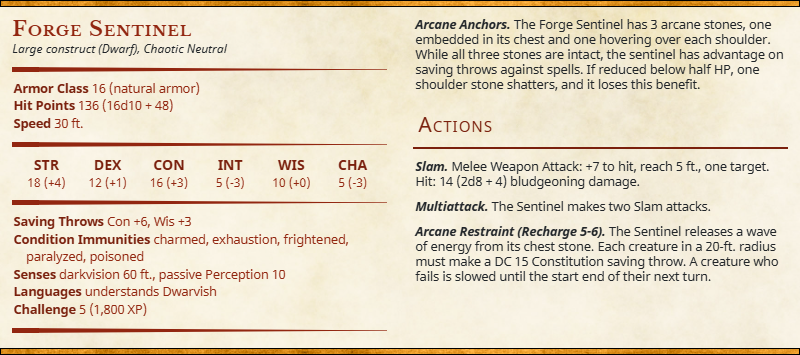
- 1x Forge Sentinel (Blazing Destroyer model)
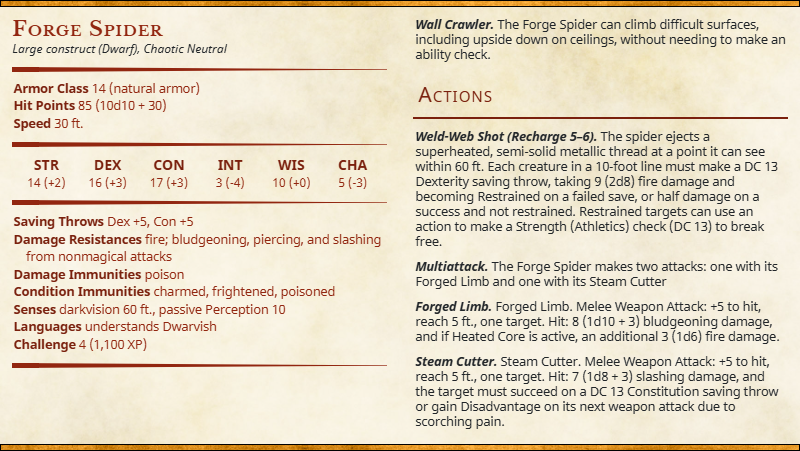
- 1x Forge Spider (Tracking Spider model)
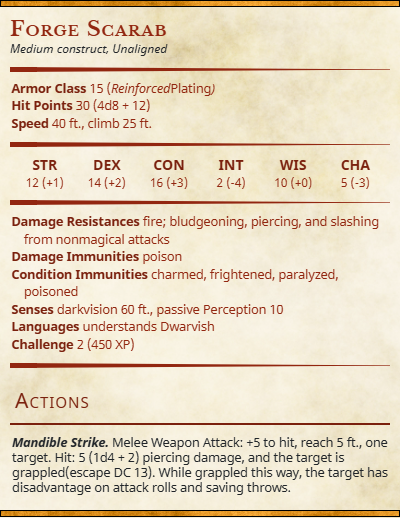
- 3x Forge Scarabs (Clockwork Exterminator model)
Once destroyed, a faint glow emanates from within each construct. If a player inspects, they will discover the constructs core to be the source of the glow. The core is easy to remove, and doing so causes the glow to cease.
- These construct cores are essential for activating the Anvil. They cannot be destroyed by neither physical or magical means.
Outer Chamber Points of Interest
There are three main POI's in the outer chamber: The Anvil, Combustion Chamber and Steam Machine. Aside from those, there are a few other exploration points:
- Scrap Cache: A pile of copper wiring and brass fittings stuffed into a corner. Worth a few gold pieces as raw materials, or potentially usable as patchwork repairs.
- Discarded Tools: A rusted hammer and a cracked pair of smith’s tongs lie forgotten under a collapsed pipe. Though useless for crafting, they suggest the chamber once bustled with dwarven engineers.
- Engraved Floor Panel: A loose flagstone bears faded dwarven runes that translate to “Strength lies not in the forge, but in the hand that wields it.”
- Abandoned Satchel: Leather cracked with age, its strap broken. Inside: a waterlogged journal with smudged entries, the only discernable word being a title: “power surges” and one intact healing potion tucked into the lining.
The Anvil
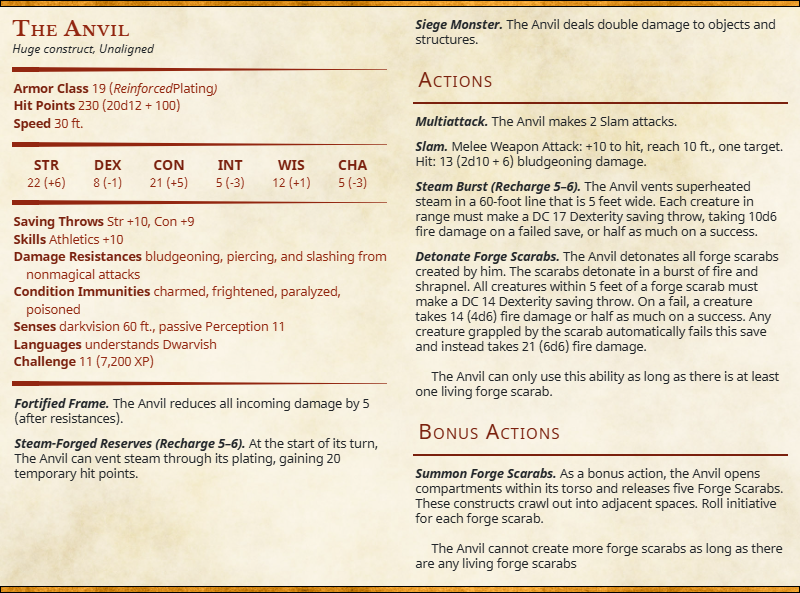
Looming just before the sealed white-stone doors to the south rests a massive dwarven construct. Its frame is built of iron and brass with rounded edges, its bulk more functional than ornamental. The front of its torso is dominated by a massive grill, dark and cold, while its head seems to merge seamlessly into its chest with no clear neck. Brass plating covers the mechanisms at its joints and limbs, reinforcing the machinery responsible for its movement. Though motionless, its sheer size and design suggest a sentinel built for endurance and strength.
A player who inspects the Anvil will discover a recessed compartment beneath the grill at the front of the torso. If a player looks inside, or reaches in, they will find a hexagonal object, similar to the hexagonal key the players already have. (Give the players the second piece of the Anvil Core prop, if you are using real props.
The Door
Set into the southern wall stands a colossal door of smooth white stone, its surface etched with intricate dwarven carvings of hammers, anvils, and flowing runes. Despite its size, there are no visible seams—no hinges, cracks, or sign of where the stone might part. The craftsmanship is so precise it looks as though the entire thing were carved from a single slab. Faint traces of dormant runes are carved around the frame, their glow long since extinguished.
- DC 14 Arcana - DC 14 Arcana: The runes carry faint traces of abjuration magic. The spellwork doesn’t resemble a barrier against entry—it feels like a threshold, waiting for a condition to be met before it responds.
- DC 17 Arcana - the magic doesn’t read like typical abjuration wards at all. The resonance feels closer to planar binding — enchantments woven to connect to or draw power from another plane, rather than simply defend this one.
Combustion Chamber
Set into the west wall, a brass-plated chamber dominates its alcove. The surface is scorched and blackened in places, the riveted seams dulled by age. A large circular panel marks its front, with a heavy brass lever at its center. Dust coats the edges, but the chamber feels purposeful, as though built to harness enormous pressure when activated.
The Combustion Chamber was used to charge magical items by those who created it. Once the players have both pieces of the Anvils core, as well as the 5 inert construct cores, the small cores can be placed within the anvils core, the core placed within the chamber and closed. If the steam machine is active, the lever can be pulled and the chamber activated.
The chamber can be opened with a DC 15 athletics check, otherwise it will open on its own once the steam machine has been activated.
Once opened - Inside, the chamber’s walls are blackened brass, scorched and cracked from years of violent use. At the very center of the chamber, a large recess catches your eye—its edges precise, carved in runed metal that gleams even beneath layers of soot. The recess looks deliberately shaped to hold something.
- If a player further inspects the combustion chamber - DC 13 Investigation Hidden beneath a piston on the doors rail:
- Steamfist Gauntlets (Counts as armour)
- Wondrous Item, Very Rare (requires attunement)
- These heavy brass gauntlets are laced with small vents and pistons that hiss faintly when clenched. When grasping a melee weapon, the gauntlets release bursts of compressed steam upon impact, driving the weapon deeper into the target,
- Properties:
- Steam-Powered Strike: While wearing the gauntlets and wielding a melee weapon, your weapon attacks deal an additional 1d6 damage of the weapon’s type.
- Armor Stress: When you hit a target wearing armor or composed of metal, roll a d20. On a 3 or lower, the steam burst damages their armor, reducing the AC value of the armour, or metal by 1.
- This reduction cannot lower the AC value below 11.
- Magical armor regains its integrity after a long rest (or via mending), but mundane armor remains permanently damaged until repaired.
- Overpressure Hazard:
If you roll a natural 1 on an attack roll while using the gauntlets: - You take 1d4 fire damage as the steam vents back toward you.
- The gauntlets seize up from the sudden pressure spike, locking your grip tight. Until the end of your next turn, you cannot use or release items or weapons held in your hands, and you cannot perform somatic components of spells. (You may still take other actions as normal, so long as they do not involve the use of your hands)
Steam Machine
Across the chamber to the east stands a sprawling assembly of iron pipes, gears, and levers. The machine rises from the floor and climbs partway into the wall, its shape more functional than decorative—an intricate skeleton of engineering meant to move and redirect force. Several joints and couplings are cracked, and some of the pipes hang slightly out of alignment, but the frame itself looks solid, like it could still be coaxed into service.
Skill Challenge: Repair the Steam Machine
The steam machine is required to activate the combustion chamber. In order to activate the machine, the players must make a series of repairs, ensuring the steam flows properly from the crank wheel assembly to the combustion chamber, on the opposite side of the outer chamber.
The steam is inactive until the crank wheel assembly is activated. Once the crank wheel is turned, the steam will begin to flow steadily, but not too strong. Once the lever on the combustion chamber is activated, the steam intensifies and any repairs not made sufficiently will result in their failure outcome being activated.
Each repair has a series of potential checks to repair them and each one has a success outcome and a failure outcome. If the check for a repair is successful, the steam flows through without consequence. If the check for a repair is failed, once the machine is activated, it will result in that repairs failure outcome, giving the Anvil a bonus once activated.
When a player makes a check to determine the state of repairs, give them the Steam Machin handout. If they failed the check, leave out the third repair Power Surge Regulator as failing the check means the players do not notice this repair.
Step 0: Initial Diagnostics
Description:
The machine stands silent in the chamber, a bulky framework of iron gears, pipes, and valves. Dust lies thick across its surfaces, and spots of rust eat at joints where condensation once gathered. Several panels hang askew, exposing the dark tangle of mechanisms within, and broken glass litters the floor where gauges once sat. Though dormant and long-abandoned, its structure remains intact.
- Investigation DC 15: Identify all four major repair needs.
- Success: The party locates all four repairs (Crank Wheel, Shattered Pipe Assembly, Power Surge Regulator, Power Redirect Conduit).
- Failure: The party locates only three repairs—they miss the Power Surge Regulator entirely, automatically resulting in its failure outcome.
Step 1: The Crank Wheel
- Investigation DC 13: Find a replacement cog in the workshop (failure results in an imperfect replacement found and the failure outcome when activated, reduced to 1d6 fire damage if successfully replaced).
- Sleight of Hand DC 12 or Tinkers/Smiths tools DC 10 to replace the old cog (Failing this check results in the failure outcome)
- Tinker’s Tools/Smith’s Tools DC 16: Adjust or refit the teeth properly.
- No change if failed. The wheel simply remains broken.
- Athletics DC 15: Force the crank through by sheer might.
Success: The crank turns smoothly, releasing a steady rush of steam into the pipes. The system hums to life.
Failure: The crank catches partway. Steam bursts violently from a valve, dealing 2d6 fire damage to the one forcing it. The machine still starts, but it’s unstable—future repairs will be harder to manage (disadvantage on next repair check by the same character).
Step 2: Shattered Pipe Assembly
- Additional Discovery: Arcana DC 15: Notice that the steam is infused with magical energy, that could be manipulated.
- Repair Options:
- Strength DC 14: Hold the pipe steady (will need to be held when the combustion chamber is activated. Player holding the pipe takes 1d6 fire damage from the heat of the steam.
- Survival DC 13: Construct braces to hold the pipe in place. (Once the machine is activated, roll 1d20. If the number is higher than the total number of the nature check to construct the brace, it results in the failure outcome)
- Smith’s Tools DC 15: fuse the broken pipe pieces together.
- Arcana DC 16: (Requires successful Additional Discovery check) Channel the steam magically, guiding it into its proper flow (must be maintained (concentration) or done right before activating).
On Success: The pipe is sealed and passes through the pipe as expected.
On Failure: The pipe remains unstable—The anvil gains 20 temporary hit points.
Reasoning for players: Less steam released in the chamber means the constructs have denser, reinforced internal pressure, making them harder to damage.
Step 3: Power Surge Regulator (Electrical Stabilizer)
(Only visible if the party succeeded in the initial diagnostic.)
- Investigation DC 13: Identify that the copper housing can be repaired to contain the erratic runes, or the runes can be re-inscribed to function properly.
- Arcana DC 14: Re-inscribe or magically reinforce the regulator.
- Smith’s Tools DC 15: Repair the copper housing to hold the runes in alignment.
- Insight DC 14: Determine The pulses aren’t random; they rise and fall with a steady rhythm, like the beat of a drum..
- On success - with the timing in mind, you realize the combustion chamber could be activated safely during one of these surges, when energy peaks.
On Success: The regulator stabilizes, the sparking fades, and the energy flow smooths into a steady hum.
On Failure: The regulator fails—The Anvil deals an additional +1d4 lightning damage on all physical attacks.
Step 4: Power Redirect Conduit (Energy Rebalancing)
- Discovery: Investigating the conduit, you notice that there appears to be a partial blockage in the system.
- Nature DC 13: Recognize the buildup as crystalline mineral deposits, likely caused by minerals from the ground water drawn into the system and impurities in the energy source, fusing under the constant heat and pressure, creating crystalline blockage in the seams.
- Arcana DC 13: Recognize "Mana Slags" within the crystalline mineral deposit caused by excess arcane energy. Could possibly be drawn out.
- Repair Options:
- Arcana DC 15: Draw out the mana slags, softening the mineral deposits for easy removal.
- Mason’s Tools or Smith’s Tools DC 14: Chip out or clear the mineral buildup.
- Strength DC 15: Smash the buildup apart by force. (If unsuccessful, leads to the failure option. Even if successful, the force of physically smashing the buildup causes unseen damage which results in the Anvil gaining a +1 to its first attack roll on each of its turns)
On Success: The conduits glow bright and steady, humming as power balances across the system.
On Failure: The conduits sputter and flare erratically—The Anvil gains a +1 bonus to attack rolls as the unstable energy sharpens their reflexes unnaturally.
Step 5: Pull the Lever
Once the players have made the necessary repairs, activated the steam by turning the crank wheel and pulled the lever on the compression chamber, read:
With a groan of strained metal, the crank wheel locks into place. Steam begins coursing through the machine’s patched pipes, hissing at joints and filling the chamber with a rising hum. The repaired gears clatter into motion, and the floor vibrates underfoot as pressure builds. Across the chamber, the combustion chamber shudders as valves snap open, and its heavy face seals shut around the Anvil’s Core.
The brass lever resists at first, then slams down with a jolt. A deep roar echoes inside the chamber as steam surges into its heart, flooding the receptacle. The walls glow faintly orange, runes flickering to life for the first time in centuries. After a long, tense moment, the chamber hisses open again. Within the scorched recess lies the Anvil’s Core—no longer inert, but pulsing with molten light, radiating heat and power as though alive.
The Core
Once the players have both parts of the core, they will need to remove five cores from the dispatched constructs, place them within the large core, seal it and place it within the combustion chamber to charge it.
After the core has been charged, it can then be placed back inside the Anvil.
The Anvil Encounter:
As the charged core slides into place within the construct’s chest, there’s a deep, metallic thud—like a hammer striking iron. The grill at its torso flares with sudden orange light, pulsing brighter with each beat, as if the machine is drawing breath for the first time in centuries. Steam hisses from vents along its brass plating, spilling into the air with the sharp scent of heated metal. The Anvil’s limbs shudder, gears locking into motion as the weight of its massive body shifts. Slowly, its head rises—though it is fused into the chest, the faint glow of burning embers gleams where eyes might have been. With a heavy grinding of stone beneath its feet, the Anvil takes a step forward, though no eyes are seen, you can feel its gaze piercing you as it moves to strike.
Post Battle
Once the Anvil has been defeated, the cover over his core pops open, revealing once more the core, now instead of a matte black look however, it is glowing in a multi-colour pattern, and the door to the Inner Chamber will pop open.
If you are using the physical objects, hand the players the charged core object
The players will need to navigate the labrynth lock on the physical puzzle, and once opened, they will find inside five charged cores which are 1 of the 2 requirements to ignite the Phoenix Forge.
Inner Chamber
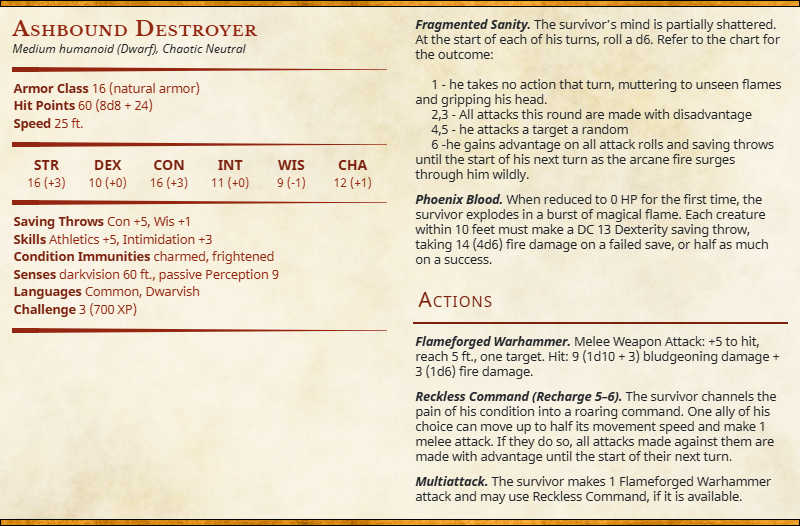
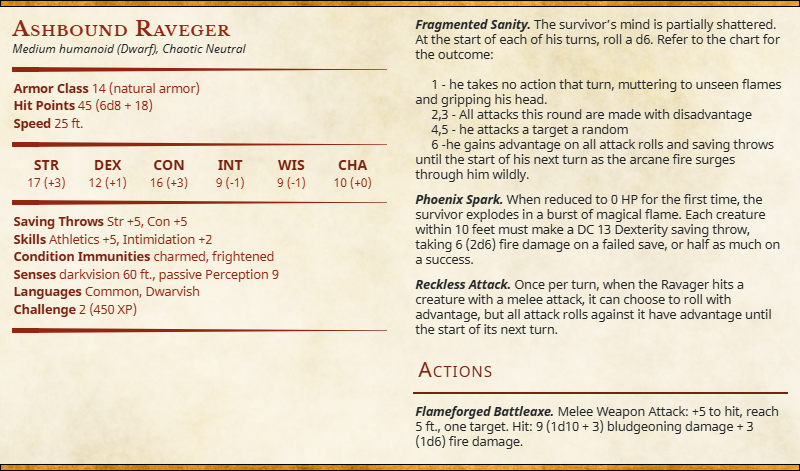
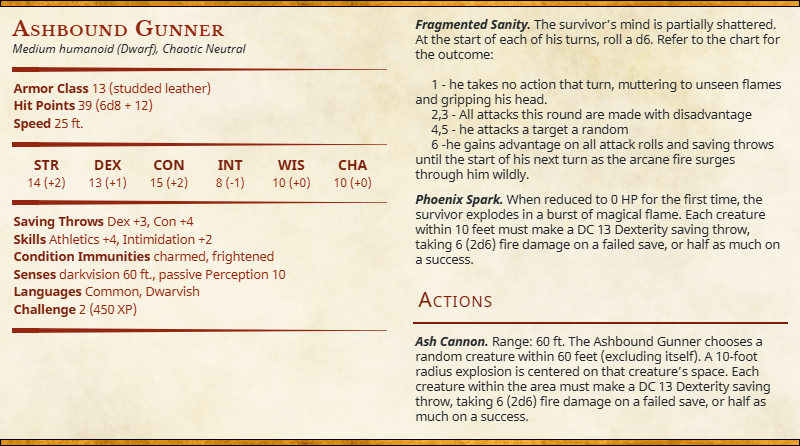
When the players enter the inner chamber, they are confronted by a group of dwarves—the remnants of a previous expedition. Centuries ago, these dwarves sought to rekindle the Phoenix Forge, but their arrogance brought ruin. The forge’s guardian spared their lives, yet condemned them to remain sealed within the chamber until the doors opened again.
With no food or water to sustain them, they endured on the forge’s ambient magic, their bodies warped and their minds slowly fraying. The magic has kept them alive but left them broken: their memories are fragmented, their demeanor difficult to read, and their actions prone to sudden volatility. They know little of who they once were, but their presence is a living reminder of the forge’s cruel judgment.
The massive stone doors grind open, revealing a vast chamber outlined in smooth marble walls and floored with intricate cobblestones, each stone set with precision. The air is heavy and dry, carrying the scent of long-cooled ash and iron. Rows of dormant forge machines line the chamber—bellows, furnaces, and great hammers poised above anvils—each one a monument to dwarven craft, though all long silent.
Four towering dwarven statues stand in a square at the chamber’s center, their stern gazes cast over the hall as though judging all who enter. On the far wall, a grand marble forge sits dormant, its runes dark and lifeless. Scattered among the wreckage are broken weapons, shattered armor, and one relic that gleams faintly even in the gloom—a massive, mounted crossbow wrought in the likeness of a phoenix, resting in the corner.
At the far end of the chamber, movement catches your eye. Several figures stand there—dwarves, their skin cracked with ember-glow beneath the surface. They stare at you wide-eyed, clutching their weapons tightly, but they do not advance. They appear to be murmuring to themselves, or perhaps to each other—their voices hushed and uncertain. They watch you with a look as though unsure if they see intruders, saviors… or phantoms.
The Survivors
Roleplay Guidance
- Demeanor:
- They are not quick to attack.
- They are confused, distrustful, and prone to sudden anger.
- Their fragmented memories make them inconsistent, sometimes contradicting themselves or each other in the same breath.
- Mannerisms:
- Murmur constantly, sometimes to themselves, sometimes to each other.
- Repeat phrases, stutter over words, or trail off mid-thought.
- Frequently glance at the sigils on their own armor as if trying to remember what it means.
- Fragmented Memory Clues:
- They recall fire and a terrible battle, but not against what.
- They know they were part of something greater, but cannot remember the expedition clearly.
- They mention being “spared” but don’t recall by whom or why.
- They gesture vaguely at a melted, ruined object among the forge debris—an old, destroyed dwarven key similar to the one the players used.
Dialogue Samples:
- “The fire took them, it took them all… but why are we still here?”
- “You wear their faces. Or… no, no, not their faces. Whose faces?”
- “She burned us clean, left us empty. Empty as ash.”
- “Do you hear it? The forge still hums. Always humming. Always waiting.”
- “Lies! No, truth. No… it’s both, it’s both, it’s always both.”
Cultural Sigil
- All of them wear armor etched with a faded, identical sigil—an anvil crowned by crossed hammers.
- A successful History (DC 14) check identifies this as the mark of an ancient dwarven culture of master-smiths. (If the history check was above 17 - Clan Aurmigan Smiths)
- Their weapons and armor were renowned for extraordinary quality—but they were equally infamous for greed, ruthless business, and arrogance in their craft.
- To dwarves or scholars, seeing this sigil is a grim confirmation: these survivors hail from a culture that vanished in shame, and their presence here hints at why.
Player Interaction Outcomes
- Careful Approach: If treated with empathy and patience, the survivors can be convinced the doors have opened and they are free. At first, they refuse to believe it, fearing the Phoenix’s curse, but if the party persists, they leave shakily, overwhelmed with emotion.
- Aggressive Approach: If the players are harsh, mocking, or threatening, the survivors’ distrust curdles into rage and they will attack.
Survivors Exit Inner Chamber
The survivors exit the inner chamber, slowly, hesitantly, they step beyond the chamber for the first time in centuries. The faint glow of their ember-lit skin drifts across the outer chamber like lanterns in the dark.
For a moment, it is almost hopeful—until, one by one, the lights flicker and vanish. The sound of stumbling boots and the hollow clatter of armor echoes through the darkness. Silence follows. The Forge’s magic sustained them for longer than any mortal body could endure. With its blessing absent, their time has ended. Only empty husks remain, fallen where they walked.
Phoenix Arbalest
On a raised stone platform rests a massive crossbow, its frame wrought in the likeness of a phoenix in flight. The weapon is mounted to the floor on iron struts and wheels that long ago seized with rust. Its limbs are carved from a single piece of marble, inlaid with faint traces of glowing red crystal. A single bolt, etched with flame-like runes, is already loaded. No other ammunition lies in sight.
The arbalest cannot be moved, nor can the bolt be removed. It is as though they are fused as one.
DC 15 Arcana/Detect Magic Spell - The weapon gives off both Evocation and Necromancy auras.
Effects - A player may pull the trigger on the arbalest, which requires a considerable amount of force to engage the trigger. Doing so launches the bolt:
- Regardless of the target of the attack, the bolt selects a random Humanoid creature within the inner chamber. The target is immediately reduced to 0 hit points and all death saving throws are made with Disadvantage.
- The next time the creature dies, they collapse in a pile of ash.
- At the start of the next round, they are resurrected from the ashes with the following:
- They gain all the benefits of a long rest.
- They permanently suffer 1 level of exhaustion (only removable by a wish spell).
- Their maximum hit points increase by 10 permanently.
- They gain resistance to fire damage.
- They gain a Phoenix Healing Pool equal to their new maximum bonus HP (10). They may spend points from this pool as a bonus action to heal creatures within 20 feet, at any amount they choose.
- If a wish spell is used to reverse any one of these effects, all effects also deminish.
Once the players have placed the cores into the forge, and the correct statue is facing the forge, the forge comes to life and the doors to the Outer Chamber crash closed.
As the final core drops into the heart of the forge, a tremor ripples across the chamber. A low hum builds into a deep, resonant thrum, echoing through the white stone like a heartbeat. The forge’s basin flares—first with orange, then white-hot flame—and molten light pours from its seams like veins igniting. The air grows thick and heavy, the heat oppressive, and then…
A sudden burst—like a solar flare—erupts from the forge. Fire spirals upward, not chaotic, but deliberate, coalescing into shape. Wings stretch wide, vast and incandescent, as a towering figure takes form above the flames: a great phoenix, its feathers forged from living flame and molten brass, its eyes burning with ancient memory. It lands with a deafening impact, the forge dimming to embers beneath it.
The creature folds its wings slowly, fire trailing from its wingtips like falling starlight. It regards you—not with menace, but with a weight that threatens to press your very soul into ash.
(The phoenix speaks…)
“At last, the Flame stirs once more.”
“You who have kindled the forge—know that this place was never merely a crucible of steel, but a crucible of spirit. Those who sought to wield its fire without understanding were undone. Those who endured its trials with strength alone found only ruin.”
“You tempered iron with spark, bound steam with will, and broke what could not be controlled. But this alone does not make you worthy.”
“This forge was wrought to grant power—but only to those who prove themselves its equal in heart, not just in hand. You now stand at the final threshold.”
“Face the Flame.”
“If your soul is strong, you shall claim the Phoenix’s gift. If it is not... you shall be unmade.”
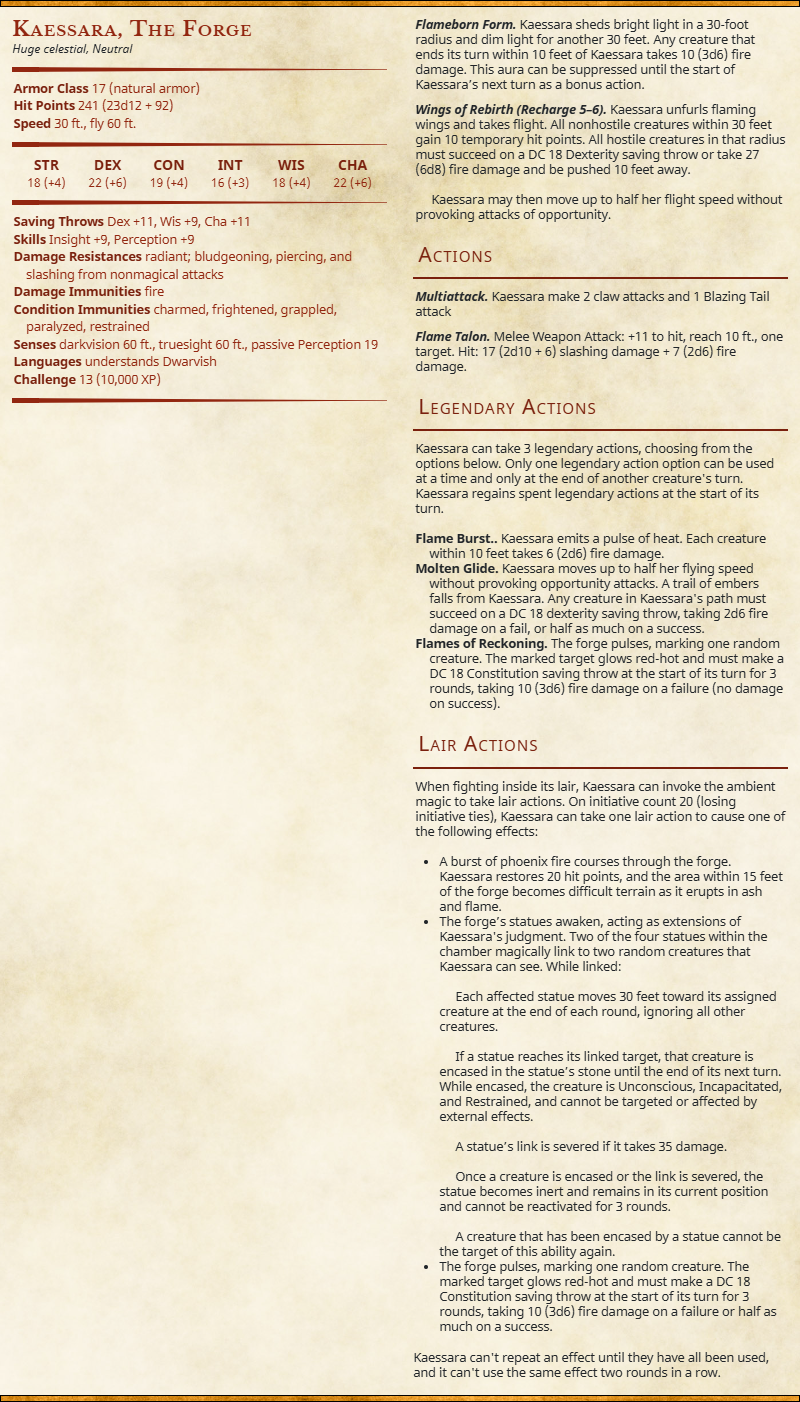
Combat ensues with Kaessara, The Forge.
Once defeated:
As Kaessara falters beneath the final blow, her form erupts not in flame, but in silence — a sudden collapse into ash that scatters across the stone like a breath held too long. The room dims, the forge’s fire vanishing in an instant, leaving only ember-glow and silence.
Then, from the blackened pile, a gust of wind — no, a breath — sweeps outward.
The ashes swirl upward, drawn into the empty forge like smoke inhaled. For a moment, all light returns in a single, breathtaking burst — the shape of a great phoenix formed in flame, wings unfurled in radiant defiance. It rises high, its cry echoing across the chamber not in sound, but in sensation — a warmth that brushes the soul, a whisper of you are seen.
The phoenix vanishes, collapsing inward into the heart of the forge, which now blazes with steady, welcoming fire.
Then, a hum — low and resonant — vibrates through the very stone beneath your feet. The machinery stirs, but not as before. No churning gears, no arcane surges. This is something older. Something aware.
A voice — not spoken, but understood — fills your thoughts:
“The Trial is passed. The Flame is kindled. The Forge is yours.”
Before you, the fire pulses in quiet rhythm, waiting.
Not for tools. Not for hammers. Not for steel.
But for intention.
And as each of you gazes into the heart of that eternal flame, you feel it responding.
Your thoughts shape its heat. Your desires stir its embers.
The Forge will give form to your will — not by your hand, but by your soul.
The forge’s reignition marks the players’ triumph — their worth proven, the Phoenix Forge opens to them. Each party member may now forge a legendary item shaped by their essence, memories, or desires. The process requires no tools or action; the flame responds to their thoughts, crafting a unique reward that reflects who they are.
END
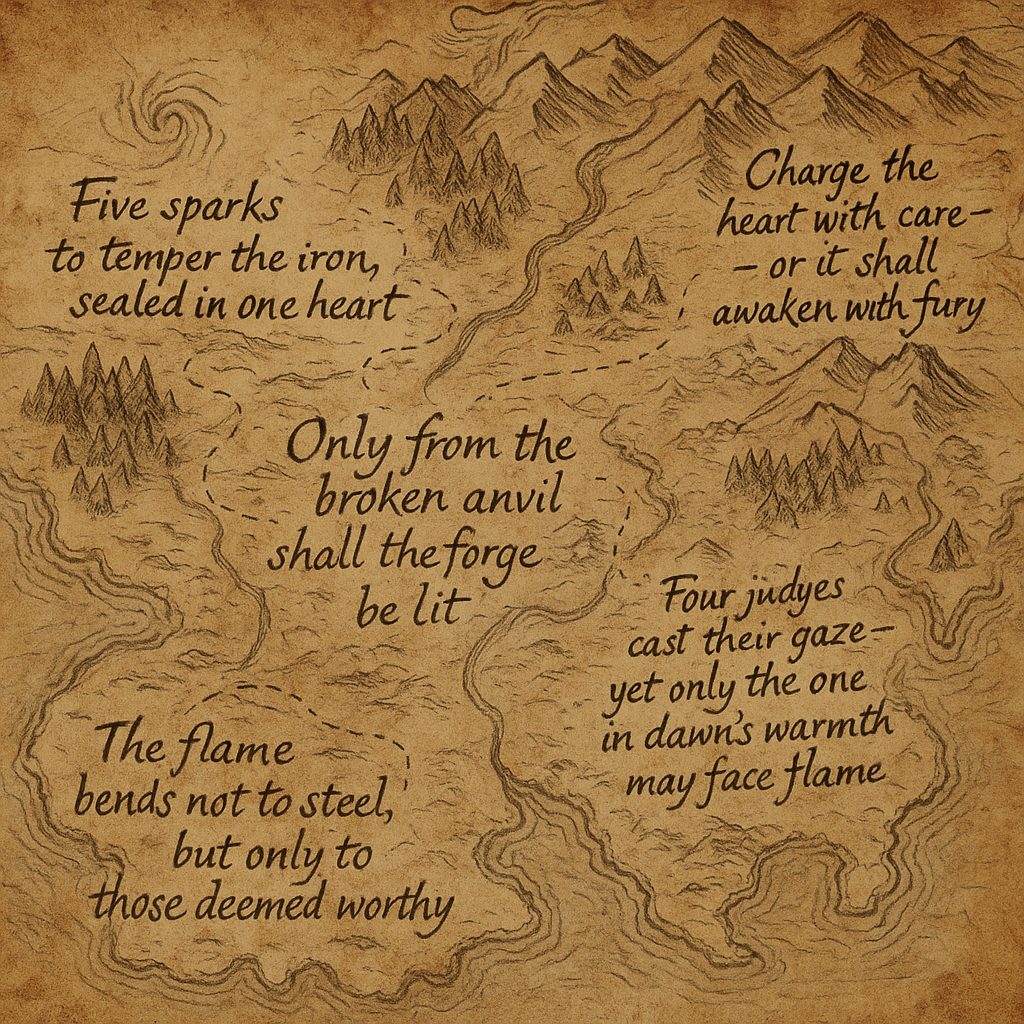
Clues for the Trials (as written on the map)
These are ink-scrawled phrases scattered across the parchment map, not in a neat list, and each corresponds to a phase of the forge’s activation and testing process:
1. Clue for Charging the Core
“Five sparks to temper the iron, sealed in one heart.”
This refers to the five construct cores being placed into the Anvil’s core casing.
2. Clue for Properly Charging the Core (Avoiding Empowered Anvil)
“Charge the heart with care — or it shall awaken with fury.”
(This was the finalized pick unless you now prefer one of the recent alternatives.)
3. Clue for Activating the Forge Itself
“Only from the broken anvil shall the forge be lit.”
Refers to powering the Phoenix Forge only once the Anvil’s core has been charged.
4. Clue for the Statue Puzzle
“Four judges cast their gaze — yet only dawn’s warmth may face the flame.”
Tied to rotating the statues properly before the forge can be activated. “Dawn’s warmth” references the east-facing statue.
5. Clue for Final Worthiness / Thematic Resolution
“The flame bends not to steel, but only to those deemed worthy.”
This foreshadows the final trial and the phoenix-like guardian that tests the characters — both thematically and literally.
Player Handout
Steam Machine:
This contraption is designed to channel steam pressure from the crank wheel assembly at one end of the chamber, through a series of pipes, and into a combustion chamber on the far side. The combustion chamber has a button built into it—this button will only function once steam has been properly routed through the system. There are several broken pieces along the way that will need to be repaired:
The Crank Wheel
- At the machine’s base sits a massive iron crank wheel. On the back side of the wheel, the teeth on a broken cog are bent and compressed, preventing them from properly aligning. This wheel looks like the key to driving the first rush of steam. It could be repaired or forced, but the strain of forcing it could be hazardous to those nearby.
The Shattered Pipe Assembly
- Along the steam channel, you discover a section where the pipe has clearly been broken. The two ends don’t quite align — one seems to have slipped from its mount, leaving a jagged gap where steam would leak out once pressure builds. In order for the steam to flow properly, the pipes will need to be realigned.
Power Surge Regulator
- Tucked behind a mesh grate is a small copper box with fractures along its side and glowing runes runes etched into the internal surface. The symbols flicker erratically, sparks jumping across the housing in bursts of blue-white light. The regulator was clearly meant to smooth the energy flow into the machine—but now it threatens to overload the entire system.
Power Redirect Conduit
- At the far end of the machine, a thick, crystal-lined conduit extends into the chamber. A faint inner light pulses within, but instead of a steady glow it flickers and sputters, flaring and dimming as though struggling to remain lit. The pattern feels unstable—as though the energy is being suppressed.
Player Resources
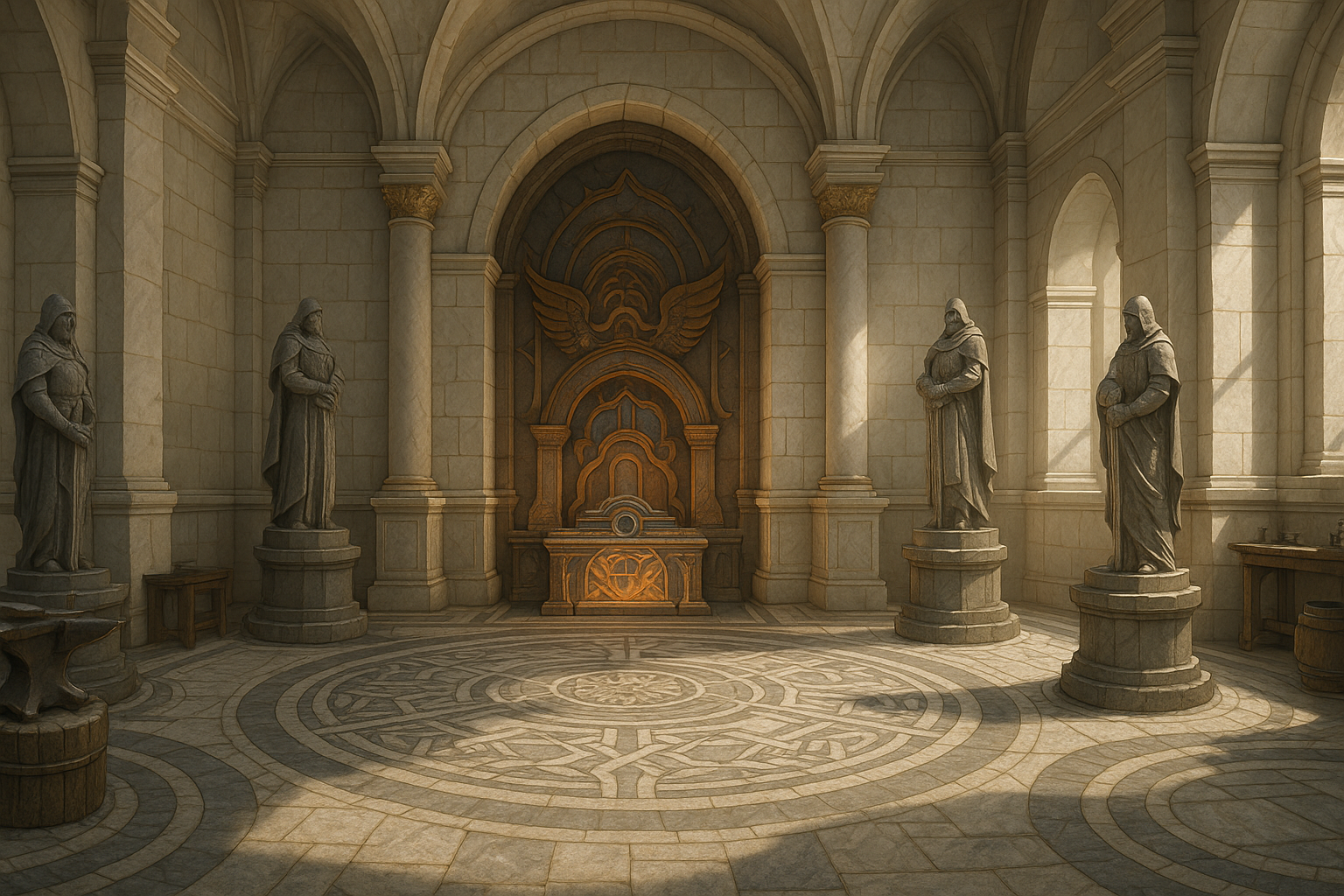
Character Creation Guide
For centuries, whispers have passed through the halls of dwarves and the taverns of men alike — whispers of the Phoenix Forge. Some claim it was no mere forge, but a crucible, wrought to test those who would dare to shape weapons in its immortal fire. Legends speak of trials carved in brass and stone, of machines that walk without masters, and of a guardian forged from the forge’s own heart. Time buried these tales in silence—until a clue was uncovered.
An aged map, weathered and torn, has found its way to you — its dwarven script and strange markings promising more than myth. Alongside it rests a fragment of a dark metal core, shaped like part of a hexagon. Its surface is etched with faint, ancient runes that glow only when caught at the corner of your vision. Cold to the touch, yet carrying the weight of something more, it feels less like a relic and more like a piece of a puzzle, waiting to be solved.
Steel your courage, for the Anvil is but your trial’s beginning. The forge does not simply grant its gifts. It judges.
Edition: 5e
Level: 9
Stats: Point Buy
Gear:
- Starting gear
- 1x armour, weapon OR shield +2
Magic Items - 6 points
- Potion of Healing - 1 point
- Uncommon - 2 points
- Rare - 3 points
- Very Rare - 4 points
Resources
Props
This adventure uses 4 props.
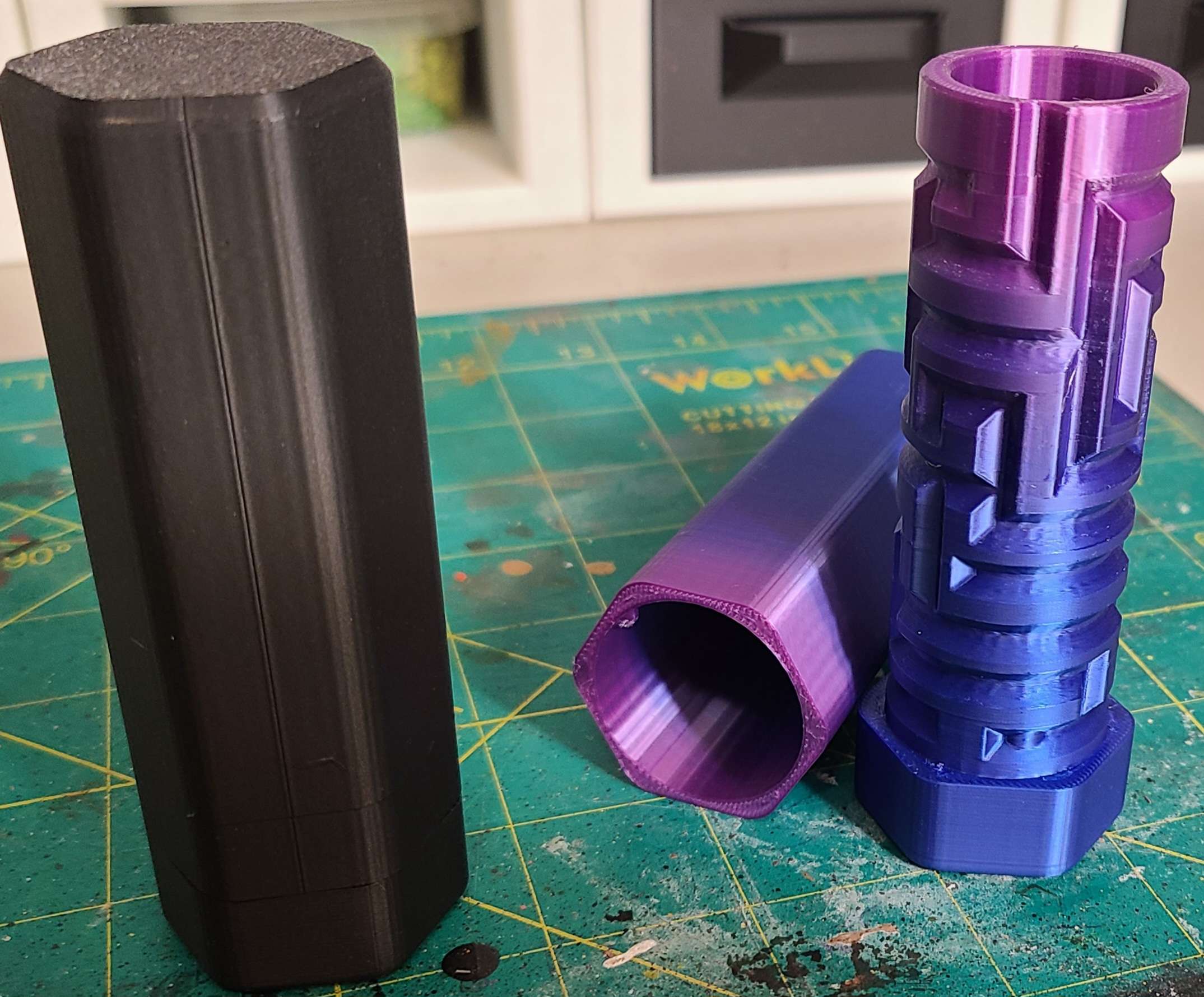
2x Labyrinth Puzzle Box
- I found the ones in the image below on Maker World. There are several options, this one is an easy one but you could always go with a more challenging one.
- I filed down the nub on the black one to add to the feeling of it being "inert", and so the players don't experience the puzzle for the first time by closing the box.
5x Small Stones
5x Small Gems (or coloured stones)
Player Map - Give this to players at the beginning of the adventure.
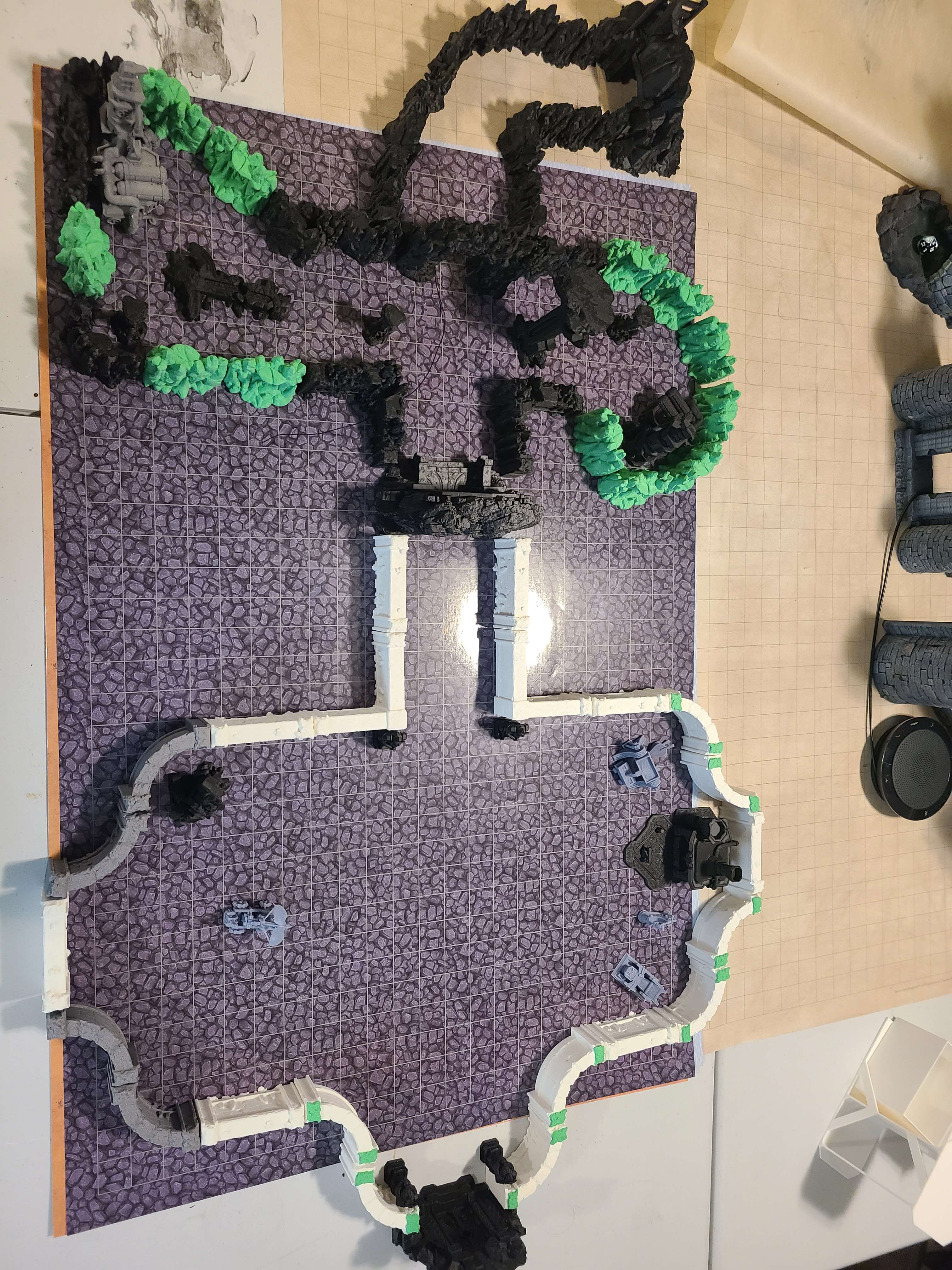
Adventure Map
The map is separated into an Outer Chamber (The cave walls section), and an Inner Chamber (The engineered walls section). I did not have the statues setup when I took the photo, but they should be situation around the chamber as detailed in the Inner Chamber section of the adventure.
For the Constructs, place the smaller ones around, randomly and The Anvil in front of the door between the inner and outer chambers.
This map is a bit of a mess, I know!
Stat Blocks
Constructs
Survivors/Ashbound
Kaessara, The Forge

Comments