

Chorvix
Habitat and Biome
Chorvix colonies thrive in the dark places of the world. They are most often encountered in subterranean caverns, abandoned ruins, and collapsed tunnel systems where their burrowing reshapes the stone into honeycombed warrens. They prefer damp, mineral-rich environments, and their acid can leave walls and floors scarred with smooth, glassy residue where stone has been partially dissolved.
When Chorvix infest surface lands, they often hollow out beneath farmlands, hillsides, or even towns, weakening the ground above until it collapses into their expanding hive.
Temperament and Behavior
Chorvix are aggressive and territorial. They do not communicate in ways understood by outsiders, but within the resonance of the hive they move and fight with chilling coordination. To the eye of an observer, a group of Chorvix will attack in perfect unison, as though driven by one will.
They show no fear, fighting until slain, though this is not mindlessness. They are calculating predators, exploiting terrain, ambushing from beneath the earth, and overwhelming intruders with relentless waves of bodies.
Reproduction and Life Cycle
At the heart of every hive is a Broodmother, a queen fused to a fleshy spawning pod. This living cradle anchors her in place while she produces egg-sacs, which are carried away by drones and stored in incubation chambers. The eggs hatch into pale, grub-like larvae, which molt rapidly into their adult forms.
Most larvae become drones, the expendable laborers and hunters of the hive. Some, under the influence of the Broodmother’s will, molt into larger, stronger castes such as Ravagers, the elite warriors. All serve the queen. Should the Broodmother perish, the hive collapses into chaos, and the surviving Chorvix become little more than scattered predators.
Diet and Feeding
Chorvix are carnivorous, though their method of feeding is alien. They exude acid to soften and dissolve their prey, consuming the liquefied remains. Unused carcasses are often left half-digested in hive chambers, where larvae and other castes feast upon them. This grisly economy ensures that nothing brought into the hive goes to waste.
Weaknesses
While individually formidable, Chorvix have notable weaknesses. Their pink, fleshy seams are vulnerable to focused strikes. They are also most dangerous when clustered; if separated from the Hive Resonance, a lone Chorvix becomes less coordinated, slower to react, and more predictable.
Hive Structure and Hierarchy
Chorvix hives are sprawling networks of tunnels and chambers carved into the earth by Burrowers and reinforced by resin-like secretions. The Broodmother anchors the hive at its deepest chamber, surrounded by Broodtenders and the ever-churning mass of larvae.
Hierarchy is absolute:
- Broodmother — central mind and source of all Chorvix.
- Ravagers — commanders of force, defenders of the hive.
- Broodtenders — guardians of the brood larvae.
- Burrowers — builders and ambushers.
- Skivers — scouts and harassers.
- Drones — workers and expendable front-line swarm.
The hive operates as a singular entity through their shared Hive Resonance. Though individual Chorvix lack true intelligence, the resonance grants them coordinated action, allowing them to outmaneuver foes as if guided by one will.
Hives expand constantly. If left unchecked, a single Broodmother can produce hundreds of Chorvix, their tunnels sprawling outward until they collide with settlements or surface lands. Few who have faced a hive report victories — most speak only of collapsing caverns, chittering darkness, and the endless scrape of claws in the stone.
Castes
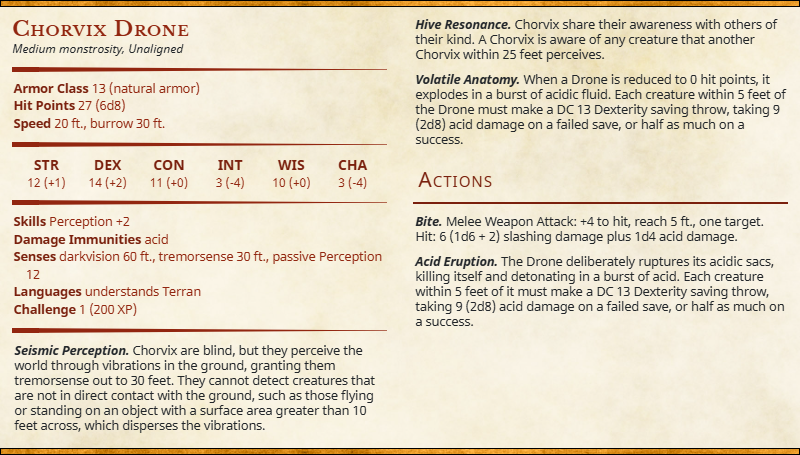
Chorvix Drone
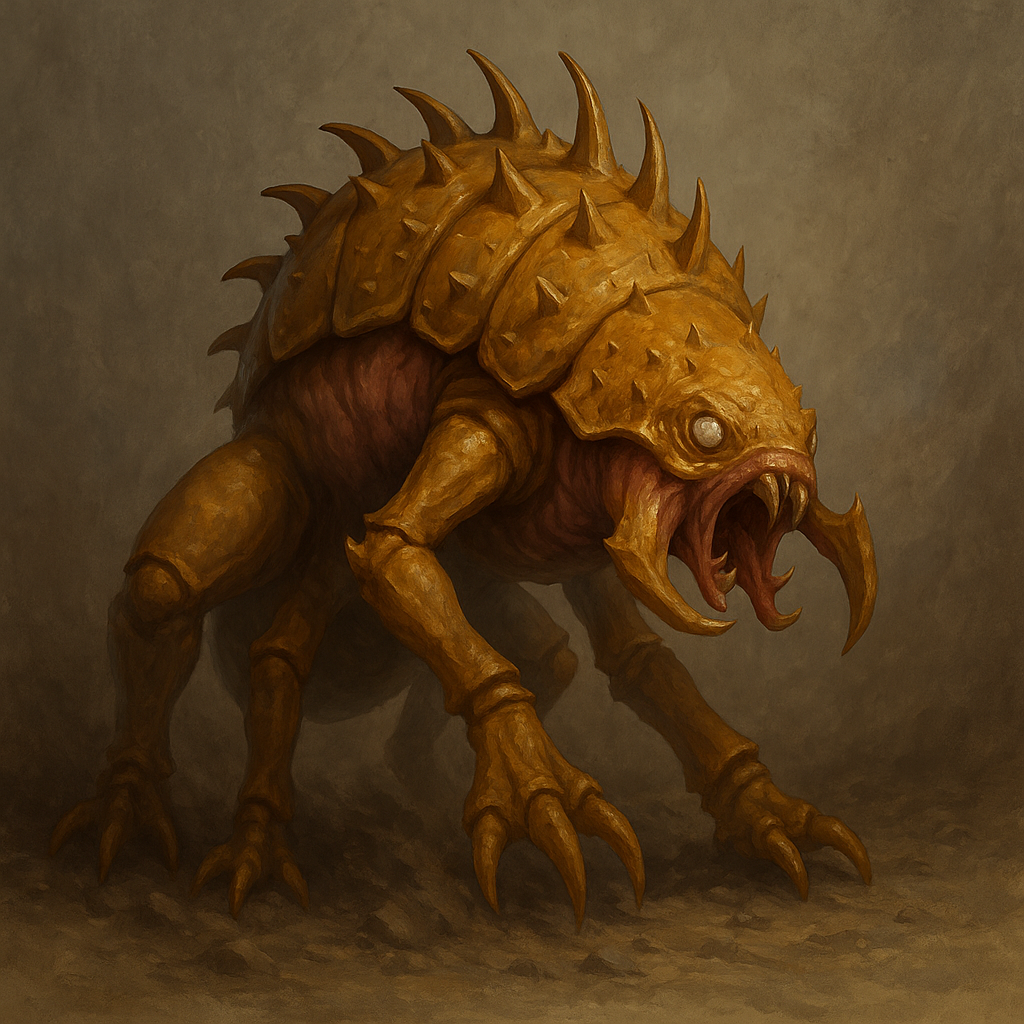
The first you are likely to see, and the first to die, are the drones. They shuffle on four crooked legs, hunched low to the ground, their pincer-hands clacking as they drag stones and corpses alike into the depths. Rows of spines jut from their backs, quivering whenever the hive stirs. Individually they are weak, brittle things — yet they come by the dozen, and each will gladly die if it means dragging you a step closer to the jaws of the hive.
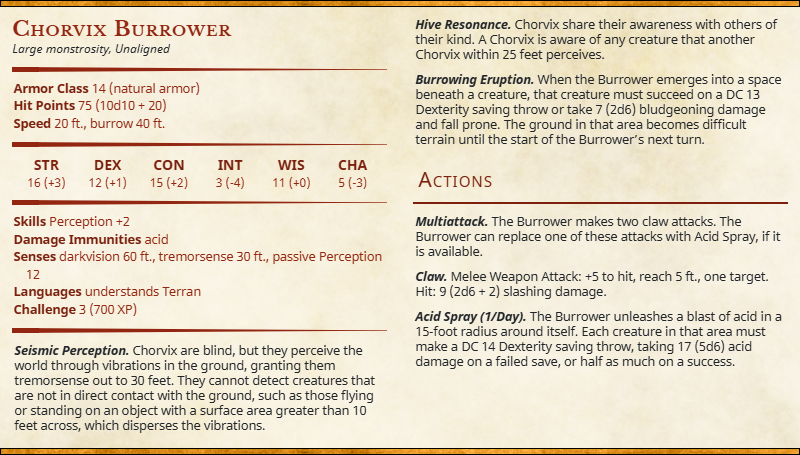
Chorvix Burrower
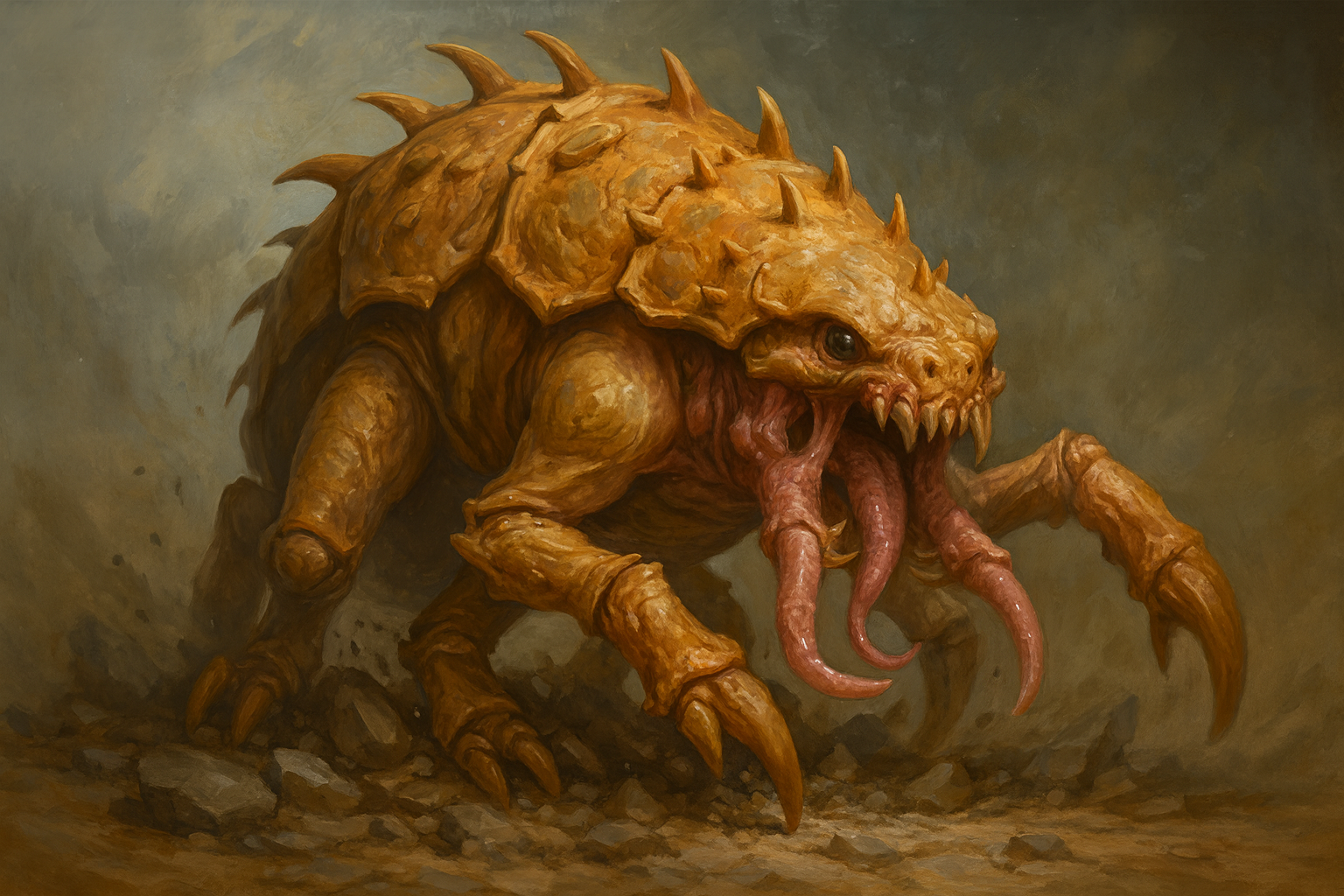
Where the drones scuttle, the burrowers thunder. Vast creatures with shovel-like claws, their bodies are living engines of excavation. When one erupts from beneath your feet, the ground heaves like water, and stone shatters as though it were soft clay. Their mandibles are slick with acid, their shells ridged with strength, and their patience endless. They do not pursue prey far; they simply wait, listening through the ground until the time comes to strike from below.
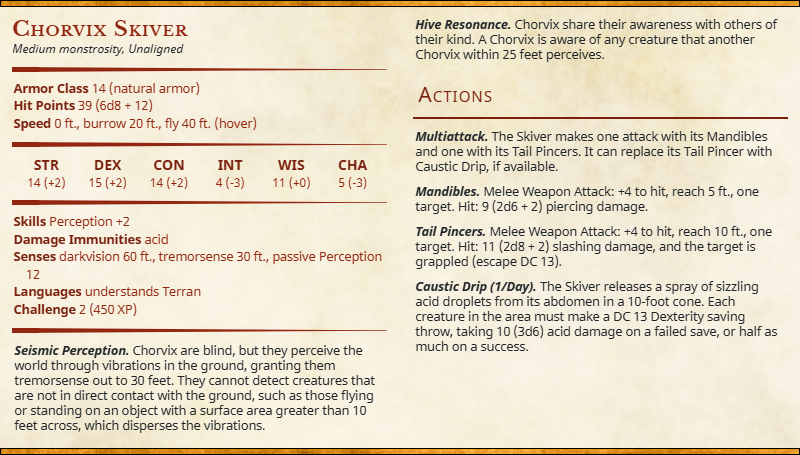
Chorvix Skiver
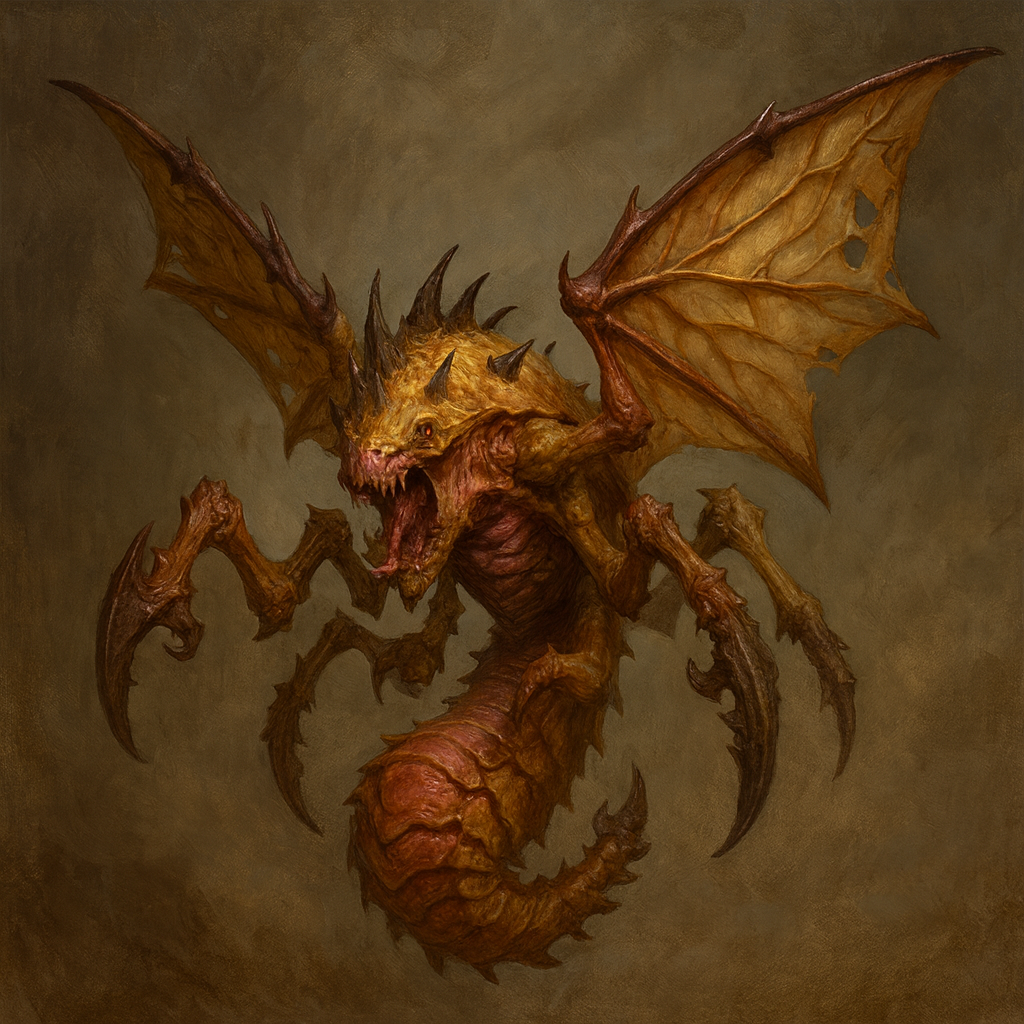
From the ceilings and chasms come the Skivers, their wings shrieking in a metallic hum that rattles bone. Though blind like their kin, they sense the world through the same subterranean rhythm — their tail pincers feel the faint reverberations of echoed footsteps and vibrations that travel through air and stone alike, allowing them to perceive movement even while aloft. Their middle limbs are grotesquely overgrown, snatching prey from ledges or holding them aloft as pincers at their tail snap shut. They are hunters of the high places, the hive’s eyes and ears in caverns too vast for drones or burrowers. One Skiver can harry a traveler for hours, but a swarm of them will strip a caravan bare before a scream can echo.
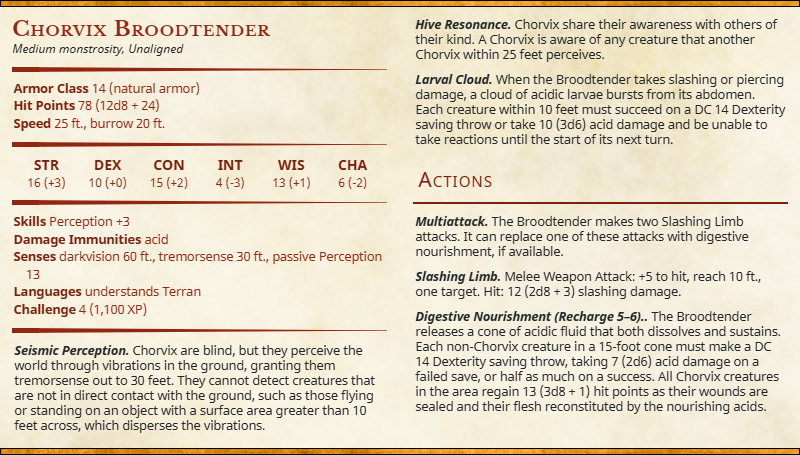
Chorvix Broodtender
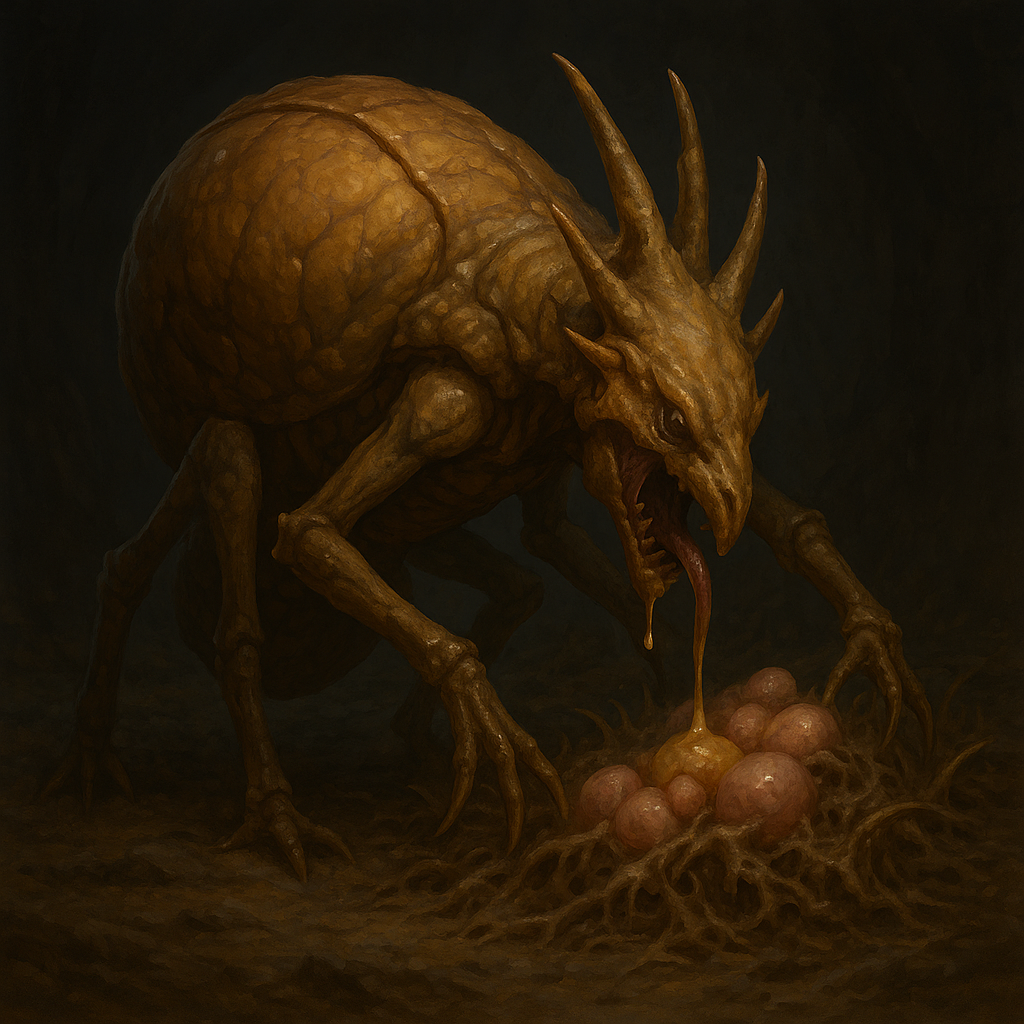
The broodtenders are perhaps the most disturbing to witness, for they are not warriors but nurses. Their swollen abdomens trail slime as they drag themselves between chambers, their small forebodies gnashing with rows of teeth, while delicate arms ferry lumps of flesh into larval pits. They gorge themselves on corpses, then dissolve what remains in bubbling acid, regurgitating it into the maws of the young. Harmless at a distance, yes — but intrude upon a nursery, and you will find their devotion no less deadly than a Ravager’s blade.
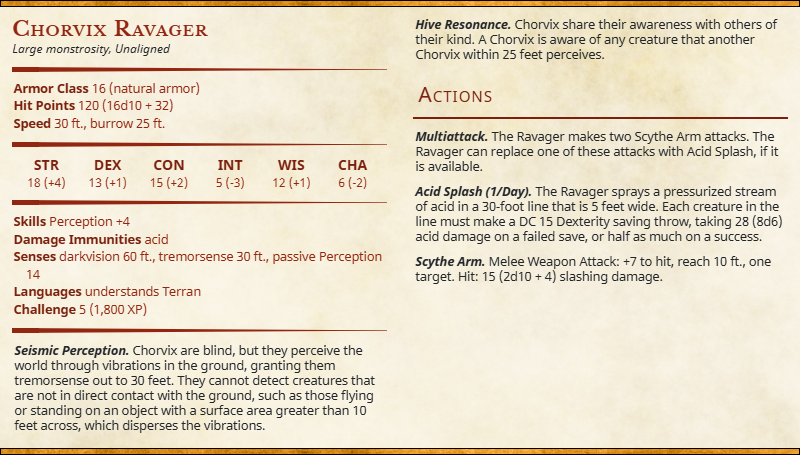
Chorvix Ravager
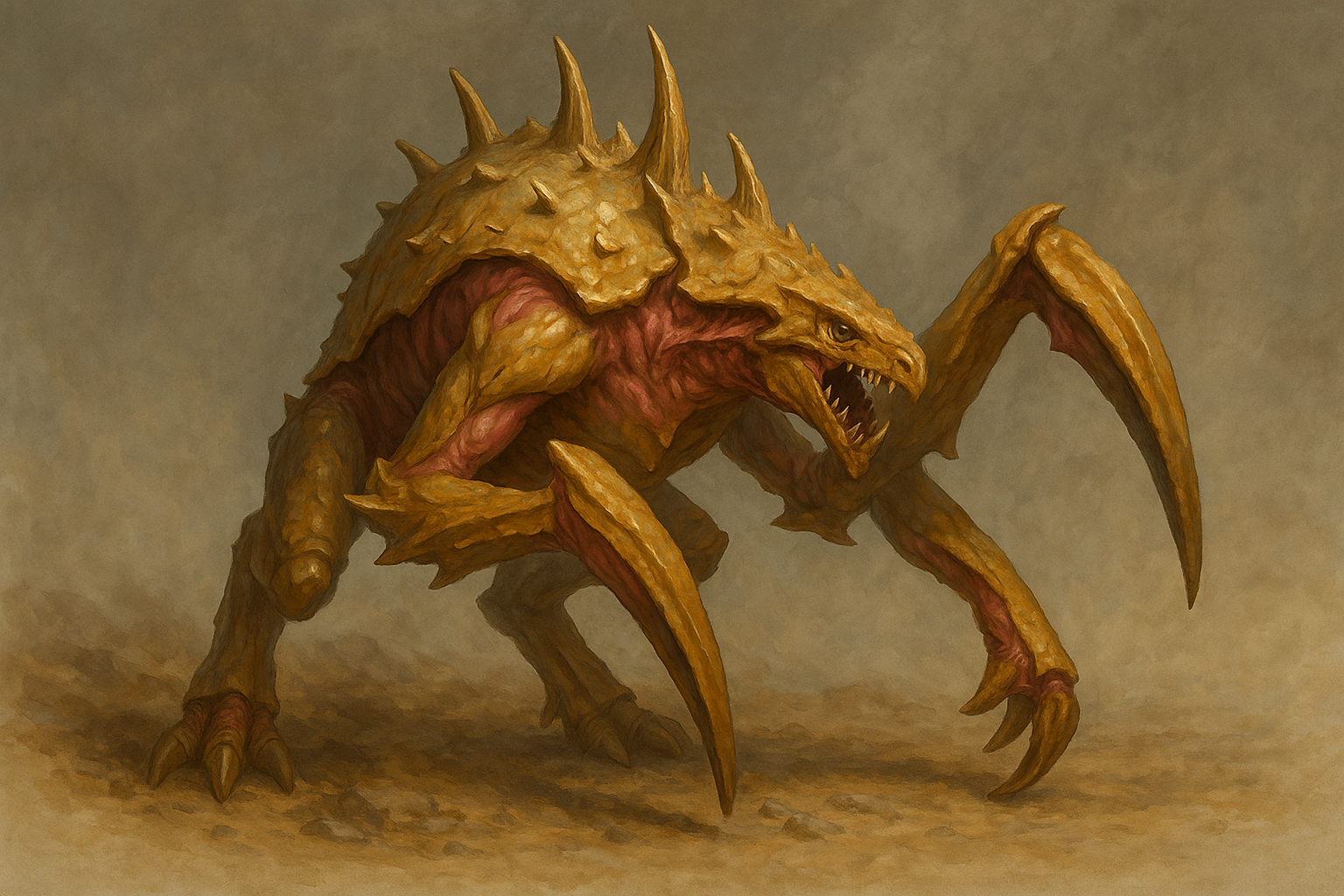
When the hive demands slaughter, it is the Ravagers who answer. Taller than horses, their scythe-like arms gleam with acid and scar tissue. They stride with a soldier’s certainty, cutting through steel and stone as if both were brittle wood. Lesser Chorvix defer to them without hesitation, and it is through them the Broodmother enforces her will. In their presence, the hive ceases to be a swarm and becomes an army.
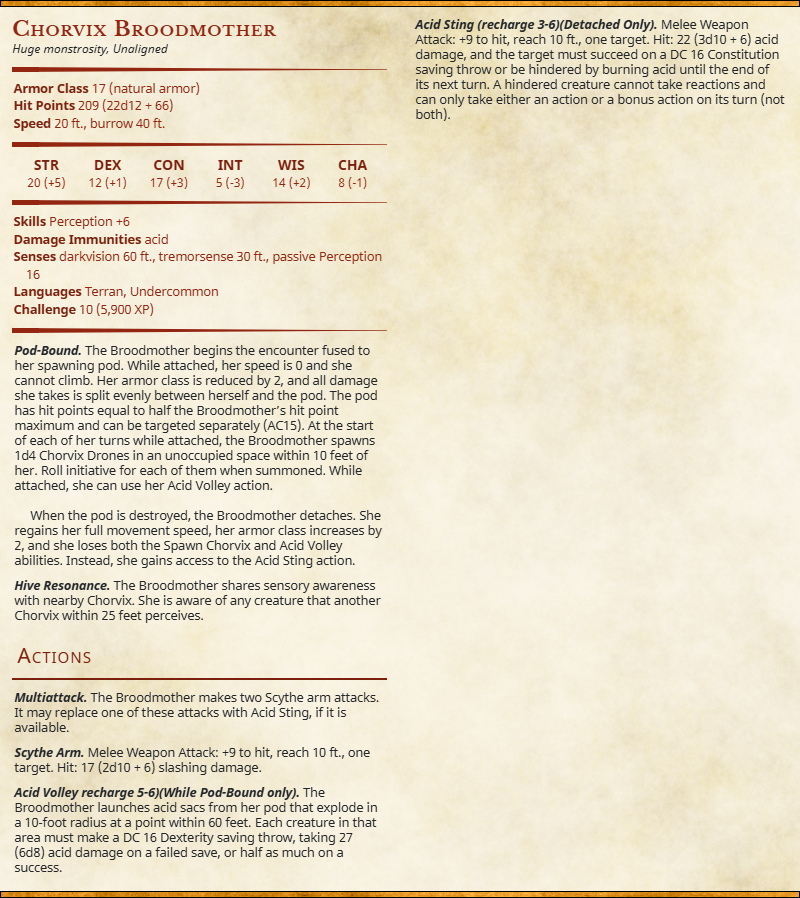
Chorvix Broodmother
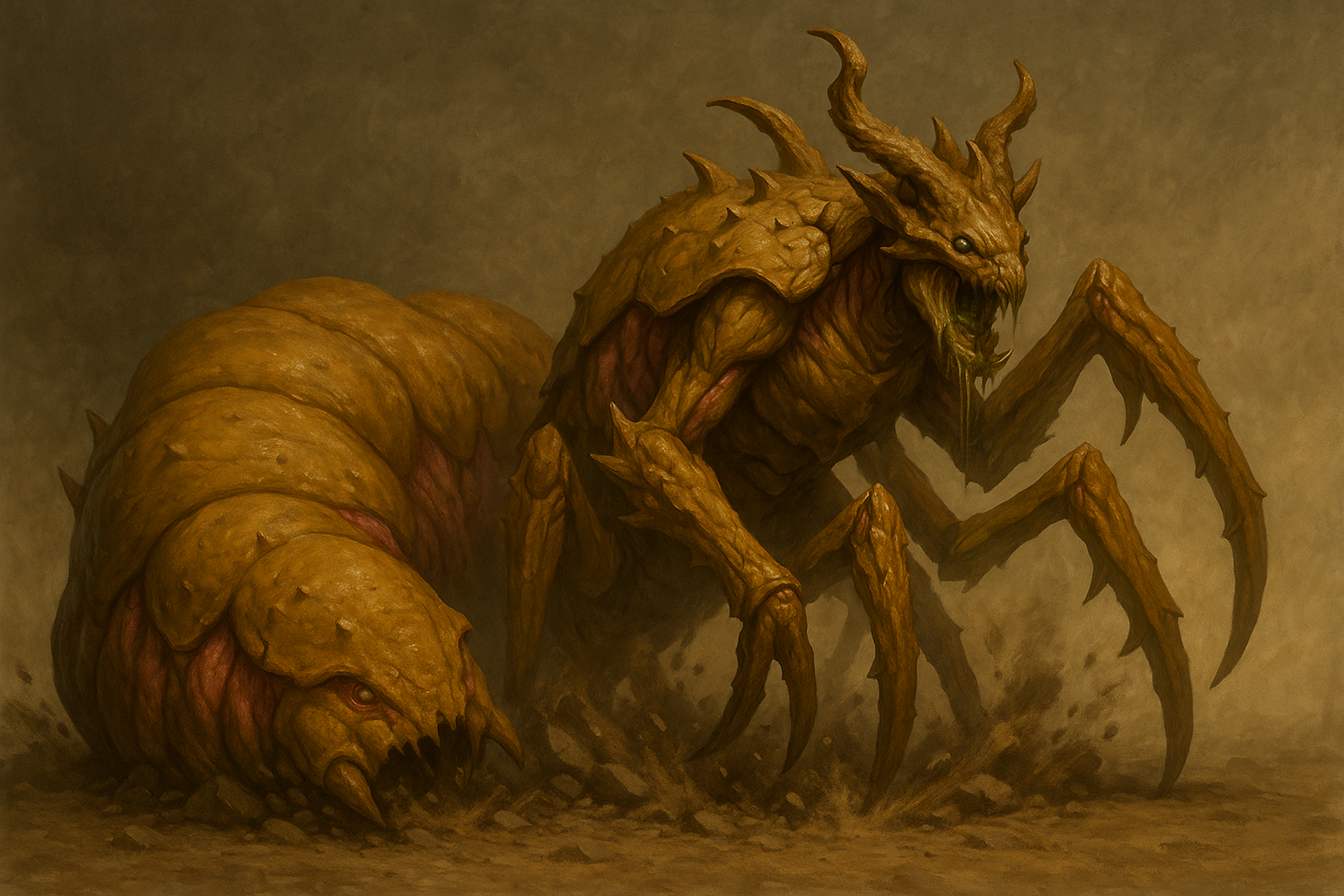
At the center of it all, swollen and immobile, lies the Broodmother. Her body fuses with her pod, a living engine of birth. Veins pulse across her abdomen, feeding clutch after clutch of egg sacs that swell and burst with new life. Her upper body looms over the nest, mandibles clicking in a dreadful rhythm as her scything arms guard her progeny. She need not see; the resonance of the hive flows through her like blood, carrying with it every thought and tremor.
But should her pod be destroyed, she tears herself free. No longer shielded by her swollen cocoon, she becomes a thing of speed and rage, scythe-arms lashing, globules of acid hurled with terrifying strength. It is said that when a Broodmother rises from her pod, an entire hive rises with her.
Characteristics
- Blindness. Though Chorvix are blind, they perceive the world through tremors, vibrations, and subtle shifts in air and stone. This sense is astonishingly precise, allowing them to detect even the smallest step in their tunnels.
- Hive Resonance. Chorvix are linked through a psychic resonance often described as a “hive mind.” When one senses prey, the knowledge spreads instantly to all nearby, creating a flawless web of awareness. Adventurers often find that striking down one drone alerts the entire nest.
- Acidic Biology. Specialized glands allow Chorvix to secrete or expel highly corrosive acid. Some excrete it in sprays or sacs, others project it in concentrated streams. It serves as both a weapon and a method of breaking down stone or flesh into digestible slurry.
- Chitin and Flesh. Their natural armor is formidable, yet the exposed seams of soft tissue are far more vulnerable. Those who have fought Chorvix often aim for these pulsing pink fissures to bring the beasts down more swiftly.
“The Chorvix display a disturbing efficiency that is neither animalistic nor truly intelligent. They are bound together in what we have termed a resonance of thought, a shared awareness that allows them to act as many while moving as one. To study them is to glimpse the terrifying possibility of unity without individuality — and the ruin such creatures could bring should their hives spread unchecked.”
— Scholar Venra Dhal, Orbaal Lyseum, Collected Studies on Monstrous Taxonomy
Chorvix Statblocks

Comments