
Conversion Engine
The existence of advanced mechanical computers has far-reaching implications for the economy of the peoples living under the Manifold Sky who are capable of producing or procuring them. This is especially true because the various peoples of the Manifold have not only different economic systems and policies from one another, but they even have different numbering systems and units of measure due to having developed in relative isolation from one another for thousands of years, presenting difficulties in securing fair trades.
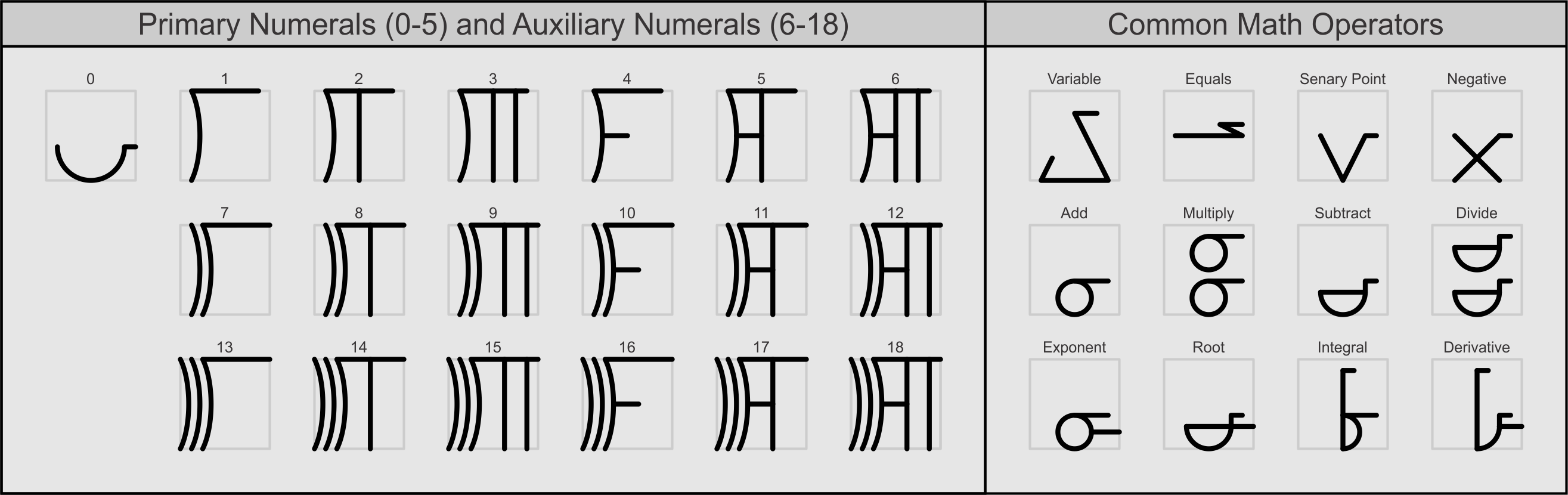
Iuxat Numerals by BCGR_Wurth
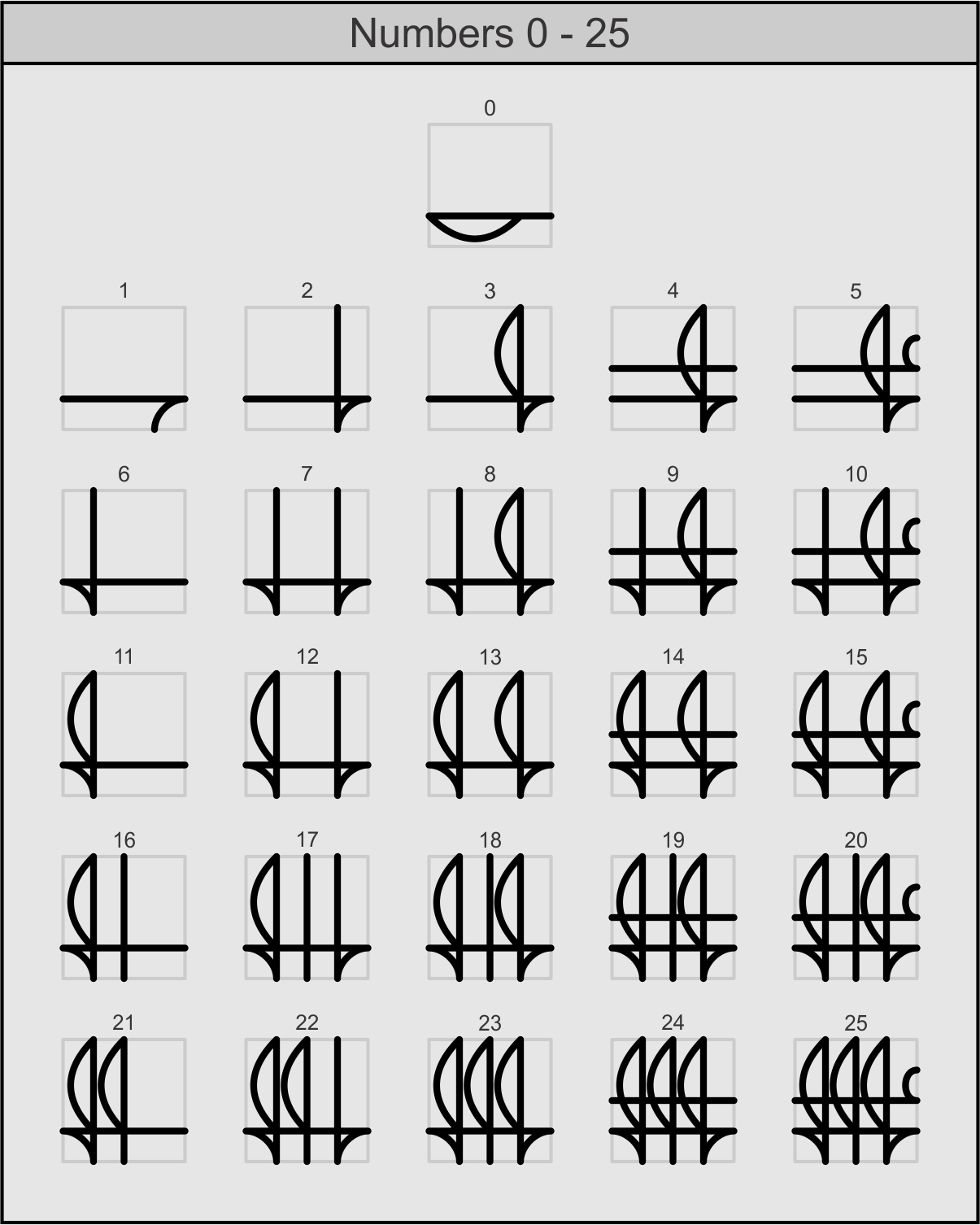
As an example of this issue, speakers of Iuxat - primarily Rostrans but also many members of the Navigator's Guild - speak, write, and perform mathematics using a senary (base six) numbering system (above). In contrast, their potential trade partners in Petalcap Vale do business primarily in Valespeak, a language with a bijective quintal (base five) numbering system (right) that has separate words and glyphs for values up to 25. While it is possible to perform conversions between these systems manually - and it is true that the Guild has attempted to standardize trade through the development of the international auxiliary language Guild Pidgin - manual conversions are expensive in an environment where time is money.
For this reason, specialized mechanical calculators known as "conversion engines" have been developed to facilitate such transactions between cultures.
Valescript Numerals by BCGR_Wurth
Mechanics & Inner Workings
The specific feature set of a conversion engine depends on where and in what contexts it will be used. A conversion engine could be as small as a pocket watch for simple day-to-day calculations, such as those often found in the luggage of tourists, or as large as a washing machine, such as those found as part of scientific data engines in places like the Vianne Tributaries Facility.
At the very least, a conversion engines has a set of spool-based incremental counters which can be advanced and reset by a crank. Each counter advances at a different rate depending on the number system of a given language. A booklet or plaque often included with the conversion engine offers some insight into the vagaries of spoken numbers in different languages so that the user can interpret what he or she is hearing, though more expensive models might factor in these complicating factors through the implementation of more counters (i.e. a 'linguistic Valespeak' versus a 'mathematical notation Valespeak' indicator, along with a mirror to visually flip the endianess).
Scientific conversion engines might include additional slide selectors and spools to allow for conversion directly from one system of units and notation to another without the need for manual calculations. Similarly, engines in business-facing contexts might include dials for the input of currency conversion rates and simple mathematical functions for the calculation of taxes, discounts, invoice totals, and so forth. In academic, governmental, and financial institutions, conversion engines are often implemented as components in autonet so that these calculations are 'baked in' whenever needed to accomplish a task. Similarly, factories working from gasketype instructions might need integrated conversion engines to interpret schematics coming from outside of a manufacturer's own design department, but companies will typically enforce a single numerical standard across their branches to forestall these needs; the presence of conversion engines on a production line could be perfectly innocent, but it could also be one piece of evidence in an investigation related to industrial espionage or intellectual property theft, as in-house blueprints would reasonably be expected to come pre-converted. A conversion engine might even feature spools for numbering systems not found in natural languages under the Manifold Sky. Merely changing base is considered insufficient in cryptographic contexts, for example, but it is a step towards obscuring a number from casual interpretation. These additional bases may have uses in broader mathematical operations, such as math relating to angles, higher spatial dimensions, or time.
Out of a desire for error handling and correction capability, even conversion engines embedded into a larger autonet feature visible display spools. A disparity in the way that the counters increment could indicate some problem with the deeper mechanisms that must be addressed to ensure proper functioning of the connected machinery, and the spools themselves can be coupled to the underlying mechanism in a way that doesn't meaningfully add to the mechanical failure rate of the device (i.e. via magnetic coupling). Such integrated engines tend to be more bulky to provide additional durability against wear, including elements like internal lubrication systems and extra-stout cogs and levers made of carefully tempered engineering alloys.

Dieseltech Punchcard by BCGR_Wurth
Item type
Mechanical
Related Technologies
Rarity
Small conversion engines are about as common as cash registers, but larger ones that serve as components in larger analytical systems are generally only found in single-digit numbers at major trade hubs (i.e. Silkenvault).



Comments