
Korean Empire
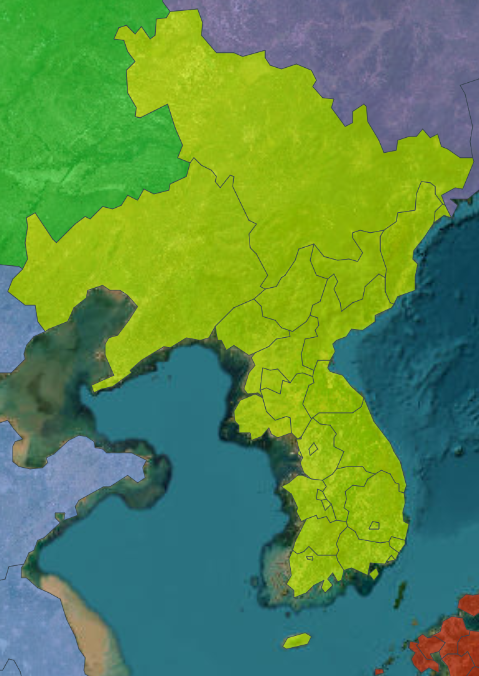
The Korean Empire is a nation in Asia, bordering the Russian Empire, Mongolia, and China.
Public Agenda
As a found signatory of the Greater East Asia Co-Prosperity Sphere, Korea opposes any and all European intervention in Asia. However, they are largely under the discretion of the Japanese government.
At the beginning of the Empire, Emperor Gojong attempted to gain recognition from foreign powers. However, many nations such as Great Britain refused to recognize the independence of Korea at first, instead signing the Anglo-Japanese Alliance, but gradually came to accept it.
History
Korea had largely been a tributary state of the Empire of China as the Kingdom of Joseon, occupying most of the Korean Peninsula. However, following the victory of the Empire of Japan in the First Sino-Japanese War, Joseon received nominal independence. In 1897, two years after the war, King Gojong of Joseon announced the start of the Korean Empire, with himself as emperor. During his reign, he attempted to enact the Gwangmu reforms, modernizing and westernizing the Empire. This angered many Korean conservatives, and Gojong was asked to abdicate on many occasions.
During a brief turmoil between the Russian Empire and Japan, Tsar Constantine II agreed to recognize Japanese influence over the Korean Empire in exchange for Emperor Meiji agreeing to recognize Russian influence over Laiodong and Manchuria, so long as neither annexed their respective regions. Following this, Korea was announced as a Japanese protectorate in 1905. Emperor Gojong refused to accept the treaty declaring this, but was overruled by five of his ministers.
Despite the declaration, Gojong attempted to gain support from foreign nations such as Great Britain, Russia, and Germany, going as far as protesting the treaty at the Hague Convention in 1907. Japan gained knowledge of the attempt, and moved to block the Korean diplomats from attending. Korean foreign policy was largely disbanded and came under discretion of the Japanese government. Later that year, Gojong abdicated as emperor under duress, and was succeeded by his son, Sunjong.
Japanese influence over the government of Korea became immense, as the Resident General of Japan held the power to appoint and dismiss Korean officials he felt were not sympathetic enough to Japanese intentions. Sunjong became a form of puppet ruler of Korea. Eventually, the Korean government became under the control of Japanese officers. Many in the Korean Imperial family, including Prince Imperial Yeong, became educated in Japan and served as Japanese military officers.
Korea became implicit with Japanese conditions during the Great War. Korea became an invasion point on the Japanese to Russian Manchuria. The Korean military fought the Russians and many Chinese warlord parties in mainland China, helping to secure the Laiodong Penninsula from Russia and capturing the railway in which Russia relied on to reinforce their army. Though Japan and Korea were successful in their theater of the Great War, their allies were defeated elsewhere, and came under international pressure to sign a white peace. During the treaty conditions, Korea regained much of their autonomy, and Japan was forbidden from annexing any further territory in Asia. However, as a measure to tie Japanese and Korean interests, Prime Imperial Yeong was married to Japanese Princess Masako in 1920.
Korea enjoyed this autonomy until Japan entered the Russo-German War in 1932. Korea was once again forced to fight for Japanese strategic interests in Manchuria, though this time was victorious. The now Emperor Yeong agreed to sign the Greater East Asia Co-Prosperity Sphere, which aligned Korea against the intervention of European or American powers in Asia. Korea informally surrendered its autonomy to Japan in 1940, agreeing to grant Japanese industrialists access to Korean natural resources.
Korea became home to a Japanese aircraft carriers, officially flying the Korean ensign but commanded by Japanese officers. This carrier assisted the two Japanese Carrier Groups in the Battle of Guam, which attacked the Americans en route to Guam. America declared war on Japan, and Korea as an extension.
Japan impressed many Koreans into the war effort, including many women used to comfort Japanese officers. Korean citizens grew more aware of these atrocities, and began to protest. The Korean navy mutinied against their Japanese commanders, and the carrier and many battleships came under direct Korean control.
The World War also saw protests against the Korean monarchy, being viewed as puppets. The emperor was overthrown in favor of his brother, Yi Kang, who took the name Ui. Emperor Ui rallied Korean military efforts, and began to fight against Japanese rule.
Much of the fighting by the Koreans occurred in the Korean Peninsula, as well as the regions in Manchukuo. Emperor Ui called on Russia for support, and Tsar Vsevolod agreed. Korea invaded Jilin and Liaoning, while Russia invaded Heilongjiang. Korea performed well, and used the local populace's disdain for the Manchurian emperor to fight against the Japanese.


Poor Korea hasn't had much luck determining its own fate. Hopefully that will change going forward. Your articles always make me want to look into the real history so that I can compare.
Explore Etrea | WorldEmber 2025