
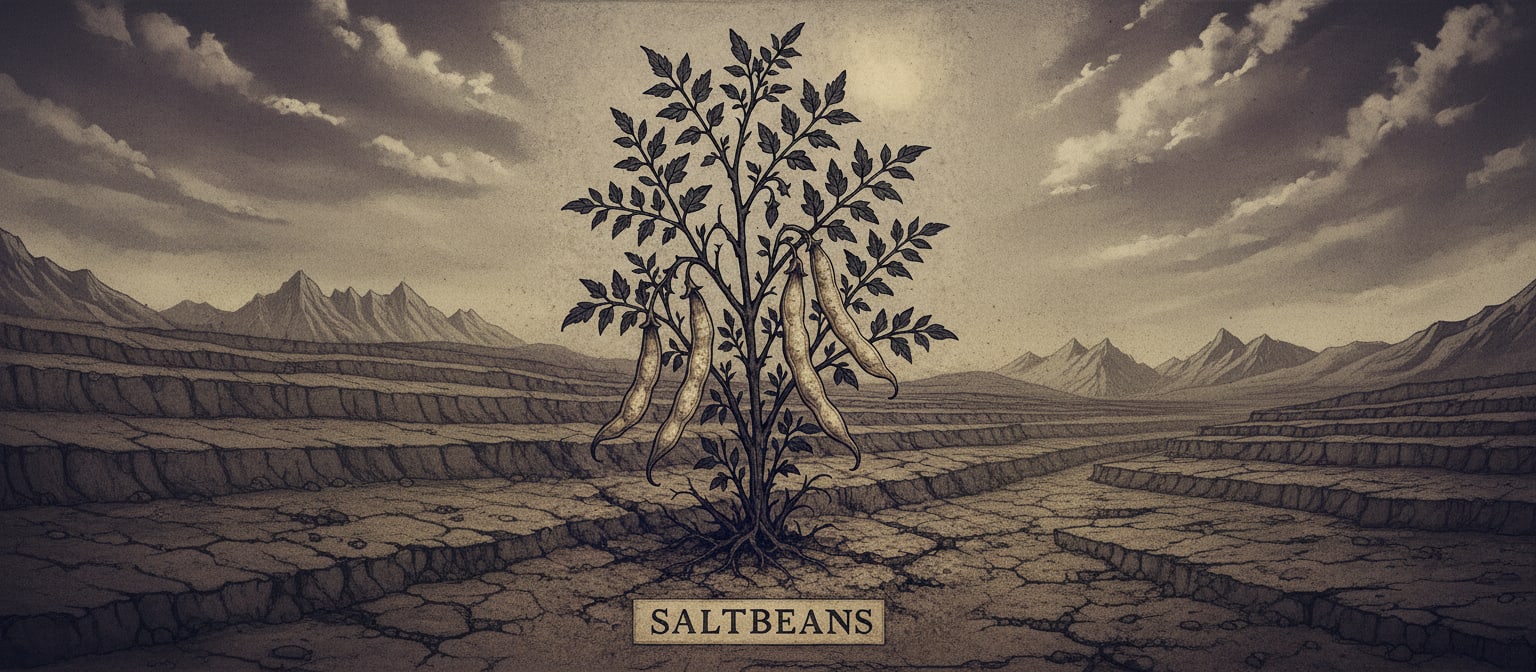
Saltbeans
Saltbeans are a protein-rich legume grown in rotation with Needlegrain and other terrace crops. They were brought in from more temperate farmland and adapted to Sameb’s conditions because they restore some nutrients to the soil and produce dense, filling food that stores well when dried.
Basic Information
Anatomy
Saltbean plants are low, branching bushes with compound leaves and thin, wiry stems. The pods are long, slightly curved, and have a faintly dusty, matte skin. The beans themselves are pale and firm, with a slightly briny taste even when cooked in plain water—hence the name. The roots are more substantial than Needlegrain’s, anchoring deeper into the soil, with nodules that house nitrogen-fixing bacteria encouraged by years of cultivation.
Genetics and Reproduction
Saltbeans reproduce through seed, set in pods produced after flowering. The plant is self-pollinating but capable of cross-pollination where several strains are grown close together. Farmers in Sameb keep a small number of lines and cycle them over seasons, avoiding uncontrolled mixing to keep cooking qualities and growth habits predictable. Outside of enriched, irrigated terraces, seedlings struggle and are often stunted.
Growth Rate & Stages
Saltbeans sprout moderately quickly, then spend more time in vegetative growth than Needlegrain does. First come leaf sets, then branching, then flowering along the stems. Pods develop over several weeks. They can be harvested green for fresh eating or left to dry on the plant for storage beans. The total life cycle is longer than Needlegrain’s, so farmers usually fit Saltbeans into rotations rather than planting them in every bed every cycle.
Ecology and Habitats
In Sameb, Saltbeans occupy beds that have just had a heavy feeder crop, helping to rebalance the soil. They prefer slightly deeper, looser soil than the grain beds, but still rely entirely on irrigation. They do not establish in unmanaged land. A few terrace pests target the leaves and pods, mostly insects introduced unintentionally along trade routes, but they’re kept in check through rotation and culling.
Biological Cycle
Saltbeans are annuals. After harvest, the remaining stems dry down and are either composted or turned back into the fields. Seed is selected from healthy, uniform plants and dried thoroughly before storage. As with Needlegrain, the plant’s continued existence in the region is directly bound to Sameb’s farm cycles.
Comments