
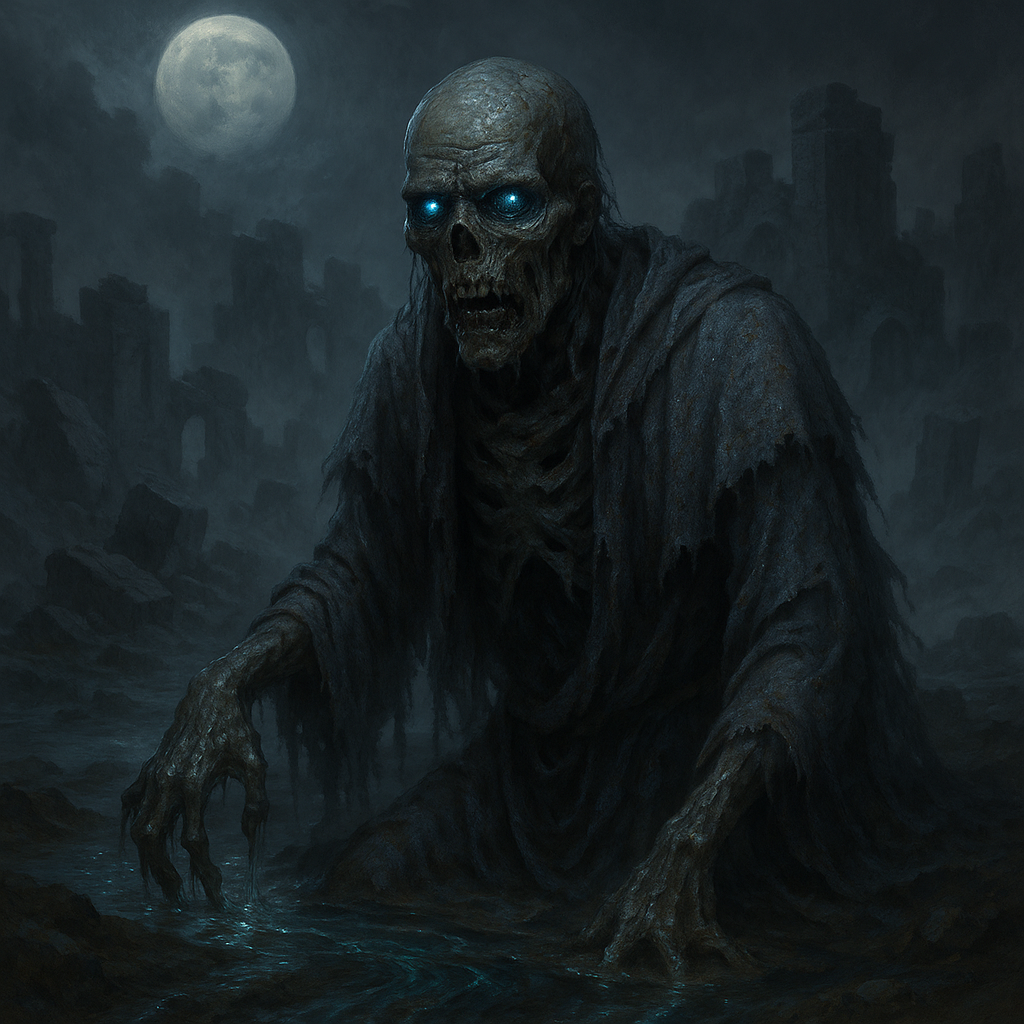
Undead
"The flesh forgets. The soul does not."
They walk not because they wish to, but because something, sorrow, hunger, command, or curse, refused to let them rest. The world’s oldest blasphemy. The undead are not a species, but a condition, a violation of continuance, the soul’s refusal, or inability, to pass beyond. Whether raised by necromancers, bound by oaths, or trapped in the echo of trauma, they represent the single most visible reminder that the laws of death in Everwealth are not laws at all, merely suggestions ignored by the desperate. From skeletal remnants rattling through moonlit ruins to bloated ghouls that feast on flesh and blood, their presence stains the land, a perpetual hum of half-remembered life. Their bodies decay but never rest. Flesh falls away, bones crumble, and still the soul twitches. In time, even that memory fades, leaving only instinct, to move, to feed, to reach toward the living warmth they can no longer feel. To see one is to glimpse the world’s unfinished work, death that has lost its meaning. The Undead are not evil by nature, only proof that the soul, once broken, can learn to walk without forgiveness.Basic Information
Anatomy
Undead retain as much of their mortal shell as circumstance allows. The recently risen appear almost living, pale, stiff, with the eyes glassed over like cold marbles. Others are little more than sinew and bone, rotted skin clinging like wet parchment. Some glow faintly blue from trapped Arcane residue; others steam with necrotic vapor. Within their chests, where breath once lived, lingers a faint vibration, the echo of a soul unwilling to leave. The binding that keeps them animated varies, a necromancer’s sigil etched into bone, a lingering curse, or a natural tether formed when death and magick overlap too closely. The stench of them is infamous, sweet, wet rot that clings to lungs for hours after exposure.
Genetics and Reproduction
They do not reproduce, in any form, they spread. Each necromantic ritual or curse that severs a soul from judgment risks contagion. Where one corpse rises, others nearby may stir, drawn by resonance. Some rare variants replicate through infection of the living, their rot carrying dormant magick or germs that blooms upon death.
Growth Rate & Stages
Their forms are as diverse as their causes:
- Skeletons - stripped of flesh, their souls anchored through runes or resonance alone. Mindless, efficient, unfeeling.
- Ghouls - Flesh-eaters driven by decaying instinct. They remember hunger, not life.
- Wights - Commanding intellects, retaining fragments of memory and power. Often former mages or generals who refused the grave.
- Revenants - Souls returned to their bodies to settle one task through ancient means, divine or damned. They burn bright, briefly, then vanish.
Ecology and Habitats
The Dead thrive where the veil is thinnest, graveyards, battlefields, plague-warrens, and magick-scorched ruins. Places of repetition, where death is constant, birth the strongest infestations. In the Everwealth heartlands, The Knights of All-Faith maintain pyre-fields and salt wards to contain outbreaks. But in Kathar and Drazahar, where corpses outnumber priests, the dead often form their own societies of rot, silent, self-guarded necropolises ruled by memory alone. Some necromancers claim The Dead feel comfort near leyline fractures, the Arcane flow keeping their souls tethered like moths circling flame.
Dietary Needs and Habits
Undead do not eat for nourishment, but for compulsion. The act of consumption mimics life, blood for warmth, flesh for texture, even magick for recollection. Ghouls gorge themselves to simulate living sensation. Wights devour souls to maintain intellect. Revenants drain vitality to stay whole long enough to complete their vengeance. Those raised by external control often exhibit no hunger, only obedience.
Biological Cycle
The Dead have no true life cycle, only decay and persistence. Once raised, by magick, curse, or sheer will, they remain until destroyed or their animating force fades. Flesh rots, bones crumble, but the will that drives them endures far longer than the body. Some collapse within days, others linger for centuries, little more than whispering skeletons or stains that move against the wind. There is no growth, no reproduction, only the slow surrender to rot, or the mercy of fire.
Behaviour
Their behaviors echo life distorted. They moan not from pain, but memory. They move as they once did, repeating routines from long before their death, farmers tilling fields of dust, soldiers patrolling roads that no longer exist, lovers scratching at doors that collapsed centuries ago. When bound, their will bends entirely to the caster’s voice. When unbound, instinct and unfinished emotion dictate all motion. Some weep without tears. Others laugh until their jaws dislocate. All remember, in fragments.
Additional Information
Perception and Sensory Capabilities
Sightless eyes perceive heat and soul-light, deaf ears hear the hum of breath. They navigate by resonance, the thrum of life within others. Clerics report that standing near the Dead feels like being watched through still water.
Scientific Name
Mortis resonantia.
Origin/Ancestry
Spirits stitched into corpses or pieces of a corpse through pervasive magickal means; Either for the purpose of a mindless grunt or a way to spit in death's eye.

Comments