
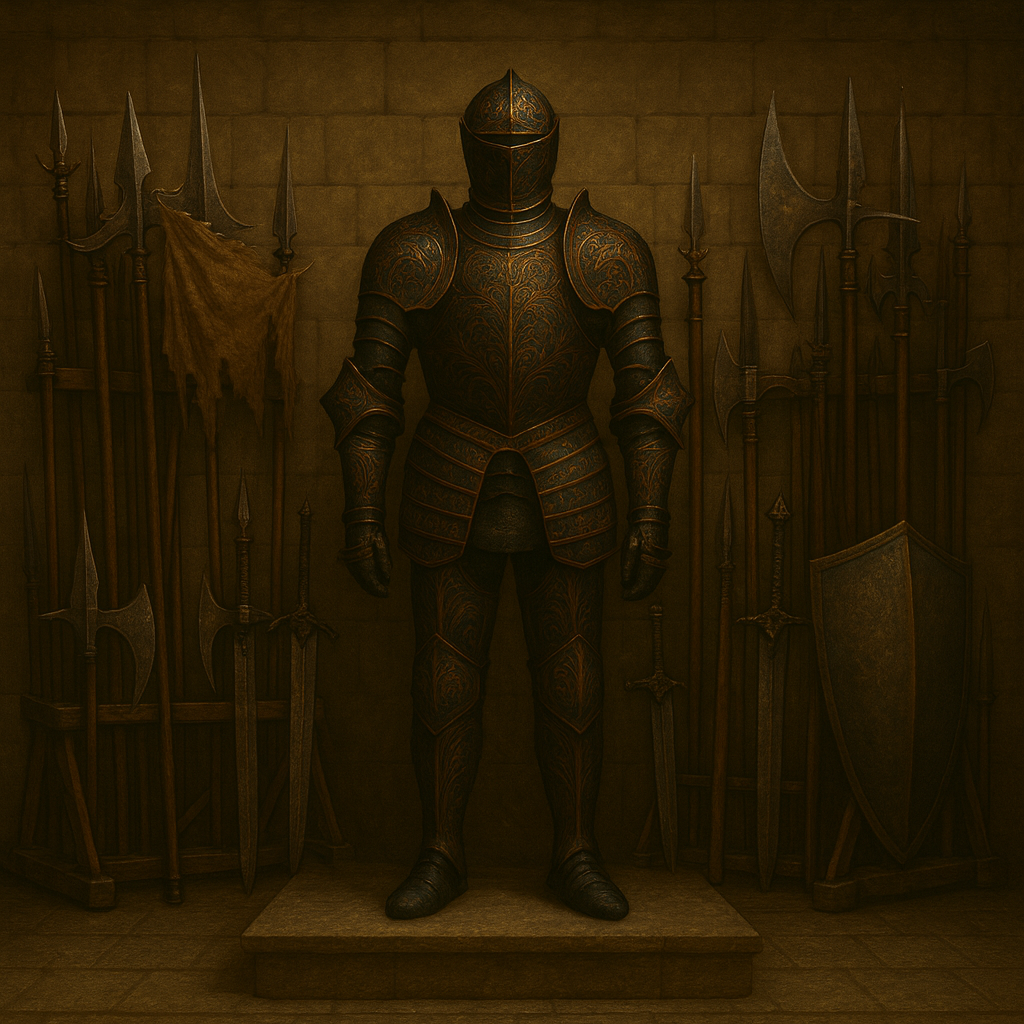
The Witchplate Armor
“He thought the armor made him invincible. We found him days later, still standing, roots of iron twisting through his chest."
The Witchplate is a paradox given form, beauty hammered from damnation, a knight’s dream lacquered atop a swamp-born nightmare. At first glance, it gleams with all the trappings of valor, gilded etchings of triumph, scrollwork worthy of cathedral halls, and a finish so polished it reflects torchlight like a mirror. But beneath this finery lurks the truth, the metal cursed Mire-Iron dredged from the The Bog of Lies, poisonous and foul; Hammered into a prison and steeped in curses a thousand times. The Witches who birthed it knew well that men covet beauty, and so for their own amusement gave them a masterpiece of horror disguised as honor. To don the Witchplate is to invite both protection and betrayal. Strikes that would split bone or burn flesh glance harmlessly aside, magicks unravel uselessly against its surface, and for a time the wearer is untouchable. But with every clash, every ringing blow endured, the armor awakens its inward briars, thorned roots of iron that burrow deeper into the flesh, curling through muscle and vein until the knight within is woven into his armor like ivy strangling a statue. Some wearers die standing, corpses locked upright as though still on parade. Others collapse days later, their bodies shredded from within by beauty’s price. Thus the Witchplate endures as both lure and curse, a relic whispered about in the catacombs of Opulence, where it lies sealed among other abominations of The Civil Age. Knights, kings, and collectors alike have sought it, only to learn too late that its true artistry is not in its filigree or its gilding, but in the exquisite cruelty of the fate it reserves for all who mistake its splendor for salvation..
Mechanics & Inner Workings
- Magickal Immunity: Resistant to nearly all spellwork, warding, and divine radiance due to its Mire-Iron foundation.
- Physical Invulnerability: Hexes and engraved curse-wards make it nearly impervious to blades, arrows, and blunt force.
- Briar Curse: Every strike upon the armor causes cursed iron-thorns to grow inward, puncturing the flesh and nesting deeper with each blow; Taking days if-not weeks to retract depending on the severity of the assault suffered while wearing it.
- Immunity to Mire-Iron Poisoning: Those around the user not-so-much, but the wielder in-tandem with the other resistances it provides also render the user immune to the toxic effects the metal normally has.
- The Witch’s Claim: After the damage their former champion had done to them without it; The coven that forged it wove a final seal before leaving it to the world of folk. With a whispered invocation, they could lock the armor in place should they grow bored or displeased with it's current master, sealing its wearer immobile as the briars dig ever deeper.
Manufacturing process
The Witchplate was not merely forged, but crafted over many moons of intense rituals. Mire-Iron was smelted with corpse ash, hammered thin and chased with etchings in molten copper and gilded silver to mimic knightly grandeur. Witches performed ritual drownings with the armor submerged in the bog, inscribing curses into its seams while chanting hymns of inversion, prayers turned backward until their sanctity rotted. The final step was the Rose of Thorns Rite, a moonless ritual in which the armor was “blossomed” with briars, grown to rest dormant until blood awoke them.
History
The Witchplate was first wrought for a knight who had cast aside his vows to crown and country, a treacherous oathbreaker who pledged himself instead to a coven deep within the Bog of Lies. For his loyalty and strength, the witches rewarded him with their masterpiece, a suit of Mire-Iron plate layered in curses which came with just as many benefits. A prince crowned with deadly beauty. It was not only armor but a binding pact, protection purchased at the cost of his flesh, for the briars that slumbered within it were meant to punish him should he grow too reckless and falter in their service. For a time, he carried out their will faithfully, a grim champion wrapped in gilded horror. But ambition is a sharper blade than faith. The knight betrayed his mistresses, turning his cursed gift against them. He stole the Witchplate and fled the bog, offering his sword to the kingdoms he once scorned. In his betrayal, he prospered, estates, riches, victories, until the day the witches found him on the eve of a great battle. They did not reclaim the armor. Instead, they let the briars finish their work, and when his body was discovered, it was rooted into the plate like a vine-strangled corpse, locked in place forever. Yet this was not the end. The coven, in a twist of cruel delight, whispered tales of the Witchplate to the world beyond their swamps, stoking the hunger of kings, knights, and collectors. They wanted the armor coveted, fought over, worn again and again. Each fool who strapped themselves into its gleaming plates became another lesson, another body claimed growing too drunk on the witch's gifts, the briars within always watching, always waiting for one sure blow, for their own time to strike. A final, cackling echo of the witches’ vengeance. In their petty, poisonous glee, they made the Witchplate not merely a prison for one man, but a curse for all mankind, a relic too beautiful to ignore, too deadly to keep.
Significance
The Witchplate remains both feared and desired. It is whispered to rest now in the catacombs beneath Opulence, taken and sealed along with many other dangerous but potentially useful artifacts in the early Civil Age; Though none have braved the halls of bones and skulls to claim it for centuries. None have dared to find it. again To witch covens, it is proof of their mastery over deceit and pain. To collectors, it is the most dangerous relic of knightly craft. To any who see it, gleaming in its impossible splendor, it is temptation itself, power gilded in beauty, with death hidden beneath.
Creation Date
Believed to have been forged in the early Civil Age (c. 40-80 CA), not long after the Great Schism when frontier covens sought to arm champions against roaming horrors and rival cults.
Rarity
The witches left but one.
Weight
110 lbs
Dimensions
Designed for a tall warrior of roughly 185-195 cm (6’1”-6’5”). When fully assembled, the armor adds about 5-8 cm (2-3 inches) to stature because of the raised gorget and thick sabatons.
Base Price
Beyond coin.
Raw materials & Components
- A full suit of plate mail, polished and engraved in stylish inlayed flourishes of copper.
- Inlaid with copper and silver filigree.
- Mire-Iron beneath the veneer, forever damp, faintly warm, and thrumming with a hollow hum.
Tools
- Bog-forges stoked with corpse ash and oils derived from flesh.
- Hex-chisels tipped with witchbone.
- Ritual altars where knightly etchings were inverted into curse-glyphs.
- Silver-gilding brushes anointed in blood.

Comments