
Thalyss
"What is forgotten is not gone. It waits, and it remembers you." -Fragment from the Codex Obscura.
Thalyss is memory incarnate, the sovereign of story and secrecy, the eternal archivist of what mortals strive to keep and what they wish would vanish. Unlike his siblings among the pantheon, Thalyss embodies not fire, stone, or hunger, but the act of holding knowledge itself, and the certainty that nothing is ever truly lost. Every tale whispered, every oath broken, every name erased from record still belongs to him. His presence permeates mortal life in subtle but unavoidable ways. Scribes bow their heads to him before setting ink to parchment, mourners whisper his name when laying names into record, and liars dread his gaze in the silence after their words. Revered by scholars, oracles, and archivists, Thalyss is also feared by kings and criminals alike, for his dominion ensures that all secrets are his, whether kept, buried, or betrayed. Unlike Xaethra, whose cults are suppressed, Thalyss’s worship is sanctioned. The Knights of All-Faith give him special reverence in their scriptoria and archives, drawing upon his patronage for the preservation of treaties, lineages, and oaths. Yet their reliance is uneasy, for to serve Thalyss is to accept that truth cannot be destroyed, and that revelation is his to decide, not theirs.
Divine Domains
Thalyss presides over the vastness of thought and recollection, his dominion spanning the breadth of what mortals remember and what they would bury.
- Primary Domains: Memory, knowledge, story. Every remembered truth, every whispered confidence, every tale set to ink belongs to him.
- Secondary Connections: Divination, prophecy, hidden wisdom. His faithful believe that glimpses of the future are simply forgotten pages already written in his tome.
- Tertiary Reflections: Madness, obsession, paranoia. Those who draw too deeply from his endless archive often find themselves consumed by truths too heavy to carry.
Artifacts
Thalyss’s relics are not weapons of conquest but burdens of revelation. They are as coveted as they are feared:
- The Codex Obscura: A tome that fills its own pages with the nearest secrets. To carry it is to live burdened with knowledge one cannot unlearn.
- The Mirror of Ink: A basin where reflections reveal not appearances, but hidden truths. Many who gaze into it have gouged their own eyes afterward.
- The Keeper’s Chain: A necklace of keys, each unlocking doors never before seen by the bearer. Every use, however, exacts a memory as toll.
Holy Books & Codes
Thalyss’s doctrine was never delivered in radiant decree but pieced together through whispered fragments and dangerous manuscripts.
- The Silent Archive: Writings that vanish after being read, preserved only in memory. Used to train priests in discipline, recall, and the burden of truth.
- The Palimpsest Psalms: Hymns layered upon themselves, their meanings lying more in what was erased than in what remains.
Divine Symbols & Sigils
Thalyss’s marks are subtle, but chilling:
- An unblinking eye inked upon a sealed book.
- A quill dripping black flame instead of ink.
- A chained tome, etched in stone or pressed into wax seals.
Tenets of Faith
His creed is austere, precise, and unyielding:
- Nothing is truly forgotten. Erasure is a lie; every silence leaves a trace.
- Knowledge is weight. Bear what you can, or be broken beneath it.
- Secrets are sacred. To betray another’s trust is to betray Thalyss.
- Every story deserves a witness. No deed, no matter how shameful, may be denied its place.
Holidays
- The Veiling (Garnet 9th): A day when worshippers cloak faces, silence tongues, or bury objects in earth, honoring his dominion over what is hidden.
- The Day of Recollection (Amethyst 14th): A public rite of names read aloud, binding memory into the world. The Knights of All Faith have made this into a major ceremony, honoring soldiers, saints, and martyrs alike.
Divine Goals & Aspirations
Thalyss’s purpose is veiled but persistent:
- Preserve All That Is: No truth shall vanish, no story be erased.
- Guard Secrets from the Unworthy: Knowledge is not for all. He decides who may bear it, and who must remain blind.
- Bind Mortals to Their Stories: Actions cannot be undone. Memory itself enforces consequence.
Physical Description
General Physical Condition
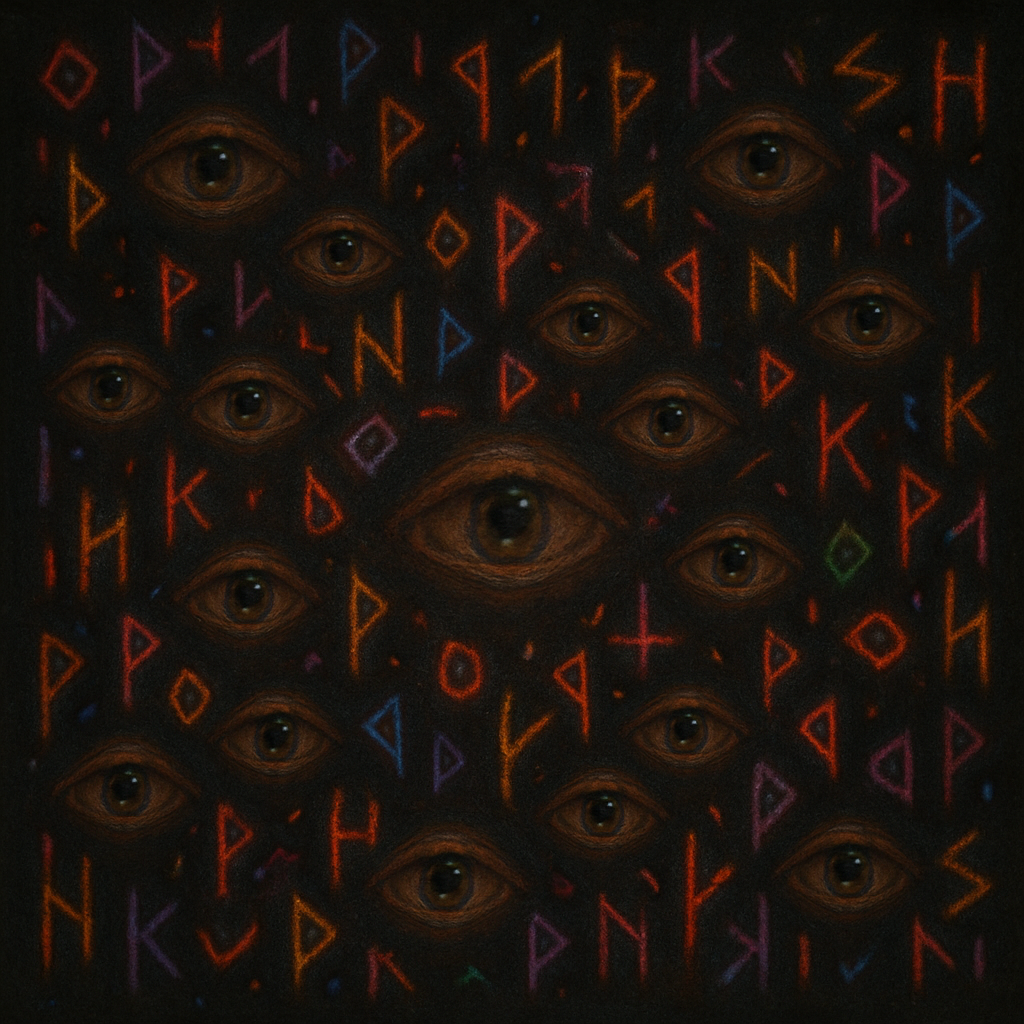
Thalyss’s true form is utterly alien, a manifestation of memory and secrecy that no mortal frame can fully endure. He appears as a shifting wall of runes and sigils, written in countless scripts both known and long-dead, flashing and reforming too fast for the eye to track. Each character pulses with unnatural hues, some burning with light, others dripping with shadow, as though the very act of language were alive and predatory. Between these ever-turning glyphs drift innumerable floating eyes, each one sliding into place to meet the gaze of the viewer no matter where they stand. To be seen by them is to feel as though every thought has been opened and catalogued, laid bare and remembered forever. Mortals do not endure this sight without consequence, migraines, endless weeping, sudden muteness, or voices echoing their secrets aloud without consent. It is less a vision than a contact, the weight of an infinite archive pressing against the mind. When Thalyss chooses to interact more directly, he cloaks himself in dream-like guises, a hooded archivist, a masked scholar, a shifting figure whose face rewrites itself like living parchment. These forms are mercy, a mask of comprehension that mortals can endure as Gods typically take on the rare occasion they commune with a mortal directly. Yet even here, his strangeness leaks through: his shadow flutters like pages in a storm, his touch stains skin with ink that never washes away, and his eyes are not eyes at all, but empty margins where text should be. To stand before Thalyss is to feel the gaze of history itself. Every deed, every secret, every story that has ever been lived hangs in the air, pressing down like the silence in a library that knows it will outlast empires.
Divine Classification
God.
Children

Comments