
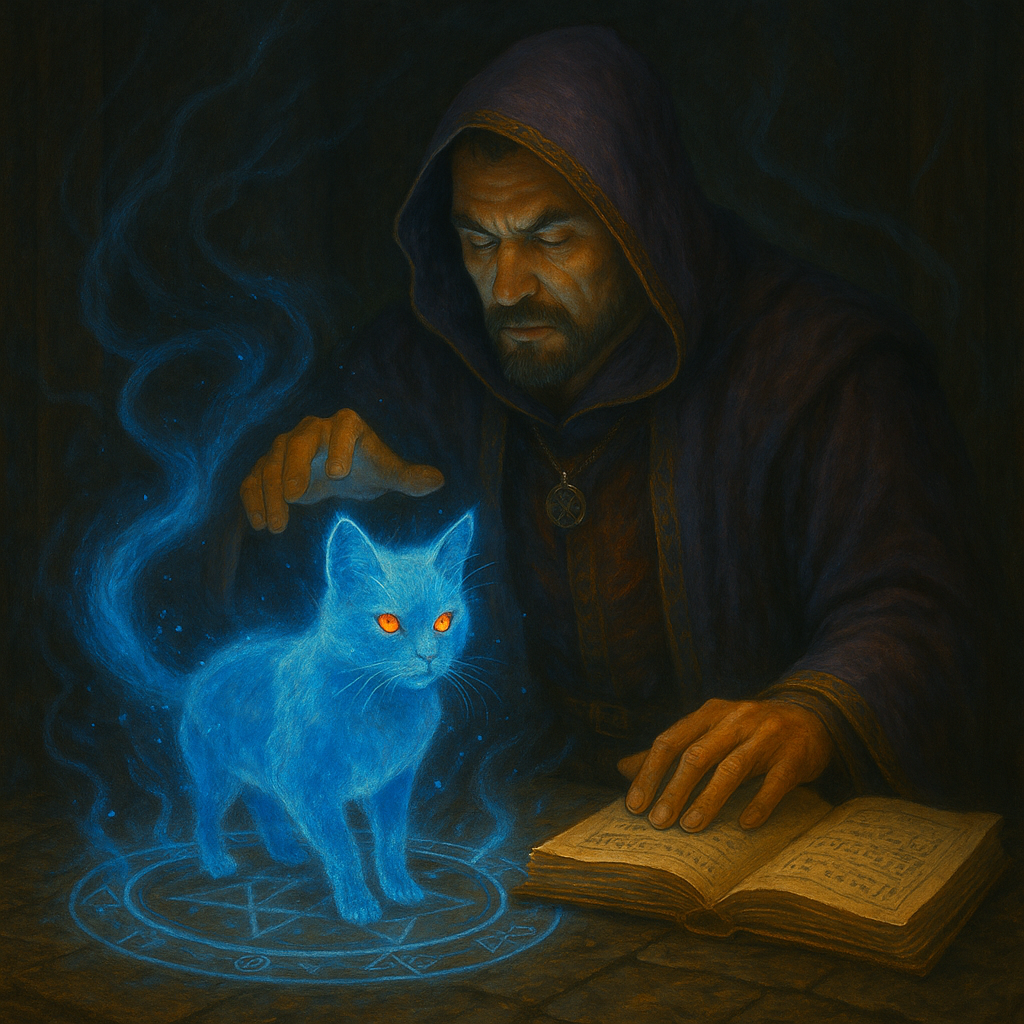
Summoning a Familiar
"In a time of progress unbridled, so-to did this progress yield the mage's greatest companion."
Summoning a familiar is considered one of the great turning points in a mage’s journey. It is not merely a parlour trick or a mark of status; it is an act that binds the caster’s soul to a living form, one that will serve, guide, and reflect them for as long as both endure. Though primarily associated with the school of Conjuration, for its focus on calling and manifesting creatures, the act draws upon multiple branches of magick. In its essence, the familiar is a manifestation of the self, pulled from the unseen folds of The Arcane's magickal lattice empowering the world, shaped by materials, rituals in-need of great willpower and the caster’s truest nature laid-bare. In many circles, the Summoning of a Familiar is seen as the first true act of mastery. Not only does it demand precise control over conjuration principles, but also an understanding of the Unseen Thread, that hidden web of dimensional pressures that must be plucked and threaded to call something into the world. It requires a balance between physical endurance (to survive the channeling without succumbing to Magebane or Portal Fever), ritual knowledge (timing, materials, and planar alignments), and deep self-knowledge. Without a clear understanding of one’s own drives, fears, and essence, the summoned form will fail to take shape. The familiars that result vary wildly, from the mundane (cats, owls, foxes) to the fantastical (giant moths, ember-scaled serpents, horned hares). Their forms often carry the marks of the Arcane: unnatural colors, impossible eyes, spectral auras. The reasons that familiars always take an animal shape are unknown, perhaps lost in the Schism along with the spell’s original creator.
Effect
When successfully cast, the spell manifests a living creature bonded entirely to the summoner. This familiar:
- Shares a portion of the caster’s magical aptitude.
- Acts independently but will never act against its summoner’s will.
- Can communicate wordlessly through empathic impressions or flashes of thought.
- Possesses senses and talents that often complement its master’s weaknesses.
Side/Secondary Effects
- Physical and Mental Strain: Even successful summons can leave the mage drained, fevered, or trembling. Symptoms are often similar to early-stage Portal Fever, muscle twitching, mild disorientation, and transient nosebleeds.
- Soul Fracturing: A failed summoning can result in a “hollowing”, a dull ache in the chest, difficulty focusing, or a persistent emotional numbness. In extreme cases, the fragment of soul intended for the familiar may linger in the Arcane fold, creating a hostile Echo-Form that seeks to reunite, violently, with its source.
- Magebane Susceptibility: Familiars amplify the caster’s connection to the Arcane, which can make both more vulnerable to certain anti-magick effects. Wounding the familiar can cause sympathetic backlash to the master.
Manifestation
The casting produces strong sensory phenomena:
- Visual: A ripple in the air like heat-haze, sometimes with arcs of ghost-light or shapes glimpsed in the folds.
- Auditory: A rushing sound, as if the ocean were in the ears, punctuated by animal cries not native to this plane.
- Physical: A sudden pressure in the chest, as though one’s breath is being drawn outwards. It is imperitive the ritual not be interrupted during this stage, this pressure if-not expelled even if the ritual fails can lead to violent cardiac arrest
Source
The power is drawn directly from the caster’s own soul, guided through the Arcane lattice via conjuration techniques. Advanced practitioners may weave in planar energy from aligned realms to enhance the familiar’s traits, but the tether remains a soul-bond, severing it often damages the caster permanently.
Discovery
The exact origin of familiar-summoning is lost to the horrors of The Fall and The Great Schism soon-after. Fragments from pre-Schism texts suggest it was created by an advanced conjurer of The Origin Age once worshipped like a god known as 'He-Who-Makes' as a method for apprentices to safely test their conjuration abilities without risking uncontrolled planar entities. Ironically, it has since become one of the most dangerous rites for the unprepared. Legend holds that Valtren White-Flame’s own owl-familiar, a white, pterodon-sized beast with sun-bright eyes, was not only his mount but also the key focus in the ritual that birthed Everwealth’s second moon.
Material Components
While the soul is the true vessel of power, physical reagents focus and stabilize the working:
- Binding Focus: A personal item of deep sentimental value (lock of hair, childhood toy, lover’s keepsake).
- Symbolic Vessel: An object aligned with the intended form (owl feather, wolf fang, tortoise shell).
- Arcane Stabilizer: Crystals, runestones, or powdered star-metal to anchor the familiar to this plane.
Gestures & Ritual
Most traditions require a circle of tethering, drawn in chalk, blood, or light, with runes marking the caster’s life events. Chanting often begins with self-declaration, the caster naming themselves, their true desires, and the qualities they wish embodied in their companion. The final moment of summoning often involves direct physical contact with the forming familiar, to “seal” the bond before it slips away.
Related Discipline
Soul-binding, ritual conjuration.
Related School
Conjuration (primary), with elements of enchantment and (arguably) necromancy.
Related Element
Varies by caster’s nature, flame for the passionate, stone for the steadfast, shadow for the cunning.
Effect Duration
Permanent, until one of the two perishes, the soul-bond is severed by great magick, or the caster willingly releases the familiar..
Effect Casting Time
Typically 3-6 hours of uninterrupted ritual work, though prodigies and the desperate have been known to complete it in under one.
Range
The initial manifestation occurs within arm’s reach of the caster. Once bonded, familiars can travel any distance but can be summoned back instantly if both are on the same plane.
Level
This is considered an apprentice-to-adept threshold spell, a rite of passage for serious students of magick. Attempting it without adequate preparation is the most common cause of magical burnout in young mages.
Applied Restriction
The act is seen as noble in the Scholar’s Guild, but in smaller villages it often invokes superstition. Some believe each familiar summons a shadow twin of the caster somewhere else in the world, an echo that may someday come looking. This belief mirrors the Phantom’s Toll superstition in broader conjuration, only here it is thought the toll-taker is the familiar’s “true” other half. Among thief-mages, familiars are prized, able to scout, deliver contraband, or distract pursuers. Among nobility, a well-bred familiar is a status symbol, with rare forms fetching more in arranged mage-marriages than estates. The legalities are much-less openended:
- The ritual to summon a familiar is illegal to perform within Coalition juridstiction without a License to Practice Magick, this includes having one when it expires, which can quickly net the owner of a familiar a long stay in a dark, cold dungeon with the level of magicks the summoning ritual possesses.
- Outright forbidden for known criminals, guild oathbreakers, or those already bonded to specific extraplanar entities such as priests who worship Xaethra, the Goddess who's armies ravaged the world of-old who's worship is still miraculously, 'tolerated' by the government by The Knights of All-Faith; Those among these ranks specifically if-seen with one will be dragged to the guillotine on sight of the creature without hesitation; Unassuming animal spies just-as potentially dangerous as their masters and their masters in-turn, an unnacceptable outcome for most given their history.
- Culturally taboo in some regions where familiars are seen as “half-born” abominations

Comments