
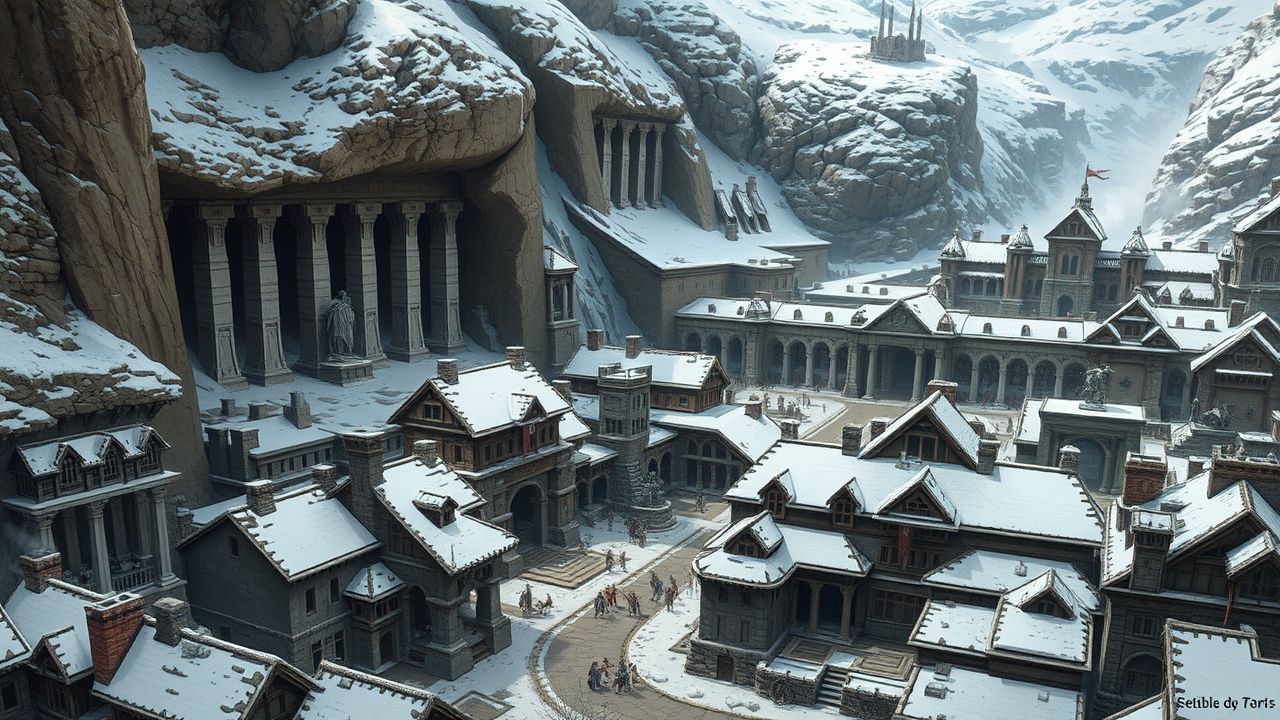
Doher
Doher, the Old Stone City, is one of Wescovia’s oldest settlements and a proud stronghold of orcish heritage. One of the oldest cities in Wescovia, Doher was founded in 620 and governed by a Council of Elders. It blends ancient traditions with enduring strength. Massive stone walls, a renowned militia, and masterwork weaponsmithing make it a key center of martial prowess and trade. Though fiercely independent, Doher has stood loyal to the Wescovian crown for centuries, its arena and warrior culture drawing adventurers and scholars from across the kingdom.
Demographics
Orcs make up the majority of the population, about 65%. Goliaths make up about 15%, and the rest are split between humans, dragonborn, dwarves and gnomes, along with a few other species.
The city works on a sort of pseudo-caste system, with the warrior caste at the top. These are families who can trace their heritage all the way back to the original clan leaders; martial prowess is deeply respected in this city. The next caste is made up of artisans and craftspeople - blacksmiths, masons, armorers, siege engineers and many others.
The lowest class of people in the city is made up of the common folk - farmers, herders, traders, etc.
Social mobility is based more on merit (especially martial or craft skill) than on wealth.
The city works on a sort of pseudo-caste system, with the warrior caste at the top. These are families who can trace their heritage all the way back to the original clan leaders; martial prowess is deeply respected in this city. The next caste is made up of artisans and craftspeople - blacksmiths, masons, armorers, siege engineers and many others.
The lowest class of people in the city is made up of the common folk - farmers, herders, traders, etc.
Social mobility is based more on merit (especially martial or craft skill) than on wealth.
Government
Doher is governed by a Council of Elders, a nine-member assembly drawn from the city's oldest and most respected families. Though dominated by orcs, the council includes notable goliath and human voices as well.
The High Elder presides over the council's deliberations. While the city swears fealty to the monarch, Doher maintains a strong local identity and autonomy; the King’s Royal Liaison attends council sessions but holds no direct authority outside times of war.
The High Elder presides over the council's deliberations. While the city swears fealty to the monarch, Doher maintains a strong local identity and autonomy; the King’s Royal Liaison attends council sessions but holds no direct authority outside times of war.
Defences
The city's defenses are legendary; twenty-foot-thick walls, iron-reinforced gates, and dozens of large balistas mounted along the battlements. Doher keeps a large standing militia of around 2,000 warriors, many of whom come from proud bloodlines of soldiers and war mages. The city is particularly famous for its expertise in siegecraft, a tradition born from centuries of conflict with its neighbors before Wescovia's unification.
Industry & Trade
Doher has a thriving economy, centered around weaponsmithing, armor production, and heavy stonework. Its exports include brutal, beautifully crafted weaponry, siege engine parts, livestock, wool, salted meats, and rough-hewn stone blocks. Fine goods such as rare woods and textiles are imported, alongside spell components and enchanted tools when available.
Infrastructure
Built of dark stone quarried from nearby mountains, Doher’s infrastructure is designed for defense and endurance. Its streets are broad, lined with squat, fortified buildings to withstand both harsh winters and enemy sieges. A vast network of aqueducts and cisterns ensures reliable water even during a blockade. At the city's center lies the arena, where games, tournaments, and celebrations of martial skill are held regularly, drawing both locals and visitors from across Wescovia.
History
Doher’s resistance against the dwarves of the Jadeheart region during the Siege of 871 is a matter of fierce local pride, seen as proof of the city's resilience. When King Sigurd the Winterbound forged the Kingdom of Wescovia in 1024, Doher was one of the first city-states to join; not through conquest, but through a carefully negotiated alliance that acknowledged the city's traditions.
Tourism
Today, visitors are drawn to Doher to experience its arena games, commission masterwork arms and armor, or study ancient orcish customs. Tourism is practical rather than luxurious; inns are sturdy and no-frills, catering to adventurers and mercenaries rather than pampered nobles. Highlights for travelers include the arena, the Hall of Ancestors, a sprawling underground memorial to Doher’s storied past, and the scarred remains of the Old Wall, where ancient battles left their mark.
Founding Date
620
Population
22,00
Owner/Ruler
Additional Rulers/Owners
Ruling/Owning Rank
Owning Organization

Comments