
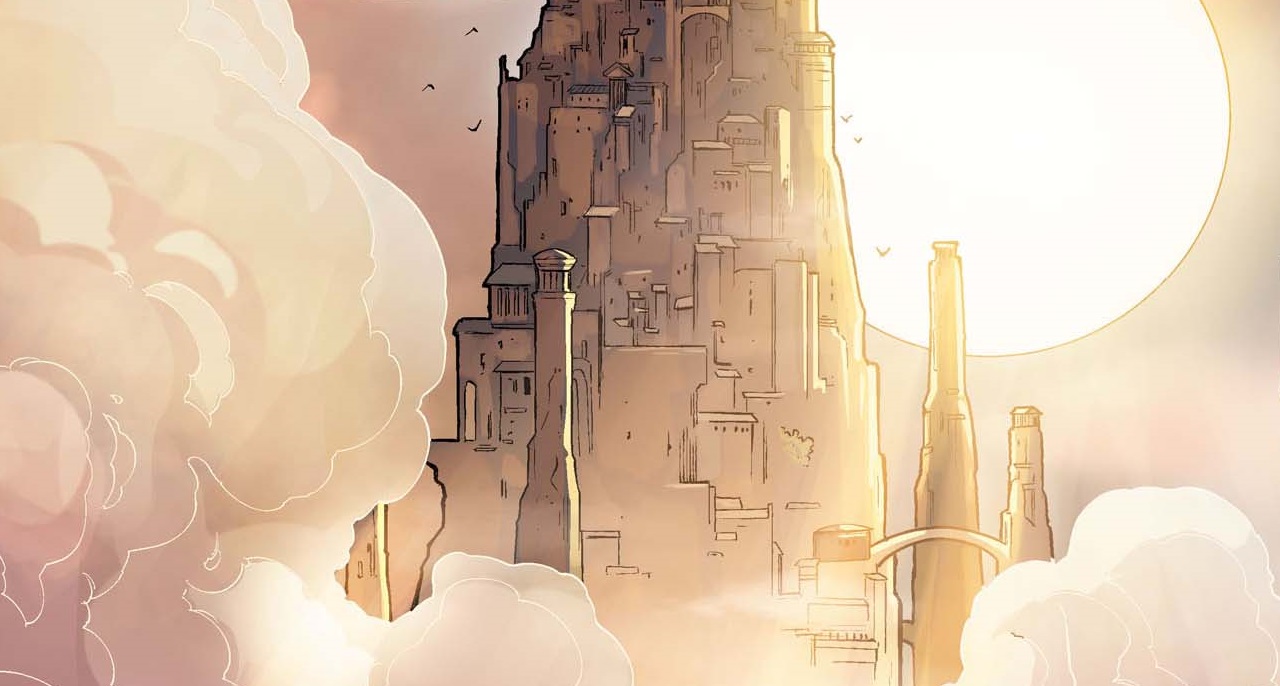
Mount Olympus
The Mythic: Olympian are a humanoid race of extradimensional beings that hail from Olympus.
They are also known as the Gods of Olympus Romana who have been worshiped by humans of Ancient Greece and throughout the Roman Empire from about 2,000 BC to 500 AD. The worship of the gods fell with the rise of Christianity.
Olympus was one of the God Realms, among the Inner Planes, a small "pocket" dimension adjacent to Earth and accessible via an interdimensional nexus located somewhere on Mount Olympus in Greece, and a small other-dimensional planetary body whose nature and physics are different from those of planetary bodies in the Earthly dimension.
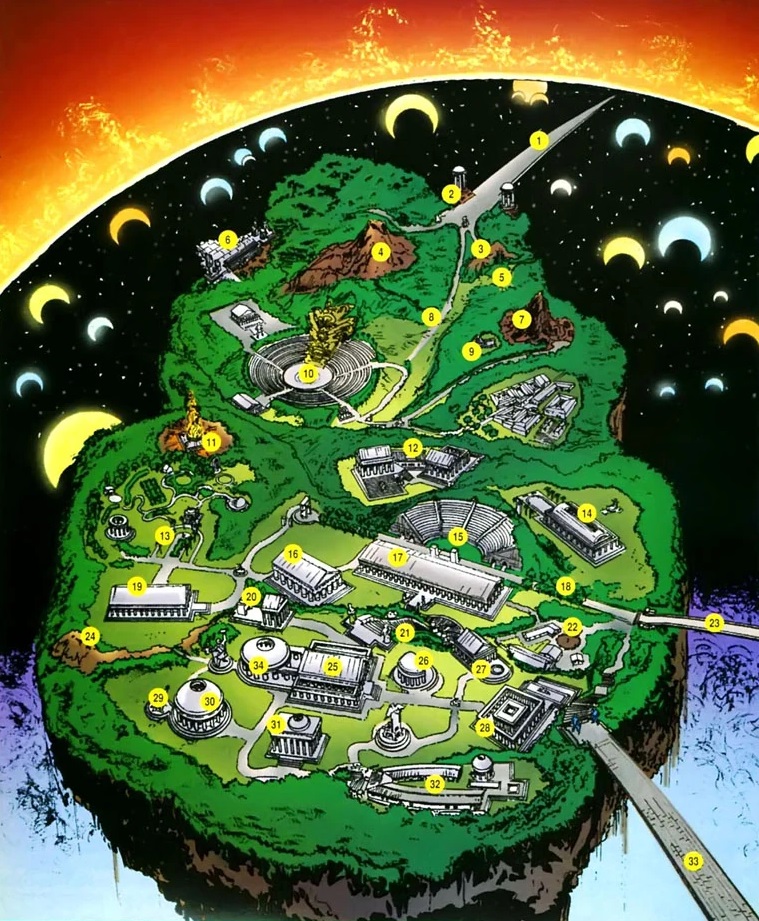
Olympus serves as the home to the Olympian gods. Olympus resembles the Asgard (Realm), although it is no bigger than a large city. This relatively flat asteroid-like landmass is suspended in space, and is surrounded by what its inhabitants call “the Abyss.” It is not known if Olympus's source of light and heat is Earth's sun, or a glowing ball of light dissimilar to a star in most of its properties. Unlike Earth, where the force of gravitation radiates from the mass of the planet, Olympus has gravity, which apparently radiates from some point or object beneath the suspended landmass. Consequently, there is a topside to Olympus, upon which beings can stand.
There is apparently some force that keeps the bottom and edges of Olympus's landmass from eroding away. This force also prevents Olympus's atmosphere from escaping. Olympus is surrounded by what Olympians call "the Abyss," which may be similar to Asgard's "sea of space." The exact nature of space in the Olympus dimension is unknown.
While the gravity of Olympus is roughly analogous to Earth's, common Olympian matter is considerably denser than Earth's on the average. Consequently, a chair made of Olympian wood would be more massive, heavier, and more durable than a chair made of analogous Earthly wood.
Olympus is linked to at least four other dimensions. The dimensional bridge between Olympus and Earth leads to somewhere on Mount Olympus in Greece. There is also a nexus between Olympus and Tartarus, the realm of Pluto, and an apparently artificial nexus between Olympus and Asgard. Also, there is a bridge leading to another realm, from which the Olympian race is said to originate.
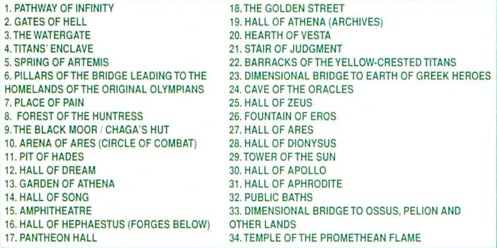
Among the major buildings of Olympus are the great halls of the principal Olympian gods and the Pantheon Hall, where the Olympian high council meet. Those Titans not confined to the land of the dead live in an enclave amid the large forest governed by Diana. Wrongdoers are punished at the "Place of Pain".
Demographics
Government
Monarchy
Defences
The Gods of Olympus.
Assets
Mount Olympus, Greece.
History
Origin
Their origins are shrouded in myth, making it difficult to nail down the truth of all of the stories written about them.
At first in the universe there was nothing but the primordial abyss of nothingness, whose sole resident was Nox, the first of the Olympians.
According to ancient myths, the primeval Earth goddess Terra is the progenitor of the principal Olympians. She Terra created the first to the sky god Uranus.
Reign of Uranus
Uranus now ruler of Olympus mated with Terra producing a number of powerful offspring: the Titans, the Cyclopes and Centimanes. Uranus feared his children would usurp his power so he imprisoned the Centimanes and Cyclopes in Tartarus, the dark abyss of the underworld. Terra, disgusted with the treatment of her children urged the Titans to overthrow Uranus. The youngest Saturn agreed and led his brothers into ambushing Uranus in his sleep. He then castrated him with a sickle given to him by Terra. A dying Uranus prophesied that one of Saturn's own children when overthrow him just as he had overthrown Uranus. Saturn then took his sister Ops as his wife and became the new ruler of the Olympus.
Reign of Saturn
Saturn seized Olympus, but he neglected to free the Cyclopes or the Hekatonkheires. His wife, Ops, upon the birth of each of his own children, Saturn had the infant imprisoned in Tartarus. The offspring he sent there were Pluto, Neptune, Juno, Ceres, and Vesta. Appalled at the mistreatment of their children, Saturn's wife Ops concealed her sixth pregnancy from him and secretly gave birth to Jupiter and hid him on the island of Crete.
Titanomachy
Jupiter grew to adulthood among the shepherds of Mount Ida, Crete, and then set about taking revenge on Saturn. Jupiter went down into Tartarus and freed his siblings, who had all now grown to adulthood, Jupiter also freed the three one-eyed giants called Cyclopes and the three hundred-handed giants called Hekatonchieres, all six of whom Saturn had imprisoned there for fear they would help overthrow him. The Cyclopes provided the young Olympians powerful weapons to defeat the Titans. They gave Neptune a powerful "Trident", Pluto the "Helm of Invisibility" and gave Jupiter the powerful "Thunderbolts." The young Olympians and his allies fought a ten year war with the Titans which ended with Jupiter's victory.
The Titans were imprisoned in Tartarus, and the Hekatonkheires were made their guards. Atlas was given the special punishment of holding up the heavens.
Reign of Jupiter
Following their final victory, the three brothers divided the world among themselves: Jupiter was given Olympus, and was recognized as overlord. Neptune was given the oceans of Earth, whereas Pluto was given Tartarus, the Underworld, the realm of the dead. He was tasked with guarding the Titans for all eternity.
Jupiter married the goddess Juno, but he engaged in many affairs with goddesses, titans, nymphs and mortal women and produced various famous offspring. By Juno, he sired Mars, Discordia, Juventas, and Vulcan. His first lover was Metis, a Titan with whom he sired Minerva. A relationship with Dione, another Titan produced Venus. He was involved with Latona and sired the twins; Phoebus and Diana. He was also involved with Maia a Nymph and sired Mercury.
With the expansion of the Olympians, Nox became an outcast within her people, harboring a disdain for the Olympians' pageantry. She attempted to find happiness by emulating the other gods bearing children, resulting in the birth of Somnus. With the evolution of mankind, the night and the dark became correlative to the unknowns humanity feared. Mortal storytellers used their words to dispel these terrors and find comfort in heroes of myth, shaping Jupiter and his children into these ever-growing heroes, causing Nox to become their opposite. With each legion of followers the Olympians gained, both Nox's rage and the Olympian's contempt for her grew stronger. With her mind filled with thoughts of betrayal, Nox gave birth to the twins Fraus and Dolus.
Conflict between Nox and her children and the Olympians became inevitable. When a war broke out, Nox and her children were defeated by the rest of the Olympians. Jupiter shattered Nox's soul into three Night Shards to depower her, and then cast her out along with her children into a prison of darkness, ensuring their confinement with a spell that sealed their fate for as long as the Sun shone upon the Earth. Out of her hatred, Nox manifested her fourth and most powerful child, Miseria.
Pre-Cataclysmic Age
Circa 50,000 BC, the inhabitants of Atlantis worshiped Jupiter.
Some accounts depict them as being active as long ago as 20,000 BC. The Olympians, including at least Minerva and Neptune, were active and worshiped on Atlantis. Atlas supported the Axis Mundi was located in Atlantis.
Circa 8,000 BC, beings known as the Olympians travelled from the interdimensional realm of Olympus via a nexus located on Mount Olympus to Earth. They began interacting with the Humans of the region who began to worship them.
Eternals
Mount Olympus lay near Olympia, the principal city of the Eternal. Jupiter and his daughter Minerva met with Zuras, the leader of the Eternals, and his daughter Azura. Noticing the physical resemblance between Jupiter and Zuras and between Azura and herself, Minerva suggested that the Olympian gods and the Eternals form an alliance in which the Eternals would act as the gods' representatives on Earth. The other three enthusiastically agreed, and Azura took her current name of Thena to signify the sealing of the pact. However, over the years, many humans came to think of many Eternals not as the gods' representatives but as the gods themselves. This led to a growing resentment by the gods towards the Eternals, which erupted into a brief war.
Hercules
The great hero Hercules was born in Thebes ancient Greece the son of Jupiter, king of the Olympian gods, and Alcmena. Throughout his life he went on many adventures around Greece.
Circa 1,271 BC and 1,268 BC Hercules was best known for his celebrated Twelve Labors, which were performed in part to prove his worthiness for immortality to Jupiter.
4th Century
When Christianity replaced the worship of the Olympian gods in the Roman Empire, Jupiter decided that the time had come for the Olympians to break most of their ties with Earth. Neptune, however, was still allowed to watch over his Atlantean worshipers.
At some point in time, Jupiter took a leave of absence from Olympus, leaving Venus in charge of Olympus. She immediately moved the dimensional nexus from Mount Olympus to the planet Venus. She allowed non-Olympians to reside in Olympus, such as Cleopatra, and the Biblical Samson.
10th Century: Third Host
In 1,000 AD, the Third Host of the Celestials occurred, during which the aliens informed they would return 1,000 years later to judge Earth's right to continue existing. Izanagi attended the Council of Godheads meeting to discuss this threat. While the pantheons prepared for war, Terra planned a peaceful solution to the problem with many goddesses.
For the next thousand years, they searched for humans representing mankind's highest ideals, to be offered to the Celestials as an offering. The goddesses placed the candidates in suspended animation, with their superhuman potential, the legacy of the First Host, awakened.
20th Century
Jupiter's children Hercules and Venus spent periods living among Earth mortals in recent years. By 1948, Venus had established her own private kingdom on the planet Venus, and took a leadership role along the Olympian gods, having absolute control before she decided to go to Earth to stop her boredom.
In the late 1940s, Jupiter returned to Olympus, taking control of the pantheon again, and ordered Venus to return to Olympus, but the goddess defeated him in a battle of wills and remained on Earth.
In 1949, Olympus was almost invaded by the demonic hordes of Tartarus led by Loki, who at the time ruled Tartarus. The invasion was halted when Joya posed as Venus to trick Loki into returning to Tartarus.
In 1950, one of Loki's demons infiltrated Olympus by possessing the body of Apollo. He attempted to convince Jupiter to allow Loki to reside on Olympus, however this plot was exposed by Venus. Later that year Olympus was invaded by creatures that inhabited the mind of Earth scientist Profesor Buffanoff. Olympus was defended by Jupiter, Apollo, and the Asgardian thunder god Thor until Venus was able to trick the creatures into returning to Buffanoff's dying brain.
21st Century
When the vengeful goddess Nox escaped the prison Jupiter locked her in, she and her children attacked the gods, slaying everyone including Jupiter himself. After the massacre of the Olympians, the palaces were reduced to nothing but burning ruins. Though the Olympians were reborn soon after, they instead roamed the galaxy in New Olympus.
Points of interest
The Parthenon of the Gods.
Architecture
Ancient Greek Architecture, Doric, Ionic, and Corinthian.
Geography
Mountainous.
Climate
Temperate.
Natural Resources
Ambrosia, Nectar.

Comments