
Catfolk
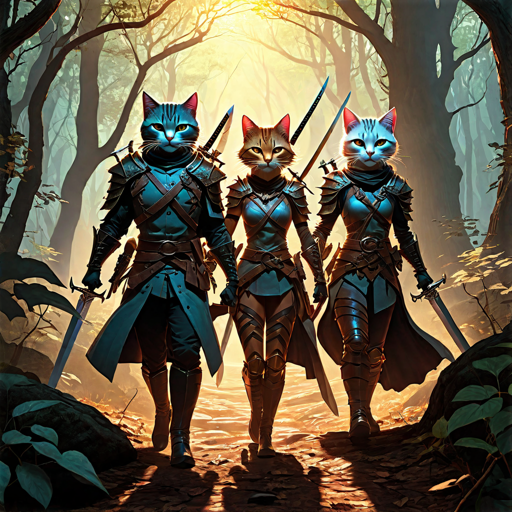
Catfolk, known in their language as amurruns, are graceful, feline humanoids renowned for their wanderlust, boundless curiosity, and protective nature. They see themselves as caretakers of Duare's natural balance, drawn to explore the world and defend it from those who would despoil it.
Physical Description
Amurruns walk upright and possess soft fur, long tails, expressive ears, and vertical pupils that grant them keen vision in dim light. Their fur patterns and colors vary as widely as those of mundane cats, and their nimble fingers end in short, retractable claws. Amurruns mature quickly and begin walking only a few months after birth, yet they come of age and start their careers at the same time as humans. Their average lifespan is between 60 and 70 years.
Temperament and Personality
Amurruns embody both the playful curiosity of a kitten and the fierce independence of a wild predator. They take joy in uncovering new stories, songs, and treasures, sharing their discoveries with loved ones or their broader community. However, beneath their gregarious exterior lies an unyielding determination to safeguard the natural world. Amurruns believe strong relationships, diverse experiences, and personal growth are vital tools in this fight, and they carry these values wherever their journeys take them.
While typically cheerful and inquisitive, amurruns are known for their swift shifts in temperament, often moving from jubilant curiosity to smoldering anger in moments. Like their feline cousins, they involuntarily purr when content and growl or hiss when startled or upset. For those who want a character brimming with curiosity, courage, and nimbleness, amurruns are a natural choice.
You Might...
- Enthusiastically ask numerous questions to learn about the people and places around you.
- Avoid direct conflict by ignoring others, withdrawing, or leaving a contentious area.
Others Probably...
- Think you dominate conversations with your endless questions or opinions.
- Mistake your involuntary purrs or growls as expressions of stronger emotions than you actually feel.
Society
Amurruns refer to themselves by their ancestral name, which they consider sacred and often keep private from outsiders. Their communities thrive on cooperation, with large extended families serving as the cornerstone of their culture. Amurrun children are given freedom to explore and experiment, often encouraged to learn through mischief and curiosity. Trade and craftsmanship are integral to amurrun life, with individuals pursuing multiple trades throughout their lifetime, often under informal apprenticeships. Their leaders, chosen through consensus, act as mediators and spokespeople. Conflict is rarely addressed with direct confrontation; instead, amurruns favor displays of disinterest or even temporary exile to allow disputes to resolve themselves naturally.
Beliefs
Amurruns believe they were uplifted by Verdantis, The Great Artist, from the great primordial felines of ancient Duare. This divine gift, they say, came with a sacred duty: to protect the natural world from forces of corruption and destruction. To this day, many amurruns devote their lives to safeguarding nature and confronting unnatural abominations that threaten to unravel reality.
Religiously inclined amurruns practice a form of animism, honoring and appeasing the spirits of the land, creatures, and elements. They view their role as harmonious stewards rather than conquerors of nature, giving thanks for their hunts and restoring balance wherever possible.
Popular Edicts: Travel widely, protect natural places, keep yourself and your surroundings in pristine condition.
Popular Anathema: Leave a mystery unsolved, harm an innocent creature unnecessarily, or defile sacred natural sites.
Names
Amurruns are given short, simple names as children. Upon reaching adolescence and leaving their families to explore the world, they choose their own adult name, reflecting their individuality and aspirations.
Sample Names:
Alyara, Crinto, Drewan, Espes, Ferrus, Gerran, Halhat, Hoya, Ruun, Sevastin, Tespa, Yonsol, Zakkar, Zathra
Known Catfolk Cultures
Comments