Castsulae
Remnants of a time of war long past, the Castsulae dominate the skyline of nearly all of the Pathway Metropolises. Located in the oldest Wards, they have been repurposed and given new life. At least those that survive. Originally built to take and hold territory in a contested city with regular building-to-building fighting. They are designed to secure large quantities of people, food, and water supplies.
History
During the Second Nexus Wars the Golden Paths became the center of the conflicts. As each combatant tried to control the Pathways, they built fortifications for the population and their forces, or Castsulae. By the beginning of the Third Nexus War the Castsulae became standardized in their construction, and with access to Orc Iron and Concrete they could grow to five or six stories tall.
Accords Era
However, in the Accords Era they became relics and typically remained in the older Wards, if they weren't torn down completely. Those that remain have been been repurposed into tenements or ghettos.
Architecture
Early Castsulae were ramshackle affairs of quickly built stone edifices in the late Baeon style. Typically they were squat squares that could host and protect a few hundred soldiers. However as the Second Nexus Wars heated up and the influence of Duranti architecture on the design grew, and access to Orc Iron opened up, the Castsulae took on their more consistent form.
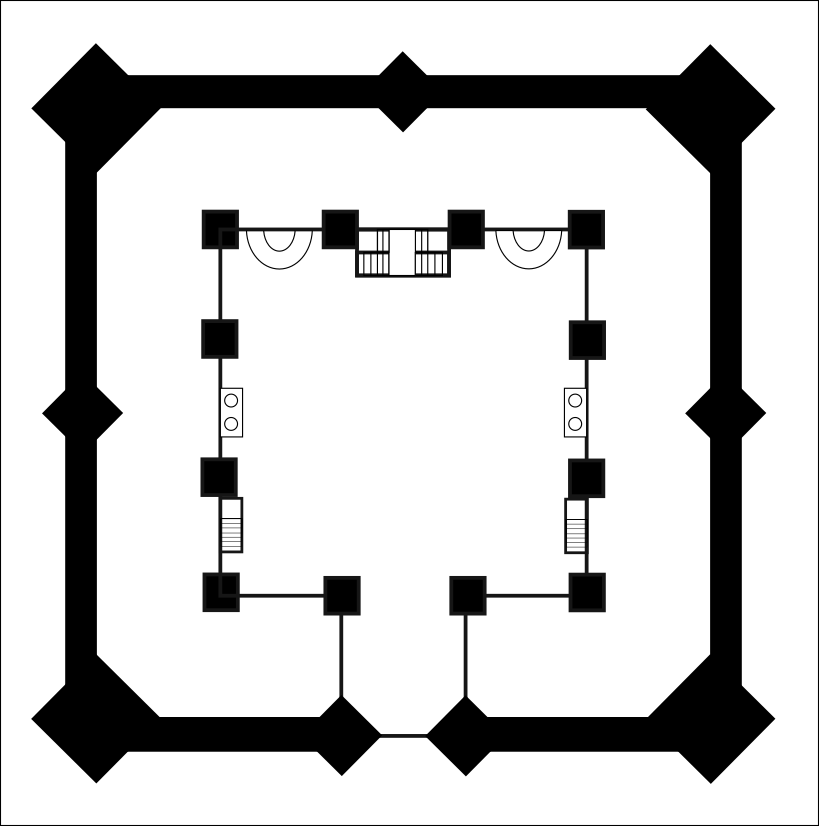
Castsulae are built as a closed ring, typically a square with four sides, though five, six, and star styles do exist. They range from three to five story tall. They are built with a thick stone wall outer wall with the inner side lined with residential structures surrounding an open common space. The first floor of the Castsulae hold common resources, laundries, kitchens, granary, and shops. On the upper level are cisterns that capture rainwater and are filled regularly. Each Castsulae can hold hundreds of people within its walls.
They have a grand entryway which is made up of two sets of great double doors that can be barred and braced from the inside. There are smaller doors that allow a single person to pass which can be easily secured. The Castsulae are also connected to the sewage system and could be used to enter with difficulty.
Accords Era
With the end of the Second Nexus Wars, the primary reason for the Castsulae's existence ended and they ceased to be built. However, with their durability destroying them would be more costly than it was worth to clear the land. So they were repurposed, typically as residential structures. Over the years they were subdivided and subdivided over and over again until they were relegated to tenements. Since then the average Castsulae can home nearly a thousand individuals within its walls.
From the outside the stone walls are typically stuccoed and painted in vibrant scenes and frescoes that advertise the Ward's amenities, businesses, or political competitions. At the higher stories the stucco is typicaly chipped and cracked revealing the stone and cement that make up its structure.
Within the ward is a cacophony of people going about their business, children playing in the common area, the scent of food cooking at all hours and of all cuisines.
Occupants and Usage
The denizens of a Castulae depend on the Ward that surrounds it. While they typically are tenements that reflect the lower income population distribution of the Pathway Metropolises, they also become ghettos for insular communities.
Most Castulae have Bullyboy guards who maintain order within them and protect the occupants. The services offered within the Castsulae are typically not for the general public, but the occupants alone. However, they will occasionally contain some sort of industry that produced wares that are sold elsewhere.
Cultural Influences: Baeon castles, Imperial Duranti manorhouses.

Comments