
Sanctuary Tree
Introduction
"The Tree is not a refuge. It is a verdict.”
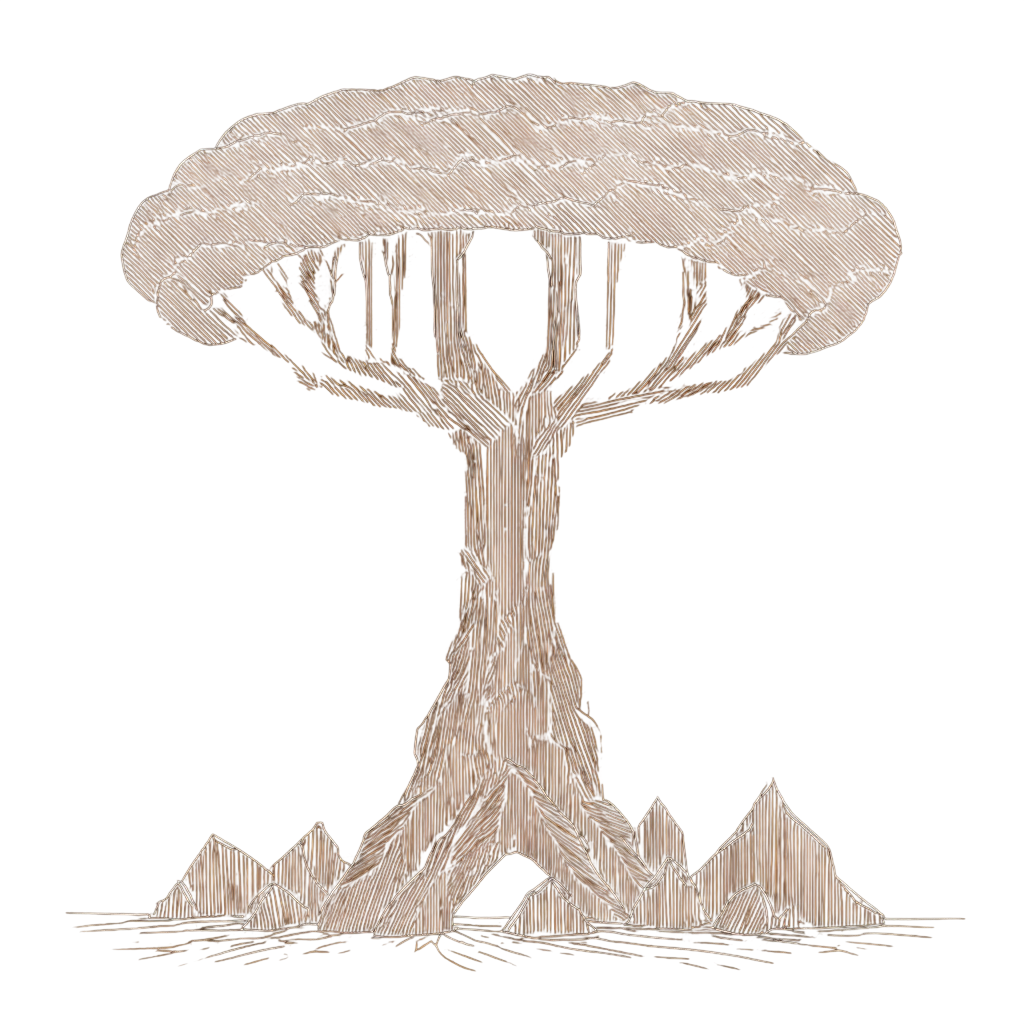
A colossal, ancient trunk rises from a scar in the earth. Vast branches spread outward in a perfect circle, and within that boundary the seasons shift: bloom collapsing into frost, decay yielding to warmth; all within the span of a single day, never escaping the tree’s shade.
People call it the Sanctuary Tree - a name that clings to it like a prayer. The tree holds no fixed location. It does not answer maps or memory. Instead, it emerges where the Veil Tears bleed most fiercely into the waking world, standing as if it had always been there, appearing only at moments of great need, or at the precise point where something is about to fail. Whatever soil it drinks from, it is older than the ruins and stranger than the laws that now govern them. And yet, wherever it stands, the world steadies just a little longer. It is a monument grown from catastrophe, a refuge born not of hope, but of refusal: the refusal of something ancient to allow reality to collapse completely.
To most, the Sanctuary Tree is only a story told to soften the nights between disasters. A legend masquerading as mercy. But those who have stood beneath its canopy do not debate its existence.
They ask only this:
Why does something so untouched still remain -
and what price is being paid so that it may?
The air tasted of metal and broken teeth. Dust chased him through the ruins, coiling into the shapes of hands that reached and recoiled, eager to drag him back into the hungry dark. Every step felt borrowed. Every breath felt contested. Then, without warning, the storm shattered against nothing and silence fell like a cloak.
He staggered forward, heart hammering, and saw it: an enormous tree rising through the twilight like the spine of the world. Its vast canopy shifted with a single breath of time, trading seasons in impossible harmony: winter frost cracking along one limb, spring bloom unfolding on another, emberfall drifting from a third, evergreen dusk holding fast beneath them all. He stepped beneath its branches - trembling - and felt peace. Not relief. Not numbness. Peace. Real and unguarded. The kind he had forgotten was possible.
He pressed his scarred, blood-slick hand against the bark.
A pulse answered.
Beneath his palm, glyphs stirred; lines sliding and reforming into a pattern he almost recognized, as though a memory he had never lived was trying to surface. The roots hummed. Something like a voice followed.
You are safe now.
He fell to his knees and wept. The pain broke loose and poured out of him, clean and unrestrained. It was the kind of crying that scours something raw and leaves it bare. For a moment - just a moment - it felt like catharsis.
When he woke, the Tree was gone. The ruins were unchanged. Only the memory remained, nested deep in his mind like a splinter of light. And around his wrist, branching in indigo lines like lightning trapped in flesh, was a mark he did not remember receiving.
He searched for the Tree for years afterward.
It never appeared again.
Type
Tree
Classification
Mobile Landmark
Status
Unmapped
Estimated Size
- Trunk height: approximately 80–100 meters
- Canopy diameter: 250–300 meters
Territorial Radius
Approximately 180–200 meters from the trunk
Known Manifestation Zones
- Collapsed urban centers
- Failed ritual sites
- Historical Cataclysm impact zones
- Areas with repeated Wyld Surge activity
Environmental Effects
- Rapid seasonal cycling within the perimeter
- Suppression of minor Wyld Surges
- Partial stabilization of Veil bleed-through
- Slowed natural decay of organic and inorganic matter
Duration of Manifestation
Unconfirmed
Accessibility
- Non-hostile
- No physical barriers observed
- Entry is consistently described as permitted
Known Restrictions
- Attempts to cut, burn, mark, or harvest the Tree always fail
- Tools degrade or lose efficacy when used against it
- Structures built within the perimeter do not persist after departure
- Prolonged stays correlate with disorientation, survivor’s guilt, and refusal to leave
A Living Haven
What the Tree Refuses
"It is the only place where my hunger dims. Do you understand what that means? It means the Tree remembers a world without us."
The Sanctuary Tree is often mistaken for a miracle; a false assumption born of desperation.
The Tree does not answer prayers. Words spoken beneath its canopy fall flat, neither resisted nor received. They simply fail to matter. By all surviving accounts, the Tree does not respond to intent.
Magic fares no better. Workings attempted beneath the canopy do not backlash or unravel. Nothing collapses. Nothing surges. Nothing occurs. Spells refuse to pass through the Tree’s domain, as though permission has already been decided and no appeal will be heard. Attempts to treat the Haven as a focus - for Veil sealing, mass attunement, or restorative rites - have all ended the same way: the Tree remains present, unchanged, and unmoved. This indifference has proven more unsettling than hostility ever could. Scholars note that the Tree does not oppose such efforts.
It ignores them completely.
Immortals report a different kind of refusal.
Most are repelled outright, unable to cross the perimeter, halted not by force, but by a sensation witnesses struggle to describe - as though the Tree has already reached a conclusion about them. On the rare occasions when an Immortal does stand beneath the canopy, the accounts are unanimous, and more disturbing still.
The hunger falls silent.
Not eased. Not satisfied.
Just absent.
For as long as the Immortal remains beneath the Tree, the need that defines them simply ceases to exist. When the Haven departs, the hunger returns at once: unchanged, unweakened, and rendered unbearable by the memory of its absence.
The Marked
Some who pass beneath the Sanctuary Tree return bearing a mark; a scar that appears as branching indigo or violet lines beneath the skin, most often along the wrist, spine, or ribcage. Those who carry it report an unusual resilience: wounds healing faster, fear muted, pain clarified rather than dulled. Alongside this comes a surge of lucidity: a brief, unsettling sense of understanding that fades before it can be named. They often describe it as being chosen, without knowing for what.
Reactions to the Marked diverge sharply. Survivors regard them as blessed, living proof that the Tree can be reached. Mages treat them as resources, studied for patterns that might draw the Haven into the world again. Immortals on the other hand, view them with suspicion and often avoid their presence entirely.
Of course, not all who find the Tree are marked. No rule governs who is chosen. Still, the Marked remain the clearest sign that the Tree does not grant sanctuary without purpose, and does not reveal that purpose in advance.
The Sanctuary Tree does not bargain. Its offerings are narrow and exact. It interrupts collapse, but does not reverse it. It shelters those who arrive, but does not promise they will leave unchanged. Its Haven is not a cure for a dying world. It is a pause imposed upon one.
The Tree does not punish hope, but it does not reward it either.
What little consensus exists agrees on one thing:
The Sanctuary Tree does not save.
It judges.
The Myth of Aodhán
Among the surviving mage orders, there persists a shared, uneasy conviction: The Sanctuary Tree is not a tree at all.
It is Aodhán.
Aodhán, one of the Verdant Chorus and among the greatest wielders of the Matter Pillar. Shaper of forests, binder of stone and root and river into harmony. The one who believed, against all precedent, that magic could mend what it broke; that it could heal rather than consume.
When the Cataclysm came, when the Veil screamed and reality tore itself open, Aodhán vanished. Some accounts claim he was destroyed outright, unmade in the attempt to stabilize a fracture too vast to hold. Others insist he betrayed his own kind, hesitating where others burned themselves away to end the war.
Among those who study the Sanctuary Tree, however, a quieter theory endures.
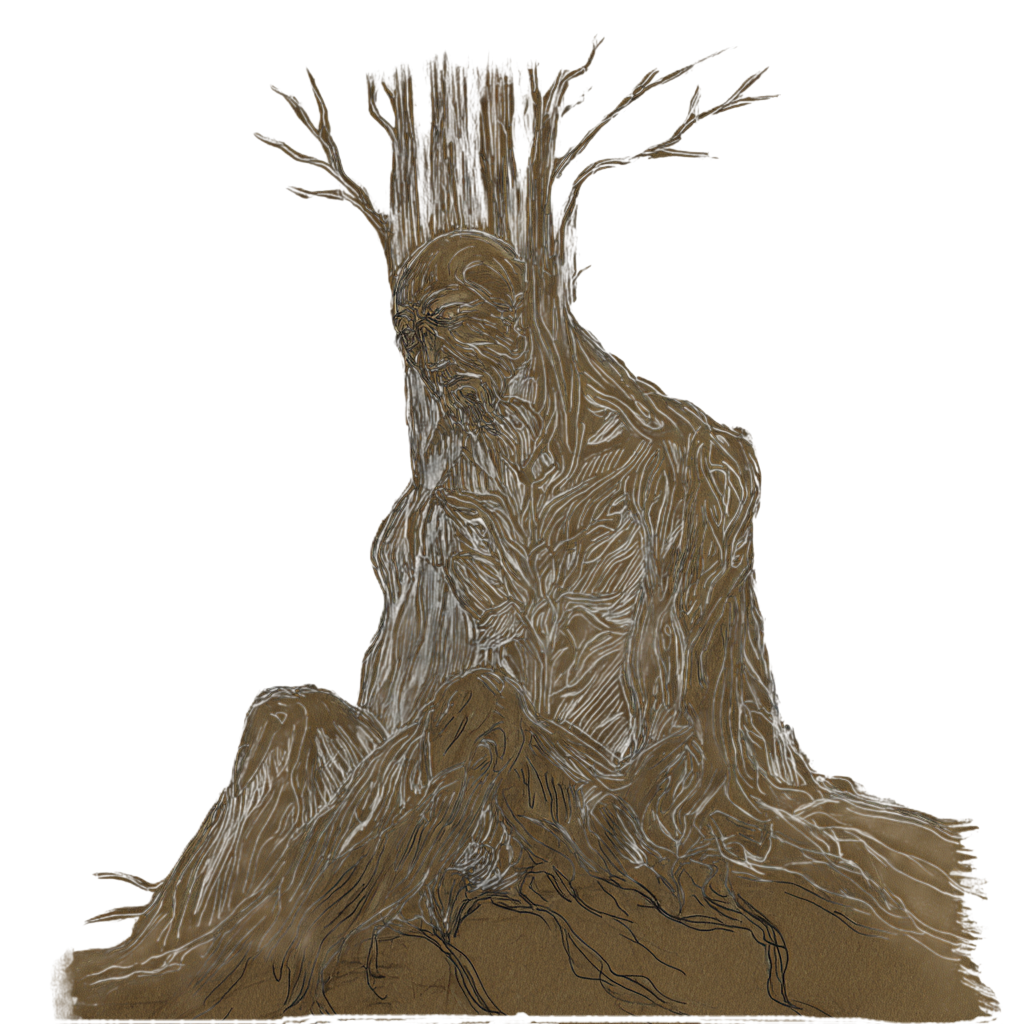
That Aodhán chose a different path entirely. That when the Veil ruptured, he dissolved himself and willingly merged with the remnants of the natural world; flesh into root, breath into leaf, soul into sap. He bound his being into living structure to hold the world’s wound closed, not forever, but long enough.
In this telling, the Sanctuary Tree is his dreaming body.
Or his prison.
Or his grave.
Supporters of this myth point to the Tree’s resistance to alteration, its refusal to grow or decay, its mastery over matter without exertion. They note the glyphs etched into its bark resemble sigils long associated with the Matter Pillar. Those who sleep beneath the Tree’s heartwood report a voice - heavy with exhaustion, threaded with grief - whispering through the soil:
You are safe now.
The Silence it leaves behind
The Sanctuary Tree is never recorded where it last stood. By the time agreement forms, the Haven has already moved on, and the land it once occupied has resumed the long, indifferent work of falling apart.
Those who encountered it speak of it rarely. When they do, they choose their words with care; as if careless words might thin the memory. Among survivors, the Haven becomes a measure rather than a memory. Every shelter is found lacking by comparison. Every moment of safety feels provisional.
Mages continue to argue over what the Tree is.
Immortals continue to avoid what it does.
The Marked continue onward, carrying resilience without context, clarity without instruction, and the persistent sense that they are burdened with a purpose that eludes them.
And in the mean time, the world continues to break. Which leaves an uncomfortable possibility that none of the surviving records are willing to state outright:

Comments