
Voidart & Magic
The Manipulation of Void Energy
Of the Four Spheres the use of Void is the one of greatest familiarity to me. It is also the one holding the deepest mysteries. It is also the catalyst for the most - and greatest - tragedies. It was a misuse of Void that created Stone Town, and that gave birth to the Rotting Plague. Void is difficult to control, dangerous, and potentially the most powerful and versatile. This is evident even to mortal users, though most mortals, even the most practiced of sorcerers, have familiarity with only the slimmest band of what "magic" truly is.
It is the consequence of the way in which we learned the Dance. As ephemeral beings, we most often rely on magic systems to provide "learning pathways" for mortals to traverse en route to understanding. Yet, even as we make our choices, we know that to journey down one path means not seeing where the others lead... and no single path can touch every part of an expanse as large as the Void."
The Nature of Voidart & Magic
Voidartistry is the art of moving, channeling and manipulating Void, a form of energy that permeates the world itself and is present in all things. One could say it is the energy that fuels existence. It is, therefore, a much more generalized form of energy than, for example, the Od energy that fuels Odaturgy. It is also present in far greater quantities, which can be both a benefit and a flaw to the dancer.
Terminology
In its default form, Void itself is invisible to the naked eye. However, when examined by an energy sensor or forced to become visible, it appears as a white light. This light permeates all things - a stronger glow inhabits living things, but the light of the Void is present even in inanimate and inorganic matter.
This is the engine behind void-dancing -- and magic.
General Spheres and EffectsThere are three general "spheres" of colored energy (Red, Green and Blue), each of which roughly correlates to a wider swathe of effects (Destroy or Remove, Create or Add to, and Transform or Change, respectively). As always, white is the color of all colors combined. To create effects using void, one must learn to pull those colors apart and manipulate individual "shades" by amplifying, diminishing, altering or combining them in various degrees and patterns.
Once this begins, the energy being used becomes visible with a hue reflecting the specifics of the manipulation in process. For example, using a transformative voidic ability would create a blue glow as the dancer separates the blue energy out and shapes it.
As another example, an effect that combines destruction with transformation will have a purpleish hue. When all three work in tandem, the effect appears visibly white - this is All-Sphere, used to fuel reality-bending or rule-breaking effects.
Alternately, when spheres are actively suppressed or drained, the resulting effect appears similar to shadows - Null-Sphere - which has logic-breaking and negation effects.
Finally, when Void is processed through a magic system (more on that later) rather than manipulated directly, it is referred to as "magic." This is most commonly associated with mortals.
Unlike Odaturgy, and unless some ability or object is specifically used to dampen it, voidic abilities will always have a visual effect; brighter effects generally indicate a greater amount of energy being utilized and thus a stronger effect.
Sphere Breakdowns
Void Spheres are defined by color and by the final effect, not by the means through which the effect is reached - that is to say, whether you use a bolt of energy or a fireball to blow something up, you are using Destroy or Remove, and so the light will run red. Different void-dancers may specialize in different spheres, yes, but often in different effects within the spheres as well, e.g. perhaps someone is better at generating fire effects than direct energy bolts. Both destructive, but one can be better or worse at either one.
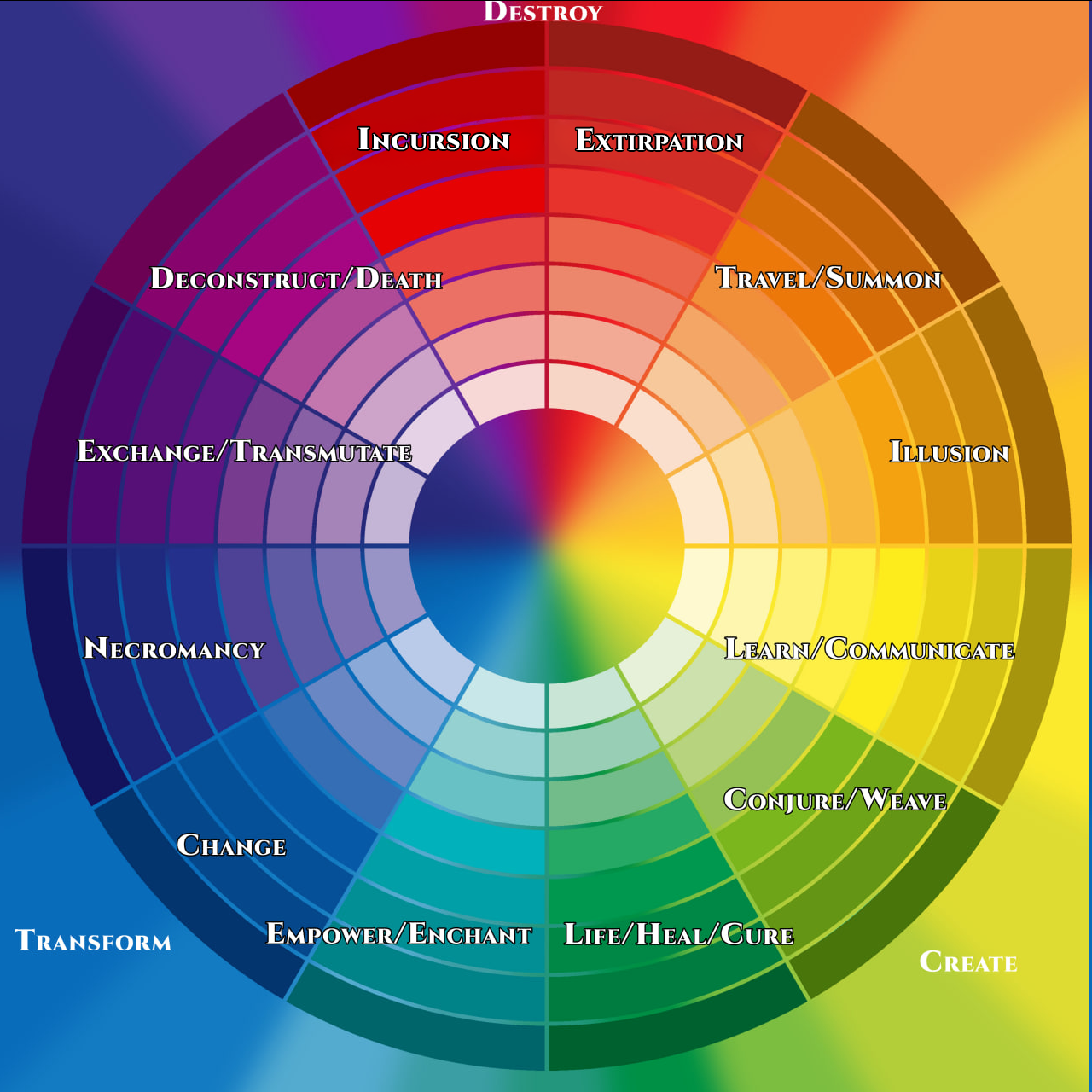
The spheres are, at times, somewhat abstract - e.g. "Extirpation," the name for inherently destructive effects.
It's worth noting that the personality and nature of the person using Void can have a strong impact on what sorts of effects come most naturally to them - a violent person may struggle with voidic effects like healing while a pacifist would find destructive effects difficult. A slight conflict between a dancer's nature and their desired effects can be overcome with will, time and practice, but there is a point beyond which the connection is essentially severed.
What follows is a list of the spheres along with examples of effects one might create with that sphere, and what sorts of people might thrive with or fail at the sphere.
Extirpation
The purest expressions of physically destructive energy. Fireballs, lightning strikes, force bolts, ice shards that fly across space to impale enemies.
Classic Examples: force bolts, fireballs.
Difficult for: Anyone with a gentle or very empathetic personality, pacifists.
Comes Easily To: People with rage issues, violent people.
Travel/Summons
Sphere of movement from one place to another. This includes teleportation as well as gateways, summoning, etc.
Classic Examples: Teleportation, summoning monsters
Difficult for: Homebody types
Comes Easily To: Most others, as people tend to want to go places.
Illusion/Phantasmal Matter
Creates images, sounds, etc., that do not exist outside of the voidic effect. This can include solid constructs, but all effects must be actively maintained.
Classic Examples: Solid light constructs, phantasmal servants or mounts, creation of visual or audio experiences.
Difficult for: Unimaginative people, people who struggle with abstract concepts
Comes Easily To: Deceptive people, creative people, abstract thinkers
Learning/Communication
Uncover secrets or communicate at range. This can include things like language interpretation, precognition, energy detection.
Classic Examples: Farsight, language translation, matter analysis, communication with animals
Difficult for: Closed minded people; people who dislike a certain thing will have a hard time communicating or learning about that thing.
Comes Easily To: Intellectually curious, scholars, nosy people
Conjure/Manifest
Creating actual things that previously did not exist. These things are not summoned from elsewhere, they are spun into creation by the Void itself, but are self-persisting. This is the purest form of creation or addition, and can include things as simple as manifesting a feather pen or as complicated as the growth of homunculi.
Classic Examples: Food or drink creation, homunculi, creation of simple objects
Difficult for: Destructive people
Comes Easily To: Architects, artists, etc. People will have an easier time with things directly related to their personality or habits (for example, an expert blacksmith would find manifesting a sword easier than creating a meal).
Life/Heal/Cure
Transform disease or wounds through the application of constructive energy that purifies and heals. This sphere is associated with life in all its forms, however - it can also be used to, for example, restore life and health to plants.
Classic Examples: Healing, regenerating lost limbs, reviving plants, speeding plant growth.
Difficult for: Destructive or hostile people
Comes Easily To: Healers, biology experts, selfless or kind people.
Empower/Enchant
Use void to enhance, empower, strengthen. This is used to bind effects to objects. It is also used to, for example, temporarily boost strength/speed or even intelligence for oneself or others.
Classic Examples: Enhancing the physical power of oneself or others, creating permanently empowered items.
Struggles With: Nihilists
Comes Easily To: Perfectionists, leaders and protectors
Change/Alter
Turning things into other things. Water turns to blood, blood turns to soup. Often, but not always, temporary. Easily used for minor cosmetic changes (e.g. hair color) but can also have more substantial effects.
Classic Examples: Shapeshifting, changing the flavor of a food someone has to eat but dislikes
Struggles With: Rigid personalities
Comes Easily To: Adaptable people, physical or emotional shapeshifters
Necromancy
Sphere related to death and transfigurations linked directly to death or dead things. Animating skeletal remains, trapping souls to empower golems, etc., all fall under necromancy.
Classic Examples: Corpse animation, soul anchoring, spirit summoning
Struggles With: Those who are disturbed by death
Comes Easily To: Killers, morticians, those who are interested in death.
Exchange
Consumes one thing to create another. This can often look similar to change or alteration, but the underlying mechanism is very different as exchange destroys one thing to create another. This form of Void usage relies on the principle of equivalent exchange, but what qualifies as "equivalent" can vary between objective (two pounds of cherries for two pounds of blueberries) or subjective (someone's favorite music box for a thousand gold pieces).
Classic Examples: Alchemy, growing physically stronger by consuming matter.
Struggles With: Hoarders
Comes Easily To: Bargainers
Deconstruction
Taking things apart or removing them. This takes a thing/person/object/etc and removes it by way of pulling it apart a piece at a time. Disintegration would be a prominent example, but it can also be used to negate effects or form protective circles that destroy any attacking item or voidic effect. This is the purest form of destroy/remove use, of course.
Classic Example: Effect negation, banishment, removing enchantments
Struggles With: Pacifists, artists, builders
Comes Easily To: Nihilists when used in obvious ways. Protectors when used for defensive effects.
Incursion
The battle for control over the minds and behavior of others. This includes any effects designed to control, invade or influence the mind or spirit of others.
Classic Example: Altering emotions or memories, controlling minds, hypnotism, activating others' abilities against their will.
Struggles With: Very physical or straightforward people
Comes Easily To: Controlling people
The Hidden Spheres
All-Sphere
When all three major colors are used simultaneously and in equal measure the effect is the manifestation of All-Sphere, which can warp reality and time-space. Rare, since it requires both extraordinary skill to balance and abilities in each of the three major areas.
Classic Examples: Slowing or stopping time, granting wishes, reality warping
Null-Sphere
When Void energy is pulled back in whole or in part this creates Null-Sphere phenomena, which includes black-hole-like occurrences, negation of effects or objects, and the unraveling of logic. In short, it destabilizes and destroys.
Classic Examples: Life drain, will drain
Essential Information
Voidic abilities are nearly universal among Demons, and fairly common among Celestials as well. No Mortal is born with the instinctive ability to use Void energy, but many can learn to do so - most often through a Magic System and in the form of, well, magic rather than unfiltered Void energy.
It is to be expected that Demons, which are more inclined toward Void, have a higher incidence of extraordinary talent development as well as a higher percentage of people who have access to Void to begin with. The estimated layout of availability by metaspecies is below.
Rarity of Ranks by Metaspecies
| Ability | Demons | Mortals | Celestials | Comments |
|---|---|---|---|---|
| Palen | 5% | 75% | 42% | No ability to manipulate, or inaccessible ability. This is extremely rare among Demons. |
| Enop | 20% | 10% | 10% | A low level of ability capable of small/simple manifestations. For Demons, this level is most common among Debils, Gargoyles, and Drereccas. |
| Modu | 52% | 15% | 25% | The most common level of ability for those who have the ability to begin with. Capable of small but more complicated tasks or larger but simple tasks (e.g. lighting a furnace). For Demons, this is the average level of any subspecies other than Djinn, Baetolori and Archdemons. |
| Dumen | 15% | 4% | 10% | The level of ability demonstrated by most Djinn and Baetolori. |
| Vaham | 8% | 0.75% | 7.5% | The highest rank (usually) achievable by most Demons aside from Djinn, Baetolori an Archdemons. The level typically demonstrated by Archdemons. |
| Vallus | 0.33% | 0.02% | 0.25% | This is the highest level typically achievable by Djinn and Baetolori, the highest level achievable by mortals to date, and the usual cap of Celestials aside from Dei. |
| Vis | 0.0002% | 0%* | 0%* | The level of ability common to the most powerful archdemons or Dei and a statistically insignificant number of non-Dei Celestials. |
Void: A Bottomless Well of Power
Unlike Odaturgy, aetherweave or physiurgy, there is theoretically no limit to the amount of Void energy one can use in creating their choice effect. This is because the energy used is external to the body and permeates the world itself, creating a hypothetically near bottomless well of power on which to draw. This does mean that even a low ranked Debil could, in theory, use world-shaping Voidart. Again, in theory.
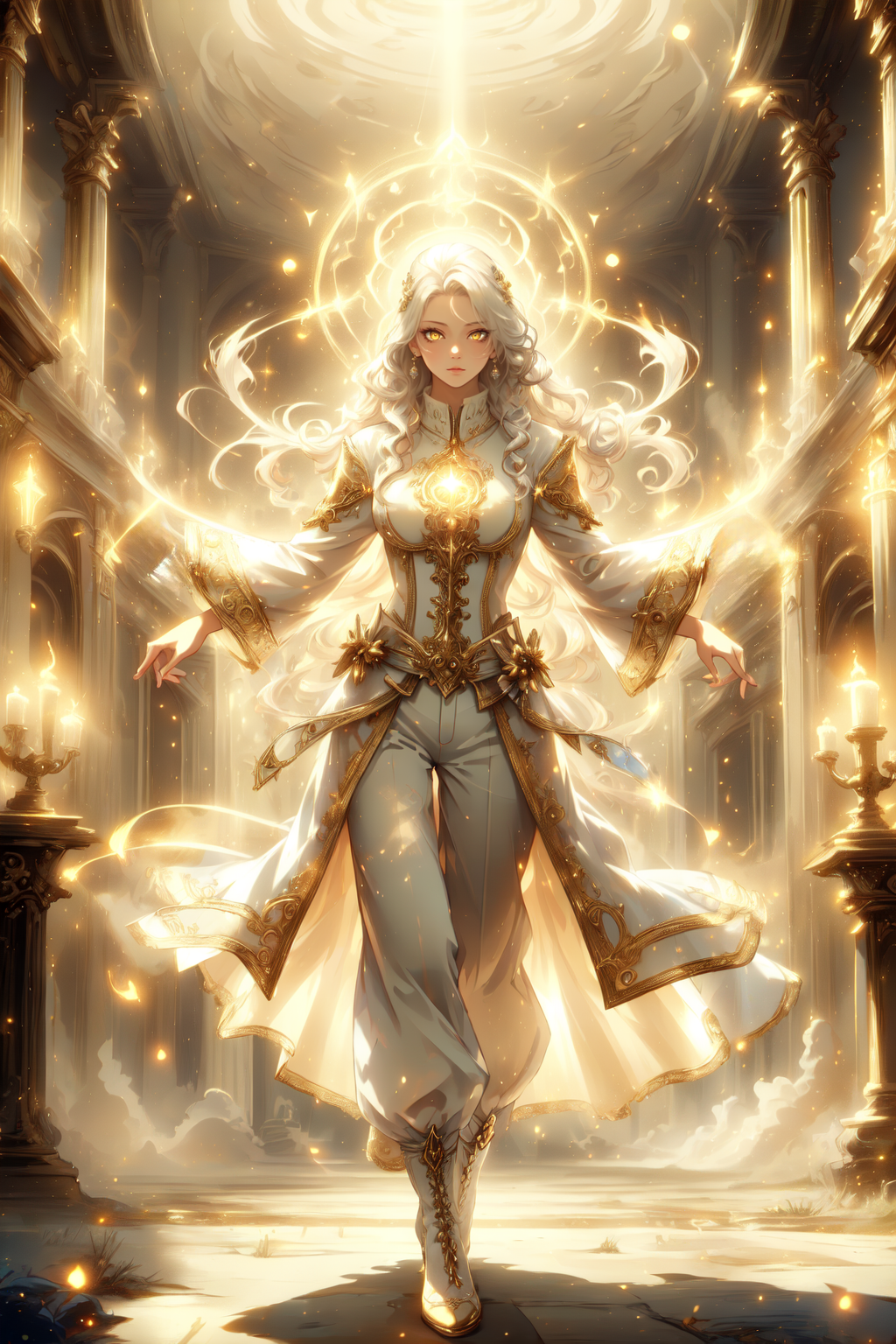
One of the all-time masters of All-Sphere, Laelea Kanete
Practically, however, limits are imposed by the physical and mental endurance of the wielder. For more on this see Effect on the User.
Ranking Void-usersThe strength of a void-user is ranked by the typical Palen through Vis scale. Rank is determined by a mix of competence/skill level and physical/mental limits. More information on these scales can be found at Class & Hierarchy.
ManifestationVoidart is the most visually spectacular of the various ability spheres. Once Void energy is "touched" or changed in any way, the invisibility of the "light" is shattered, and the power being used announces itself to anyone within range of sight. The visual effects of Void make subtle use difficult, as the color advertises the sphere in use, and the brightness hints at how much Void is being pushed.
There are positives and negatives to this - obviously it's somewhat difficult to manage a sneak attack when powering up causes one's hands to glow red. On the other hand, this can be easily leveraged toward intimidation and, most importantly, it helps those who are highly knowledgeable in Void to assess the relative ability of potential foes or rivals. This especially comes in handy for the primary users, Demons in their challenge and violence-heavy culture.
Obtaining a Pet Squirrel
Achieving a similar looking outcome does not mean that the means of achieving that goal are the same. Before using a given method, a dancer person should be certain that they understand and can deal with/accept what, specifically, they are doing.
Let's say, for example, a dancer wanted a pet squirrel. There are multiple ways to approach this goal:
In all cases you end up with a squirrel, and in the case of Alteration and Exchange Voidart it may even look as if the same "transaction" occurred, but they are not the same at all, really.
Void is also the most complicated of the spheres - unwieldy and sometimes difficult to control. In order to truly excel at its use, one must understand how certain effects are achieved, and it is all too easy to trigger incorrect effects by tweaking the energy in a slightly incorrect way.
It is also a rather bombastic form of power, marked by bright lights, multicolored displays and endless visual effects.
Accessing Spheres as a Void-DancerIn theory, anyone who can access and manipulate Void energy can do so in any area along the spectrum of spheres. There is, strictly speaking, no such thing as a person who can use the Creation sphere but not the Destruction sphere (assuming that one is not using a limiting system!).
However, in practice, users are often limited by their own personalities and tendencies: a person who does not value life will struggle with healing voidartistry, for example, and a person who is loath to violate the agency and free will of others will find it difficult to comprehend Incursion, and even harder to use it effectively. Because of this, people will most often have a specific (bespoke, perhaps?) suite of spheres that are most natural to them.
This would include specific uses within the spheres as well - the ability to use the energy itself does not imply knowing any specific use for it. A user of alteration Voidart may be able to shapechange themselves but struggle with turning water into wine, for example. These capabilities are largely formed by one's interests, practice, personality, way of seeing the world and, at times, their desires (whether conscious or unconscious).
In other words, a person's general ability set is a reflection of themselves.
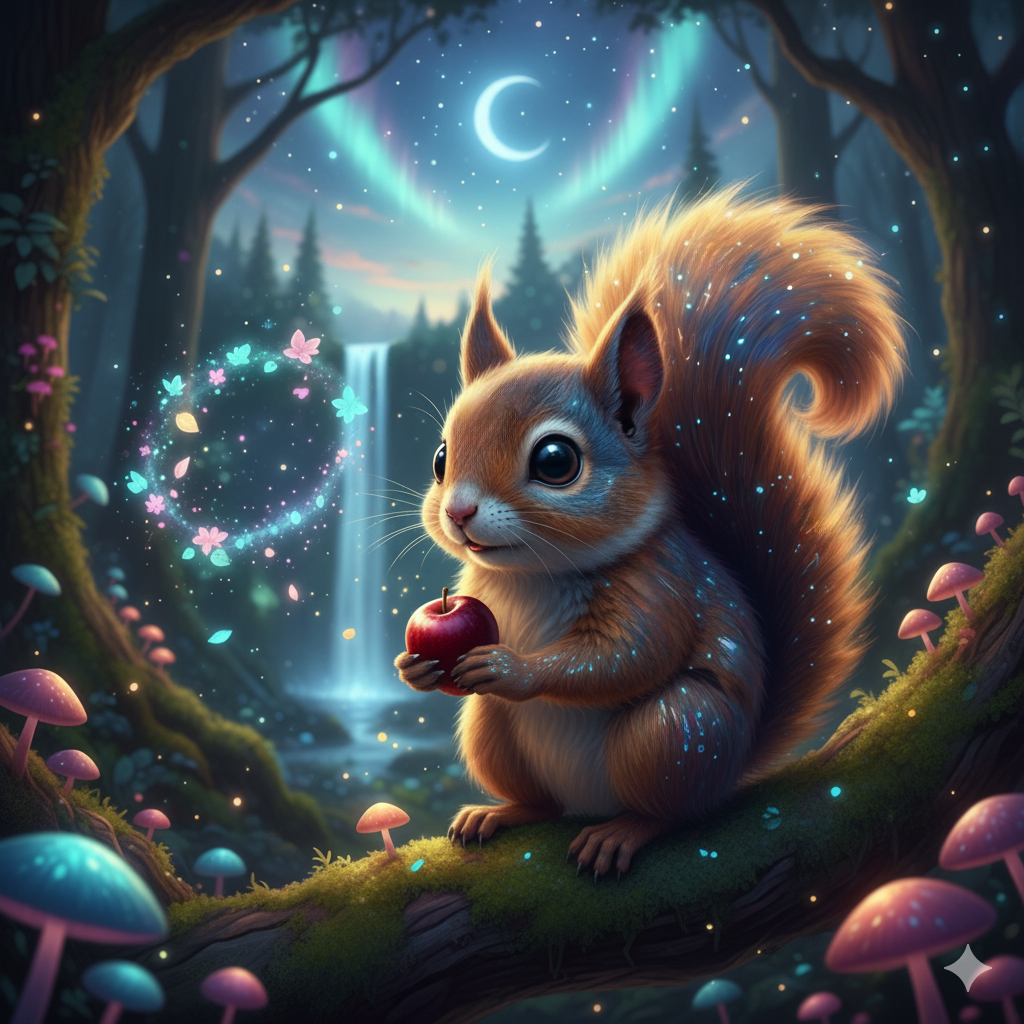
This squirrel may or may not have previously been a rat.
The visual "loudness" of Void use can be somewhat manipulated - including some slight changes to the intensity of the light as well as the shaping of the light itself... but that isn't the only way one can alter the presentation of void and voidlight! Some of the more dramatic users are able to develop a specific visual signature to their abilities - specific patterns of light, for example - or even sounds, smells, temperature shifts, etc.
Aside from being useful for people who want to make a splash, this is very common among Mortals associated with specific magic systems - for example use of void through the runic system often results in the voidlight appearing as the symbols power the user's magic. On the other hand, signatures can also be an unconsciously applied "special effect" of sorts; in that case, the presentation will usually be a reflection of the user, much like their sphere access in itself.
It's worth noting that the presentation is keyed to the user and generated at the time of initial use. So, if someone whose voidart tends to leave the scent of brimstone were to use Void to empower a sword, the sword itself would not smell of brimstone - rather the initial use would conjure the scent, which would then fade.
Effect on the User
Though undetectable in its basic form, once "touched" Void (and thus magic) immediately begins to flood into the dancer. It becomes like a wild current in the ocean and the dancer must try to stay steady and remain under control. The constant surge of energy running through the body of the dancer also tends to slightly destabilize their emotional regulation. This has resulted in Demons being perceived, correctly, as on the chaotic/erratic side. Under normal circumstances, this is more of a personality effect than a serious concern for them or others.
Limits, however, are more serious.
Soft, Hard & Catastrophic Limits
Due to the bottomlessness of Void energy, all limitations are imposed by the physical, mental and emotional landscape of the dancer or mage. Any given user will have soft, hard and catastrophic limits across both their physical and mental spheres, as well as a basic capacity that they can use without pushing those limits.
Setting the Limits
An individual's Void use limits are determined by the following factors:
Imagine it as tubes of different sizes: a wide tube can contain more without the seams breaking than a thinner tube can, but they will both split at some point.
The space between reading basic capacity and a soft limit, a soft and a hard limit, or the hard and catastrophic limit is proportionate to the basic capacity - so someone with a greater capacity will also have more leeway between limits. But, again, everyone reaches their cap eventually.
When one hits their soft limit there is an obvious and undeniable effect on the person; this is a warning to them to back down.
If they do not cease pushing their limits, they will eventually reach their hard limit, which will result in permanent damage to their body or their minds.
Should they persist even beyond this point and reach their catastrophic limit, they will suffer extreme and irreversible damage from which they will likely never return.
While it is case-by-case, a good rule of thumb is that demons will reach their mental limit before their physical limit, while celestials will reach their physical limit first. Mortals are very nearly a coin toss; they may even encounter both simultaneously.
Physical LimitsThe most straightforword limit, this is largely dependent on the physical sturdiness, strength, durability, etc. of the user's physical body. Demons, who as a whole have extremely strong bodies and more vulnerable emotional and mental states, will often emerge physically unscathed from even an extreme mental limit incident.
Physical limit effects are:
Chaos & Structure
There are two routes through which one can "control" Void energy, though only one is actually an attempt to control it directly.
First, one can learn to step back from it and mold the chaos into order. Analyze, predict, breakdown and sculpt. This is generally the tack taken by Celestials; it is also the foundation upon which the systems of magic (often used by mortals in particular) are built - the systems merely take it several steps farther in order to further break the process down for easier comprehension.
The other way, the way favored by the Demons, is to accept the chaos, move with it and direct it. This is closer to leading a dance than being a sculptor - this is, of course, the approach that gave rise to the term "void-dance."
The latter approach is almost always the more powerful option... however, it is also the most dangerous. To lead Void in a "dance" is to accept the danger that the Void will lead the dancer instead of the other way around.
This danger increases in proportion to the amount of energy used... and when one loses control of the Void, that is when consequences occur.
Mental and Emotional limits are tied to a person's emotional strength, willpower, and ability to cognitively map the use of the energy in ways that they can control vs. losing the thread and spiraling into uncontrolled places or madness. An accounting of mental limits follows.
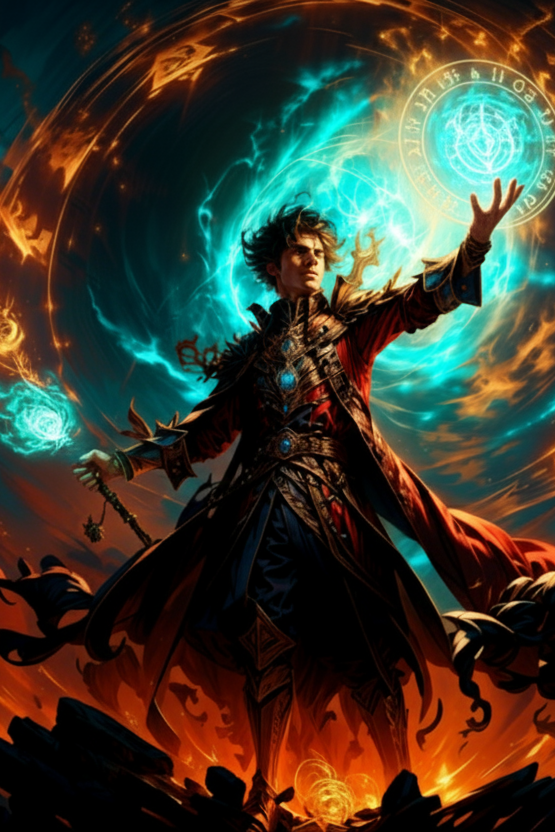
Peydin Kalil was the first Mortal to achieve parity with the immortals in void-dancing.
Since limits are per-user, and physical vs emotional limits can be quite different based on the body and personality of the person, practical limits are often much shorter than true limits. For example, Nefilor are extremely physically powerful and often capable of channeling immense amounts of energy, but they are not any more mentally resilient than the average Demon, and so they are generally not as "powerful" as their physical power might otherwise imply.
Once the line is crossed, the effects can spiral out of control - for example, a person who surpasses their mental limits becomes less capable of judging their own limits and thus is in greater danger of pushing even farther, causing serious and permanent injury to themselves. Worse, if the person has access to other ability spheres, their ability to regulate or judge their own ability in other fields is also affected. Thus, a person might overreach their mental limits, lose the ability to judge their use of both Void and Odaturgy and end up surpassing their safe odic usage limits causing themselves physical damage even while further unbalancing their own psyche.
Expanding LimitsOf course, many void-dancers would wish to expand their capacity. The only way to do this directly (without special actions or events) is strengthen one's mind and body - this naturally expands capacity in line with their increased durability/resilience, etc. It is also possible to refine one's Dance, which uses less energy and thus has a similar effect.
It is possible to expand capacity through external means, as well - and significantly more than one would otherwise be able to manage.
For demons the primary means is through Exedis, while for celestials this is done by Ascension.
For mortals, the primary path is through organization and refinement, generally through a system of magic.
Magic Systems & The Route to Magic
Generally speaking, Demons and Celestials who can access Void do so directly. In the case of Demons, it is largely instinctual - for Celestials it may take some work, but they are usually able to directly manipulate the energies without filters or tricks - only by ordering their thoughts in the right way. In most cases, however, mortals who have learned void-dancing have done so through the use of a magical system, also called a magical model.
Taking a cue from Aetherweave, this school of thought focuses on mixing and matching elemental essences to produce various effects. They are, therefore, only able to produce effects that they can conceptualize and manifest as a mix of elemental energy.
Features: Powerful elemental magic, strong offenseFlaws: Can't use anything that can't be expressed through elements. This is largely dependent on the user's imagination.
This system divides magic by larger effects - mind-affecting spells, offensive spells, protection spells, etc - with the option to specialize in specific schools. This is also one of the systems that creates specific spells with specific effects, sometimes requiring verbal, material or somatic components. This school is primarily associated with adventurer types.
Features: A wide range of abilities available.Flaws: Requires spells, may require components.
Ritual magic focuses on slow-burn or large effects enacted through often elaborate rituals. There are a number of symbols associated with and evoked during ritual magic; often things like incense, candles and, if relevant, items associated with whom or whatever the ritual is meant to affect. Like the Schools system, ritual magic is primarily associated with specific spells.
Features: Few, if any, limits on what can be done.Flaws: Doing anything at all takes anywhere from minutes to years, requires spells.
This system focuses on symbols; effects are triggered by placing the symbols in specific orders either physically or in one's mind. Generally runic magic can be identified by the series of symbols that form in the light of the Void.
Features: Few, if any, limits on what can be done.Flaws: Requires memorizing and recreating an endless number of symbols.
A system of magic that uses verbal patterns as a focus to produce effects. The effect of the spell must be verbalized with the use of the specific pattern - examples would be rhyming descriptions, or speaking words in some nonstandard order, or even an invented language. The patterns are often associated with specific families or regions.
Features: Few, if any, limits on what can be done.Flaws: Having to stick to the verbal pattern! It's harder than it looks!
A system that uses physical objects as focal points to control magic. This can be something obvious like a magic wand or it can be something unexpected or specific to the person such as particular accessories, pets.
Features: Few, if any, limits on what can be done.Flaws: You must have your focus object in order to use magic. If lost, you must train your mind to channel through a different object, which can take time.
Uses chance-based or otherwise uncontrolled foci. This could be throwing dice to determine effects, using tarot cards to trigger an effect appropriate to the card or layout, anything along those lines. This system depends heavily on the idea that destiny or good fortune will determine the appropriate outcome.
Features: Few, if any, limits on what can be done.Flaws: Difficult, if not impossible, to control what effects pop up.
Focuses on meditation, self-awareness and mindfulness to expand the mind and create a more ordered mental place. This does not tend to provide enough mental structure for mortals, particularly humans, as they are not naturally inclined to energy manipulation. It can, however, be useful for Celestials and Demons, who often just need a bit of a nudge, and mortals can use it to enhance any other system.
Features: No limits on the actual effects.Flaws: Practice must be consistent to maintain benefits.
What is a System of magic?
A system of magic is a specific way of looking at Void and its use. Systems can encompass a number of theories, worldviews and/or beliefs about how magic works and how it should be used. It may include methods of access (rituals, focuses, etc), but this is not necessarily the case. The key is that they provide a framework for looking at Void energy. In this sense, consider it as analogous to a school of literary interpretation: if one looks at text through a specific perspective, they will see different things than someone using a different framework or no framework at all. This can both cause certain subtext and implications to "pop" and cause other potential readings to quiet and fall into the background. This doesn't make any of the approaches "wrong" - it is simply a way of reading that helps the read to focus on the elements that sing for them.
Similarly, a magic system makes certain aspects of magic easier or more difficult to see or make use of.
Some of the more famous systems of magic are listed on the side insert, but there are infinite ways to look at and approach it - including some invented in private and used by only one or two people - and many variations on the different systems, as well. That said, different systems do adhere to different rules - these rules are not inherent to the use of Void energy, but are part of the architecture that specific system has put into place. If someone has learned magic through an external focus, they will find it difficult - or even impossible - to use magic without a focus - while others who use a different model or no model at all will not have that limitation.
Why Make that Sacrifice?Using a particular system of magic or magical model imposes requirements, barriers and limitations, but it also has advantages - advantages that are more meaningful to mortals than to Celestials or Demons, thus the disparity in usage between Realms. Specifically, by ordering the way they think and narrowing the lens through which they look at voidic energy, models are able to substantially speed the process of learning and mastery, allowing mortals to achieve high levels of ability much more quickly than they otherwise could have. This is why some exceptionally talented mortal "mages" can find themselves using magic on par with many Demons and Celestials despite being almost certainly far younger.
While mortals are the ones most likely to use systems, Demons and Celestials are also able to enhance their rate of learning through the same means. That said, they rarely do so -- and Demons in particular almost never do - for two primary reasons:
First, both are immortal and thus do not need to rush their mastery. But, more importantly...
Second, as said before each magic system has inherent barriers and limitations. This means by using a system instead of learning direct manipulation they are giving up a great deal of flexibility as they internalize a way of framing Void that is extremely difficult to unlearn once built into a their perspective. For example, if someone learns runic magic they will find it very difficult to learn to use magic without runes later on, as the runes have become integral to their way of conceptualizing magic use.This doesn't mean that one cannot unlearn... but, given their infinite lifespans it is generally not considered worthwhile to accept those barriers in exchange for quicker advancement. Patience allows them a more complete and boundless understanding of the energy and how to make it sing.
Even so, there are still some who choose to take that path, most famously Grigorius Bieloskytes, a Celestial who mastered magic through systems for personality reasons.
There are several different systems, as well as a number of smaller niches put together by specific families or villages that are specific to them. Some of the larger systems are explored below.
Mixing and Matching Systems
With some exceptions, it is generally not advised to mix and match systems, as the competing theories can create internal logic conflicts and make learning more difficult rather than less so. However, some systems are more compatible with others, e.g. Expansive Magic is compatible with nearly any system, and there's nothing to stop someone from using a focus to aid in their use of elementalist magic.


The channeling, movement and manipulation of Void energy, aka the energy that powers the world. Demons are naturally attuned to Void, and Celestials can also move it directly. For some, inherent ability can be enhanced through the use of formalized magic systems, though it is mostly mortals who make use of the systems. Channeling Void has a destabilizing effect which can trigger chaotic or erratic thinking/behavior in users who overuse or abuse it. Users commonly called Void-Dancers.
PractitionersEngine
Void
ResonanceDemon
PrevalenceSee Rarity chart
Effect on UserWhen used responsibly there is no harm to the user. Excess use can destabilize and damage a user temporarily or permanently in various ways.
This was by far the biggest job as far as the Ability Sphere revisions go, just because Void is a complicated system... and since it's also the primary system used by most of my main characters, I really needed it to make sense. There were some specific things I was trying to address/clarify that used to be a bit fuzzy. I needed to...
Hopefully I've done a decent job at this!

So much interesting stuff! Awesome!
Thank you so much!
Crimson Court: Where immortals gamble with lives, loyalty is currency, and the only rule is never lose the king's favor. A world of dark fantasy, romance and horror... with a touch of isekai.