The Triad Wars
The Conflict
Prelude
The Defiler whispered in every ear, turning grievances into bloodshed. Ancient rivalries between the Triad species, once manageable, erupted into endless war. Resources dwindled, alliances fractured, and trust collapsed.
Deployment
Each species fought from their homelands, but battles sprawled into borderlands and sacred places. The wars were not neat fronts but shifting tides of raids, sieges, and retaliations. The Foes slipped through all armies, stoking hatred but never fully standing revealed.
Battlefield
Varied — mountain fortresses, river crossings, ancient groves, even the ruins of once-thriving trade cities. The climactic final battles occurred on a vast plain later marked as the Pit of the Foe, where the ground itself collapsed from the fury of combined forces.
Conditions
Unnatural storms plagued armies, thought to have been summoned by the Foes.
Disease and famine spread as rivers were poisoned and croplands burned.
Entire regions became wastelands. Scars still visible to this day.
The Engagement
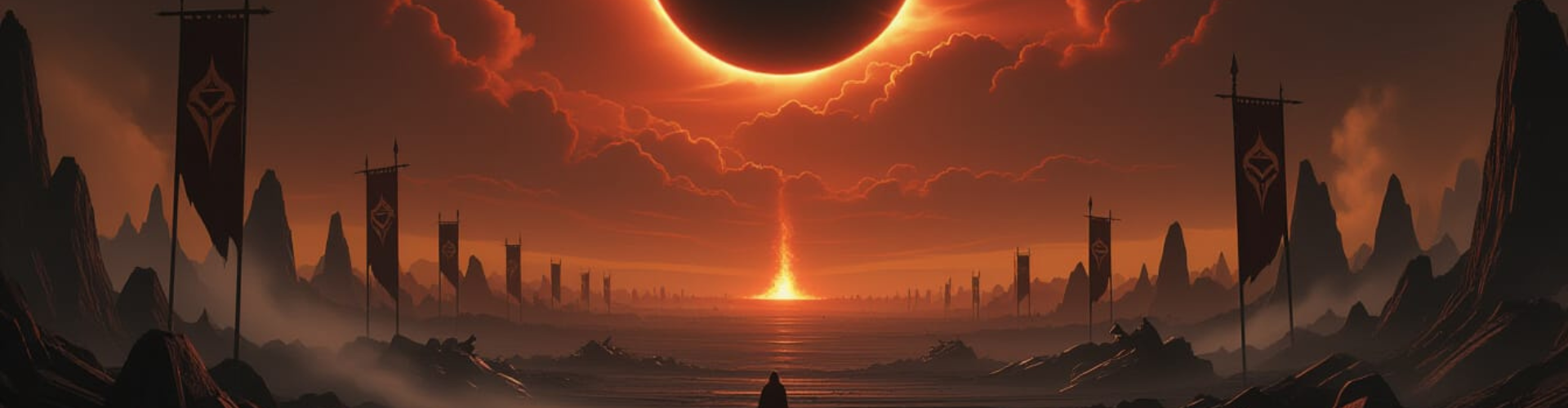
Battles raged endlessly until exhaustion overtook the Triad. At the height of ruin, leaders from each species realized the Defiler’s treachery. Reluctantly, they called for parley. Out of this truce came The Graven Pact, sworn at an eclipse under living stone. Together, they turned their weapons outward against the Fourth. The final battle is remembered not as victory but as banishment but as a sealing of the Foes in their prison, the Pit of the Foe.
Outcome
The Triad species were left shattered but alive. The peace that was forged was not from love but from necessity. Their unity against the common enemy established a precedent that endured for centuries.
Aftermath
The Pit was left as a warning. The Pact as a promise. Generations remembered the horror of the wars as proof that no single species could dominate without inviting annihilation.
Historical Significance
The Triad Wars are remembered less for individual battles than for their ending — the forging of peace and the banishment of the Foes. For humans today, it is myth: some dismiss it as allegory, others search for evidence of the Pit and Pact as historical reality.
Legacy
The wars gave rise to the Graven Pact, an enduring symbol of unity.
The Pit of the Foe remains a mythic warning of what happens when division prevails.
Among Humans, the Triad Wars inspire endless debate: history, myth, or both?
In Literature
Epic poems sung by Ta- bards of the final march to the Pit.
Pecou hymns of the eclipse and the Pact.
Kiwta murals depicting shattered cities reborn after peace.
Human retellings often recast it as a cautionary tale about division and reconciliation.
Technological Advancement
Kiwta war machines were repurposed for peaceful construction.
Pecou ritual magicks refined during the war found new purpose in healing and agriculture.
Ta siege craft techniques became the basis for mining marvels after the war.
Expanded Overview of Conflicts
First Schism Campaign — Early Second Sun, First Era
The war’s ignition point. Minor border disputes between Ta mining guilds and Pecou sanctuaries spiral into open conflict after the Defiler’s manipulation of sacred trade routes. Small-scale at first, but it sets the pattern — resource wars disguised as holy cause.
Second River War — Late Second Sun, First Era
Fought over the fertile southern waterways. Pecou armies dammed rivers to starve Ta settlements, while Kiwta engineers tried to redirect them underground. The resulting floods and plagues claimed more lives than any battle.
Siege of the Singing Plains — Early Third Sun, First Era
An industrialized massacre. Kiwta war engines clashed with Ta siege columns; Pecou ritualists unleashed storms said to have “sung with the dead.” The plains became a resonant wasteland where sound itself lingered unnaturally long.
Ashfall March — Mid Third Sun, First Era
As volcanoes awakened across the highlands, armies trudged through ash storms and black rain. Many myths claim this was the first sign that the Foes were feeding — hatred made manifest as burning sky.
Siege of the Hollow Peaks — Late Third Sun, First Era
A mountain stronghold vital to all three species. The siege lasted twelve cycles and ended when the defenders — mostly Kiwta — collapsed their own tunnels rather than surrender. Later became a sacred ruin and site of the first known calls for peace.
Silent Accord Interlude — Early Fourth Sun, First Era
A brief, fragile peace negotiated by Ta elders and Pecou priest-historians. Trade reopened for a single generation before collapsing again when Foe infiltrators turned suspicion into murder at a peace feast.
Shadowfront Offensive — Late Fourth Sun, First Era
The last and most terrible campaign. Entire armies marched under eclipsed skies, chasing shadows they could not strike. The Foes’ influence peaked — generals turned on their own, and fortresses fell without siege. This offensive drove the Triad to the brink of extinction, forcing their leaders to convene at the Eclipse Truce that birthed the Graven Pact.
Final Eclipse and Banishment — Fifth Sun, First Era
Under twin-dark suns, the Triad united for the last time. Their combined strike sealed the Foes within the earth, creating the Pit of the Foe. This act ended the Triad Wars, though none considered it a victory — only a silencing.
Table of Contents
Second River War
Siege of the Singing Plains
Ashfall March
Siege of the Hollow Peaks
Silent Accord Interlude
Shadowfront Offensive
Final Eclipse and Banishment
Defiler exposed as the betrayer
Forging of the Graven Pact in living stone
Joint defeat and banishment of The Forgotten Fourth(the Foes) into the Pit of the Foe
Enduring peace between the Triad species.
Belligerents
The Ta
The Pecou
Warlords who later gave way to the legendary peace-broker.
Priest-historians who viewed the war as sacred destiny.
Strength
Casualties
Objectives
The Kiwta
The Foes (Forgotten Fourth)
Artisan-councils turned into war-leaders
Unknown — remembered only as shadowed figures.


Comments