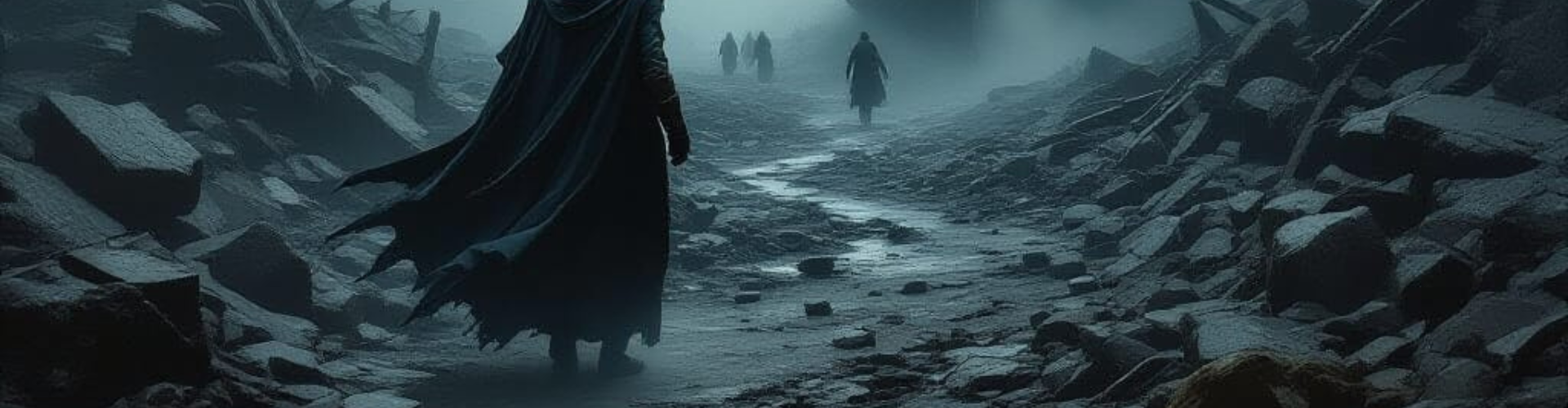
Downfallen
Demographics
Primarily Kiwta. In the later part of The Triad Wars, Pecou and Ta- visited. A small population took up residence after the war before it was destroyed.
Government
The city was run by a Clan Assembly of Elders, with rulership rotating between the oldest surviving matrilineal leaders. Justice was carried out communally, with disputes settled by ritual oath and exchange of carved tokens.
Infrastructure
Subterranean tunnels connected all major districts.
Central aqueduct drew from volcanic springs.
Ash-resistant stone roads wound up and around the volcanic slopes.
Public squares carved directly from cooled lava flows.
Districts
The Ember Court
The civic heart of the city, where representatives of the Ta, Pecou, and Kiwta once gathered to maintain postwar accords. The Court’s open plaza was paved with vitrified stone that shimmered under torchlight, said to glow faintly even centuries later. The Hall of Voices—its central structure—was designed with three spires, each representing one race, converging at a single apex. During the Static Storm, the Court was struck directly, melting portions of its central dais into a black, glasslike crater. Archaeologists report that when the wind moves through its ruins, faint echoes still resemble whispered debates.
Ashmarket
A sprawling trade hub and cultural crossroads, Ashmarket was where goods, ideas, and languages mingled freely after the Triad Wars. Ta miners brought precious metals from the deep seams; Pecou artisans traded food (staples and exotic), and the Kiwta offered intricate bioluminescent textiles and worked glass. The market’s great canopy was made of woven resin and metallic threads, strong enough to reflect sunlight and cool the stalls beneath. When the Static Storm hit, the canopy ignited and collapsed, sealing thousands of wares and merchants beneath molten layers — an entire economy frozen in its last transaction.
Lantern Hollows
The residential heart of the Kiwta quarter, Lantern Hollows consisted of winding tunnels and chambers carved into ancient lava tubes. Bioluminescent mosses and crystalline growths lit their homes, casting perpetual twilight. The Hollows were designed to hum softly with resonance — Kiwta architecture often integrated sound and vibration as a cultural comfort. After the disaster, the tunnels filled with suffocating ash, extinguishing the natural light. Today, archaeologists describe it as the most haunting sector of the ruins, where shadows cling unnaturally to the walls and the air feels “too thick to breathe.”
The Silent Furnace
Once the roaring industrial quarter of the Ta, The Silent Furnace housed immense foundries, forges, and heat wells used to shape alloyed metals for tools, architecture, and ceremonial rings traded between species. The Ta engineers designed the furnaces to run off geothermal vents, channeling molten rivers through controlled conduits. When the Static Storm struck, power feedback caused the entire network to collapse inward — fusing machinery, workers, and the very stone into one jagged mass. It is said that even now, the earth beneath the Furnace remains warm, pulsing faintly like a dying heart.
Industry & Trade
Mining & Smelting: Primary industry, extracting volcanic metals.
Artisan Crafts: Ash-glass pottery, obsidian blades, volcanic crystal jewelry.
Trade: An exchange hub between all three species.
Assets
Ash-Glassworks: Legendary translucent pottery, shards still unearthed by archaeologists.
Memory Tablets: Clay and obsidian inscribed with Kiwta genealogies, many now fragmented.
Collapsed Council Chamber: The city’s ruined heart, where archaeologists found petrified figures frozen mid-flight.
History
Founding and Early Era: Long before the Triad Wars, the Kiwta founded the city of Tir-Vaen — “City of Cooled Fire” — upon the volcanic basin of the Northern Isle. Built amid cooled lava flows and ringed by basalt cliffs, it was a marvel of early Kiwta engineering. The city drew its power and identity from the earth’s living heat; magma conduits were shaped into forges, vents into steam channels, and stone into living architecture that glowed faintly at night. Tir-Vaen became a spiritual and industrial center — the Kiwta’s forge-city, where craft was seen as both prayer and legacy.
The Isolation of War: When the Triad Wars began, Tir-Vaen’s position on the Northern Isle spared it from the worst of the mainland devastation. For most of the war, it remained an isolated Kiwta stronghold — wary of outsiders and fiercely protective of its forges. However, as the wars dragged on and resources dwindled, Pecou envoys seeking alloy metals and Ta miners in search of safe trade routes began arriving at the city’s edge. At first, they were met with suspicion, but desperation tempered old hostilities. Near the war’s end, Tir-Vaen became one of the few neutral grounds where the three races could meet without immediate bloodshed.
The Age of Renewal: After the signing of the Triad Pact, Tir-Vaen transformed into something new — a shared city, a symbol of what peace could look like. The Kiwta opened the Ember Court to representatives from all peoples. The Pecou brought exotic trade goods and silks to the Ashmarket, while the Ta restored and expanded the geothermal network, digging deeper than any Kiwta had dared. Homes were carved for all three in the Lantern Hollows, where molten light once illuminated shared hearths. Tir-Vaen thrived as the first true multi-racial city of the new era — a living testament that survival could breed kinship.
The Static Storm: Centuries later, peace was shattered by an unnatural catastrophe. A Static Storm — the largest on record — descended without warning upon the Northern Isle. Witnesses from distant coasts described lightning that “fell in curtains,” and thunder that “split the horizon.” The storm’s core struck Tir-Vaen directly, melting stone and metal together. Whole districts — the Silent Furnace, the lower Ashmarket — were swallowed by molten ash. The city’s geothermal systems overloaded, venting through the streets as liquid fire. When the storm passed, Tir-Vaen was gone. Half of the island’s coastline had collapsed into the sea.
Rediscovery and Excavation: Millennia later, archaeologists rediscovered the site — by then nicknamed Downfallen — while mapping the fractured cliffs of the Northern Isle. Excavations revealed melted towers and glassy corridors preserved mid-collapse, frozen as if time itself had stopped. Artifacts recovered from the upper levels show clear signs of blended Kiwta, Pecou, and Ta craftsmanship — tools, ornaments, and trade seals forged during the postwar age of unity. Many believe the Doom Bell, now cracked and half-buried, once hung in the central citadel of Tir-Vaen.
Points of Interest
The Ember Court: Frozen statues of leaders mid-speech, preserved in ash.
The Lantern Hollows: Collapsed lava-tube homes with murals intact on blackened walls.
The Silent Furnace: Half-melted forges where ore still clings, warped by the Static Storm’s energy.
The Fracture Vaults: Caverns beneath the city, sealed but rumored to contain pre-Storm Kiwta relics.
Ashmarket: An entire economy frozen in its last transaction.
Architecture
Blend of subterranean Kiwta carving and volcanic stone shaping.
Walls of obsidian inlaid with silver veins to catch lanternlight.
Narrow, spiraling passages leading to open plazas.
Emphasis on vertical construction — stairways climbing natural lava chimneys.
Geography
Built into the volcanic ridge of the Northern Isle, on the edge of an active geothermal field.
Upper levels exposed to the sky, lower districts tunneled underground.
Now buried under 30–40 feet of compacted ash and rubble.
Climate
Originally: Warm, volcanic climate with constant ash drifts.
Now: Deadly still — no wind, no birds, the air heavy with sulfur. Electrical activity lingers in low levels, creating ghostly arcs of lightning. Static Storms heighten the electrical activity causing a lightning aurora.
Natural Resources
Volcanic metals (iron, silver, rare crystalline alloys).
Geothermal heat sources.
Volcanic glass (obsidian, ash-glass).
Table of Contents
Aruven (Renamed at the end of the Triad Wars)


Comments